

An elementary particle and an event horizon
An electron has mass, electric charge and angular momentum. So does a rotating, electrically charged solution of Einstein's gravitational field equations. That resemblance motivates an arresting proposal: perhaps what we call an elementary particle is the low-energy face of a microscopic black hole. The idea connects two of the deepest descriptions of nature, but the identification encounters a quantitative obstacle almost immediately. The dimensions associated with an electron in quantum mechanics and in ordinary general relativity differ by about forty-four orders of magnitude.
The difference is more consequential than any similarity in vocabulary. A black hole is characterized by a causal boundary, an event horizon, from which future-directed light rays cannot reach distant observers. An elementary particle, in quantum field theory, is an excitation with a definite set of quantum numbers and measurable scattering amplitudes. Nothing in the latter definition requires a small trapped region of spacetime. To decide whether the two descriptions might ever meet, we need to ask what happens when energy is concentrated into a sufficiently small region [1–3].
The question has an illuminating history. Einstein and Rosen studied geometric bridges in the 1930s while seeking a description of particles without singularities. John Wheeler later investigated self-gravitating configurations of electromagnetic radiation called geons. Modern approaches include Compton–Schwarzschild correspondences, charged and spinning compact objects, black-hole scattering amplitudes, and quantum-gravitational remnants. These are related research programs, but they make different physical claims [3–7].
Two lengths that run in opposite directions
For an approximately static, spherical, uncharged body of mass , the classical Schwarzschild radius is
Its meaning is geometric: if an appropriate isolated gravitating configuration forms an event horizon, this is its radius in the Schwarzschild solution. It is not the measured radius of every object having mass . In particular, inserting the mass of an electron into the formula does not prove that an electron possesses such a horizon. The equation assumes a classical, uncharged, nonrotating gravitational setting which is manifestly inadequate for a relativistic charged fermion [1,2].
Quantum mechanics supplies another characteristic length, the reduced Compton wavelength,
The Compton length signals the energy scale at which a single-particle localization picture becomes unreliable: attempting to localize a relativistic particle more sharply can involve enough energy for particle–antiparticle degrees of freedom to matter. It is not a hard-edged material radius. The distinction is essential because elementary particles can be pointlike in scattering without behaving as classical objects of literally zero spatial extent [1].
These scales have opposite dependence on mass. Adding mass enlarges while reducing . For the electron, using its measured mass gives a Schwarzschild radius of about and a reduced Compton wavelength of about . Their ratio is only roughly . The classical horizon scale is inconceivably smaller than the scale at which quantum field theory must already be taken seriously. The same argument applies to the proton, with quite different numerical values but the same overwhelming hierarchy.
 Figure 1. Mass–radius parameter space showing quantum, relativistic and black-hole domains. The Compton and Schwarzschild boundaries cross near the Planck scale. B. J. Carr, Frontiers in Astronomy and Space Sciences 9, 1008221 (2022), Fig. 1; original figure credited there to Carr (2018). Source, CC BY 4.0.
Where the boundary lies: the Planck mass
The dimensionless comparison can be written without evaluating either length separately:
Here is the conventional Planck mass, corresponding to about . With the reduced Compton convention, the two length scales cross at ; order-one coefficients depend on precisely which localization length is compared with which horizon definition. The qualitative result is independent of that convention. Near the Planck scale, classical gravitational radius and quantum localization scale become comparable [1–3].
For an ordinary electron, the ratio is so tiny that a semiclassical event-horizon picture cannot be transplanted to the observed particle. For a hypothetical object many times heavier than the Planck mass, a Schwarzschild description may instead be appropriate if the energy is genuinely compressed and the physical state meets the assumptions required for collapse. In between lies a region where neither a purely particle-like nor a purely classical black-hole description is obviously self-consistent. That intermediate territory is what makes the idea scientifically interesting.
The crossing is sometimes called the Compton–Schwarzschild or black-hole uncertainty-principle boundary. It marks a limitation of extrapolating familiar theories, not a theorem that particles turn into black holes at exactly one mass. Quantum gravity might replace classical horizons, alter the localization relation, introduce new states or resolve the apparent conflict in a different way. Models with a smooth crossover are proposals about dynamics, and each needs a consistent theory and observational consequences [2,3].
The charged electron makes the hypothesis harder
A more ambitious analogy treats the electron not as a Schwarzschild black hole but as a Kerr–Newman configuration, the classical solution for a rotating charged mass. The similarity begins with three asymptotic properties: mass, charge and angular momentum. A classical Kerr–Newman object also has a magnetic moment with a gyromagnetic ratio . That value is striking because a Dirac point fermion has the same tree-level factor. Arkani-Hamed, Huang and O'Connell have shown how spin-dependent black-hole structures can emerge naturally in modern amplitude language, making the relationship a technical subject rather than a purely visual analogy [4].
However, a genuine classical Kerr–Newman black hole must possess horizons. In SI units its formal radial horizon locations can be written
The expression under the square root has to be nonnegative for these horizons to exist. Substituting the electron's measured electric charge and spin magnitude makes the classical expression negative by an enormous margin. In plain terms, ordinary Einstein–Maxwell theory with electron parameters produces an overcharged, overspinning solution with no event horizon, not a tiny conventional black hole. The formal solution has an exposed singular structure and is not accepted as a model of the electron [2,5].
Even the apparent success of is limited. Precision measurements of the electron's magnetic moment require quantum-electrodynamic radiative corrections, so its observed value is not exactly two. A useful analogy must reproduce the mass spectrum, charge quantization, spin statistics, lepton scattering, high-precision magnetic moment and interactions of all known species. Merely arranging three conserved parameters to look alike does not satisfy that requirement.
 Figure 2. Inner and outer horizon branches in classical charged Reissner–Nordström models, compared with the Compton relation. The plotted objects have nearly Planckian parameters and are not conventional electrons. B. J. Carr, Frontiers in Astronomy and Space Sciences 9, 1008221 (2022), Fig. 3, adapted in that article from Carr and collaborators (2020). Source, CC BY 4.0.
Could quantum gravity join the two descriptions?
One proposal changes the relation between position and momentum uncertainty near gravitationally extreme energies. A commonly studied generalized uncertainty principle takes the schematic form
The dimensionless parameter is model-dependent; it is not a measured universal coefficient. At modest momentum uncertainty the first term reproduces the quantum-mechanical scaling. At sufficiently large momentum uncertainty the second, gravitationally motivated term increases. This suggests a minimum operational resolution, although the precise interpretation and consistency of the modification depend on the underlying theory [2,3].
A related phenomenological ansatz joins the two characteristic length scales into a single expression, for instance
For large mass the first term dominates; for small mass the second dominates. Positive makes the curve turn around rather than continuing to zero radius. One can interpret the small-mass branch as particle-like and the large-mass branch as black-hole-like, but calling the complete curve a black-hole radius is an additional physical postulate. The interpolation alone does not construct a quantum state, demonstrate a trapped surface or reproduce a Standard Model fermion [2,3].
Lake and Carr developed a more structured correspondence using extensions of de Broglie relations. Carr later surveyed charged, rotating and higher-dimensional variants, including approaches inspired by loop quantum gravity. Some models permit sub-Planckian effective horizon solutions; others keep a separation between particle and black-hole branches. Their differences underscore a crucial point: the proposed unification is sensitive to assumptions about quantum localization, the gravitational field and the number of spacetime dimensions [2,3].
 Figure 3. Model-dependent inner and outer horizon curves for generalized-uncertainty-principle Reissner–Nordström geometries. These curves illustrate possible theoretical continuations, not measured subatomic horizons. B. J. Carr, Frontiers in Astronomy and Space Sciences 9, 1008221 (2022), Fig. 4; original curves credited to Carr and collaborators (2020). Source, CC BY 4.0.
What a tiny black hole would mean thermodynamically
A classical event horizon is also a thermodynamic object. Semiclassical theory attributes to an uncharged nonrotating black hole a Hawking temperature
Lighter semiclassical black holes are hotter in this approximation. For stellar-mass black holes the temperature is extremely low; reducing the mass raises it sharply. Extrapolating the same relation all the way down to the Planck mass is not reliable because the calculation treats the gravitational background semiclassically exactly where spacetime quantum fluctuations may become essential. Claims that an electron is a stable Hawking-radiating black hole therefore require a new account of the horizon, evaporation and why the observed particle remains stable [6,7].
Holzhey and Wilczek studied certain extremal dilatonic black holes whose response can behave more like that of elementary particles than a simple thermal reservoir. Their result does not identify ordinary electrons with tiny classical holes; it demonstrates that quantum and charged black-hole systems may have qualitative features which invalidate naive applications of thermal intuition [8]. The broader lesson is that the microscopic degrees of freedom, charge and boundary conditions matter as much as mass.
For a clear discussion of why black holes force general relativity and quantum theory into the same calculation, PBS Space Time provides a substantial overview. Its treatment of horizons, thermodynamics and quantum information is a useful companion to the more specialized literature cited here.
https://www.youtube.com/watch?v=t_AMURAIcF0
PBS Space Time, Black Holes. Explained. For 1.5 Hours. (18 December 2025). Embedded video from the verified PBS Space Time channel.
The collider question: can a particle collision create one?
The Planck energy implied by ordinary four-dimensional gravity is far beyond the energies reachable at contemporary colliders. Hypotheses with large or warped extra dimensions alter gravitational behavior at short distances and can lower an effective fundamental gravity scale toward the teraelectronvolt regime. Within those models, sufficiently energetic particle collisions might form short-lived microscopic or quantum black holes. Their expected signatures include high-multiplicity energetic particles or, for particular quantum black-hole scenarios, high-mass lepton–jet pairs [9–12].
This possibility has been tested rather than simply left to speculation. CMS reported a search using 138 inverse femtobarns of proton–proton collisions at 13 TeV, published in 2026. The analysis observed no excess over Standard Model background predictions and excluded semiclassical black holes with benchmark threshold masses below roughly 8.4–11.4 TeV, depending on the extra-dimensional model. These are exclusions of specified theoretical realizations, not a measurement that rules out all forms of microscopic gravity [11].
ATLAS also analyzed 164 inverse femtobarns collected in its 13.6 TeV Run 3 program, probing quantum black holes in lepton–jet final states. Its September 2026 summary reported no significant evidence and improved model-dependent limits. The precise result depends on the assumed extra dimensions, production dynamics, thresholds and decay channels. A model which does not predict accessible production in those channels does not become excluded merely because the word black hole appears in its description [12].
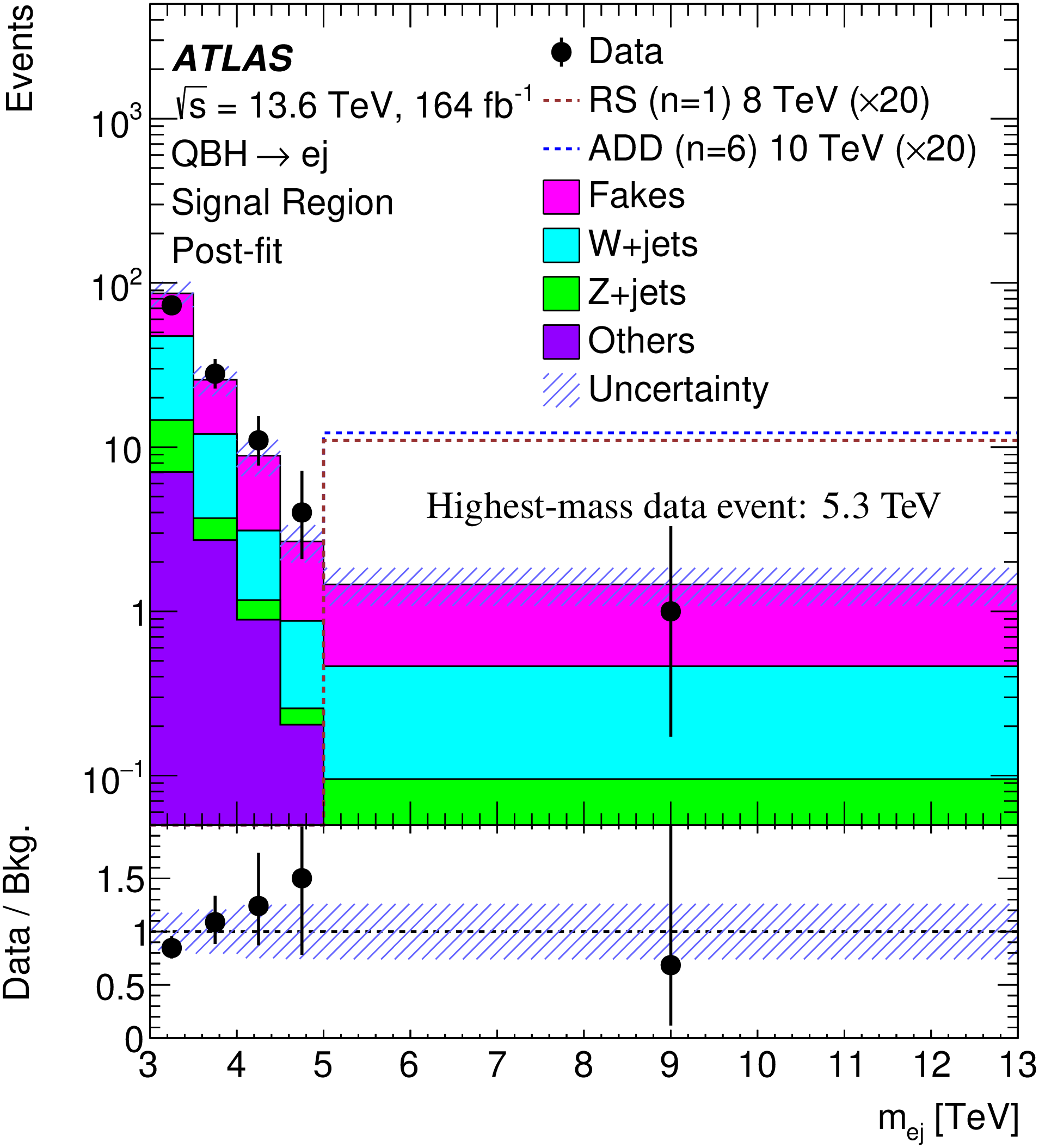 Figure 4. ATLAS Run 3 invariant-mass spectrum for the electron-plus-jet channel, compared with Standard Model expectations and illustrative quantum-black-hole benchmarks. ATLAS Collaboration, The hunt for quantum black holes ventures into the energy frontier (24 September 2026), Fig. 1a. Source; © CERN/ATLAS, reproduced with scientific attribution.
The distinction between detecting a new heavy resonance, finding an unexpected collision topology and demonstrating an actual causal horizon is also important. A collider sees decay products, missing momentum and scattering patterns. Interpreting such observations as microscopic horizon formation requires a sufficiently predictive model that relates measured final states to short-distance gravitational physics. Absence of an excess is informative within that model; it is not a comprehensive experimental verdict on quantum gravity.
How close is the analogy in scattering theory?
In quantum field theory, an elementary particle is characterized operationally by the poles and residues of correlation functions and scattering amplitudes, together with its spin, conserved charges and interactions. This language has no automatic place for the classical surface of a black hole. Yet perturbative amplitude techniques have revealed nontrivial bridges. Scattering from a classical spinning black hole can encode remarkably simple functions of the spin variables, and some of those structures mirror the amplitudes used to describe elementary spinning particles [4].
Those correspondences are especially valuable for gravitational-wave physics, where black holes are treated as compact external objects in controlled expansions and their spin-dependent interactions influence the waveform. They do not establish that the electron is an astronomical black hole shrunk by an enormous factor. Rather, they reveal how universal long-range fields and symmetries constrain scattering by objects that otherwise have very different microscopic descriptions.
It is also possible for a black hole in a quantum theory to behave as a state with definite mass and charges. That is a distinct claim from saying all observed light particles are black holes. Quantum black holes, near-extremal states, remnants and horizonless compact configurations are different research targets, and each carries a different burden of proof [4,8].
The stronger question is what spacetime permits
The tempting slogan that every particle contains a microscopic black hole hides at least four separate questions. Can an elementary quantum excitation generate a self-consistent spacetime geometry? Can that geometry contain a genuine event horizon? Can a horizon-bearing quantum state reproduce the electroweak and strong interactions of the Standard Model? And can any resulting differences be tested by precision experiments, cosmic observations or collider scattering? A successful model must answer all four, not merely point to a shared symbol such as mass or spin.
An eventual theory might reveal a common microscopic language for particles and black holes. Such a theory could explain why spacetime geometry, quantum entanglement and the spectrum of matter obey related constraints. But the ordinary electron provides a sharp falsification test for simplistic models: its mass, charge, angular momentum and quantum localization scales are already known to enormous precision, and classical Einstein–Maxwell geometry does not place an event horizon around it.
The most productive conclusion is therefore narrower and more powerful than the original slogan. Elementary particles are not established to be mini black holes; in familiar four-dimensional gravity an electron is emphatically not a classical black hole. What survives is the research question of whether the particle description and the horizon description merge, transform into one another or remain distinct when quantum gravity becomes important. The place to look is the Planck boundary, and the way to make progress is through equations which yield consistent states and experimental signatures.
 Figure 5. How hypothetical additional compact dimensions change the Compton–Schwarzschild mass–radius diagram in competing higher-dimensional scenarios. B. J. Carr, Frontiers in Astronomy and Space Sciences 9, 1008221 (2022), Fig. 5; original illustration credited to Lake and Carr (2019). Source, CC BY 4.0.
References
- [1] G. Dvali, “Quantum black holes,” Physics Today 68(1), 38–43 (2015). DOI: 10.1063/PT.3.2656.
- [2] B. J. Carr, “The Generalized Uncertainty Principle and higher dimensions: Linking black holes and elementary particles,” Frontiers in Astronomy and Space Sciences 9, 1008221 (2022). DOI: 10.3389/fspas.2022.1008221.
- [3] M. J. Lake and B. Carr, “The Compton-Schwarzschild correspondence from extended de Broglie relations,” Journal of High Energy Physics 2015, 105 (2015). DOI: 10.1007/JHEP11(2015)105.
- [4] N. Arkani-Hamed, Y.-t. Huang and D. O’Connell, “Kerr black holes as elementary particles,” Journal of High Energy Physics 2020, 46 (2020). DOI: 10.1007/JHEP01(2020)046.
- [5] B. Carter, “Global Structure of the Kerr Family of Gravitational Fields,” Physical Review 174, 1559–1571 (1968). DOI: 10.1103/PhysRev.174.1559.
- [6] S. W. Hawking, “Black hole explosions?” Nature 248, 30–31 (1974). DOI: 10.1038/248030a0.
- [7] S. W. Hawking, “Particle creation by black holes,” Communications in Mathematical Physics 43, 199–220 (1975). DOI: 10.1007/BF02345020.
- [8] C. F. E. Holzhey and F. Wilczek, “Black holes as elementary particles,” Nuclear Physics B 380, 447–477 (1992). arXiv:hep-th/9202014.
- [9] S. Dimopoulos and G. Landsberg, “Black Holes at the Large Hadron Collider,” Physical Review Letters 87, 161602 (2001). DOI: 10.1103/PhysRevLett.87.161602.
- [10] S. B. Giddings and S. Thomas, “High energy colliders as black hole factories: The end of short distance physics,” Physical Review D 65, 056010 (2002). DOI: 10.1103/PhysRevD.65.056010.
- [11] CMS Collaboration, “A search for microscopic black holes, string balls, and sphalerons in proton-proton collisions at 13 TeV,” Journal of High Energy Physics 08 (2026), 098. CMS-EXO-24-028.
- [12] ATLAS Collaboration, “The hunt for quantum black holes ventures into the energy frontier,” ATLAS Physics Briefing (24 September 2026). ATLAS result and figures.
- [13] A. Einstein and N. Rosen, “The Particle Problem in the General Theory of Relativity,” Physical Review 48, 73–77 (1935). DOI: 10.1103/PhysRev.48.73.
- [14] J. A. Wheeler, “Geons,” Physical Review 97, 511–536 (1955). DOI: 10.1103/PhysRev.97.511.