

How can a cloud of atoms form bound objects without the chemical bonds that hold molecules together? In one dimension, attractive interactions can organize quantum particles into collective states whose defining signature lies in the complex structure of their Bethe-ansatz solutions. Nearly a century after Hans Bethe introduced the mathematical framework, a 2026 experiment produced mixtures of these “Bethe strings” in an ultracold caesium gas and revealed clusters containing more than six atoms. The result opens a remarkable window into the physics of integrability, quantum solitons and emergent particles.
Consider a group of cold atoms free to move along a very narrow tube. If their interactions are repulsive, they tend to avoid occupying the same place. If the interaction is tuned attractive, several atoms may cluster into a composite object. But this is not an ordinary molecule. The relevant atoms are represented by a many-body quantum wavefunction in a nearly one-dimensional geometry, and the stability of the cluster can depend on the precise scattering constraints of an integrable system. The collective entity is a multiparticle excitation, not a new chemical species created by rearranging covalent bonds. [1][2]
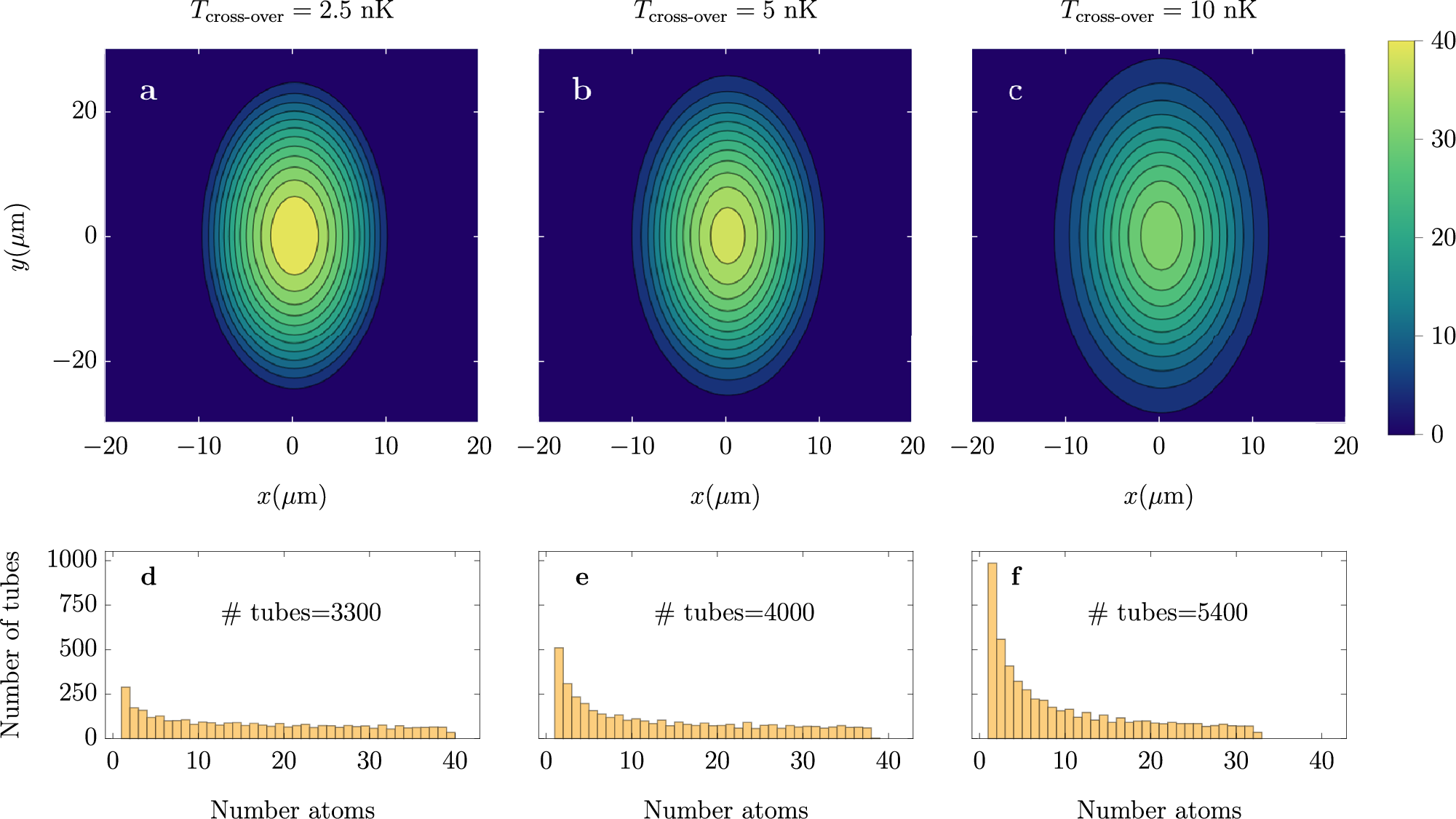
In August 2026, Milena Horvath, Alvise Bastianello, Sudipta Dhar and collaborators reported Probing Bethe strings in an attractive one-dimensional Bose gas in Nature Communications. They prepared an ensemble of ultracold caesium atoms in thousands of effectively one-dimensional tubes, then swept the interactions from repulsive to attractive. By comparing expansion within the tubes to free expansion in three dimensions, the team measured released binding energy, inferred the presence of bound states larger than six atoms and found further evidence in momentum distributions and the Tan contact. Quantitative comparisons used generalized hydrodynamics, a theory for evolving populations of quasiparticle species in nearly integrable many-body systems. [3]
Those observations are powerful but indirect: the individual clusters were not photographed as stable atomic necklaces. Their presence was inferred from how a carefully prepared many-body gas responded to interaction changes and release measurements. The distinction makes the physics more interesting, not less. It shows how one can infer the existence of mathematically defined emergent excitations from observable energy and correlation signatures.
Why one spatial dimension changes the problem
In three dimensions, scattering particles can deflect into many directions, and an attractive Bose gas may suffer rapid clustering and inelastic losses. In one dimension, ordered particles have far fewer ways to pass one another, and exactly solvable interactions can constrain the outcomes of collisions dramatically. An ideal description for bosons interacting through a contact potential is the Lieb–Liniger Hamiltonian,
The atoms have mass , positions , and coupling determined by the transverse confinement and microscopic scattering interaction. Positive is repulsive; negative is attractive. It is useful to write , which has dimensions of inverse length. The sign and magnitude of determine the allowed Bethe-ansatz root structures. The ideal Hamiltonian neglects weak confinement, three-body loss and deviations from strictly one-dimensional dynamics, making it a precise benchmark rather than a complete description of every real gas. [1][2]
For the repulsive model, the elementary Bethe rapidities can be taken real. In the attractive case, complex rapidities organize into regular clusters in the complex plane: the celebrated strings. The mathematics is not merely a trick for solving a differential equation; each allowed group of rapidities corresponds to a family of real many-body bound-state excitations. The string's spatial extent and binding energy emerge from the imaginary separations of these rapidities. [2]
The Bethe string is written in complex momenta
For an ideal attractive string made of atoms with center rapidity , the rapidities are
They share the same real part and possess equally spaced imaginary parts. In the ordered coordinate sector $x_1 For the same convention, the string's energy separates into center-of-mass motion and a negative binding contribution: The positive first term describes a composite object with effective mass and center rapidity . The negative second term binds the constituents. Notice the strong scaling with particle number, approximately as for large at fixed . This makes the ensemble of possible strings qualitatively different from a dilute gas of independent atoms: large clusters may dominate parts of the energy distribution even if they are relatively uncommon. The corresponding spatial scale is of order , becoming smaller as more particles bind under the same attractive interaction. [2][3] The ground state of an ideal attractive Bose gas with fixed can be a giant bound object containing essentially all particles. But the Innsbruck experiment sought a nonequilibrium mixture of strings of different sizes. The atoms initially occupied a repulsive one-dimensional regime and were driven across the weak-coupling region to attractive interactions at a finite rate. The final state therefore inherited information about the initial density, temperature and sweep protocol rather than relaxing instantly into a single ground-state cluster. [3] Integrability plays a central role in this survival. In an ideal integrable model, scattering among stable quasiparticle species is highly constrained; collisions can shift trajectories without the generic inelastic breakup familiar in higher-dimensional systems. Real cold gases are only nearly integrable. Weak trapping, transverse excitation, three-body recombination and experimental imperfections can eventually spoil this behavior, so the observed stability is meaningful over a finite experimental window, not absolute immortality for the clusters. [3] The experimental platform contained thousands of narrow tubes created by optical lattice beams. The caesium gas was first cooled to tens of nanokelvin, with transverse confinement sufficiently strong to suppress most unwanted degrees of freedom. Magnetic-field tuning near a Feshbach resonance varied the underlying scattering interaction. This makes the system unusually useful: the interaction parameter, dimensionality and preparation protocol are under laboratory control rather than fixed by chemistry. [3] The clearest experimental intuition comes from comparing two kinds of expansion. Allow the gas to expand along its original one-dimensional tubes, and stable strings can continue to behave as bound clusters. Remove confinement and let atoms expand in all three dimensions, and the one-dimensional binding description no longer applies in the same manner. Energy released from breaking the composites appears as additional kinetic energy. Comparing the two experiments yields a binding-energy signature that cannot be understood from the original gas density alone. [3] The experiment's two release conditions must be analyzed with care because expansion also converts trapping and interaction energy into kinetic motion. A claim about the binding energy of Bethe strings therefore requires comparing protocols under controlled conditions and modeling the other energy contributions. Horvath and collaborators derived an experimentally relevant mean binding energy and compared its interaction dependence to theoretical predictions. The resulting behavior supported a distribution including states containing more than six atoms. It did not require imaging each constituent atom within a string. A string's collective center-of-mass motion and its relative-coordinate binding affect the distribution of atomic momenta. Experiments can infer this through time-of-flight expansion. A state populated by a mixture of strings generally does not produce the same momentum profile as one of independent bosons with the same average density. The observed distribution encodes both single-particle motion and many-body correlations. [3] Theoretical inference must distinguish the individual rapidity distributions of each string species. A distribution of elementary atomic momenta is not identical to the probability distribution of Bethe rapidities, since the latter label emergent scattering data of the integrable model. Converting one into the other requires a model of the prepared state and the measurement. The 2026 work uses consistency among momentum distributions, released binding energy and contact correlations to support its interpretation, rather than identifying string populations from a single visual feature. A remarkable observable in short-range interacting quantum gases is Tan's contact. It connects the high-momentum tail of an atomic momentum distribution with local interaction correlations. In one-dimensional contact-interaction models, the momentum occupation behaves at sufficiently large as for a convention-dependent contact . The contact also relates through an adiabatic identity to how the many-body energy responds to changing the interaction strength. Large contact indicates strong short-distance pair correlations, which become important when atoms bunch into bound clusters. It does not on its own give the exact size distribution of all strings. [4][5] The combination of observables matters. An expanded cloud can suggest a stored binding energy, a momentum profile can indicate correlated relative motion, and the contact is sensitive to close encounters among particles. Agreement across these signatures with one coherent quasiparticle description is more persuasive than any single measurement. The Innsbruck team compared these experiments with generalized-hydrodynamics predictions for the prepared nonequilibrium state and reported quantitative consistency. [3] Conventional hydrodynamics tracks quantities like density, momentum and energy. In an integrable system, however, there are infinitely many conserved quantities in the thermodynamic description, so those three fields may be insufficient. Generalized hydrodynamics (GHD) follows the local density of quasiparticle species in both position and rapidity. For the attractive Lieb–Liniger gas, those species include strings of different sizes. A representative continuity equation is Here is the density of -atom Bethe strings at rapidity , and is their dressed propagation velocity, calculated self-consistently from the quasiparticle occupations and their two-body scattering phase shifts. The dressing is central: each string species moves through a medium populated by other strings, and the effective velocity depends on that medium. GHD generalizes ordinary hydrodynamics by retaining this rich quasiparticle information instead of collapsing the state to a few thermodynamic averages. [6][7] The experimental comparison does not establish that all possible out-of-equilibrium attractive Bose gases follow a particular simple hydrodynamic description. It tests a specified prepared gas within measured time and interaction ranges. Even there, the success is meaningful: a theory derived from integrable scattering structure predicts macroscopic expansion observables and local correlations in a strongly interacting cold-atom experiment. [3] Classical bright solitons are localized wavepackets stabilized when nonlinear self-focusing balances dispersion. The mean-field attractive nonlinear Schrödinger equation admits familiar localized solutions in one dimension. Large Bethe strings share some of this physical intuition, and an appropriate many-particle semiclassical limit connects their behavior to bright solitons. But a genuine few- or intermediate-particle string is a many-body quantum state, with correlations that cannot generally be reduced to one classical complex field. [2][3] This difference matters especially for the Innsbruck experiment, which operated in a regime not fully described by the mean-field nonlinear Schrödinger equation. A mixture of bound-state species can have interaction-dependent hydrodynamics and correlation functions that a simple soliton picture misses. The strings are also not the same as the cosmic or fundamental strings invoked in high-energy theories; “string” refers here to the aligned complex Bethe roots and the composite excitations they label. The next challenge is to move from inferring a population of strings to controlling and measuring individual string species more directly. A precise probe of a string's size, propagation speed and scattering with another string could test the quasiparticle description beyond spatially averaged thermodynamic quantities. Quantum gas microscopy and improved state preparation may help, though binding energy release and contact will remain valuable bulk diagnostics. [3] There is also a connection to transport in spin chains and to universal nonequilibrium behavior. Large bound-state excitations can control unusual energy and spin transport in integrable magnets, where the distribution of composite quasiparticles shapes long-wavelength dynamics. The cold-atom realization opens a complementary route to testing how mixtures of emergent particles carry information and energy through a strongly correlated medium. [7][8] The broader discovery is not simply that atoms can attract. Rather, nearly one-dimensional kinematics and integrability allow clusters of different sizes to exist as meaningful quasiparticle species, with their own binding energies, rapidities and collective dynamics. The 2026 measurements bring a classical piece of exact mathematical physics into a tunable laboratory system, and they reveal how much structure can emerge from a deceptively simple Hamiltonian of kinetic energy and contact attraction. [1] Bethe, H., Zur Theorie der Metalle, Zeitschrift für Physik 71, 205–226 (1931). Foundational Bethe ansatz. [2] Lieb, E. H. and Liniger, W., Exact analysis of an interacting Bose gas. I. The general solution and the ground state, Physical Review 130, 1605–1616 (1963). Lieb–Liniger model. [3] Horvath, M., Bastianello, A., Dhar, S. et al., Probing Bethe strings in an attractive one-dimensional Bose gas, Nature Communications 17, 10330 (2026). Original experiment. [4] Tan, S., Large momentum part of a strongly correlated Fermi gas, Annals of Physics 323, 2971–2986 (2008). Contact relations. [5] Olshanii, M. and Dunjko, V., Short-distance correlation properties of the Lieb–Liniger system and momentum distributions of trapped one-dimensional atomic gases, Physical Review Letters 91, 090401 (2003). One-dimensional contact. [6] Castro-Alvaredo, O. A., Doyon, B. and Yoshimura, T., Emergent hydrodynamics in integrable quantum systems out of equilibrium, Physical Review X 6, 041065 (2016). Generalized hydrodynamics. [7] Bertini, B., Collura, M., De Nardis, J. and Fagotti, M., Transport in out-of-equilibrium XXZ chains: Exact profiles of charges and currents, Physical Review Letters 117, 207201 (2016). Quasiparticle transport. [8] De Nardis, J. et al., Subdiffusive hydrodynamics of nearly integrable anisotropic spin chains, Physical Review Letters 127, 057201 (2021). Transport and integrability. Cover illustration: Bethe-string quasiparticle trajectories, University of Innsbruck research announcement (September 2026). Illustrative artwork, not a direct image of individual bound-state particles.Why a whole gas does not simply collapse into one giant cluster
The decisive test: release the strings into a different dimension

Momentum distributions: fingerprints of composite particles

Tan's contact and the hidden probability of meeting

Hydrodynamics for a gas made of many different kinds of bound states
Are Bethe strings quantum solitons?
What comes after the first mixture of quantum strings?
References