

When two quarks are pulled apart, the field between them can form a narrow string of energy. Stretching that string costs more and more energy, until producing new charged excitations becomes preferable to stretching it further. In 2025, a programmable neutral-atom experiment made an analogue of that string-breaking process observable in a laboratory. The atoms were not quarks. Their collective quantum dynamics nonetheless obeyed carefully engineered gauge-theory rules.
The experiment by González-Cuadra, Hamdan and collaborators used Rydberg atoms arranged in a Kagome geometry to simulate a (2 + 1)-dimensional lattice gauge theory with emergent U(1) structure and dynamical matter. It showed both equilibrium competition between intact and screened strings and time-dependent transfer after local laser detunings were changed. This is more than a visual imitation of particle physics: the relevant string and charge sectors are defined within an effective Hamiltonian and probed through site-resolved measurements. [1]
Why a field can behave like a string
In ordinary electrostatics a charge's electric field spreads through space. A confining gauge theory can instead concentrate flux into an approximately one-dimensional tube between charges. For sufficiently separated test charges, the energy grows approximately linearly with their separation R, with proportionality coefficient called string tension σ. In QCD this behavior is part of the mechanism that keeps colored degrees of freedom in hadrons. [2][5]
If matter is dynamical, however, a sufficiently energetic string can be screened. Creating an extra matter-antimatter pair can allow the original external charges to bind into new screened arrangements. A simple energy comparison explains why: a connected string gets more expensive as it lengthens, while the cost of producing the screening excitations need not grow in the same way. Actual critical separations depend on the model and quantum mixing.
The effective mass here belongs to the simulator's degrees of freedom, not to physical QCD quarks. The 2025 experiment studies an Abelian U(1) model in two spatial dimensions, not a complete non-Abelian SU(3) description of the real strong interaction. It is the structure of confinement and screening that is being emulated, with controllable parameters that particle experiments cannot ordinarily change at will.

From optical tweezers to an emergent gauge law
The physical platform consists of neutral atoms trapped at chosen positions by laser fields. A coherent drive couples an atomic ground state to a high-lying Rydberg excitation. When one atom is excited, its strong interaction with neighboring atoms shifts their energy levels and prevents certain nearby simultaneous excitations. This Rydberg blockade sharply restricts the many-body configurations that can be occupied. [1][6]
Here Ω is the laser Rabi frequency, Δ the detuning and ni the Rydberg occupation operator. The displayed interaction is a conventional van der Waals approximation for suitable Rydberg levels. Within the strongly blockaded manifold, the constraints on atoms positioned in a Kagome lattice map to an effective lattice gauge model. The gauge rule is emergent in that restricted sector, not an exact fundamental symmetry of all the microscopic atomic states.
Kagome geometry matters because it contains corner-sharing triangles and a network in which effective strings can bend and fluctuate transversely. A one-dimensional gauge chain cannot represent all such configurations. The additional spatial dimension permits the simulation to explore string paths and dynamical matter behavior beyond the simplest linear models.

A local rule determines which strings exist
A lattice gauge theory assigns electric flux to oriented links and charges to sites. Gauss's law becomes a local constraint: the difference between outgoing and incoming flux must match the charge. A physical state therefore cannot have an arbitrary flux string ending in empty space. Charge defects or screening matter supply the allowed endpoints. [3]
This is a generic U(1) lattice constraint; the exact relation between the measured Rydberg occupations and link fields depends on the simulator mapping. Its purpose is to explain why identifying the string requires more than counting excitations. The connectivity of the pattern and the local constraints are essential. Site-resolved measurements let researchers estimate probabilities of configurations compatible with a connected or screened state.
First establish the equilibrium competition
The team used quasi-adiabatic preparation with controlled defects to generate charge pairs and explore the parameter region where confining strings occur. The experimental ground-state configurations showed subregions dominated by fluctuating connected strings or by screened arrangements interpreted as broken strings. The study compared measured occupation patterns and their statistics with model calculations rather than inferring a transition solely from photographs. [1]

This is already notable because many-body states with similar excitation counts can encode different string connectivity. A connected flux structure and a screened state need not differ in a single scalar observable. Spatially resolving the atoms adds enough information to reconstruct relevant gauge configurations. Such measurements also reveal how finite preparation fidelity and imperfect blockade influence the observed state distribution.
The string is now allowed to break in time
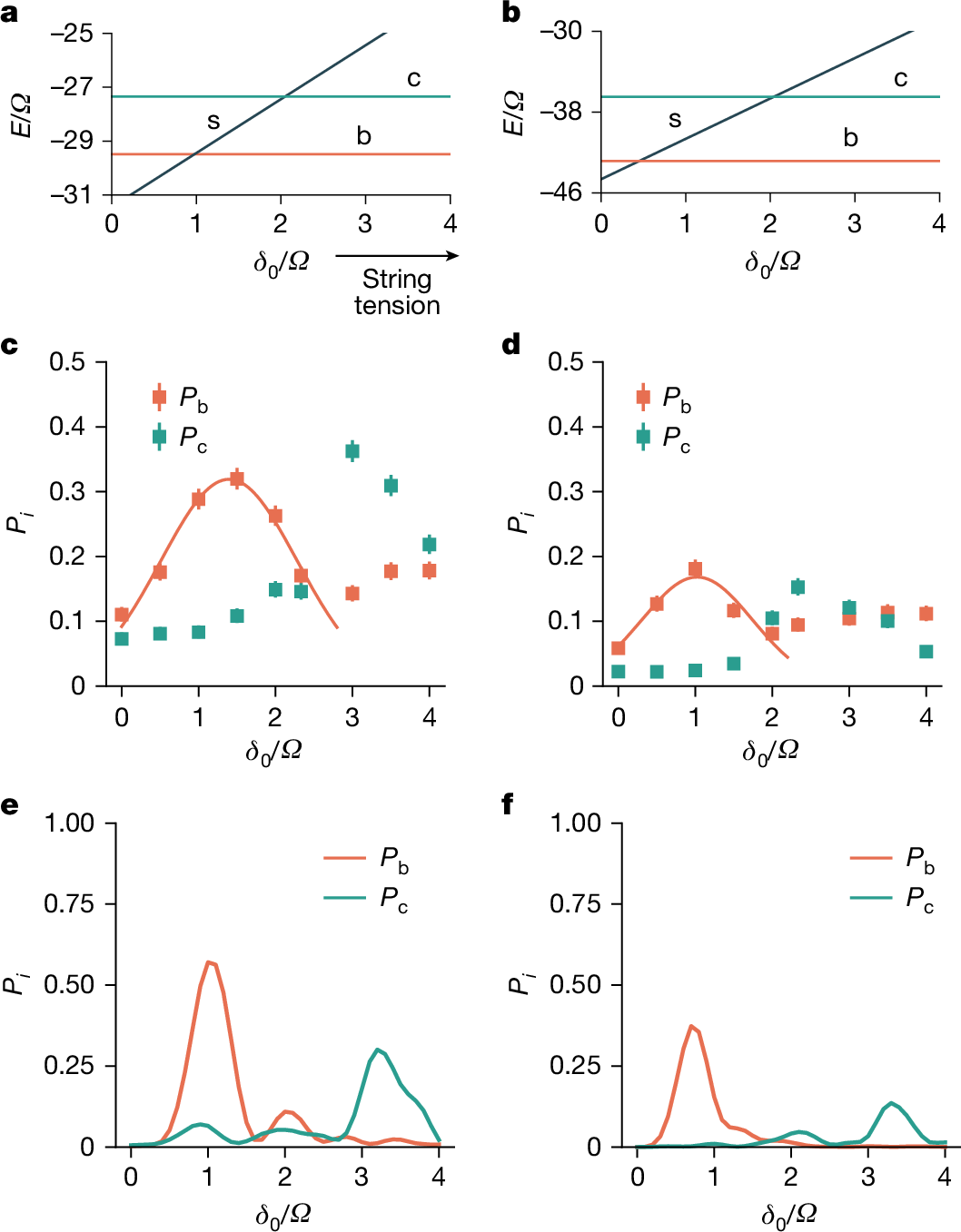
An equilibrium diagram says which arrangement is energetically preferable. A dynamics experiment asks how the system moves between them. After preparing a particular connected string, the researchers abruptly adjusted local atomic detunings, changing the effective tension and bringing different many-body configurations into energetic competition. At later times they observed changing probabilities of connected, intermediate and screened configurations. [1]
This two-state Hamiltonian is an illustrative approximation: the connected state and broken state have energies Es and Eb and are coupled by g. Near an energy crossing, the eigenstates become strongly mixed. In reality, the Rydberg system contains many more configurations, with intermediate string paths and residual noise. The approximation explains the importance of resonance without claiming to reproduce the full dataset.

Many-body spectroscopy rather than a metaphorical snap
The experiment swept local detuning and measured transitions into broken-string configurations. Enhanced transition probabilities occurred near resonance conditions whose positions depended on the effective energy landscape and charge separation. This is a form of many-body spectroscopy: a frequency or detuning response reveals interactions and mixing in an otherwise complicated spectrum. [1]
The probability formula follows from an isolated two-state model at constant Hamiltonian. The experimental lineshapes are affected by multiple accessible many-body states, blockade violations, motional dephasing and preparation errors. A claim of coherent string breaking therefore requires controls for those effects and agreement with a larger effective model, not merely a visually impressive change in occupation.
The superconducting-qubit route is complementary
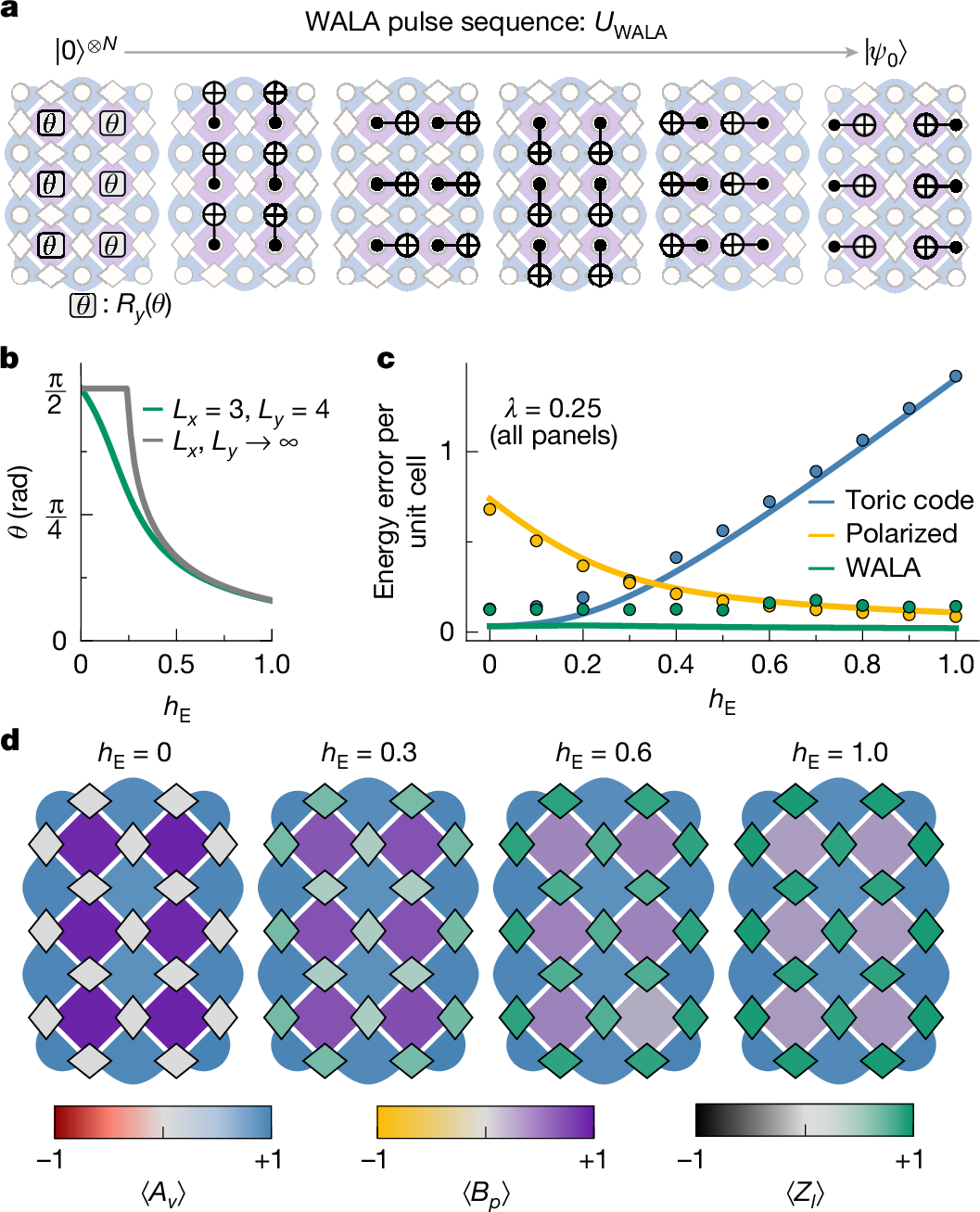
The same month, Cochran and collaborators published a distinct experiment using superconducting qubits to realize a two-dimensional Z2 lattice gauge theory. They digitally prepared low-energy states, excited charges and measured the resulting dynamics. As an electric-field parameter increased, the excitations became confined and string-like structures emerged, with transverse fluctuations varying between weak and strong confinement. [4]
The gauge group, microscopic Hamiltonian and experimental controls differ from the U(1) Rydberg atom simulator. The comparison is valuable precisely because the same broad questions can be posed across different platforms while keeping their assumptions clear. Neither experiment should be advertised as a full direct simulation of three-dimensional QCD or as proof of unconditional quantum computational speedup.
What a serious next experiment would establish
Two-dimensional interacting gauge systems can be hard to model classically, particularly during strongly entangling real-time evolution, but tensor-network methods, exact diagonalization and suitable Monte Carlo calculations remain powerful controls. A good hardware comparison should hold the target Hamiltonian, geometry, observable set and error tolerances fixed. The near-term scientific value is the ability to probe gauge sectors experimentally while comparing them to well-understood numerical regimes.
Future studies could track confinement strength and dynamical matter mass independently, measure longer transverse string fluctuations, explore multiple defect separations and quantify gauge-constraint violations directly. Distinguishing coherent transitions from incoherent relaxation would become increasingly important as the lattice grows. These are concrete measurements, not simply the ambition to build larger arrays.
An abstract theory made visible
A flux string in particle physics is not a tiny rope. It is a connected configuration of quantum fields whose energy and endpoints obey gauge constraints. The neutral-atom experiment demonstrated how some of those defining features can emerge in a controllable lattice model, from equilibrium screening to dynamically enhanced string breaking. That is why these simulations matter: they let researchers construct, perturb and measure particular aspects of difficult quantum-field dynamics while remaining precise about the differences between the emulator and the fundamental theory.
References
[1] González-Cuadra et al. (2025), Observation of string breaking on a (2 + 1)D Rydberg quantum simulator. https://doi.org/10.1038/s41586-025-09051-6.
[2] Wilson (1974), Confinement of quarks. https://doi.org/10.1103/PhysRevD.10.2445.
[3] Kogut (1979), An introduction to lattice gauge theory and spin systems. https://doi.org/10.1103/RevModPhys.51.659.
[4] Cochran et al. (2025), Visualizing dynamics of charges and strings in (2 + 1)D lattice gauge theories. https://doi.org/10.1038/s41586-025-08999-9.
[5] Gross et al. (2023), 50 years of quantum chromodynamics: introduction and review. https://doi.org/10.1140/epjc/s10052-023-11949-2.
[6] Scholl et al. (2023), Erasure conversion in a high-fidelity Rydberg quantum simulator. https://doi.org/10.1038/s41586-023-06516-4.
[7] Zhang et al. (2025), Probing quantum floating phases in Rydberg atom arrays. https://doi.org/10.1038/s41467-025-55947-2.
[8] Yan et al. (2023), Quantum optimization within lattice gauge theory model on a quantum simulator. https://doi.org/10.1038/s41534-023-00755-z.
[9] González-Cuadra et al. (2024), Observation of string breaking on a (2 + 1)D Rydberg quantum simulator, preprint. https://arxiv.org/abs/2410.16558.
[10] Nature Physics (2025), Predicting topological entanglement entropy in a Rydberg analogue simulator. https://doi.org/10.1038/s41567-025-02944-3.
[11] Google Quantum AI, Quantum lattice-gauge simulation experiment and code. https://quantumai.google/cirq/experiments/lattice_gauge/lattice_gauge.