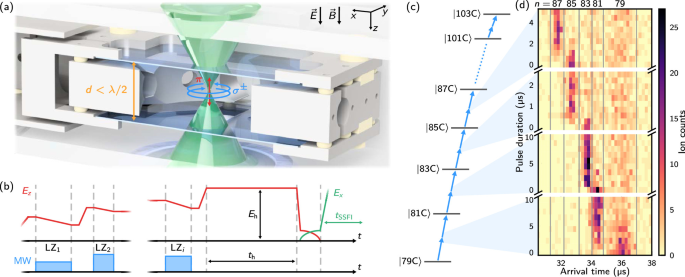

An atom can be made extraordinarily large without making its nucleus any larger. Excite an electron into a high principal-quantum-number state and its wavefunction can spread over a distance comparable to a bacterium. At such scales, the atom becomes a remarkably sensitive microwave object. It is also vulnerable to the thermal radiation of an ordinary laboratory. A September 2026 experiment by Einius Pultinevicius, Aaron Götzelmann, Fabian Thielemann, Christian Hölzl and Florian Meinert demonstrates that this vulnerability can be addressed without refrigerating the entire apparatus. The researchers trapped individual strontium atoms in circular Rydberg states, reached principal quantum numbers as high as 103, and measured internal-state lifetimes exceeding ten milliseconds at room temperature. Their approach changes the electromagnetic environment experienced by the atom rather than simply lowering its temperature [1].
The distinction matters because a long-lived excited state is not necessarily a long-lived qubit, and neither property guarantees that an atom remains trapped. In this experiment the electronic state lifetime, the motional confinement time and the coherence of a superposition are three separate observables. The state lifetime passes the ten-millisecond threshold; the measured tweezer confinement time reaches 133(6) milliseconds; the presently achieved phase-coherence scale remains substantially shorter. Understanding those numbers requires following three pieces of physics together: angular-momentum selection rules, the photonic density of states between conducting plates, and controlled transitions through a ladder of highly excited atomic levels.
Why the circular state is unusual
A hydrogenic electron is labeled by a principal quantum number , orbital angular momentum , and its projection . A circular state occupies the extreme end of the allowed angular-momentum manifold: . Its probability distribution is concentrated near a ring in a plane perpendicular to the quantization axis. The classical orbit picture is a useful visualization, but the electron is not a small particle following a definite planetary trajectory. It is a stationary quantum wavefunction with a sharply constrained angular-momentum content. At high , the characteristic radius grows approximately as , while the level spacing between adjacent principal manifolds falls approximately as . Consequently, transitions between neighboring circular states lie in the microwave spectrum.
Electric-dipole radiation obeys angular-momentum selection rules, including and . A circular state has relatively few dipole-allowed downward channels: its large cannot suddenly collapse into a low-angular-momentum state through one ordinary dipole transition. The radiative transition to the adjacent circular state is allowed, but the cascade through numerous strongly coupled low- states is suppressed. In vacuum, this protection produces exceptionally long spontaneous-emission lifetimes. At 300 K, however, the same low-frequency microwave transitions interact strongly with thermal photons, and stimulated absorption or emission can rapidly redistribute the atom among nearby Rydberg levels [1, 6–8].
Thermal photons, not just spontaneous emission
For a mode of angular frequency , the average number of thermal photons is . In the regime , this approaches . Microwave photons are therefore plentiful at room temperature. The rate of a downward transition includes a spontaneous contribution proportional to ; upward transitions are driven by the factor . Cooling the surrounding radiation field suppresses both thermal directions, as demonstrated in contemporary cryogenic atom arrays [5]. The Stuttgart experiment instead engineers the available microwave modes while keeping the apparatus at ambient temperature.
In an electromagnetic environment, an atomic decay rate is not an immutable property of the atom alone. Fermi's golden rule weights the dipole matrix element by the local density of electromagnetic states at the transition frequency. A cavity may enhance emission if a resonant mode is available, or inhibit it if boundary conditions exclude the relevant field polarization. The latter is the operating principle here. Daniel Kleppner formulated the inhibition mechanism in 1981, and Hulet, Hilfer and Kleppner demonstrated it experimentally in a Rydberg atom in 1985 [6, 7]. The new work extends this logic to a complex, optically accessible trapping geometry and tests the resulting frequency-dependent protection across many circular states.
A capacitor that removes microwave decay channels
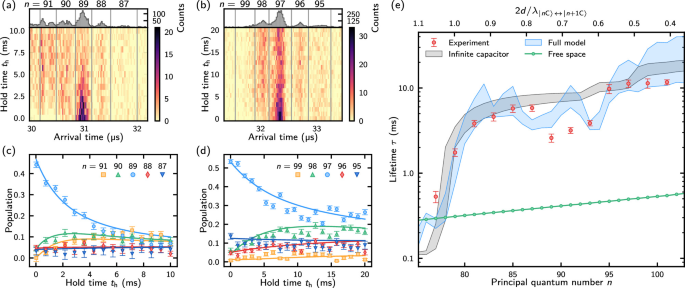
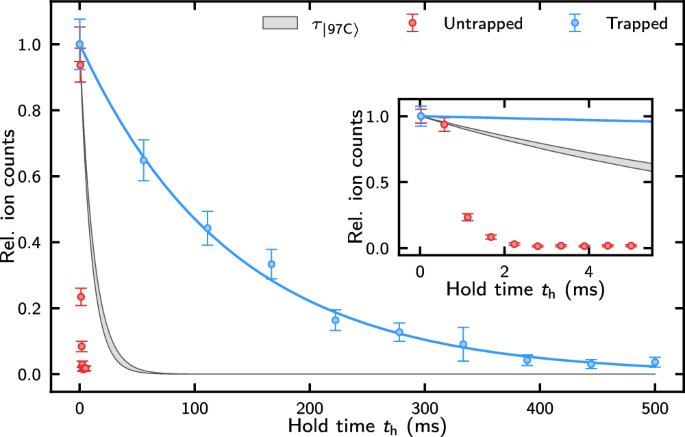
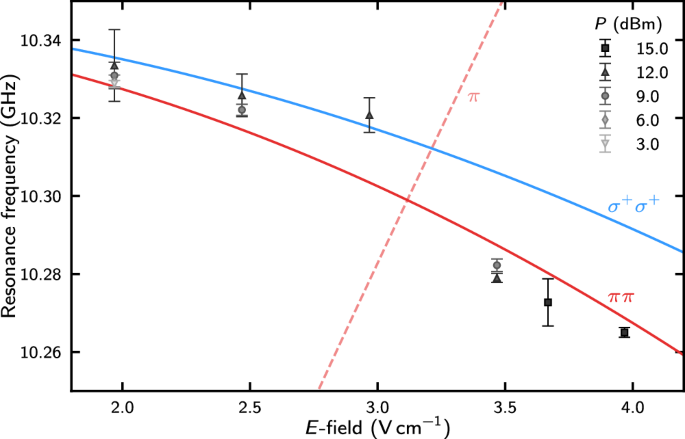
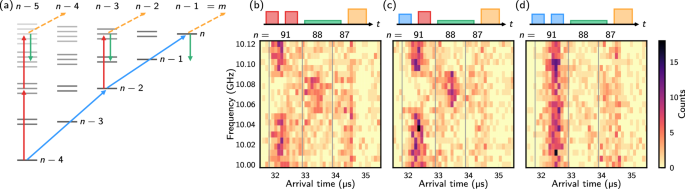
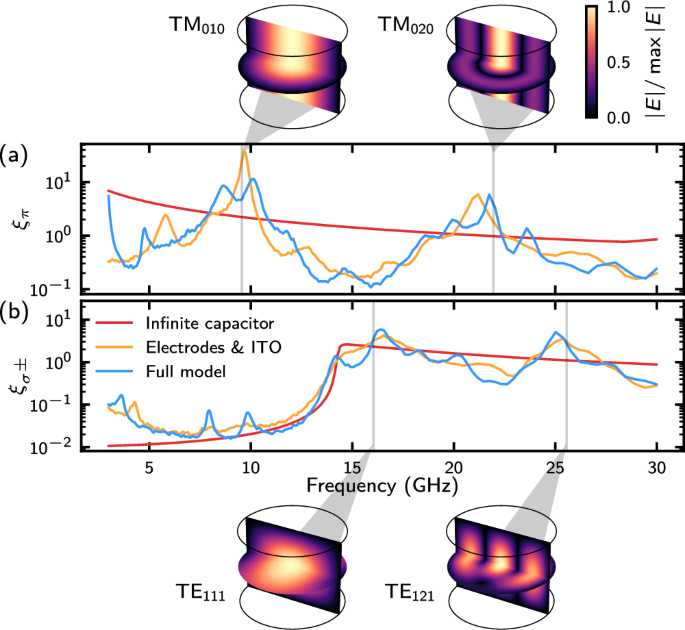
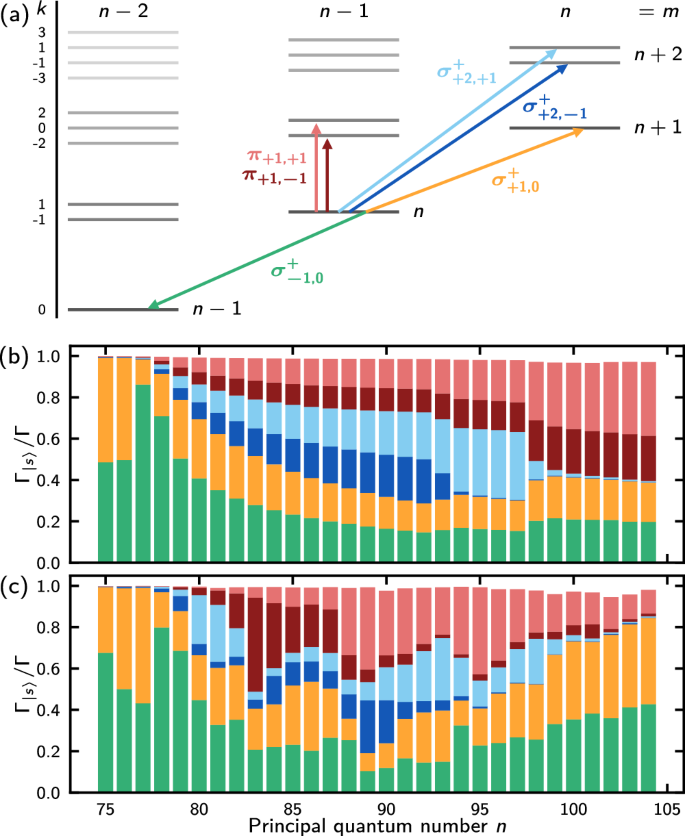
The researchers placed a trapped atom between two transparent, indium-tin-oxide-coated glass plates separated by mm. The coating transmits the optical beams needed to manipulate the atom but reflects microwave radiation. In the idealized parallel-plate limit, electromagnetic modes whose electric field lies parallel to the plates are strongly suppressed below a cutoff. The elementary geometric condition is , equivalently \(f The polarization selection is as important as the cutoff frequency. Circular-state transitions involve photons, with electric fields transverse to the quantization axis. The apparatus orients the electronic orbit parallel to the coated plates, so the field components relevant to the dominant circular-to-circular thermal transitions are suppressed. The plates do not eliminate every possible decay channel. In particular, -polarized transitions to elliptical Rydberg states can survive or even become enhanced by resonances formed with the surrounding ring electrodes. It would be misleading to describe the structure as a broadband microwave shield. Its useful effect is strongly frequency-, polarization- and geometry-dependent. Preparing a very large circular state is not equivalent to exciting an atom with a single laser pulse. Optical excitation readily accesses comparatively low-angular-momentum Rydberg states, whereas the desired circular state has nearly maximal . The experiment first prepares a circular state near , then applies a sequence of two-photon microwave transitions that increase in steps of two. Up to twelve pulses connect the starting state to . A slowly swept electric field moves the relevant Stark-shifted transition through resonance, implementing Landau–Zener transfer. In a two-level approximation, the nonadiabatic probability takes the form , where is the coupling energy and is the detuning sweep rate. The ideal two-level formula explains the design logic but does not fully describe the multilevel atom. At large , the number of nearly degenerate states increases, unwanted single-photon transitions approach the intended resonances, and microwave polarization is not perfectly controlled at the atomic position. The authors therefore map the transition frequencies and choose operating points that avoid problematic crossings. State-selective field ionization provides a readout: a high electric-field ramp ionizes different principal manifolds at different times, allowing the experiment to infer populations from detected ion arrival times. The largest states reached in the experiment have a reported electronic orbit diameter of roughly 1.1 micrometres [1]. Increasing usually weakens the thermal coupling between neighboring circular states, and the parallel-plate cutoff suggests an additional stepwise improvement. The measurements indeed show enhanced lifetimes near , with values around five milliseconds near . Yet the lifetime drops again around before recovering above . That dip is not an experimental contradiction. It reveals the failure of the simplest infinite-plate approximation. The actual apparatus contains four ring-shaped electrodes and supporting conductors. Together with the coated plates they form a finite three-dimensional resonator that supports microwave modes unavailable in the ideal geometry. The authors compared their data with electromagnetic simulations of both an infinite plate pair and the full electrode assembly. A resonance associated with a -polarized cavity mode increases access to elliptical-state decay channels near . In this regime, the dominant transition need not stay within the neat ladder . The total decay rate is more accurately written as , with an Einstein coefficient, the mode-dependent Purcell factor and the final term accounting for spontaneous emission on downward channels. The rate is sensitive to the full accessible state manifold. A measurement of the population remaining in the initial state is not automatically a measurement of its intrinsic lifetime. An atom that leaves can enter a neighboring manifold and later return, while a different decay path can populate states with the same but different angular momentum. The experiment therefore follows the distribution over detected principal manifolds as a function of hold time and fits a rate-equation model rather than imposing a single exponential on one histogram. In vector notation, , where off-diagonal entries of represent transition rates and diagonal entries ensure conservation of probability within the modeled manifold. The detailed analysis also tests how much bias is introduced by reducing a large atomic-state space to a manageable set of principal-manifold populations. The authors simulate a larger model that includes 229 elliptical states and compare fitted lifetimes with the underlying calculated lifetimes. The discrepancies remain below approximately sixteen percent in their reported tests, with the reduced model tending to underestimate the true lifetime [1]. That validation is important when the dominant decay channels change with . The measured internal-state lifetime beyond ten milliseconds is therefore a property inferred from multichannel population dynamics, not simply the time until a trapped atom disappears from an image. The same experiment reports a 1/e confinement time of 133(6) ms for atoms initially prepared in . The optical tweezer remains on while the researchers count all detectable Rydberg products rather than selecting the initial electronic level. Turning the tweezer off causes the ion signal to vanish on a millisecond timescale because atoms leave the detection region. The hundred-millisecond number is a lower bound on useful trapping in the stated detection protocol: some atoms can migrate to electronic levels outside the field-ionization window without physically leaving the trap. It should not be used interchangeably with the ten-millisecond circular-state lifetime. Strontium offers a special advantage over the alkali atoms used in many neutral-atom arrays. It has two valence electrons, allowing an optically active ionic core to remain accessible while the other electron occupies a circular Rydberg orbit. This separation makes optical confinement and possible core-based readout attractive, although engineering a complete quantum processor still requires robust addressing, interactions and gate sequences. Earlier work demonstrated circular atoms at with a room-temperature lifetime of 2.55 ms and characterized coherent microwave qubits [2]. Related experiments have probed quadrupole coupling to inner-shell excitations, extending the control toolbox without treating the large outer orbit as an obstacle [9]. At high principal quantum number, an apparently successful microwave transfer can terminate in an elliptical state with similar energy. The authors introduce an additional spectroscopic check that exploits the absence of certain Stark-shifted transitions from a genuinely circular state. By comparing preparations expected to populate elliptical states with one expected to populate , they show that a diagnostic single-photon resonance appears in the former but not the latter. The logic is sharper than merely finding population in the desired manifold: it uses the angular-momentum structure to test the identity of the state. This distinction becomes increasingly consequential as the number of accessible states grows approximately as . One might expect the entire problem to reduce to a cutoff frequency for parallel plates. The full device instead acts partly as a cylindrical resonator. Its ring electrodes support transverse-electric and transverse-magnetic field patterns, some of which concentrate electromagnetic energy at the atom. A field polarization that is suppressed by the plates in one spectral region can be enhanced near a discrete resonance in another. The Purcell factor is thus not a single number: it is a response function for each dipole orientation and transition frequency. The calculations determine it by comparing the dissipative part of the impedance of a small test dipole in the apparatus with that of the same dipole in free space. This result has an engineering implication beyond the particular strontium experiment. Extending the lifetime of an excited atomic state requires attention to every channel that can couple to the environment, including modes introduced inadvertently by mechanical supports, control electrodes and nearby conductors. Eliminating one dominant polarization may expose a weaker channel that then sets the floor. As the main channel is progressively inhibited, transitions that were negligible in free space become proportionally more important. A realistic design therefore needs both atomic selection rules and a three-dimensional electromagnetic model; optimizing only the ideal cavity spacing can produce the wrong answer. The study resolves this competition explicitly. Circular-to-circular transitions dominate many free-space calculations, but a suppressed channel cannot dominate indefinitely. The authors classify transitions by photon polarization and by changes in principal and parabolic quantum numbers. Some -polarized channels feed elliptical states in the neighboring manifold; others reach more distant manifolds. The balance varies across , because both the atomic transition frequencies and the cavity-mode density vary. Around , the authors' model finds that a substantial majority of the decay products can occupy elliptical states, whereas at larger the circular ladder again becomes comparatively more important. The resulting lesson is not that circular states are unstable, but that their exceptional stability has a conditional meaning. The long angular-momentum-protected lifetime exists in conjunction with a specific radiation environment. A laboratory can create that environment by cryogenic shielding, photonic mode engineering or a combination of both. In July 2026, a separate experiment using cryogenic cesium tweezer arrays measured a microsecond lifetime for a low-angular-momentum state [5]. That result and the present circular-state work address different atomic levels and use different protection strategies; their numerical lifetimes should not be interpreted as a head-to-head device benchmark. A qubit stored in a superposition of circular states must retain phase information, not merely survive in one electronic manifold. The energy splitting is susceptible to electric-field inhomogeneity, magnetic-field fluctuations and motional sampling of gradients. The paper notes that technical sources presently limit the observed scale to around one hundred microseconds, well below the best measured . For a simple Markovian qubit with relaxation and pure dephasing, . Although a real multilevel circular atom is more complicated, the relation captures why extending alone does not guarantee comparable coherence. Active field stabilization, dynamical decoupling and improved motional control remain essential. Nor does a single long-lived atom establish a many-qubit architecture. Strong dipole-dipole interactions can enable gates and analog spin models, but they also couple electronic and motional degrees of freedom. In 2025, experiments directly characterized resonant interactions between individually trapped circular Rydberg atoms and their orientation dependence [3]. A May 2026 study demonstrated nondestructive optical readout through an auxiliary atom array [4]. These results are complementary: one develops interactions, another readout, and the Stuttgart experiment addresses long-lived state preparation in a room-temperature environment. Integrating all three capabilities at scale, while preserving coherence, is a substantially harder undertaking than any one demonstration. At , the electronic wavefunction spans approximately a micrometre, bringing its structure closer to the length scale of tightly focused optical fields. This creates a regime in which the electron's spatial distribution may be manipulated in ways unavailable to ordinary ground-state orbitals. Recent theoretical work examines how optical tweezers narrower than a Rydberg orbit can mix electronic eigenstates and induce large electric dipoles [10]. That proposal is not an experimental capability established by the lifetime study, but it indicates why the high- frontier is interesting beyond a straightforward increase in . The large state manifold may also support qudit encodings and synthetic dimensions if leakage and addressability can be controlled. The most useful interpretation of the September result is therefore precise. A single atom can be prepared in a very high circular Rydberg state, coherently transferred along a microwave ladder, confined by an optical tweezer and protected against major room-temperature blackbody transitions through a carefully engineered electromagnetic environment. Its lifetime is not unlimited; some resonances actively shorten it, and the measured phase coherence still trails the population lifetime. Yet the experiment demonstrates that the thermal photon bath can be shaped locally, and that the microscopic geometry of an apparatus can become a genuine control parameter in atomic quantum information.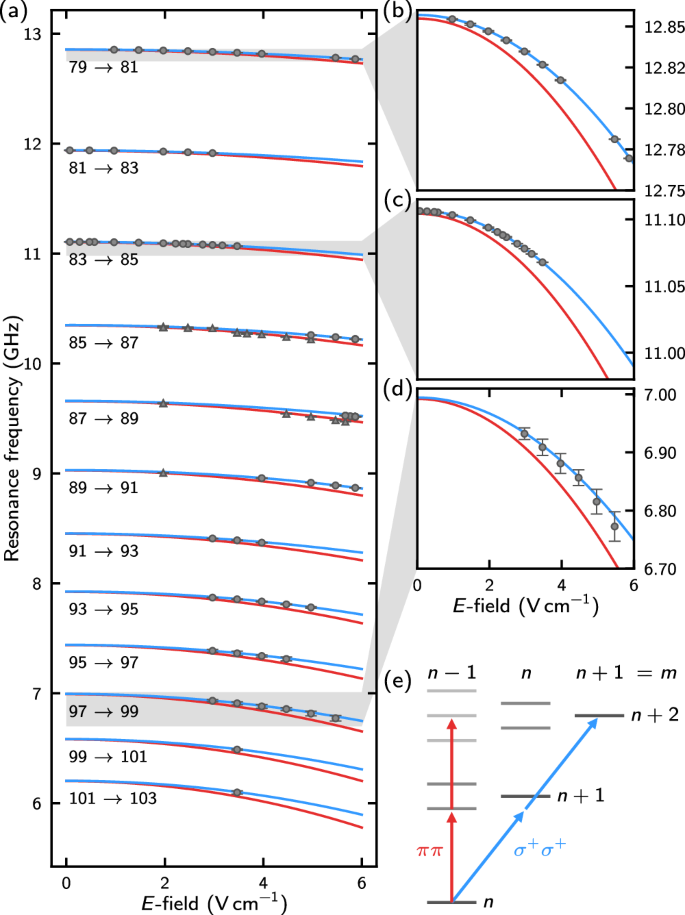
Climbing the circular ladder to n = 103
Why lifetime does not rise monotonically with n
How the lifetime is extracted
Trapping the atom is a separate achievement
Checking whether the state is truly circular
The cavity's hidden modes
Why elliptical states matter even when they are weakly coupled
What remains between long lifetime and a useful qubit
Large orbitals as an additional control resource
References