

Imagine a crystal whose repeating structure is not made of atoms. The electrons themselves form the pattern. This does not happen in an ordinary metal, where quantum motion keeps electronic states extended. But when mutual electric repulsion overcomes the energy of delocalization, electrons can organize into a regular array. Nearly ninety years after Eugene Wigner proposed the idea, a series of remarkable experiments has revealed what those electronic solids actually look like.
The word “crystal” usually evokes a rigid ionic lattice, with atoms fixed around reproducible positions. A Wigner crystal is different: the correlated electronic charge distribution develops its own spatial order. The host material remains, of course, but its atomic lattice need not dictate the period of the new electronic structure. The distinction is particularly striking in two dimensions, where electrostatic gates, magnetic fields and atomically thin materials allow researchers to tune the electron density and observe the response at nanometre resolution. [1][2]
Not every electron crystal is made in the same way. The 2024 bilayer-graphene experiment directly visualized a magnetic-field-induced Wigner crystal in the lowest Landau level. A 2021 moiré experiment had already imaged generalized electron crystals whose positions were influenced by a periodic superlattice potential. In 2024, researchers also observed ordered arrays of multielectron “Wigner molecules” inside moiré artificial atoms. These are related but physically distinct realizations. Understanding the difference is the most revealing part of the story. [2][3][4]
The original prediction: repulsion becomes stronger than motion
Consider a dilute gas of electrons moving in a two-dimensional plane. Their negative charges repel one another, so they can lower interaction energy by remaining far apart. Quantum mechanics opposes such localization. Squeezing an electronic wavefunction into a smaller region increases its momentum uncertainty and the associated kinetic energy. At high density, the electrons have enough kinetic energy to remain comparatively delocalized. At sufficiently low density, the energetic balance can favor an ordered arrangement of electron density. Wigner recognized this possibility in 1934. [1]
For an ideal parabolic-band two-dimensional electron gas, the conventional dimensionless measure of interaction strength is rs. It compares a typical interparticle distance with the effective Bohr radius set by the band mass and dielectric response.
Here n denotes electron density per unit area, m* an effective mass and ε the absolute effective permittivity in an idealized isotropic model. The scaling is more important than any particular numerical threshold. Reducing density increases rs, making Coulomb interactions relatively more consequential. Real graphene and moiré systems may have non-parabolic dispersions, screening, valley structure and nearby dielectric layers, so this formula should not be mistaken for a universal phase diagram.
The origin of the scaling is simple. In an elementary two-dimensional parabolic band, the characteristic kinetic energy varies linearly with density, whereas the Coulomb energy of charges separated by the mean particle distance varies with the square root of density. Their ratio grows as density decreases. A precise transition nevertheless requires many-body calculations because correlations and exchange can change the energies of both the fluid and crystal phases.
How a strong magnetic field changes the competition
A magnetic field supplies another route to electronic crystallization. Motion perpendicular to the field is quantized into Landau levels. Within a partially filled level, electrons no longer behave like particles with an unrestricted continuum of kinetic energies. The remaining energy competition depends heavily on Coulomb interactions and correlations. This can stabilize a crystal even in parameter regimes where a zero-field fluid would prevail. [2][8]
Two scales make the physics concrete. The magnetic length controls the characteristic orbital extent, while the filling factor ν relates the density of electrons to the magnetic flux density. In a convention where the relevant internal Landau-level flavors are resolved, these quantities are
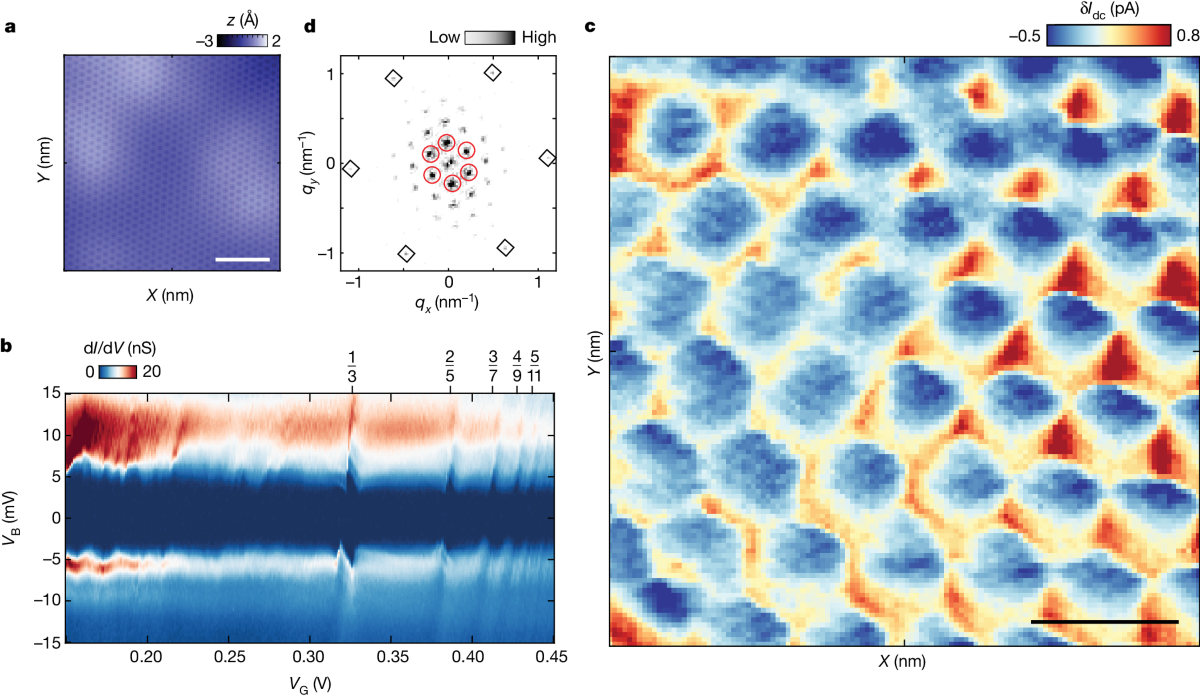
The convention matters when spin and valley degeneracies remain unresolved. For their particular resolved lowest-Landau-level configuration, Yen-Chen Tsui, Minhao He, Yuwen Hu and colleagues studied Bernal-stacked bilayer graphene at very low temperatures and magnetic fields approaching 14 tesla. In the strongest-field regime they found triangular crystalline patterns over approximately ν = 0.13 to 0.38, interrupted near fillings favorable to competing fractional quantum Hall states. This is a device- and state-specific observation, not a universal filling window. [2]
Geometry lets the experiment test whether the crystal is electronic
A triangular lattice has a particularly direct density-spacing relationship. If there is one electron per primitive cell, the area of a triangular primitive cell must equal the inverse electron density. This predicts how the ordered lattice constant changes when the gate adjusts the number of electrons per area.
Combining the prediction with Landau-level filling gives another useful experimental comparison:
The 2024 study measured a crystal spacing consistent with the appropriate density dependence, helping distinguish emergent charge order from a fixed periodic imperfection in the underlying carbon lattice. An atomic defect pattern is not generally expected to expand and contract with carrier density according to this simple geometric law. Agreement of real-space images, reciprocal-space peaks and density scaling makes a substantially stronger case than a visually appealing map alone. [2]
It is important to read the images correctly. Scanning tunnelling microscopy measures an electronic response related to local states and tunnelling processes. It does not film individual electrons following deterministic orbits. The colored patches represent spatially structured signals of a quantum many-body state. An electron remains a wavefunction with quantum fluctuations even when its correlated density is ordered.
Watching an electron solid melt
The ability to tune density, temperature and magnetic field exposes what a single static image cannot: the competition between distinct quantum phases. In the bilayer experiment, increasing density or temperature destroyed the identifiable crystalline pattern and produced a more liquid-like state with residual correlations at characteristic wavevectors. At lower magnetic fields, researchers also observed anisotropic stripe order rather than a conventional triangular crystal. The electronic solid was not merely disappearing; it was giving way to other correlated arrangements. [2]
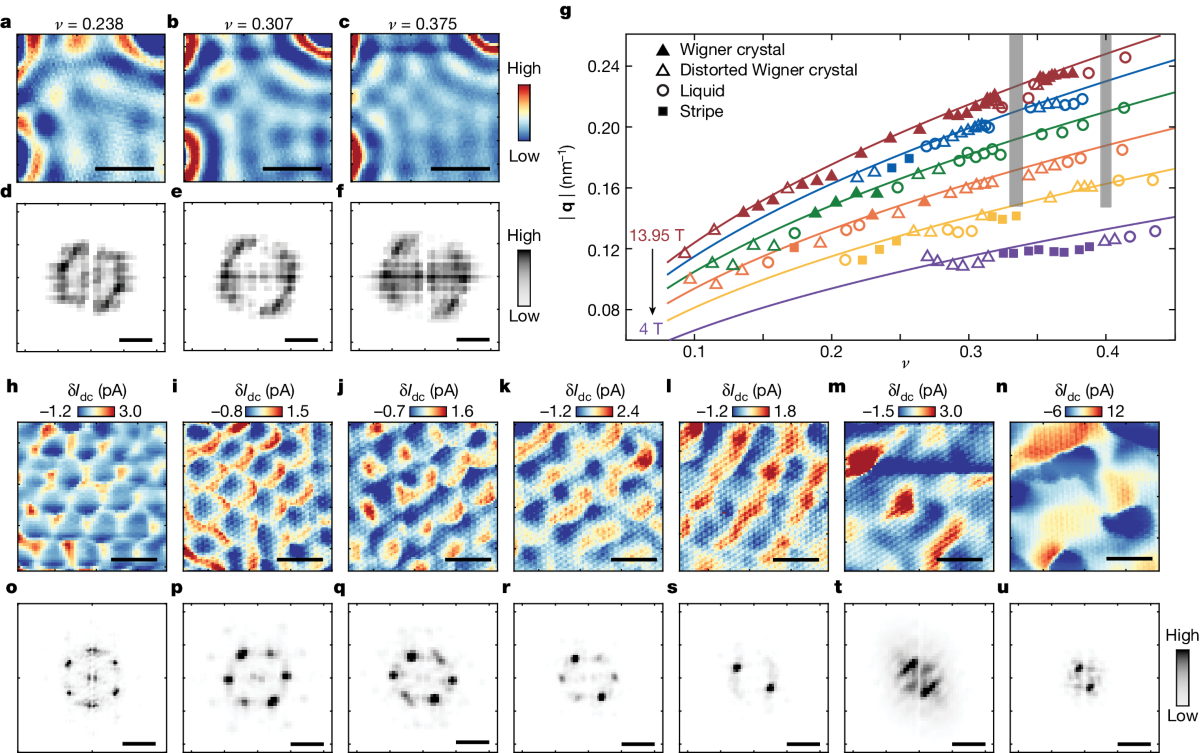
A quantitative way to discuss spatial ordering is a static structure factor. For a particle-coordinate idealization it measures the interference of density correlations at a chosen reciprocal-space wavevector. Ordered structures develop enhanced peaks at their reciprocal lattice vectors, while correlated liquids generally show broader structure. Fourier transforms of local tunnelling images provide a related experimental signature, although the tunnelling current is not literally the full many-body structure factor.
Two-dimensional melting is more complicated than the simple picture of increasing temperature until all order vanishes. Long-wavelength fluctuations, disorder, finite size and the long range of Coulomb interactions affect correlation lengths and transitions. In a specific measurement, the loss of spatial peaks, their broadening and their filling-factor evolution can be established experimentally; the microscopic universality class requires additional reasoning. [2][10]
A frozen lattice with a moving quantum wavefunction
An electron crystal is not a classical array of stationary beads. Its carriers occupy finite-sized quantum wavefunctions whose positions fluctuate. The ordered state can support collective oscillations, including vibrational modes influenced by long-range electric interactions. Such fluctuations may appear through spectral features or the shapes of local electronic responses. The 2024 authors reported local signatures that might be related to quantum zero-point motion. They did not claim to observe precisely known instantaneous electron trajectories. [2][7]
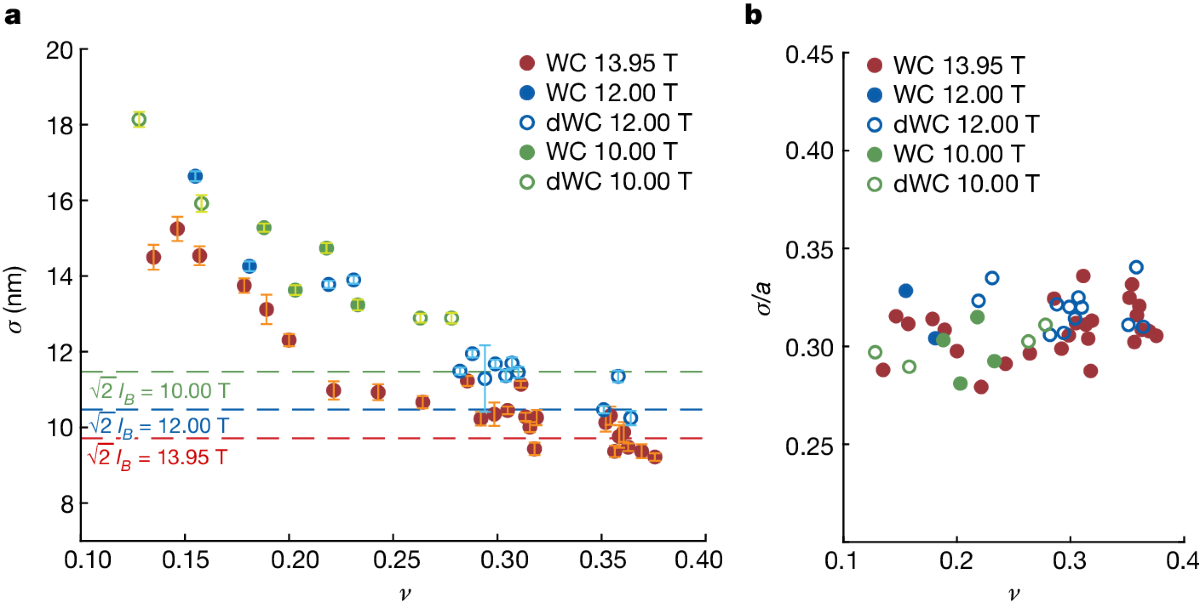
In the absence of a pinning potential, a uniformly translated ideal crystal can have the same energy as the original configuration. Real samples have edges, impurities and strain that can pin the electronic order. Pinning changes the frequency of collective modes and whether an applied electric field makes the solid slide. That motivates transport and microwave studies as complementary probes to scanning tunnelling microscopy. [7][12]
A different kind of Wigner crystal, written into moiré geometry
Now place two atomic monolayers together with slightly different lattice constants or orientations. Their overlapping patterns can produce a much larger moiré superlattice, with slowly varying potential wells that confine carriers. The moiré period is distinct from the atomic period and can create narrow electronic bands. Strong repulsion in those bands can organize occupation among moiré sites even without requiring the same magnetic field conditions as an unpinned continuum electron crystal. [3][5]
In 2021, Hongyuan Li, Shaowei Li and collaborators used a WSe₂/WS₂ moiré heterostructure together with a nearby graphene sensing layer. The graphene provided a route to scanning tunnelling measurements while reducing how severely the probe disturbed the fragile correlated charge order underneath. The device could be tuned electrostatically through fractional moiré fillings, making it possible to image patterns rather than infer all their structure from transport alone. [3]
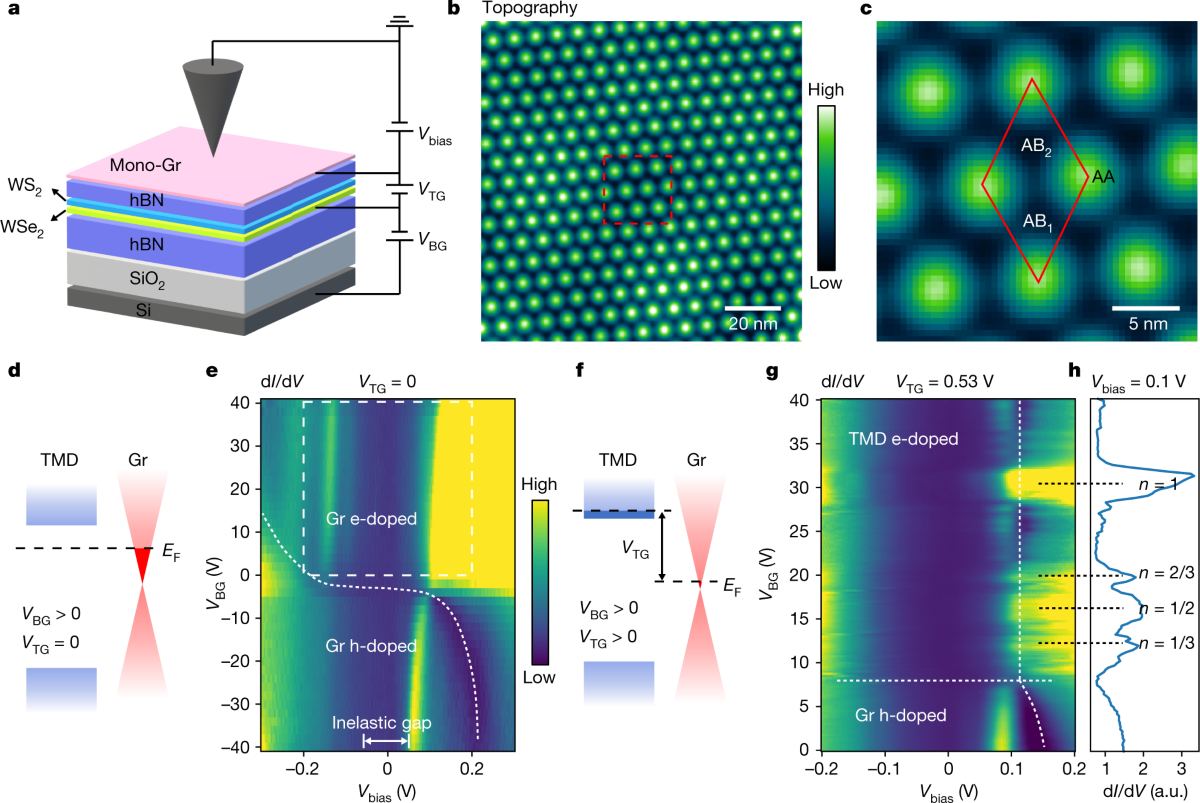
The important difference from a free Wigner crystal is pinning. The moiré potential already selects preferred locations, so the long-range electronic repulsion must decide which among those sites are occupied. That makes the phases generalized Wigner crystals. They reflect the competition of carrier hopping, local Coulomb repulsion and intersite interactions, not crystallization in a perfectly featureless two-dimensional continuum.
One schematic way to represent this competition is an extended Hubbard model, in which hopping t competes with local repulsion U and longer-range intersite repulsions Vij. The microscopic model also depends on spin-valley structure, dielectric screening, band geometry and the actual moiré potential.
Why a change in filling produces triangles, honeycombs and stripes
The most visually memorable aspect of the 2021 experiment was how a single moiré system produced different patterns at different fillings. When the mean occupation was one-third electron per moiré site, a larger-scale triangular pattern appeared. At two-thirds filling, the occupied sites formed a honeycomb-like arrangement. At one-half filling, the preferred ordering took the form of stripes, breaking the parent lattice's threefold rotational symmetry. [3]
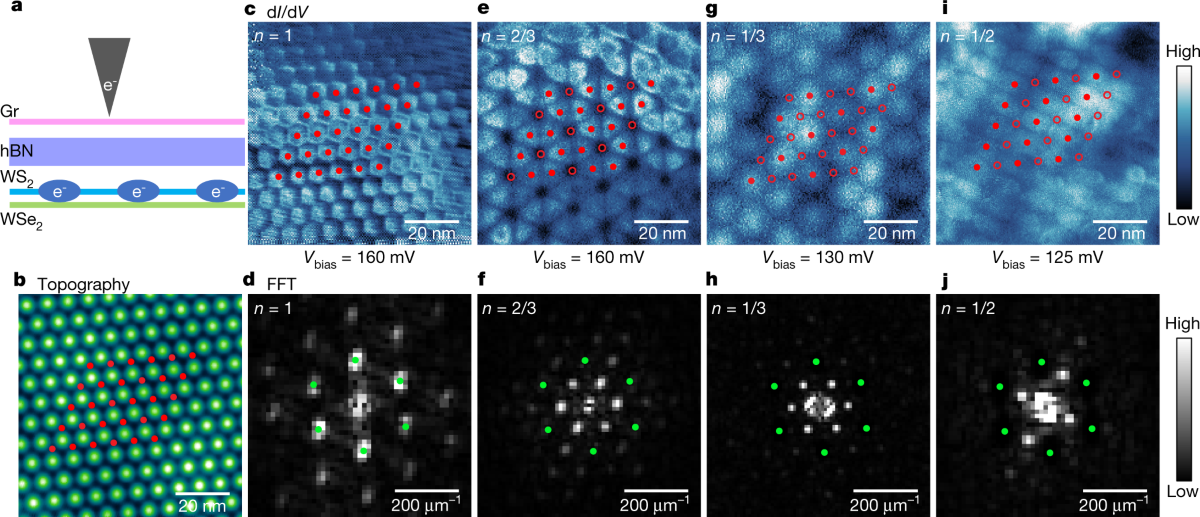
There is a simple geometric intuition behind these patterns. On a triangular set of possible sites, choosing one-third of the positions allows occupied electrons to form a new triangular sublattice with larger nearest-neighbor separation. Occupying two-thirds creates a complementary honeycomb pattern of filled sites around a triangular array of vacancies. At one-half, competing repulsive arrangements can favor parallel rows over a rotationally symmetric state. These rules are not sufficient to calculate the full phase diagram, but they explain why filling fraction is capable of selecting a particular electronic geometry.
Neither the honeycomb nor the stripe is an array of newly moved atomic nuclei. The underlying layers remain the same, while their electronic charge reorganizes. In a quantum material, spatial symmetry breaking can therefore occur in the electronic subsystem without an accompanying reconstruction of the entire atomic lattice. This is the central reason correlated-electron microscopy can reveal physics invisible in a conventional image of a crystal's atoms.
Seeing through graphene without destroying the thing being observed
Measuring an electronic solid is unusually difficult because a scanning probe can disrupt it. The STM tip applies a bias, creates electric fields and modifies local tunnelling conditions. These effects matter most when the state being measured is stabilized by delicate energy balances. The graphene-sensing approach provided a way to detect the charge configuration of the buried moiré system while limiting direct tip perturbation. [3]
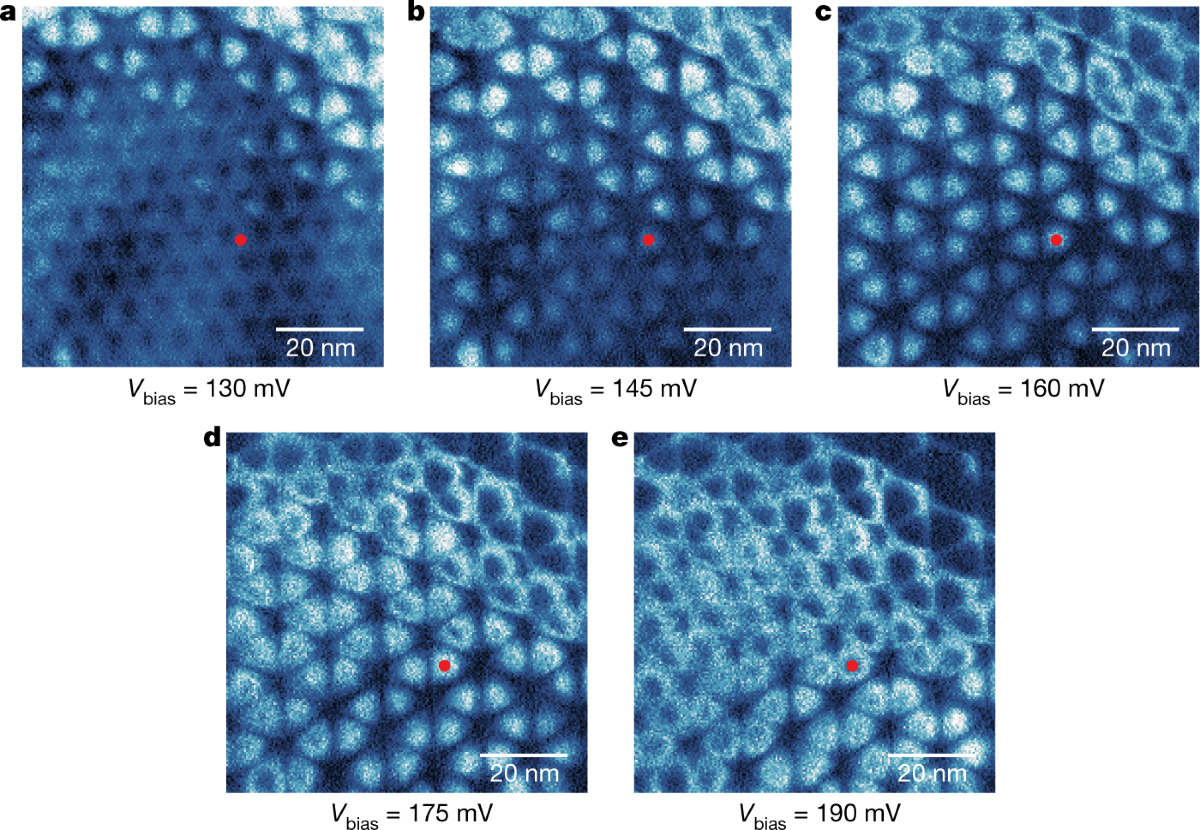
The method also creates interpretational challenges. A tunnelling conductance map depends on how the sensor layer responds to the buried charge, and Fourier filtering can remove the moiré background while leaving the correlated pattern. A rigorous claim requires controls over gate settings, bias dependence, reproducible symmetry and reciprocal-space peaks. The procedure is not simply pointing a microscope at a sheet of electrons and obtaining a literal picture of their positions.
The rival that looks like a liquid and behaves topologically
Magnetic Wigner crystals face an especially interesting competitor: fractional quantum Hall liquids. At particular Landau-level fillings, interactions favor incompressible quantum states that can support fractionally charged quasiparticles and topological order. These fluids have no obligation to produce the Bragg peaks of a triangular charge crystal. In the same device, changing filling factor can therefore shift the balance between translation-symmetry-breaking solid order and correlated topological liquids. [2]
That distinction is more than a change in how an image looks. A Wigner crystal breaks a spatial symmetry, whereas fractional quantum Hall phases can have topological order characterized by properties not reducible to a local charge-density pattern. The transition between them is a useful window into a fundamental question: when does interaction energy favor periodic charge localization, and when does it favor a liquid that organizes quantum correlations without crystallizing?
The interesting disorder between crystal and fluid
Strongly correlated matter often contains intermediate textures rather than an abrupt switch between a flawless lattice and a structureless liquid. Simulations of generalized Wigner crystals in moiré heterobilayers show how added carriers and finite temperature can favor domain walls and other competing configurations. Such states change reciprocal-space signatures and correlation lengths, and they provide candidate mechanisms for melting or doping-driven reconstruction. [10]
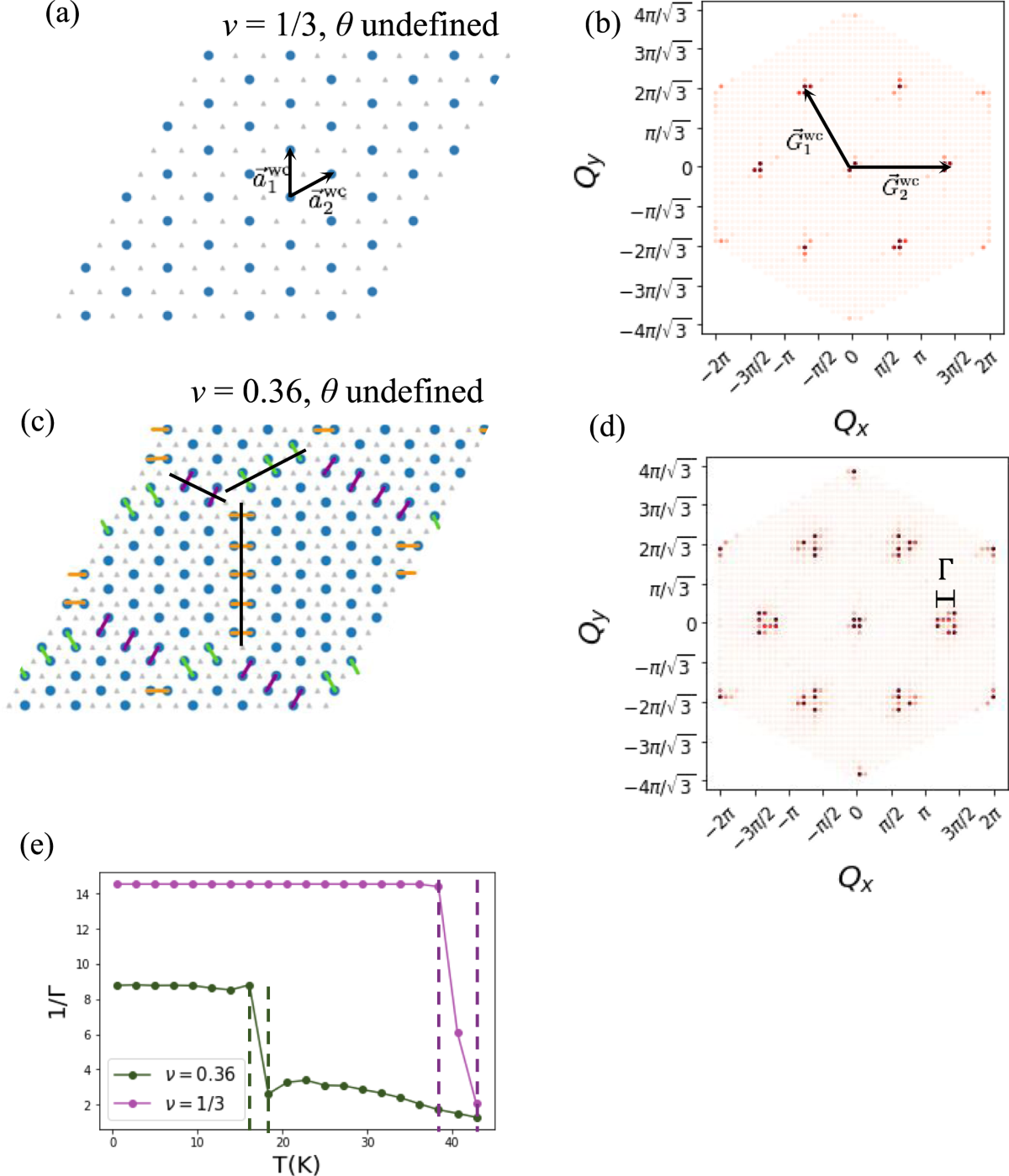
The difference between a measured image and a simulated state must remain explicit. Modeling identifies plausible phases and parameter sensitivities, but it does not demonstrate that the 2024 graphene sample contained the specific domain walls in the figure. Such comparisons are scientifically useful because they tell experimentalists what spatial signatures, temperature dependence and correlation peaks might distinguish competing microscopic explanations.
Electrons can also organize into artificial molecules
A further development came from twisted bilayer tungsten disulfide. In 2024, Hongyuan Li, Ziyu Xiang and colleagues reported Wigner molecular crystals in a moiré superlattice. Here a moiré potential minimum serves as an artificial atom-like confinement site. When several electrons occupy it, their Coulomb repulsion can produce a correlated internal arrangement. An ordered array of such multielectron objects gives another hierarchy of crystalline structure. [4][13]
The word “molecule” does not mean the electrons formed a conventional chemical compound. It refers to a correlated electron configuration confined in a moiré well. The experiments observed patterns associated with two- and three-electron artificial molecules and found that their organization could be influenced by strain, doping and moiré geometry. The ability to tune both between-site order and the structure within sites greatly expands the possible electronic phases.
This is one reason the moiré platform is important beyond a single Wigner crystal. The atomic layers create a larger electrostatic pattern; that pattern localizes electronic wavefunctions; and interactions can organize carriers within and among the resulting artificial atoms. It is a layered problem in which geometry is engineered at one scale and generated by many-body correlations at another.
What constitutes compelling evidence?
The strict experimental standard for an electronic crystal is not an attractive picture. A credible identification should connect the observed periodicity to carrier density, resolve the expected symmetry, distinguish atomic and electronic wavevectors, and show how the pattern responds to temperature, magnetic field or gating. Microscopic theory should account for the competing phases, and potential perturbations from the measuring apparatus should be evaluated. The relevant conditions differ between a spontaneous continuum Wigner solid and a lattice-pinned generalized crystal.
Complementary signatures matter as well. Transport can reveal pinning or sliding dynamics. Microwave or tunnelling spectroscopy can probe collective vibrational modes. Scanning probe maps reveal spatial order. Each technique can be fooled in a different way, and their agreement provides stronger evidence than any one readout. This is especially important for electronic stripes, charge-density waves, disorder-driven localization and other alternatives that can also produce modulated charge responses.
A solid whose geometry comes from quantum correlations
The title “crystal without atoms” is a deliberate paradox. The material itself certainly contains atoms, but the additional periodic structure arises from the correlated electrons. They do not stop being quantum particles when they crystallize. Zero-point motion, electronic exchange, collective vibrations and competition with topological quantum liquids remain part of the physics. The ordered state is best understood as a many-body wavefunction with broken spatial symmetry, not a freeze-frame of microscopic billiard balls.
Wigner's original proposal is now part of an experimental landscape in which charge patterns can be imaged, tuned, melted and compared across different platforms. A field-induced triangular electron solid, a moiré-pinned honeycomb pattern and a lattice of electronic molecules are not interchangeable phenomena. What unites them is a remarkable reversal of the usual hierarchy: the structure of the material is no longer merely a background that electrons move through. The electrons themselves contribute an emergent geometry that can be directly studied.
References
[1] Wigner, E. (1934), On the Interaction of Electrons in Metals. https://doi.org/10.1103/PhysRev.46.1002.
[2] Tsui, Y.-C., He, M., Hu, Y. et al. (2024), Direct observation of a magnetic-field-induced Wigner crystal. https://doi.org/10.1038/s41586-024-07212-7.
[3] Li, H., Li, S., Regan, E. C. et al. (2021), Imaging two-dimensional generalized Wigner crystals. https://doi.org/10.1038/s41586-021-03874-9.
[4] Li, H., Xiang, Z., Reddy, A. P. et al. (2024), Wigner molecular crystals from multielectron moiré artificial atoms. https://doi.org/10.1126/science.adk1348.
[5] Regan, E. C. et al. (2020), Mott and generalized Wigner crystal states in WSe2/WS2 moiré superlattices. https://doi.org/10.1038/s41586-020-2092-4.
[6] Smoleński, T. et al. (2021), Signatures of Wigner crystal of electrons in a monolayer semiconductor. https://doi.org/10.1038/s41586-021-03590-4.
[7] Jang, J. et al. (2017), Sharp tunnelling resonance from the vibrations of an electronic Wigner crystal. https://doi.org/10.1038/nphys3971.
[8] Goldman, V. J. et al. (1990), Evidence for two-dimensional quantum Wigner crystal. https://doi.org/10.1103/PhysRevLett.65.2189.
[9] Shapir, I. et al. (2019), Imaging the electronic Wigner crystal in one dimension. https://doi.org/10.1126/science.aat0905.
[10] Zhang, Y. et al. (2022), Melting of generalized Wigner crystals in transition metal dichalcogenide heterobilayer moiré systems. https://doi.org/10.1038/s41467-022-34683-x.
[11] Zhou, H. et al. (2020), Solids of quantum Hall skyrmions in graphene. https://doi.org/10.1038/s41567-019-0729-3.
[12] Zhang, Y. et al. (2025), Signatures of sliding Wigner crystals in bilayer graphene at zero and finite magnetic fields. https://doi.org/10.1038/s41467-025-64587-5.
[13] Berkeley Lab (2024), Scientists Capture Images of Electron Molecular Crystals. https://newscenter.lbl.gov/2024/11/07/scientists-capture-images-of-electron-molecular-crystals/.