
A magnetic field can now decide whether a diamond-containing laser produces light at all. In a study published on 22 October 2026, Florian Schall and colleagues report a magnetometer in which nitrogen-vacancy centers in diamond alter the losses of an optical cavity. By operating the laser close to its oscillation threshold, the researchers convert a modest spin-dependent absorption change into an optical signal that can fall from tens of milliwatts to zero. The resulting readout reaches 100% optical contrast, while the estimated photon-shot-noise sensitivity remains compatible with a substantial magnetic-field operating range [1].
The distinction between an optical contrast measurement and an achieved magnetic sensitivity is essential. The experiment demonstrates threshold switching and measures the resonance response; its headline femtotesla-per-root-hertz sensitivities are calculated photon-shot-noise limits, not a demonstrated noise floor after technical fluctuations have been eliminated. This is nevertheless an important change in the architecture of quantum sensing. Rather than collect the weak fluorescence of a spin ensemble and discard most photons, the apparatus makes the spins control a macroscopic coherent optical field.
The spin inside the diamond
A negatively charged nitrogen-vacancy center, written NV⁻, consists of a substitutional nitrogen atom adjacent to a missing carbon site. Its electronic ground state has spin one, with projections . At zero magnetic field, the level is separated from the approximately degenerate levels by a frequency near 2.87 GHz. A useful effective Hamiltonian, expressed in frequency units, is
where is the zero-field splitting, is the electron gyromagnetic ratio in frequency per tesla, parameterizes transverse strain or electric-field splitting, and represents hyperfine coupling to nearby nuclear spins. For a field approximately parallel to the NV axis and sufficiently far from avoided crossings, the two spin-transition frequencies are , with . A frequency shift is therefore a magnetic-field measurement [6,8].
Green optical pumping prepares the NV ensemble preferentially in . Resonant microwaves transfer population to , changing the competition between radiative decay and spin-selective intersystem crossing through intermediate singlet states. Ordinary optically detected magnetic resonance, or ODMR, reads this population change through red fluorescence. Its contrast is often only a few percent for practical ensembles, partly because both spin manifolds fluoresce and because the collection optics capture only a fraction of the emitted light [1,7]. The new device reads a different optical channel: absorption near 1042 nm associated with the lower singlet state.
From spin-dependent absorption to laser threshold
A laser begins oscillating when its round-trip optical gain balances all round-trip losses. In a minimal rate-equation description, a cavity photon number obeys
where is saturable gain supplied by an independently pumped semiconductor medium, is background cavity loss, is the spin-dependent absorption contributed by diamond, and seeds the mode through spontaneous emission. A steady-state laser is not fully described by setting the bracket to zero, because gain saturation and spontaneous emission round the threshold. Nevertheless, the sign of the small-signal net gain determines whether the system supports strong coherent output.
Close to threshold, a familiar approximate output law is , where . Here a change in magnetic field shifts the threshold pump power , not merely the detected fluorescence. Differentiating on the lasing side gives . A small field-dependent loss can consequently produce a large fractional change in output when the fixed pump is close to the threshold. At the switching boundary the piecewise model becomes nonanalytic, but the real laser has a finite, noise-broadened transition [1,4].

In the new apparatus, the gain medium is a membrane external-cavity surface-emitting laser, or MECSEL. The diamond sits inside the same optical resonator, while separate optical pumps excite the semiconductor and NV ensemble. A wavelength-selective intracavity element tunes the laser near 1042 nm. This arrangement deliberately separates the material that supplies gain from the quantum defects that supply magnetic-field-dependent absorption. It avoids requiring the NV centers themselves to provide all the optical gain [1,3].
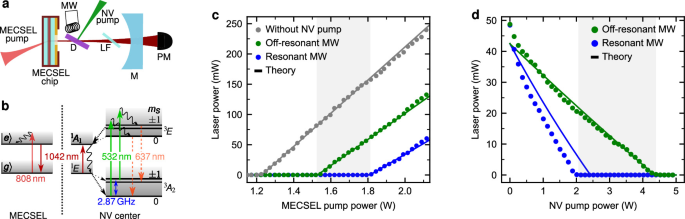
The threshold data make the mechanism concrete. With the NV spins driven on resonance, the laser threshold increases from 1.53 W to 1.82 W. Its measured slope efficiency decreases from 22.0% to 18.7%. These quantities are properties of the coupled gain-and-loss apparatus at the reported operating point, not universal properties of diamond. They show that the microwave-controlled NV population changes the resonator sufficiently to move its macroscopic lasing condition [1].
Why 100% contrast is possible
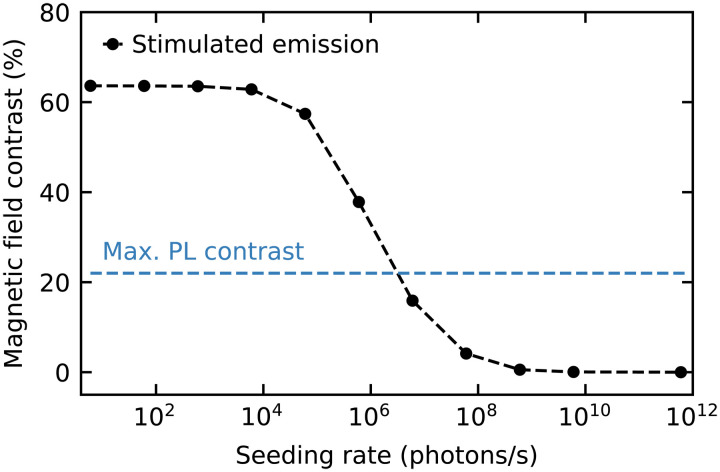
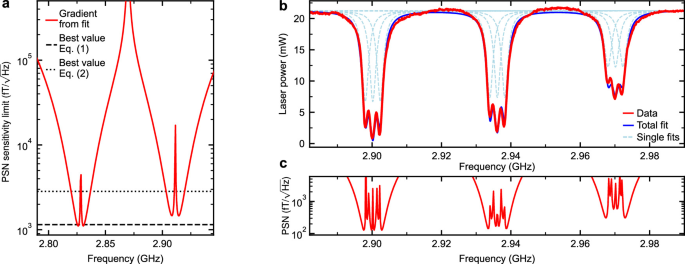
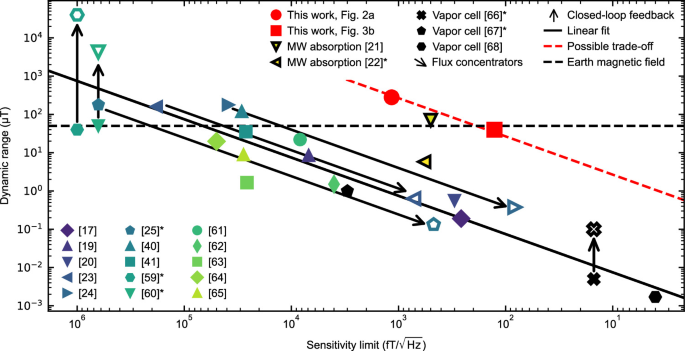
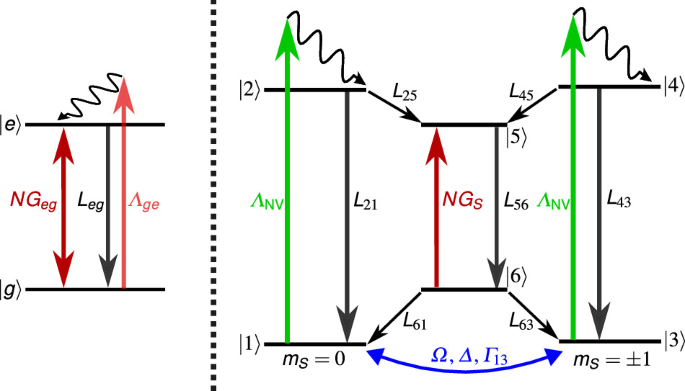
Define the optical contrast between off-resonant and resonant microwave conditions as , assuming . Conventional fluorescence contrast is limited because both spin states emit photons. In a threshold magnetometer, a particular pump setting can satisfy \(P_{\rm th,off} The team reports coherent output powers as high as 50 mW while reaching the high-contrast regime. Strong output matters because a large percentage change is of little metrological value if the detected signal contains almost no photons. Earlier NV laser experiments demonstrated stimulated emission and magnetic contrast, but did not establish this same combination of full threshold extinction, substantial laser output, and the present field-range analysis [2–5]. Diamond has four possible crystallographic orientations for the NV axis. An applied field projects differently onto each axis, producing distinct microwave resonances. In a sufficiently resolved spectrum, these projections can be combined to reconstruct a three-component field, subject to orientation calibration and degeneracies. The reported vector configuration therefore addresses more than the magnitude of a single axial component. It does not eliminate the need to track line assignments, bias fields, temperature shifts, or strain effects when a device moves through a nonuniform environment [1,8]. Magnetometric sensitivity is the field change that produces a signal equal to the relevant noise within a specified measurement bandwidth. For a detector measuring optical power , the linearized response near a bias point is . If the one-sided optical-power noise spectral density is , the corresponding magnetic amplitude spectral density is For an ideal coherent beam with photon flux , Poisson counting gives a photon-number uncertainty proportional to per square-root bandwidth. The resulting shot-noise sensitivity therefore scales as with the numerical prefactor fixed by the spectral-density convention and detector efficiency. This expression explains why neither 100% contrast nor 50 mW output, taken alone, determines sensitivity. What matters is the slope of the optical signal with respect to field divided by its noise. In particular, the point where the laser is fully extinguished is not automatically the optimal working point: an actual measurement must operate where a sufficiently large, stable slope exists [1,7]. A commonly used fluorescence estimate has the form , with a magnetic resonance linewidth. It assumes a suitable smooth resonance and a simple scaling with contrast. Near a lasing threshold the optical lineshape is strongly nonlinear, and the 2026 study explicitly finds that this familiar contrast-based approximation can misestimate the optimum. The authors instead evaluate the sensitivity from the measured optical response and its fitted gradient. Their strongest demonstration of this distinction is the super-linear improvement in the calculated photon-shot-noise limit as contrast approaches unity [1]. For one experimental configuration, the study obtains an optimum photon-shot-noise sensitivity estimate of with an intrinsic dynamic range of . With a different diamond and adjusted parameters, its vector magnetometry configuration gives a calculated limit below for each component, together with an intrinsic range of approximately . These are two different operating points, and combining the best sensitivity from one with the widest range from the other would create a specification that was not demonstrated [1]. The magnetic resonance has a finite width. A broader resonance can be followed over a larger field interval, but its optical slope is usually smaller for a fixed signal amplitude. Increasing spin coherence narrows the linewidth and can improve sensitivity while reducing the interval over which a fixed-frequency readout remains useful. The 2026 result explores a different route: amplify the optical response through cavity feedback while preserving a broad underlying magnetic resonance. The reported intrinsic range is derived from that resonance behavior; it should not be confused with a verified full-scale, closed-loop instrument range under arbitrary motion and noise conditions [1,7]. The magnetic-field sensitivity of an NV transition is set by , but optical threshold switching introduces additional transfer functions between resonance frequency, singlet population, cavity loss, and laser power. Those functions depend on pump conditions. A useful device must therefore be characterized not only by its best static slope but also by the response bandwidth, drift, calibration stability, and the degree to which different axes remain distinguishable as the bias field changes. The experiment establishes the threshold-based gain in optical response; it does not yet supply all the engineering measurements needed for a mobile biomagnetic instrument. One of the paper's comparisons reports an improvement factor up to 590 in the ratio of intrinsic range to photon-shot-noise sensitivity limit relative to a simple reference trend. Such a figure of merit is useful only when its numerator and denominator are interpreted consistently. It does not mean a 590-fold reduction of measured technical noise, and it does not establish superiority to every superconducting or atomic magnetometer under identical environmental conditions. Those comparisons would require measured sensitivity spectra, bandwidths, stability, and equal definitions of usable range [1,7,10]. Although the sensor exploits a quantum spin transition, its output can be modeled to leading order using a quantum-defect density matrix coupled to semiclassical optical rate equations. For an NV ground-state pair driven by a microwave with Rabi frequency , detuning , and dephasing rate , one may write Additional levels describe the optical triplet transitions and metastable singlet manifold. The population of the absorbing singlet contributes approximately to intracavity loss, where is the active ensemble population and is an effective infrared absorption cross-section. A separate rate equation supplies semiconductor gain and cavity-photon dynamics. The nonlinear feedback occurs because the cavity field changes the rate of optical transitions while the spin-dependent loss changes the cavity field [1,4]. This separation is valuable physically. The NV ensemble provides a field-dependent material response, while the gain medium supplies the photons that magnify it. It is not a demonstration of entanglement-enhanced metrology or spin squeezing, and the output is not intrinsically a nonclassical light source. Its advantage arises from nonlinear transduction of a quantum-controlled absorber into an intense coherent signal. Quantum projection noise of the spins, laser amplitude and frequency noise, and cavity fluctuations remain distinct limitations from the idealized photon-counting floor [1,7,10]. The present result follows a long progression rather than an isolated invention. Infrared absorption magnetometry established that the NV singlet transition could provide a magnetic readout without relying exclusively on fluorescence [6]. Experiments on stimulated emission from NV ensembles then demonstrated that coherent optical amplification was physically accessible, although ionization and competing transitions complicate gain [5]. A 2022 cavity experiment reported magnetic-field-dependent stimulated emission and optical contrast of roughly 33%, and a 2024 dual-media system combined a diamond with a semiconductor laser medium [2,3]. A 2025 two-media threshold study analyzed an earlier operating regime and the subtleties of sensitivity formulas at high contrast [4]. These milestones are not interchangeable. Stimulated emission by the NV itself, cavity-enhanced singlet absorption, and loss-controlled lasing from a separate gain medium are different mechanisms. The 2026 architecture uses the last of them: the NV singlet absorbs the 1042 nm cavity field, and a MECSEL compensates loss. That distinction explains why the paper can report a large coherent optical signal without requiring the spin ensemble to act as a high-efficiency laser gain material. It also explains why diamond quality, charge-state stability, infrared absorption strength, and pump-induced photoionization remain important materials constraints [1–5]. The strongest numerical sensitivity claims in the paper refer to the photon-shot-noise limit calculated from observed optical signals. Real laser cavities fluctuate in length, temperature, pump power, and frequency. Here two pump sources introduce independent amplitude-noise channels, and the near-threshold operating point can be especially sensitive to drift. Photothermal changes in diamond or the gain element may imitate part of the magnetic response if they shift cavity loss or gain. The authors explicitly identify stable laser design, balanced detection, lock-in methods, thermal control, and possibly active cavity stabilization or monolithic integration as necessary steps toward approaching the calculated floor [1]. There is also a tradeoff between proximity to threshold and robustness. A very sharp switching transition gives large contrast but may make the chosen bias point fragile against environmental drift. A practical instrument needs an error signal and feedback strategy that keep the sensor on a calibrated part of the optical transfer curve without destroying the intrinsic field range that motivated the architecture. Noise correlations between the optical pumps and the microwave drive may matter as much as independent intensity noise. These issues are not objections to the measured switching; they are the questions that determine whether it becomes an ultrasensitive field instrument. Magnetoencephalography, field navigation, and magnetic-anomaly detection motivate the work because all benefit from sensitive magnetic measurements with fewer constraints on cooling or shielding. Yet a single laser-threshold sensor does not establish clinical brain imaging, wearable operation, or operation at the stated photon-shot-noise floor in Earth's field. Such systems would need multichannel sensor arrays, low-noise electronics, spatial calibration, suppression of motion artifacts, and experimentally measured performance in realistic magnetic environments. A room-temperature quantum defect removes one important cryogenic requirement but not the rest of an instrument's systems engineering [1,7,9]. The more general result is a change in where amplification takes place. A conventional NV magnetometer detects the light emitted by a quantum defect and then amplifies an electrical signal. A threshold magnetometer first makes the defect control the gain-loss balance of a laser, so that amplification occurs within the optical transducer itself. The experiment establishes that a spin resonance can switch a useful laser output completely off while retaining a broad magnetic resonance. Whether the calculated sensitivity and dynamic-range advantages survive technical noise, miniaturization, and field operation is the next quantitative test.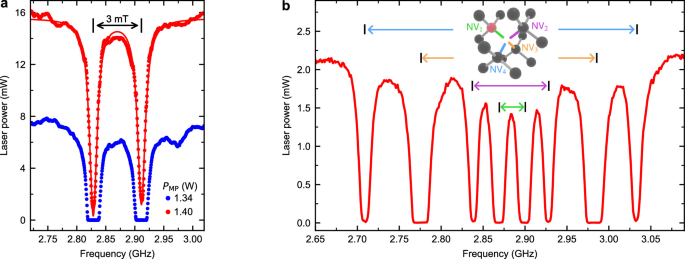
Photon counting and the sensitivity equation
What dynamic range means here
A model that couples quantum defects to a classical laser field
Why the earlier experiments matter
The unresolved noise problem
From laboratory optics to magnetic imaging
References