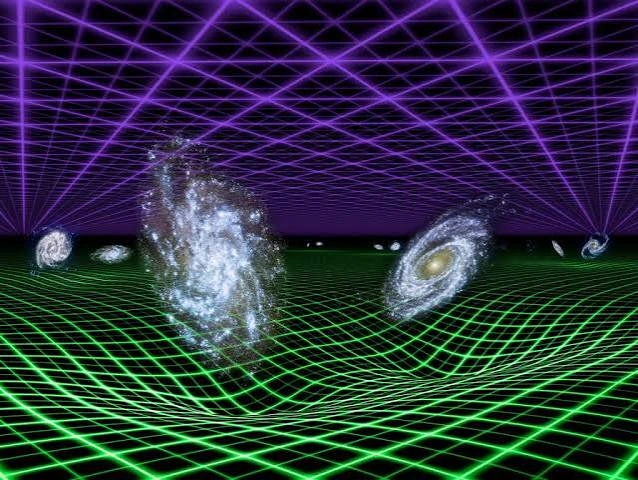

General relativity makes a radical claim about the universe: space and time are not a fixed stage on which physics happens. Their geometry responds to matter and energy, and gravitational waves are ripples of that geometry. Quantum theory makes a different radical claim: physical quantities are governed by operators, superposition and noncommuting observables. If geometry itself is a physical field, can a surface possess an exact quantum area, and could space have a state that is not even approximately smooth?
Loop Quantum Gravity (LQG) takes this possibility seriously. Rather than assuming particles propagate on a preexisting spacetime, it attempts to quantize the geometric degrees of freedom of Einstein's theory without choosing a fixed background metric. Its characteristic states are graphs whose edges carry representations of SU(2) and whose nodes carry invariant tensors. Their physical interpretation is geometric: edges contribute quanta of area, while suitable nodes encode quantum volumes. These are claims of a mathematically developed candidate theory, not observations that the universe has been shown to consist of literal wires or cubes. [1][2][4]
The theory has acquired new urgency from an old unresolved question. A finite graph can carry well-defined quantum geometry, but the real world appears to contain smooth spacetime obeying Einstein's equations across enormous ranges of scale. How do those two descriptions meet? Work published in 2026 has sharpened the mathematical problem of the continuum limit, producing both proposed constructions and constraints on which limits could reproduce gravitational dynamics. The central challenge is no longer simply to write down discrete states of space. It is to show that they become general relativity when they are viewed from far enough away. [14][15]
Why ordinary quantum field theory assumes too much
Quantum electrodynamics and the Standard Model are extremely successful because quantum excitations can be defined with respect to a specified spacetime geometry. One can use a metric to determine causal intervals, define propagators and identify the distances separating measurement locations. General relativity, however, says that the metric itself is dynamical. At high enough energies, treating geometry as an immutable background while quantizing only matter becomes conceptually inadequate.
Perturbatively expanding the Einstein–Hilbert theory about a chosen background produces a quantum field with the expected massless spin-two modes, but the gravitational coupling has negative mass dimension in four spacetime dimensions. Straightforward perturbative quantization therefore generates an infinite tower of counterterms as one pushes to higher energy, absent an additional ultraviolet mechanism. As an effective field theory, low-energy quantum gravity remains predictive. LQG's objective is different: begin with the full constrained, background-independent phase space and seek a nonperturbative quantum description. [1][4]
This action expresses a theory in which curvature R and the metric determinant are not passive parameters. Its canonical analysis leads to constraints associated with internal gauge symmetry and spacetime diffeomorphisms. Quantization is difficult partly because what counts as a measurable quantity must be invariant under those gauge transformations. A coordinate label by itself does not designate an observable location.
From the metric to a connection and an electric-like flux
Loop quantization becomes tractable after rewriting the gravitational phase space in connection variables. In the time gauge, one commonly uses an SU(2) Ashtekar–Barbero connection A and a densitized triad E. The triad encodes spatial geometry, while the connection is related to the spin connection and the extrinsic curvature of a spatial slice. The real parameter γ is the Barbero–Immirzi parameter, which influences the geometric spectra of the usual kinematical formulation. [1][17]
The configuration variable is a connection rather than a metric component. Along an oriented curve e it yields an SU(2) holonomy, obtained through a path-ordered exponential. The momentum variable, when smeared across an oriented surface, yields a flux. Working with holonomies and fluxes is what gives the loop representation its characteristic algebra of curves, surfaces and graph states.
One should not imagine these paths as microscopic cosmic strings. They are mathematical labels of quantum states of a connection. In particular, choosing a graph for a cylindrical function does not assert that a physical lattice has been installed in an otherwise empty universe. The metric emerges as a relational interpretation of the corresponding state, and the dynamics must decide which states approximate classical geometry.
A spin network is a quantum state of geometry
Select a finite graph Γ with vertices V and edges E. Assign each edge an irreducible SU(2) spin j, a half-integer, and assign each vertex an intertwiner that contracts its incident representation spaces into a gauge-invariant combination. Contracting representation matrices of all edge holonomies with those intertwiners produces a gauge-invariant spin-network wavefunction. The result is a many-body basis of quantum geometry, not a classical triangulation with fixed numerical lengths. [2][4]
The edges can carry superpositions of representation labels and the nodes can carry superpositions of intertwiners. A state of geometry can therefore have quantum uncertainty in its shape. A full physical state must also satisfy the appropriate constraints and a construction of dynamics; simply taking a labeled graph is a kinematical starting point. This matters whenever an illustration presents an elegant web of lines as though it were an experimental image of the Planck scale.
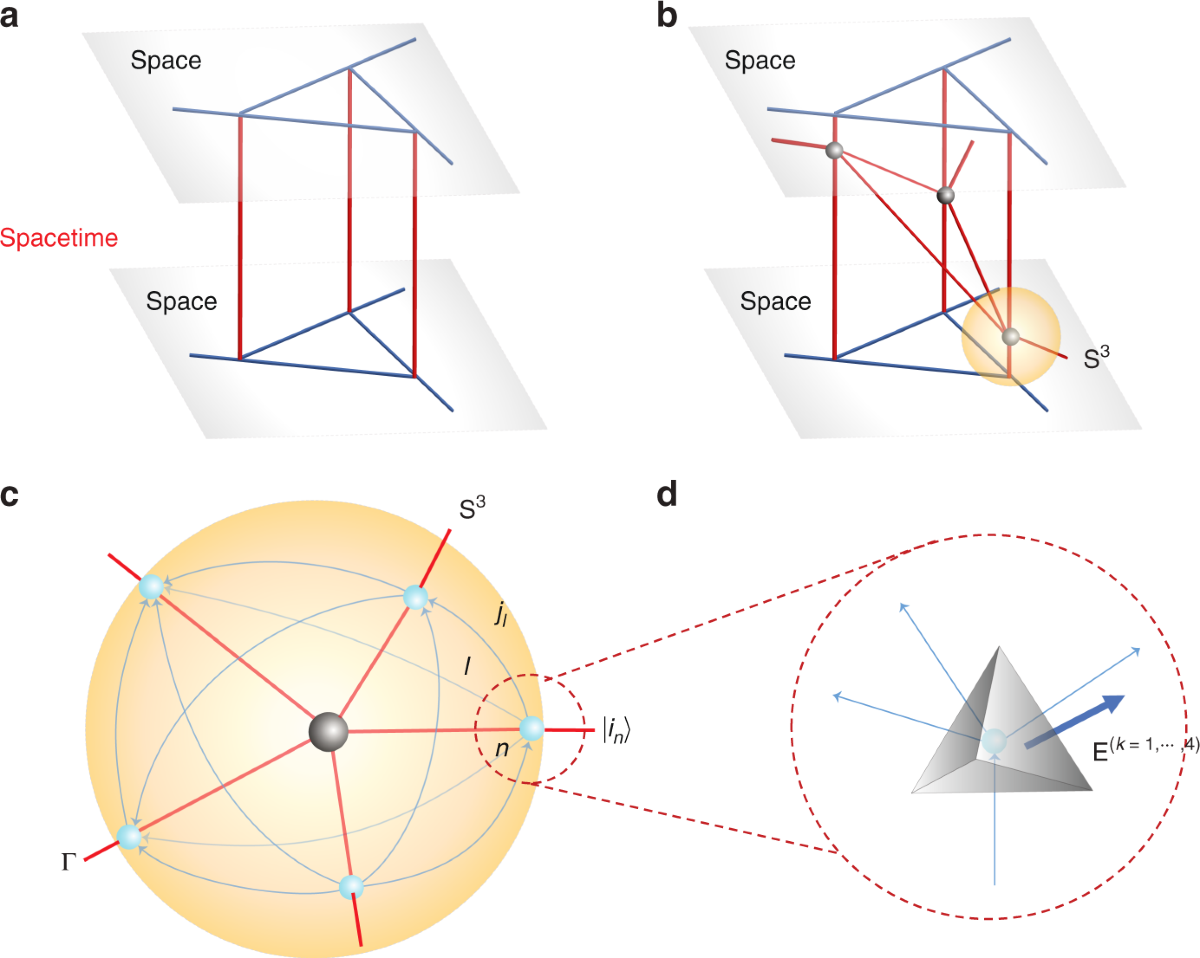
The geometric picture becomes especially concrete for four-valent nodes. In a familiar dual interpretation, one such intertwiner can be associated with a quantum tetrahedron, with angular-momentum operators describing oriented face areas. The SU(2) Gauss constraint imposes closure: the vector sum of the face fluxes vanishes. Quantum fluctuations keep different shape observables from being sharply specified simultaneously. [11]
This single equation connects group representation theory to a surprisingly tangible object. Classical polyhedra are determined, subject to suitable nondegeneracy conditions, by oriented face-area vectors satisfying closure. Quantum intertwiners are the corresponding invariant states. They provide a mathematically disciplined notion of a quantum polyhedron, while leaving open how a macroscopic smooth three-dimensional manifold arises from large collections of them.
Why area has a spectrum
In the standard kinematical construction, a surface S intersecting spin-network edges away from nodes is acted on by an area operator. Its eigenvalue depends on the spins carried by edges that puncture the surface. This is an operator-theoretic statement: distinct eigenvalues are permitted by the formalism. It does not mean that a laboratory ruler has detected a smallest measurable pixel on a surface. The definition and interpretation of fully gauge-invariant physical measurements require further work. [2][3]
The Planck length is defined by ℓP² = ℏG/c³. A single generic spin-1/2 puncture contributes 4π√3 γ ℓP² to this kinematical area spectrum, provided the simple transverse-puncture assumptions apply. More intricate intersections and the treatment of gauge constraints require care. Nor does discrete area immediately force a uniformly spaced area spectrum or a minimum spatial distance along every possible measurement direction.
Volume operators are more intricate. Their spectra are built from angular-momentum operators associated with triples of edge tangents at vertices and depend on regularization and intertwiner data. The node supplies an elementary quantum-geometric volume contribution in appropriate sectors, but there is no universal statement that every node carries the same nonzero volume. At three-valent gauge-invariant vertices, for example, the common volume operators vanish.

The Hamiltonian constraint and the problem of time
General relativity is invariant under changes of spacetime coordinates. Its canonical formulation consequently contains constraints rather than a Hamiltonian that simply advances an external clock. In canonical quantum gravity, one seeks physical states annihilated by quantized constraints. Among them the Hamiltonian constraint is technically difficult, and different proposed operators and quantization choices need not be physically equivalent. [4][5]
The absence of a preferred background time is not a declaration that nothing changes. In a generally covariant theory, evolution can be described relationally: one physical degree of freedom serves as a clock for the changing correlations of others. Defining suitable physical observables, deriving their dynamics and establishing a semiclassical interpretation remain central issues. They cannot be settled by a diagram of a spin network alone.
This also distinguishes Loop Quantum Gravity from a simple theory of atoms embedded in preexisting space. Ordinary particles move relative to a geometric arena; here the object being quantized provides the geometry itself. The concept of locality must ultimately arise from correlations and the recovery of a metric, rather than being supplied as a rigid coordinate grid.
From spin networks to spin foams
A spin network gives a candidate quantum state of a spatial slice. A spin foam describes a possible history between such boundary states. Mathematically, a foam is a two-complex with faces, edges and vertices, carrying group-theoretic labels. Its face labels generalize the spins assigned to spin-network edges; its edges inherit intertwiner information. An amplitude is assigned to the entire two-complex and, in covariant models, summed or integrated over relevant histories. [6][8]
This schematic expression suppresses boundary normalization, model-dependent face and edge weights, Lorentzian integrations and convergence questions. The EPRL family of spin-foam amplitudes implements constraints intended to connect a topological BF-type theory to four-dimensional gravitational geometry. Individual amplitudes are well-defined in important cases, but the full sum over complexes and the complete physical Hilbert space remain difficult. A spin foam is not established simply because an illustrator has drawn an evolving tangle of lines.

The local interaction in a four-simplex is a particularly important building block. A four-simplex has five tetrahedral boundary cells. Quantum tetrahedra can be glued through paired faces, and a vertex amplitude weights the quantum transition between boundary configurations. In appropriate large-spin regimes, stationary-phase calculations show connections between the amplitude and discrete Regge calculus, the classical action of gravity on a triangulated geometry. [7][8]
The asymptotic form is schematic and applies under specified nondegenerate boundary-data assumptions; orientation branches and model choices matter. Recovering an oscillatory action close to Regge calculus is an important consistency test. It does not, by itself, prove recovery of continuum Einstein equations at arbitrary scale, quantum matter propagation or a unique ultraviolet theory.
Quantum tetrahedra have been simulated in the laboratory
Quantum computers and quantum simulators offer a practical way to explore the mathematics of small spin networks and spin foams. In a 2019 Communications Physics experiment, Keren Li and colleagues used a four-qubit nuclear magnetic resonance simulator to prepare SU(2)-invariant states representing quantum tetrahedra. Reported state fidelities were above 95%, and measured angular correlations agreed with the target quantum-geometric model. The experiment also evaluated a restricted spin-foam vertex amplitude. [11]
The interpretation is narrow but valuable. NMR spin qubits were programmed to obey the same small Hilbert-space relations as the quantum-tetrahedron model. That supports the feasibility of simulating specified mathematical amplitudes. It does not show that spacetime has been directly observed to be granular, and it does not validate the entire physical theory of quantum gravity. Its claim is analogous to using one controlled quantum system to study the dynamics of another.
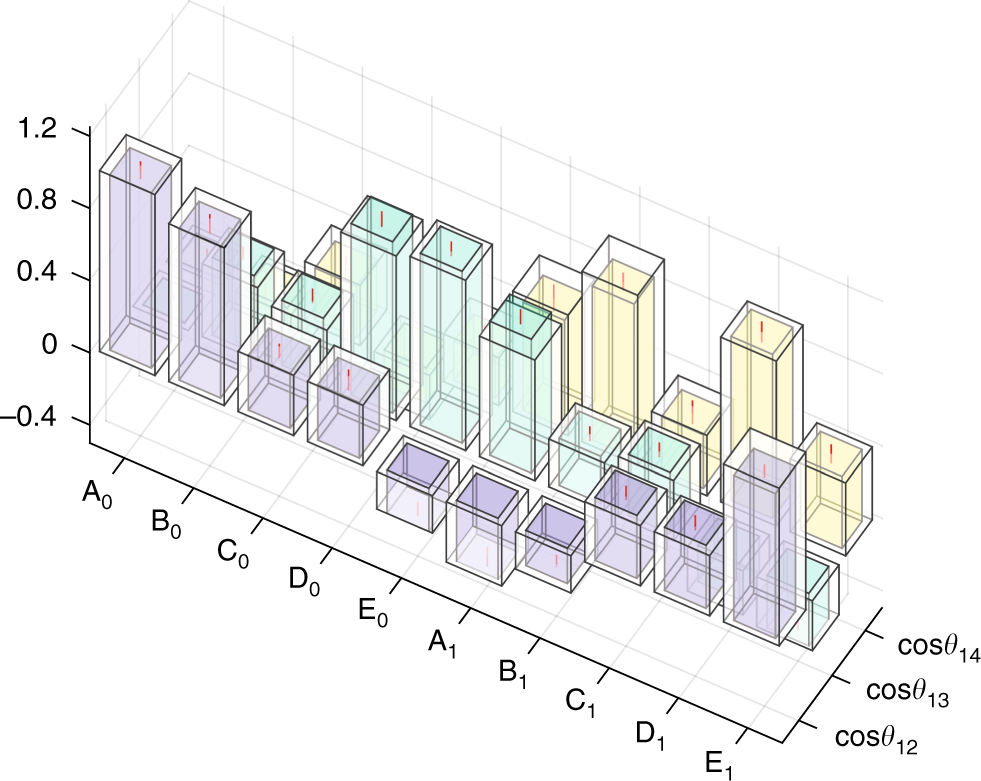
The most revealing readout was geometric rather than pictorial. Operators built from angular-momentum correlations determine the cosines of angles between the tetrahedral face normals. The research compared those values with predictions of the quantum-state model. This supplies a link between accessible Pauli measurements and a quantity that would have geometric meaning in the intended model.

A photonic chip learns the amplitude of a spacetime vertex
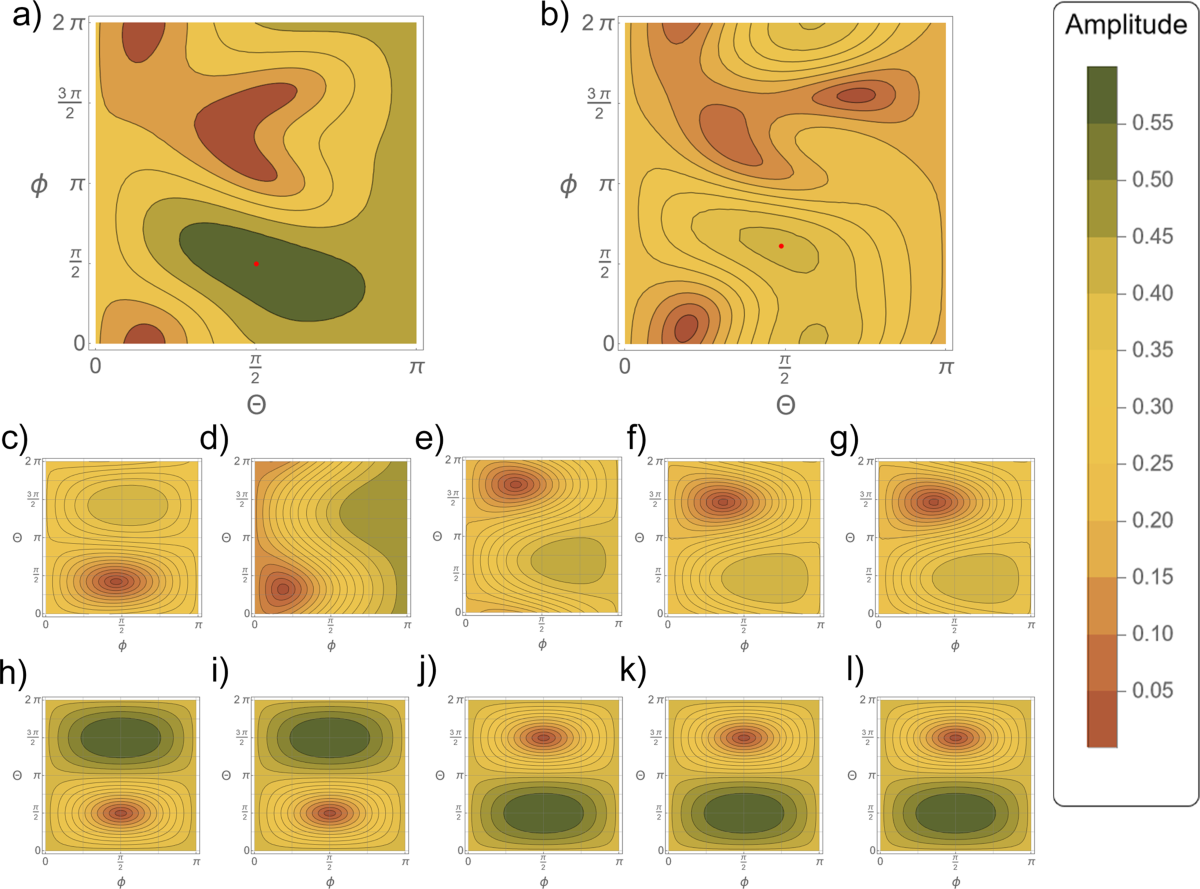
In 2023, Reinier van der Meer and collaborators programmed a silicon-nitride photonic processor to emulate a selected spin-foam vertex transition. The processor encoded a nonunitary effective map inside a larger unitary optical transformation, then reconstructed elements of that transformation and analyzed vertex-amplitude contours. For one benchmark the experimental amplitude differed from the calculated target by roughly four percent. [12]
The hardware operated on photons propagating through an integrated optical network. It was not creating a miniature region of gravitationally curved spacetime. The goal was to compute properties of a specified quantum-geometric transition by mapping its algebra onto controllable photonic degrees of freedom. The distinction matters because successful analog computation and direct experimental validation of Planck-scale physics are different scientific achievements.

The reconstructed matrix was not perfect. Amplitude and phase errors differed, and the experiment explicitly analyzed imperfect optical interference and finite characterization precision. The most useful outcome was that the shape of a selected vertex-amplitude landscape could be reproduced and compared with theory. A future processor would need to handle more vertices, summed internal spins and controlled uncertainty if it were to make predictions beyond classical simulation capabilities.
Black holes and the counting of quantum geometry
General relativity assigns a black hole an entropy proportional to its horizon area. In statistical mechanics entropy counts microscopic states compatible with coarse macroscopic data. Loop-gravity-inspired black-hole entropy calculations count horizon punctures and associated quantum-geometric configurations under particular horizon boundary conditions. These constructions can reproduce an area-law leading term with choices of counting scheme and the Immirzi parameter, while the status of universal subleading terms and physical state counting remains an active subject. [10]
This equation is the established semiclassical Bekenstein–Hawking result, not an exclusive prediction of Loop Quantum Gravity. LQG's contribution is a candidate account of microscopic geometric degrees of freedom that could underlie it. A convincing completion must explain which states are physical, why the coefficient is stable and how black-hole dynamics and information recovery fit into the same framework. Calculating an area law in a constrained model is not equivalent to resolving the entire black-hole information problem.
Does the Big Bang become a bounce?
Loop quantum cosmology (LQC) is a symmetry-reduced program that imports aspects of loop quantization into homogeneous cosmological models. In a standard spatially flat isotropic effective model, the Friedmann equation receives a density-dependent correction. The positive term familiar from general relativity is reduced at high density, and for appropriate matter a bounce replaces the classical big-bang singularity in that model. [9]
Here H is the Hubble expansion parameter and ρc is an effective critical density defined within a particular quantization. The equation is not established for general inhomogeneous gravitational collapse or all theories called LQC. Indeed, a 2026 Physical Review D analysis by Bojowald, Díaz and Duque argues that certain effective loop-cosmological constructions encounter singularities or conflicts with a consistent spacetime structure despite an apparently nonsingular background scale factor. Their critique illustrates why a bounce in an idealized model should not be advertised as an observed solution to the cosmological singularity problem. [13]
The 2026 continuum-limit controversy
One can refine a triangulation and take the number of its elements toward infinity, but doing so does not automatically restore Einstein's field equations. A viable spin-foam continuum limit must simultaneously address dependence on the chosen complex, suitable physical observables, the role of boundary states and the existence of the correct long-distance propagating degrees of freedom. This is particularly hard because a mathematically well-behaved limit may reduce to a topological theory without local gravitational waves.
In August 2026, Muxin Han reported a candidate ultraviolet fixed-point construction for covariant loop gravity, using families of spin-foam complexes and a proposed dominant small-spin configuration. The analysis concerns a controlled sector and leading-order structure, and its identification of a topological leading term invites the question of how physical four-dimensional propagating degrees of freedom arise beyond that order. It is a research proposal about the continuum problem, not independent confirmation of a completed continuum theory. [14]
A September 2026 study by Dittrich, Colaço, Mele and Rovelli formulated the continuum question through an axiomatic framework for triangulated manifolds and amplitudes. Under sufficiently strong convergence assumptions they derived an obstruction: the limiting amplitude becomes topological. They explored weaker, distributional limiting prescriptions and connections to a physical Hilbert-space rigging map. This is valuable precisely because it rules out some tempting shortcuts and makes the necessary assumptions explicit. [15]
A further April 2026 analysis investigated summation and triangulation independence within a particular large-spin or localization regime. That work provides a constructive example of reducing bulk triangulation dependence in a controlled limit. These studies are not interchangeable claims, because their amplitudes, assumptions and limiting procedures differ. Their shared scientific message is that the continuum limit is a calculation to be demonstrated, not a slogan attached to discrete quantum geometry. [16]
What would count as evidence?
The strongest direct result in the canonical approach is the mathematically defined kinematical geometry, including area and volume operators. A stronger physical claim would identify gauge-invariant relational observables, compute the semiclassical dynamics of appropriate states and recover general relativity plus familiar quantum field theory in a clear domain of validity. A still stronger claim would yield a distinctive, testable prediction separating LQG from other quantum-gravity descriptions.
Proposed signatures have included modifications of early-universe evolution, quantum geometry near horizons and possible dispersion or correlation effects at extreme energies. Each faces serious ambiguities from model dependence and the extraordinary smallness of Planck-scale corrections. No generally accepted observation has yet demonstrated a discrete LQG area spectrum or established a particular spin-foam theory as the correct description of our universe. Optical and NMR simulation experiments, although sophisticated, do not change that empirical status.
The right comparison with other quantum-gravity programs also avoids false oppositions. Theoretical physics includes string-theoretic, causal-set, asymptotic-safety, tensor-network and other approaches whose notions of microscopic structure differ. Their partial results address different consistency tests. No single attractive picture of a cosmic mesh can substitute for recovering known physics and proposing a falsifiable, quantitative deviation.
Geometry without a stage
Loop Quantum Gravity is compelling because it turns Einstein's dynamical geometry into the object of a quantum description, rather than treating geometry as a silent host for quantum matter. Its spin networks are states in a precise representation-theoretic Hilbert space; its area spectra are operator results; its spin foams are candidate amplitudes for the histories of quantum geometry. These are substantive achievements, and their mathematical limits are as important as their visual appeal.
The unresolved question is whether the connected, fluctuating quanta of geometry can produce the smooth spacetime of actual gravitational experiments. The 2026 continuum-limit results make that problem sharper rather than eliminating it. If the approach succeeds, space will not have been revealed as a secret lattice drawn on an existing background. The geometry that gives distances and angles their meaning will have acquired a quantum description of its own.
References
[1] Ashtekar, A. and Lewandowski, J. (2004), Background independent quantum gravity: A status report. https://doi.org/10.1088/0264-9381/21/15/R01.
[2] Rovelli, C. and Smolin, L. (1995), Spin networks and quantum gravity. https://doi.org/10.1103/PhysRevD.52.5743.
[3] Rovelli, C. and Smolin, L. (1995), Discreteness of area and volume in quantum gravity. https://doi.org/10.1016/0550-3213(95)00150-Q.
[4] Rovelli, C. (2008), Loop Quantum Gravity. https://doi.org/10.12942/lrr-2008-5.
[5] Thiemann, T. (2007), Modern Canonical Quantum General Relativity. https://doi.org/10.1017/CBO9780511755682.
[6] Engle, J., Pereira, R. and Rovelli, C. (2007), The loop-quantum-gravity vertex amplitude. https://doi.org/10.1103/PhysRevLett.99.161301.
[7] Barrett, J. W. et al. (2009), Asymptotic analysis of the EPRL four-simplex amplitude. https://doi.org/10.1063/1.3244218.
[8] Perez, A. (2013), The Spin-Foam Approach to Quantum Gravity. https://doi.org/10.12942/lrr-2013-3.
[9] Ashtekar, A., Pawlowski, T. and Singh, P. (2006), Quantum Nature of the Big Bang. https://doi.org/10.1103/PhysRevLett.96.141301.
[10] Ashtekar, A., Baez, J., Corichi, A. and Krasnov, K. (1998), Quantum Geometry and Black Hole Entropy. https://doi.org/10.1103/PhysRevLett.80.904.
[11] Li, K. et al. (2019), Quantum spacetime on a quantum simulator. https://doi.org/10.1038/s42005-019-0218-5.
[12] van der Meer, R. et al. (2023), Experimental simulation of loop quantum gravity on a photonic chip. https://doi.org/10.1038/s41534-023-00702-y.
[13] Bojowald, M., Díaz, M. and Duque, E. (2026), Singularities in loop quantum cosmology. https://doi.org/10.1103/7g3z-2pgf.
[14] Han, M. (2026), Ultraviolet fixed point in covariant loop quantum gravity. https://doi.org/10.1103/d8s7-jqfl.
[15] Dittrich, B., Colaço, E., Mele, F. and Rovelli, C. (2026), Structure of the continuum limit of spin foams. https://doi.org/10.1103/7493-9nb7.
[16] Han, M. (2026), Summation and triangulation independence of Lorentzian spinfoam amplitudes for all LQG. https://doi.org/10.1103/n76f-31gf.
[17] Barbero, J. F. (1995), Real Ashtekar variables for Lorentzian signature space times. https://doi.org/10.1103/PhysRevD.51.5507.