
When a qubit gate stops being a two-level problem
A superconducting qubit is not literally a spin- particle. Its logical states are selected from a ladder of circuit eigenstates, and the same microwave field that rotates the logical qubit can populate the higher levels. For sufficiently gentle driving, those additional states are far enough off resonance to remain almost irrelevant. The difficulty changes qualitatively when the pulse becomes so short that its spectral bandwidth and effective Rabi rate are no longer small compared with the device's anharmonicity. The computational subspace is then only an approximation to the system actually being controlled.
A study by Y. Gao and colleagues, published in Nature Communications on 23 October 2026, demonstrates single-qubit and gates lasting 6.8 nanoseconds, with measured gate fidelities above 99.98% and total leakage consistently below at that duration. Its central advance is a control waveform designed to suppress not only the familiar leakage channel but also higher-order, multiphoton pathways that become appreciable under strong driving [1]. The same experiment introduces a measurement sequence that amplifies coherent leakage so that errors near one part in a million become resolvable.
The physical lesson is more specific than the general observation that shaped pulses improve quantum gates. The frequency content of the square of a microwave envelope can excite transitions that are nearly invisible when one examines only the ordinary Fourier spectrum of that envelope. Preventing those processes requires control over the effective dressed-state Hamiltonian, rather than merely reducing spectral weight at one adjacent-level transition.
The transmon spectrum and its finite anharmonicity
A transmon is a weakly anharmonic superconducting oscillator. In a common approximation its stationary Hamiltonian is , where is negative for the usual transmon. The qubit states and are the lowest two eigenstates, but the operator through which the microwave field couples to the circuit also connects neighboring excited levels. Their matrix elements grow approximately as in the oscillator limit [2,3].
The device used in the 2026 experiment has a qubit transition frequency GHz and an anharmonicity MHz. That detuning is large enough for ordinary gates to discriminate from , but not so large that one can arbitrarily increase the drive without consequences. A 6.8 ns pulse spans a time scale comparable to the inverse of hundreds of megahertz, precisely where the higher-level structure becomes important [1].
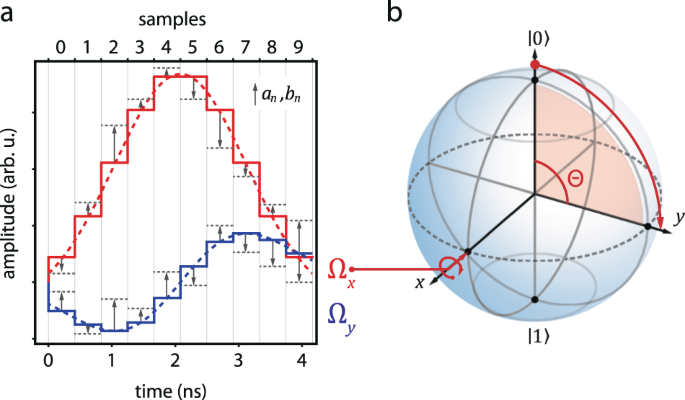
In a frame rotating at the microwave frequency, a useful multilevel Hamiltonian is with , complex envelope , and relative coupling . The and quadratures are not independent decorations on a pulse: together they determine which unwanted transition amplitudes interfere destructively.

How strong driving reveals hidden transitions
Nearest-neighbor coupling does not mean that a strongly driven multilevel system has only nearest-neighbor effective transitions. A Schrieffer–Wolff transformation perturbatively eliminates off-resonant admixtures, leaving higher-order terms in the dressed basis. Among them are effective couplings between and , and between and , proportional to at the relevant order. These are two-photon processes in the control field, not violations of the microscopic selection rules. Their effective matrix elements arise from virtual intermediate states [1,4].
The distinction matters for waveform design. A notch in , the Fourier transform of the complex drive envelope, suppresses a directly driven one-photon transition at a chosen detuning. It need not suppress a process governed by . The spectrum of a squared envelope is a convolution of the envelope spectrum with itself; it can contain substantial weight where the original spectrum is small. Consequently, a control pulse can appear well behaved in a conventional single-photon leakage analysis while still producing coherent population in or .
The experiment identifies these effective pathways by analyzing the transformed Hamiltonian and by measuring leakage separately into higher levels. This is why its result should not be interpreted as an unusually successful fit of a standard two-level pulse model. The measured error channels directly motivate the extra spectral constraints imposed on the control waveform.
The derivative pulse that established the baseline
Derivative Removal by Adiabatic Gate, usually abbreviated DRAG, is an established method for reducing leakage in weakly anharmonic qubits [4]. It adds a quadrature proportional to the time derivative of the principal envelope. Schematically, , with the sign depending on the rotating-frame convention. In the frequency domain, differentiation multiplies a signal by . An appropriately scaled derivative therefore cancels the field's response at a selected detuning while preserving the desired pulse area to leading order.
DRAG has been experimentally important because its control law is compact and interpretable. But its familiar first-order form addresses the leading adjacent-level channel; it does not automatically cancel the two-photon terms generated by a strong drive. Earlier experiments also explored piecewise-constant optimal control. Werninghaus and colleagues, for example, demonstrated that closed-loop waveform optimization could outperform analytic DRAG for very short transmon gates, while finding that experimental electronics and noise imposed their own fidelity limits [5].
The new work retains the derivative principle but extends the target. Rather than introducing an arbitrary high-dimensional waveform, it imposes analytically motivated constraints on the nonlinear control quantity . This makes the resulting pulse more structured than an unconstrained numerical search, although the actual hardware still requires calibration.

Removing two-photon spectral weight
The proposed double-recursive DRAG construction, called R2D, begins with a smooth trial envelope . Its central prescription is The coefficients and tune suppression of effective two-photon transitions associated with the and channels. A further first-derivative quadrature, , suppresses the ordinary pathway [1].
To see the spectral logic, Fourier transformation of the first equation yields Each parenthesis can create a spectral zero at a targeted effective transition frequency. The appearance of is the signature of a second derivative, and the factor of nine reflects the frequency scale of the higher transition in the authors' chosen perturbative construction. It is not a claim that every physical transmon has exactly harmonic higher-level spacings.
The square-root reconstruction of requires the corrected squared envelope to remain nonnegative over the pulse. The paper reports that below 6.6 ns the procedure becomes difficult to optimize stably because negative values can appear in the constructed . This is an actual domain of applicability for the particular pulse family, not a fundamental quantum speed limit. The three coefficients are calibrated in situ rather than assumed to equal their ideal perturbative values.
Smoothness, spectral bandwidth and the microwave line
The experiment uses a smooth envelope within its nominal pulse window, followed by a one-nanosecond padding interval to accommodate residual distortions. Smooth turn-on and turn-off are essential because a discontinuity in a waveform or its low-order derivatives introduces broad spectral tails that can defeat a carefully engineered notch. The square-envelope construction requires sufficient differentiability to apply its nested derivatives without generating singular endpoints [1].
A notch calculated at the output of an arbitrary waveform generator is not necessarily a notch at the qubit. Coaxial lines, mixers, filters, impedance mismatches and finite sampling can reshape both quadratures. A useful calibration sequence therefore measures amplitude and phase errors independently before optimizing the leakage parameters. The 2026 work combines amplified phase-error and amplitude-error measurements with a leakage-sensitive cost function and a low-dimensional Nelder–Mead search.
This separation of calibration tasks is important. The pulse amplitude determines the desired rotation, the phase or detuning compensates coherent phase shifts, and the three derivative coefficients suppress particular leakage pathways. A single scalar fidelity would obscure which physical correction was responsible for improvement. The resulting control is analytical in its structure but experimentally adapted to the actual transfer function of the hardware.
Measuring leakage too small for ordinary inspection
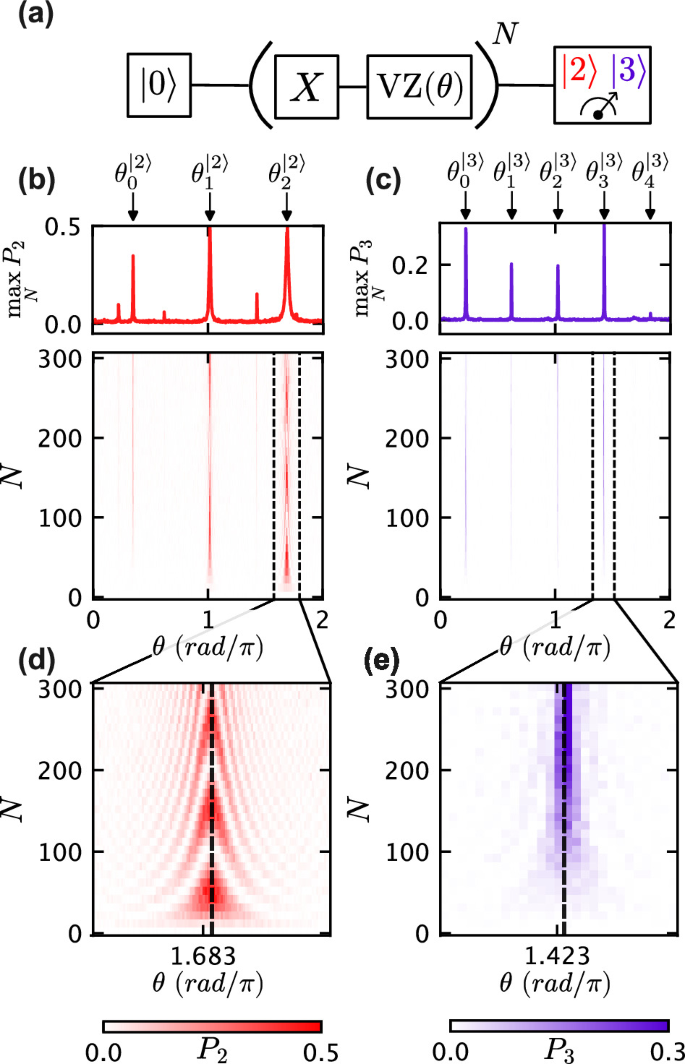
A gate that leaks population at the level of cannot be characterized reliably by measuring a single pulse once. State preparation and measurement errors are typically much larger than that, and incoherent averaging can bury coherent leakage oscillations. Gao and colleagues introduce amplified leakage error, or ALE, in which the target gate is repeated with a virtual rotation chosen to align the phase of the unwanted transition from cycle to cycle [1].
In a simplified picture, if a single gate produces a small leakage amplitude , a phase-matched sequence of gates can accumulate an amplitude proportional to , giving a population that initially grows approximately as . Randomly phased errors do not exhibit the same coherent enhancement. The exact experiment uses the resulting oscillatory dependence on repetition count and virtual- angle to extract leakage rates. For leakage into , the authors derive the phase condition ; analogous leakage produces five distinct phase-matching conditions.
The observed threefold and fivefold phase structures are not arbitrary fitting choices. They distinguish which higher level is being populated. The method amplifies coherent control leakage while being less sensitive to incoherent thermal population and some transitions between already-leaked states. ALE therefore complements rather than replaces conventional leakage randomized benchmarking. Its main contribution is a sensitive, channel-resolved diagnostic that makes the pulse-shaping optimization experimentally tractable.
What randomized benchmarking measures
Randomized benchmarking estimates the decay of gate performance over sequences of randomized operations. Interleaved RB compares sequences with and without a target gate to infer an error associated with that gate, subject to the method's assumptions. Leakage randomized benchmarking extends this analysis by tracking population outside the computational subspace; purity randomized benchmarking provides a complementary estimate of incoherent error. The 2026 study uses all three, along with ALE, because a single average fidelity cannot say whether an error is coherent misrotation, decoherence or irreversible leakage [1,6,7].
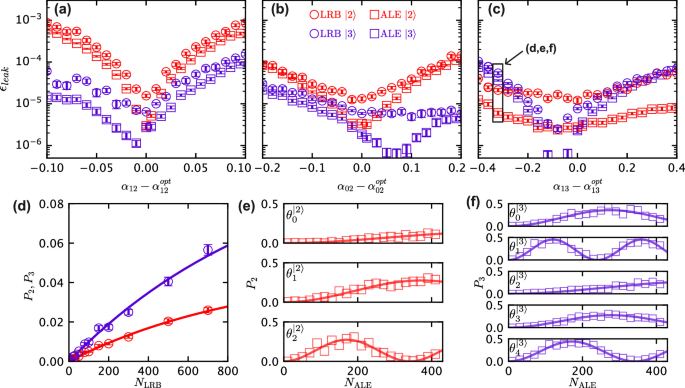
For a 7 ns gate, the researchers vary the three R2D coefficients around their calibrated optimum, . ALE and leakage randomized benchmarking identify similar optimum settings, while the former shows much larger coherent oscillations over shorter sequences. As the parameters move away from their optimum, leakage can increase by nearly two orders of magnitude. This is strong evidence that the derivative coefficients suppress physically identifiable transitions rather than simply altering the final population through an unrelated fit.
At the lowest leakage rates, ALE and randomized benchmarking do not agree perfectly. Their sensitivities to coherent and incoherent processes differ, so identical numerical estimates should not be expected. The important consistency check is that the independent methods identify the same parameter region in which unwanted transitions are minimized.
The 6.8-nanosecond error budget
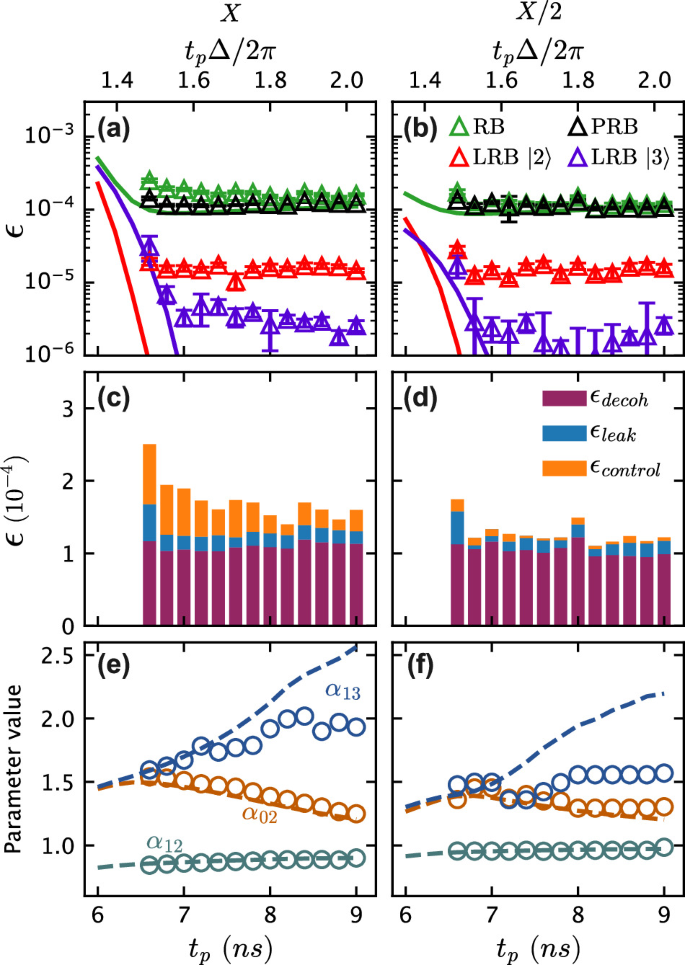
The most relevant headline is a pair of measured gate errors at ns: and . These correspond to gate fidelities of approximately 99.981% and 99.989%, respectively, using the reported error convention. Total leakage remains below at that duration. The normalized drive strength reaches , where treating the higher-level pathways as negligible would be difficult to justify [1].
The experiment tests pulse lengths between 6.6 and 9 ns. At 6.6 ns, leakage into becomes a dominant concern, consistent with the growing influence of the strongest drive components. For the 6.8 ns gates, the authors' decomposition assigns much of the error to decoherence, around , with residual leakage and coherent control errors contributing the remainder. These are estimates obtained by combining benchmarking protocols and a model, rather than three independently observed error probabilities that can be added without assumptions.
A comparison with conventional single-derivative DRAG shows a leakage reduction exceeding a factor of twenty in the reported regime. This relative result is especially informative: the new pulse is not merely fast on a high-quality qubit; it outperforms the established correction when higher-order leakage becomes important. It does not follow that all gate operations in a many-qubit processor would attain the same error budget, because spectator couplings, crosstalk and two-qubit interactions change the effective Hamiltonian.
What earlier control experiments established
The present experiment sits within a longer development of leakage suppression. Motzoi and colleagues introduced derivative-based control for weakly nonlinear qubits, demonstrating how a carefully chosen quadrature can cancel an off-resonant transition [4]. Werninghaus and colleagues later used experimentally optimized piecewise-constant controls to improve short transmon gates, showing that pulse shapes beyond first-order DRAG could provide a practical benefit [5]. Subsequent work on analytical envelopes and multiphoton suppression made it possible to identify more specific spectral constraints [8,9].
The difference between these strategies is not that one uses mathematics and the others use experiments. All require a physical model and experimental calibration. The distinctive contribution of R2D is its explicit targeting of two-photon terms in the dressed Hamiltonian while retaining only three principal leakage parameters. That economy matters for calibration throughput: the dimensionality of the search space grows rapidly when a waveform is represented by dozens of independently tunable samples.
There is also a metrological distinction. An optimizer can report improved randomized-benchmarking fidelity without proving that a particular leakage mechanism was suppressed. ALE supplies evidence for the channel assignment by showing phase-matched oscillations separately for leakage into and . Together, the control law and diagnostic make a more convincing physical case than either would alone.

Why leakage is more dangerous than a small rotation error
A coherent overrotation generally remains within the two-dimensional computational space. It can be modeled as a slightly incorrect unitary and, in some circumstances, compensated or randomized into a more tractable effective error channel. Leakage instead removes amplitude from that space. A leaked transmon can persist in or higher levels while subsequent gates and measurements assume only and . This can produce correlated errors across later operations, including quantum error-correction cycles [10].
If a circuit applies independent gates with small leakage probability , a crude first-order estimate of the probability of at least one leakage event is . Real leakage is neither perfectly independent nor automatically removed after each operation, so this expression is not a full logical-error model. Its significance is that even very small per-gate leakage can accumulate in long computations. The relevant engineering quantity is the balance among leakage creation, leakage transport, relaxation and active removal.
Reducing the leakage of a fast gate has a second possible benefit: a shorter pulse spends less time exposed to dephasing and energy relaxation. But faster control does not necessarily reduce total processor error if it increases microwave crosstalk or control-line distortion. The 2026 demonstration isolates an important component of this tradeoff; it does not replace full-cycle benchmarking of an error-corrected architecture.
The remaining physical limits
The demonstrated 6.8 ns gates are single-qubit operations on an isolated transmon at a favorable operating point. They are not a complete demonstration of scalable fault-tolerant computation. The study identifies several limits that remain relevant even after multiphoton leakage is suppressed: energy relaxation, dephasing, microwave distortion, parameter drift, residual coherent control errors and the stability of the pulse reconstruction at still shorter durations. Two-qubit gates bring additional dressed levels and spectator couplings that require their own effective Hamiltonians [1,3,11].
A useful extension would measure the R2D response while neighboring qubits are actively driven, rather than only in isolation. The resulting Hamiltonian would include conditional frequency shifts and additional avoided crossings; notches optimized for one local spectrum might move when the device is embedded in a processor. Another experiment would compare the rate of leakage generation and the lifetime of leaked population across repeated stabilizer cycles. That measurement would connect the single-gate advance to logical performance without assuming that a reduction in isolated leakage translates linearly into fewer logical failures.
The larger result is that a transmon's multilevel structure need not be treated only as an obstacle. It provides a precise account of which virtual pathways strong driving activates and which waveform derivatives can suppress them. In this regime, high-fidelity control is achieved not by pretending that the qubit has only two levels, but by engineering the spectral response of the additional levels that are actually present.
References
- Y. Gao, A. Galicia, J. D. Da Costa Jesus et al., “Ultrafast single-qubit gates through multi-photon transition removal,” Nature Communications 17, 10874 (2026). DOI.
- J. Koch et al., “Charge-insensitive qubit designed for circuit QED,” Physical Review A 76, 042319 (2007). DOI.
- P. Krantz et al., “A quantum engineer's guide to superconducting qubits,” Applied Physics Reviews 6, 021318 (2019). DOI.
- F. Motzoi, J. M. Gambetta, P. Rebentrost and F. K. Wilhelm, “Simple pulses for elimination of leakage in weakly nonlinear qubits,” Physical Review Letters 103, 110501 (2009). DOI.
- M. Werninghaus, D. J. Egger, F. Roy et al., “Leakage reduction in fast superconducting qubit gates via optimal control,” npj Quantum Information 7, 14 (2021). DOI.
- C. J. Wood and J. M. Gambetta, “Quantification and characterization of leakage errors,” Physical Review A 97, 032306 (2018). DOI.
- E. Magesan, J. M. Gambetta and J. Emerson, “Scalable and robust randomized benchmarking of quantum processes,” Physical Review Letters 106, 180504 (2011). DOI.
- E. Hyyppä et al., “Reducing leakage of single-qubit gates for superconducting quantum processors using analytical control pulse envelopes,” PRX Quantum 5, 030353 (2024). DOI.
- J. D. Da Costa Jesus et al., “Analytical blueprint for 99.999% fidelity X-gates on present superconducting hardware under strong driving,” PRX Quantum 7 (2026). DOI.
- M. McEwen et al., “Removing leakage-induced correlated errors in superconducting quantum error correction,” Nature Communications 12 (2021). DOI.
- Z. Chen et al., “Measuring and suppressing quantum state leakage in a superconducting qubit,” Physical Review Letters 116, 020501 (2016). DOI.