

Why does a two-dimensional sea of electrons retain an extraordinarily specific quantum order when the particles interact, the system grows, and the environment is imperfect? Two manuscripts in OpenAI's October 2026 mathematics release claim a major answer for the Laughlin state: a spectral gap that remains open in the large-system limit, followed by stability under a class of weak disorder. The distinction between an elegant trial wavefunction and a rigorously protected phase is the heart of the story.
In a strong magnetic field, electrons confined to a plane begin to behave in ways that defy the ordinary picture of independent charges. The electrical response can organize into plateaus at fractional values of the natural conductance unit, quasiparticles can carry fractions of an electron's charge, and the exchange of two excitations can imprint a phase other than the familiar bosonic or fermionic alternatives. These are the signatures of the fractional quantum Hall effect. At first sight the subject might seem remote from questions about the reliability of information. Yet a fractional quantum Hall fluid is an exceptionally sharp example of collective protection: its characteristic organization is encoded in correlations among many particles, and its low-energy excitations obey rules unavailable to isolated electrons. [1][2]
Robert Laughlin proposed a remarkably compact wavefunction in 1983 to explain the state near filling fraction . The wavefunction captured correlations, fractional charge, and the incompressibility of the electron liquid. It has since become a cornerstone of topological quantum matter. But a famous mathematical difficulty survived its enormous physical success. For an idealized interaction that selects the Laughlin state as an exact ground state, can one prove that the first excited state stays a definite energy above it as the number of electrons increases? A finite computer calculation can establish a gap for a particular small system. A robust thermodynamic statement must control arbitrarily large systems with a bound that does not silently shrink to zero. [2][3]
That is the challenge addressed in family 269 of OpenAI's October 2026 mathematical-manuscript collection. One manuscript presents a purported uniform spectral-gap proof for the spherical fermionic Laughlin parent Hamiltonian. A companion then claims that the unique ground state and a uniform gap survive sufficiently weak, bounded scalar one-body disorder after projection to the lowest Landau level. The repository provides Lean formalization for selected unperturbed inequalities but explicitly says the full stability argument lies outside that particular formalization. These are consequential research claims, not yet equivalent to broad independent mathematical certification of every step. [4][5][6]
How a magnetic field reorganizes an electron sea
Consider electrons in a two-dimensional layer perpendicular to a magnetic field . Classically, the Lorentz force bends their motion into cyclotron orbits. Quantum mechanically, those orbits become Landau levels: macroscopically degenerate collections of single-particle states separated by a cyclotron energy. The number of available orbitals in a level is determined by magnetic flux, so the ratio of electrons to orbital states becomes a useful measure of filling. In a conventional integer quantum Hall state, electrons completely fill an integer number of Landau levels. In the fractional regime, the partially filled level becomes the arena for strong correlations that no independent-electron filling picture can reproduce. [1]
Here is the electron number, counts flux quanta in the planar thermodynamic description, and is the magnetic length. The formulas assume the usual electron charge magnitude and ignore spin or valley degeneracies for clarity. The magnetic length sets the scale over which the single-particle orbitals spread, while the fraction determines the number of electrons available to occupy those orbitals. At , interactions cannot be treated as a minor correction to a filled band: the many-body ground state is essential.
An electron does not literally divide into three independently existing pieces. The fractional quasiparticles of a Laughlin phase are collective excitations of the correlated state. Their charge is measured relative to the incompressible background, and their braiding statistics arise from how the many-body wavefunction changes during adiabatic exchange. These properties depend on the organized phase of the fluid, not on a hypothetical fractional constituent hidden inside an electron. The role of the energy gap is to separate the low-energy sector in which this description makes sense from the continuum of ordinary excited configurations. [2][7]

The wavefunction that turned repulsion into order
The Laughlin state is most transparent in complex coordinates for particles in the lowest Landau level. At filling with odd positive integer for spin-polarized fermions, its planar form contains a product over every pair of electrons. That factor forces the amplitude to vanish as two particles approach the same position. The wavefunction thereby creates an exceptionally efficient pattern of correlation holes: each electron avoids the positions of the others, reducing the cost of short-range repulsion while remaining entirely antisymmetric. [2]
The Jastrow factor changes sign when two electrons are exchanged if is odd, as required for fermions. Its power also forbids close pairs with certain low relative angular momenta. The Gaussian factor confines the holomorphic polynomial to the lowest Landau level in symmetric gauge. The normalization depends on the system size and geometry. None of this requires pretending that the Laughlin state is the exact ground state of every realistic two-dimensional electron Hamiltonian: it is an exact zero-energy ground state of a particular positive pseudopotential parent interaction, and an extraordinarily successful description of a broad physical phase.
The distinction between a wavefunction that minimizes energy and a phase whose gap is rigorously known is subtle but decisive. A local positive interaction can annihilate a proposed state and certify its ground-state energy. It does not automatically establish that every orthogonal state costs at least some size-independent positive energy. A family of systems can have a unique ground state at every finite size while its excitation gap approaches zero when the system grows. Many celebrated quantum states are physically believed to be gapped on the strength of numerical spectra, effective field theory, and experiment, yet proving this directly from their microscopic Hamiltonians is a different mathematical achievement. [3][4]
What the spectral-gap conjecture actually asks
Haldane's pseudopotentials isolate the relative-angular-momentum sectors of pairs of electrons in a Landau level. For the fermionic Laughlin state, a parent Hamiltonian can be built from a positive operator penalizing pairs with relative angular momentum one. On a sphere, the electron orbitals are sections of a magnetic monopole bundle; a convenient flux convention for the state is
The projectors select the forbidden pair channel, and the coefficient of each projector has been set to one. This fixes the energy normalization of the mathematical theorem. The sphere is important: it is compact, does not introduce physical edges, and allows the ground state to be studied as particle number and flux increase together. A spectral gap in these units is not an experimentally measured number of kelvins or electronvolts; converting to physical units requires the actual interaction scales of a device. [3][4]
Let be the ground-state energy, and the lowest energy above the ground-state subspace. The uniform-gap question is whether the many-electron sequence satisfies
One of the October manuscripts claims an especially concrete estimate: in the unit-coefficient spherical model, the positive spectral gap is at least for all sufficiently large particle numbers. A strengthened Fock-space statement bounds the square of the Hamiltonian below by a positive multiple of the Hamiltonian, uniformly in the relevant large-flux regime. The mechanism is mathematically concise: if a positive eigenvalue obeys , then . Applied to a positive-semidefinite Hamiltonian with a known zero-energy ground space, such an inequality rules out arbitrarily small positive excitation energies. [4]
The linked Lean documentation describes a selected unperturbed Fock-space inequality and the resulting gap bound; it does not mean that every analytic or physical consequence discussed alongside the work has been kernel-checked. The repository also warns that its manuscripts are at different stages of verification and that some unformalized arguments could contain errors. For a high-profile mathematical conjecture, responsible coverage should therefore distinguish the reported theorem, the exact statement encoded in Lean, and independent expert assessment. [4][5][6]
Why disorder stability is a stronger claim
A beautiful idealized ground state can be fragile under perturbations. Real devices contain charged impurities, imperfect interfaces, fluctuating gates, and spatially variable electrostatic potentials. In the fractional quantum Hall regime, some disorder is unavoidable and may even help localize quasiparticles so that quantized transport plateaus appear. But one still wants the underlying bulk topological phase to remain distinguishable from a gapless or competing state. The companion October manuscript addresses the mathematically sharper statement that a gap survives a broad class of small scalar potentials when the interaction is restricted to the lowest Landau level. [5]
Schematically, the perturbation takes the form
where is a bounded real one-body potential, sets its strength, and projects to the lowest Landau level. The challenge is not solved by noticing that is small pointwise. The sum contains one-body contributions, so a naive global operator-norm bound grows with particle number. A perturbation argument that only says “take smaller than ” would fail to establish a disorder threshold uniform in the thermodynamic limit. [5]
The companion manuscript claims a fixed positive disorder threshold, independent of sufficiently large particle number and of the normalized bounded potential profile, together with persistence of the unique ground state and a uniform gap. These are claims for the specified projected model on expanding round spheres. They do not assert robustness against arbitrarily strong disorder, generic Landau-level mixing, every disorder distribution with unbounded tails, or the full collection of real semiconductor effects. The selected Lean comparator statement specifically excludes the disorder-stability proof; it certifies an unperturbed inequality used as input to that broader argument. [5][6]
The topology behind the energy gap
Why does a gap matter so much beyond the algebra of the Hamiltonian? At low energies, a gapped topological phase can suppress unwanted transitions and support a sharply defined class of excitations. The fractional Hall response is a transport signature. The quasihole excitations of the Laughlin state carry fractional electric charge, and their adiabatic exchange produces an Abelian statistical phase. In the canonical case, the exchange phase is (with the appropriate orientation and sign convention). These are properties of the topological phase rather than properties visible in a single-electron orbital. [2][7]
The simplest Laughlin anyons are Abelian: exchanging or winding them supplies a phase. That can provide topologically meaningful interference phenomena, but Abelian braiding alone does not form a universal set of topological quantum gates. Non-Abelian excitations, often discussed in connection with other fractional Hall states, require a richer degenerate fusion space and different mathematics. It is tempting to translate “proven gap” directly into “ready-made fault-tolerant quantum computer,” but that skips crucial challenges: manipulating quasiparticles, reading their states, controlling edges and contacts, and implementing a computationally universal gate set. [7][8]
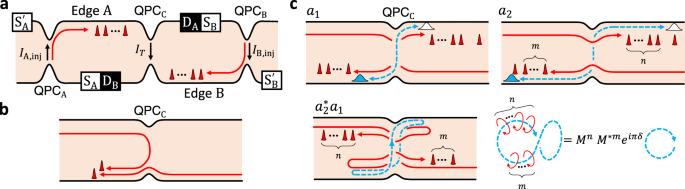
A gap is not a promise that nothing can ever happen
A spectral gap is an energy separation in a specified Hamiltonian. It does not mean that no excitations can be thermally created at finite temperature, that a sample cannot contain unwanted quasiparticles, or that a quantum Hall system is immune to every disturbance. Real experiments have edges, contacts, finite-size effects, phonons, spatial inhomogeneity, and an electromagnetic environment. As a consequence, transport plateaus and coherent quasiparticle manipulation depend on both bulk topological physics and the actual operating conditions. The most meaningful interpretation of a uniform microscopic gap is that one important obstacle to stability has been mathematically controlled in a well-defined idealized family of systems.
The 2024 experiment on Bernal-stacked trilayer graphene, for example, reports tunable fractional states with both even and odd denominator filling factors; competing phases change when the magnetic field and displacement field are adjusted. That is experimentally rich physics, and it does not contradict the idealized Laughlin parent Hamiltonian's predicted spectral rigidity. Real quantum Hall materials sample a far larger space of interactions, competing symmetry-breaking tendencies, and Landau-level structures than the minimal model. [9]

How mathematical proof changes the physics conversation
Physicists have long trusted the Laughlin state for good reasons. It explains crucial observations, matches numerical calculations, and fits into a well-developed theory of topological order and effective Chern–Simons dynamics. A rigorous uniform bound would nevertheless change the logical status of a central statement. Instead of saying that the gap is strongly expected and extensively supported, one could derive it from a precisely defined parent Hamiltonian. That matters for subsequent theorems about stability, correlation decay, and limits in which a many-body state grows without losing its organizing scale. [3][4]
It is equally important not to confuse the proof's scope with a broader claim that every fractional quantum Hall state has now been mathematically explained. The gap problem for the fermionic Laughlin parent Hamiltonian is special. Other filling fractions, non-Abelian phases, lattice fractional Chern insulators, systems with realistic Coulomb interactions, and finite-temperature open-system dynamics present additional questions. The distinction is especially relevant when a mathematical result arrives in a large collection of manuscripts rather than through the conventional sequence of public expert evaluation and peer review.
The OpenAI release itself frames the collection as work at mixed stages of verification. Its description specifies that the selected formalization associated with family 269 is an unperturbed bound, while the disorder-stability component lies outside that selected Lean proof. Reading the actual assumptions is not a minor scholarly courtesy; it determines what claims can be transferred to new models and what remains to be examined. The mathematically interesting next questions involve sharpening the domain of the inequality, understanding which perturbations preserve it, and identifying the connections to physically controlled transport and topological measurements. [4][5][6]
What remains after the gap
The Laughlin state is often drawn as electrons moving in circles under a magnetic field. The picture is much richer: a quantum liquid whose low-energy laws cannot be deduced by simply tracking those electrons one at a time. Its quasiparticles may carry fractional charge; their paths can store exchange phases; and its many-body structure can be resilient precisely because excitations are separated from the ground state by a finite energetic cost. Proving that the separation persists in the thermodynamic limit has been one of the enduring problems of the mathematical theory.
The 2026 manuscripts propose a significant advance along that path. Whether and how every claimed step survives continued checking is an essential part of the research story. But the reason the conjecture matters is already established: the long-distance organization of quantum matter can be both astonishingly emergent and quantitatively testable. If the uniform Laughlin gap holds with the stated scope, a deeply physical intuition has acquired a rigorous microscopic anchor. That anchor is not the end of fractional quantum Hall physics. It is an invitation to investigate just how far topological protection extends beyond the ideal wavefunction.
References and further reading
[1] Tsui, D. C., Störmer, H. L. and Gossard, A. C., Two-Dimensional Magnetotransport in the Extreme Quantum Limit, Physical Review Letters 48, 1559–1562 (1982). https://doi.org/10.1103/PhysRevLett.48.1559
[2] Laughlin, R. B., Anomalous Quantum Hall Effect: An Incompressible Quantum Fluid with Fractionally Charged Excitations, Physical Review Letters 50, 1395–1398 (1983). https://doi.org/10.1103/PhysRevLett.50.1395
[3] Haldane, F. D. M., Fractional Quantization of the Hall Effect: A Hierarchy of Incompressible Quantum Fluid States, Physical Review Letters 51, 605–608 (1983). https://doi.org/10.1103/PhysRevLett.51.605
[4] OpenAI Mathematics, A Fock-Space Inequality and the Laughlin Spectral Gap, manuscript dated September 24, 2026; see repository family 269 and linked Lean comparator. https://github.com/openai/math/blob/main/preprints/A-Fock-space-inequality-and-the-Laughlin-spectral-gap-September-24-2026/A-Fock-space-inequality-and-the-Laughlin-spectral-gap-September-24-2026.pdf
[5] OpenAI Mathematics, Uniform Stability of the Spherical Laughlin Gap, manuscript dated October 5, 2026; the selected associated Lean comparator does not cover the stability argument. https://github.com/openai/math/blob/main/preprints/Uniform-Stability-of-the-Spherical-Laughlin-Gap-October-5-2026/uniform-stability-spherical-laughlin-gap.pdf
[6] OpenAI, Sharing AI Progress in Mathematics, announcement and verification qualifications (October 6, 2026). https://openai.com/index/sharing-ai-progress-in-mathematics/
[7] Arovas, D., Schrieffer, J. R. and Wilczek, F., Fractional Statistics and the Quantum Hall Effect, Physical Review Letters 53, 722–723 (1984). https://doi.org/10.1103/PhysRevLett.53.722
[8] Non-Abelian Anyon Collider, Nature Communications 13 (2022). https://doi.org/10.1038/s41467-022-34329-y
[9] Chen, Y. et al., Tunable Even- and Odd-Denominator Fractional Quantum Hall States in Trilayer Graphene, Nature Communications 15, 6236 (2024). https://doi.org/10.1038/s41467-024-50589-2
[10] Universality of Quantum Phase Transitions in the Integer and Fractional Quantum Hall Regimes, Nature Communications 15, 8535 (2024). https://doi.org/10.1038/s41467-024-52927-w
[11] OpenAI Mathematics, Scope of Lean Formalization for Family 269, technical verification notes. https://github.com/openai/math/blob/main/lean/docs/269.md
Cover photograph: Laura Ockel / Unsplash (Unsplash License), an authentic silicon-wafer macro photograph used for editorial atmosphere; it is not a fractional quantum Hall device or a simulation of the Laughlin wavefunction. Research figures are individually credited to their original open-access Nature Communications articles under CC BY 4.0. Mathematical results attributed to OpenAI's October 2026 release are reported as manuscript claims with formalization scope noted, not represented as independently peer-reviewed findings.