
A cavity with an opening should lose its light. Yet inside certain photonic structures, a wave can share its frequency with freely propagating radiation and still refuse to escape. Its disappearance from the outgoing light is not caused by a perfectly reflecting wall. It emerges from symmetry, destructive interference, and, in many cases, a singularity in the polarization of light.
This is a bound state in the continuum, or BIC. Such modes are supported at frequencies where outgoing radiation channels exist, but their coupling to those channels vanishes. The effect began as a mathematical possibility in quantum wave mechanics; it is now a measurable phenomenon in nanophotonics. BICs appear in patterned dielectric slabs, waveguide arrays and metasurfaces, often at specific in-plane momenta. Their practical counterparts, quasi-BICs, have finite but often exceptionally narrow linewidths. [1][2]
The most important distinction is between trapping light and making a useful optical device. An ideal dark state cannot radiate into a particular far-field channel, which often means an external beam cannot easily excite it from that same channel. Engineers deliberately introduce small perturbations to make a state accessible. The goal becomes controlled leakage, rather than leakage suppressed at every cost.
The paradox above the light line
Photonic crystal slabs are periodic dielectric structures that support guided and resonant Bloch modes. Below the light line, a wave can be guided because the exterior has no plane wave matching its frequency and parallel momentum. Above the light line, the surrounding medium supports outgoing waves. An ordinary slab resonance becomes leaky, with a complex eigenfrequency and a finite lifetime. A BIC can remain nonradiating even in this nominally open region of the spectrum. [1][3]
With a field amplitude proportional to exp(−iωt), its energy decays at twice the field decay rate. At the ideal BIC, radiative damping vanishes and radiative Q diverges. However, physical devices absorb light, scatter it from surface roughness, and leak at finite boundaries. For independent weak loss channels, a useful approximation is an additive decomposition of the inverse loaded Q:
Sato and collaborators fabricated an edge-BIC structure from silicon nanopillars, using a terminating row with a diameter distinct from the interior lattice. The periodicity was 600 nm, and the observed device was a finite photonic crystal integrated with waveguides. Its electron micrographs show exactly why electromagnetic idealizations need experimental tolerances: every pillar, etch depth and interface affects actual confinement. [5]

The two principal routes to a vanishing radiation channel
Symmetry-protected BICs occur when a resonant mode belongs to a symmetry representation incompatible with that of the outgoing field. At a high-symmetry point of momentum space, commonly the Gamma point, the overlap with the allowed radiation channel is forced to vanish. The argument relies on the precise symmetries of the structure and the available channels; breaking the protecting symmetry generally opens a narrow resonant line. [1][3]
An interference-based or Friedrich-Wintgen BIC instead arises when two or more resonant pathways radiate into the same continuum. Their outgoing complex amplitudes can cancel. In the elementary one-channel model, suppose two internal states with amplitudes a1 and a2 couple to the outgoing wave with coefficients d1 and d2. Their combination can be perfectly dark when
This expression captures the mechanism, not a universal proof of a BIC. If upward, downward and differently polarized radiation channels exist, every open channel must have vanishing net amplitude. Likewise, cancellation at one frequency does not mean the entire band becomes a perfectly reflecting cavity. The state is usually a singular point or special locus in its parameter and momentum space. [2]

An invisible wave can leave a visible topological fingerprint
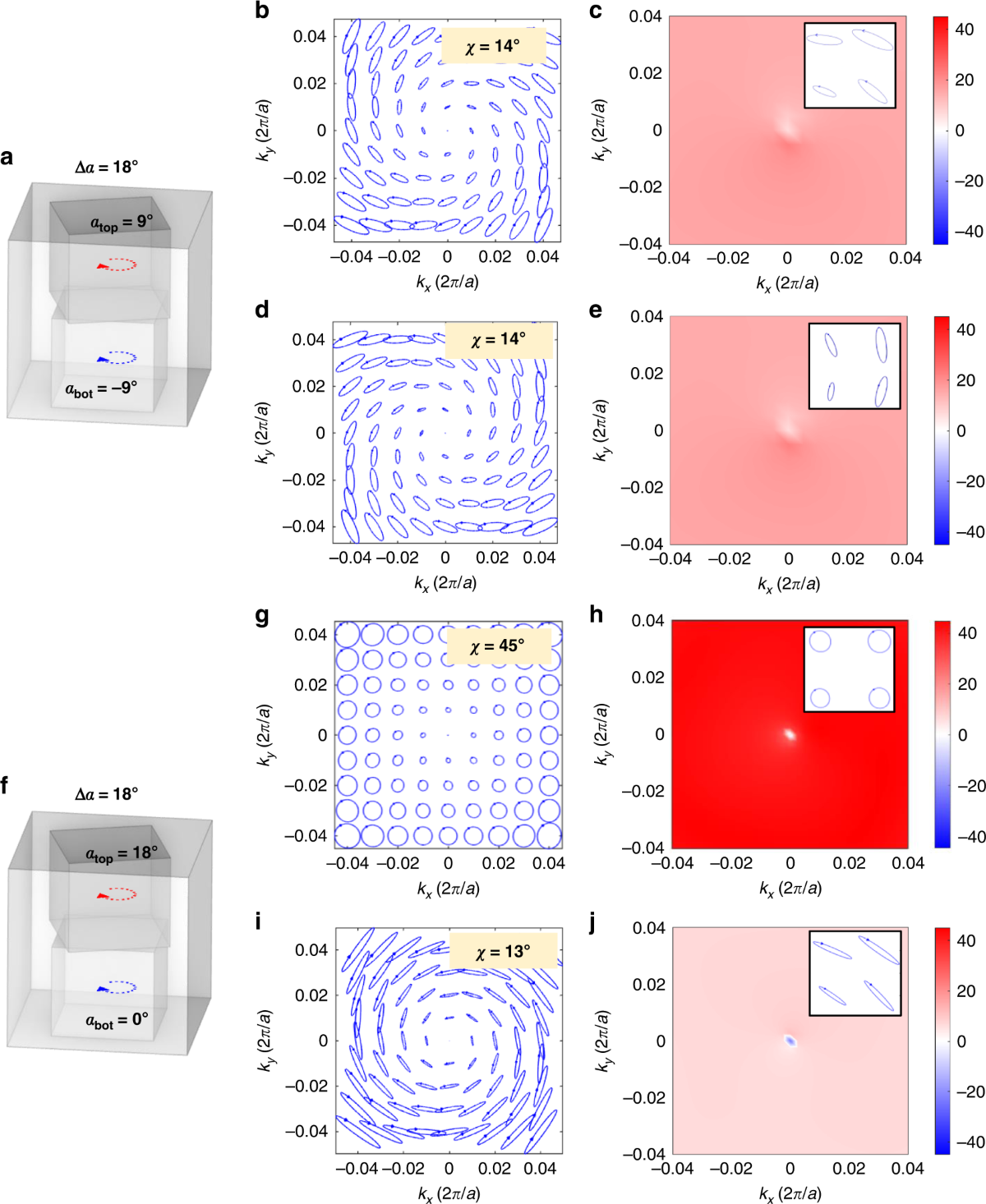
A striking property of many photonic BICs is their association with polarization vortices. The polarization direction of nearby radiating modes changes as the in-plane wave vector moves around the BIC. The far-field intensity becomes zero at the singular point, but the direction field around it can carry a winding number. Zhen and collaborators identified this topological structure, and later experiments resolved the polarization vortex around an optical BIC. [3][4]
The angle φ specifies a suitably chosen far-field polarization orientation on a loop C in momentum space. Care is needed because a polarization axis can be equivalent under a half-turn, and the winding definition depends on the field representation and symmetry. The integer can constrain how vortices move or combine under perturbations. It does not mean all fabricated high-Q modes are immune to defects, nor that a polarization vortex is the same object as a magnetic skyrmion in real space.
In a 2018 optical-grating experiment, Doeleman and colleagues used momentum-space polarimetry to demonstrate a BIC-associated vortex. Kang and colleagues later explored active coherent control of polarization using interference between incident fields on a silicon photonic crystal slab. Rather than changing the chip geometry, adjusting the relative phase of coherent drives can steer output polarization across a wide range of states. [4][6]

Why an infinite Q is not always the right target
A useful sensor, filter or light source must couple to a signal. An exact symmetry-protected BIC often has no far-field coupling in its ideal channel, making it essentially dark to the same illumination used to interrogate a conventional resonator. A designer can break symmetry slightly to induce coupling, obtaining a quasi-BIC whose radiation linewidth is narrow but measurable. If the resulting coupling amplitude is linear in a small asymmetry α, the radiative loss is quadratic and Q scales inversely with its square.
That scaling is a local small-perturbation result, not an unconditional law. Other damping rates remain finite as α approaches zero, and the linewidth eventually saturates. Even if field buildup increases, a narrower resonance brings smaller operational bandwidth and a larger sensitivity to detuning, temperature and fabrication drift. A design claiming a magnificent simulated Q but reporting no measured coupling or loss separation has not yet established a practical photonic component. [1][8]
A concrete example is the edge-BIC experiment. Sato and colleagues reported an initial resonance with Q near 237; after adding a nanometer-scale alumina coating, Q increased to about 396 while the resonance wavelength shifted. The result demonstrates tuning and surface sensitivity in a physical nanofabricated device, not an infinite-lifetime state. The distinction between an ideal radiation-free eigenmode and a measurable near-BIC resonance is the essential engineering lesson. [5]

Twisted slabs, optical vortices, and the Poincaré sphere
The topology of a BIC can become a method of structuring emitted light. By breaking symmetries or combining layered structures, researchers can engineer polarization states that vary with momentum. In twisted photonic crystal slabs, relative layer rotation provides an additional degree of freedom for controlling the polarization texture of optical modes. Calculations by Zhang and collaborators show how that texture can evolve across elliptic polarization states while retaining a winding structure. [7]
This is important for vector beams and optical angular momentum. But a carefully patterned classical light field is not, by itself, quantum-entangled radiation. To make a claim about quantum optics, experiments must establish nonclassical statistics or coherent light-matter operations on appropriate quantum emitters. The wave mathematics is shared, while the physical evidentiary standard is different.

From exceptional resonances to useful hardware
Nonlinear generation is one application. Long dwell times and intense resonant fields can enhance frequency conversion, provided the mode overlaps a suitable nonlinear material and the generated frequencies have usable output channels. That is why the correct optimization target can involve both enhancement and outcoupling. Nonlocal wavefront-shaping elements and narrowband meta-lenses exploit related interference physics, including deliberately engineered quasi-BIC linewidths. [9]
Another frontier is coupling optical emitters to resonant dielectric structures. Spin defects and other quantum emitters near BIC-inspired metasurfaces can experience modified optical environments. Sortino and colleagues explored optically addressable spin defects in such metasurfaces. The optical field distribution and emitter positioning must be measured alongside linewidth and collection efficiency; a fluorescence increase alone is not equivalent to deterministic quantum information transfer. [8]

How to test whether the light truly refuses to radiate
A strong experiment would sweep a symmetry-breaking parameter across a collection of fabricated devices, measuring resonance width, angular dispersion and polarization near the suspected BIC. The analysis should compare full-wave electromagnetic calculations with the actual substrate, finite footprint, material absorption and fabrication tolerances. If Q saturates while the predicted radiative linewidth continues to fall, the missing losses must be identified rather than folded into a spectacular headline.
To establish a topological charge, one must measure or reconstruct the polarization texture along closed loops in momentum space. To establish useful hardware, one must also report insertion losses, usable bandwidth, thermal stability and repeatable coupling. BIC physics is most impressive when all these measurements can be made consistent with the same microscopic design.
An absence that changes what can be engineered
The defining property of a BIC is the absence of radiation into a continuum that could have carried it away. Symmetry and interference can make that absence mathematically exact in idealized structures, while topology can organize how the forbidden coupling behaves nearby. Modern photonics does not need to freeze light forever. It needs to choose where, when and how much light should escape. In that sense, the most useful bound state in the continuum may be the one engineers know precisely how to unbind.
References
[1] Hsu et al. (2016), Bound states in the continuum. https://doi.org/10.1038/natrevmats.2016.48.
[2] Friedrich and Wintgen (1985), Interfering resonances and bound states in the continuum. https://doi.org/10.1103/PhysRevA.32.3231.
[3] Zhen et al. (2014), Topological nature of optical bound states in the continuum. https://doi.org/10.1103/PhysRevLett.113.257401.
[4] Doeleman et al. (2018), Experimental observation of a polarization vortex at an optical bound state in the continuum. https://doi.org/10.1038/s41566-018-0177-5.
[5] Sato et al. (2024), Observation of edge bound states in the continuum at truncated silicon pillar photonic crystal. https://doi.org/10.1038/s41467-024-54929-0.
[6] Kang et al. (2022), Coherent full polarization control based on bound states in the continuum. https://doi.org/10.1038/s41467-022-31726-1.
[7] Zhang et al. (2023), Arbitrarily polarized bound states in the continuum with twisted photonic crystal slabs. https://doi.org/10.1038/s41377-023-01090-w.
[8] Sortino et al. (2024), Optically addressable spin defects coupled to bound states in the continuum metasurfaces. https://doi.org/10.1038/s41467-024-46272-1.
[9] Wang et al. (2024), Nonlocal meta-lens with Huygens' bound states in the continuum. https://doi.org/10.1038/s41467-024-50965-y.
[10] Kodigala et al. (2017), Lasing action from photonic bound states in continuum. https://doi.org/10.1038/nature20799.
[11] Hsu Research Group, Research on bound states in the continuum. https://sites.usc.edu/hsugroup/research/bound-states-in-the-continuum/.