

Rotate two sheets of graphene by just over one degree and the electrons no longer behave as though they live in an ordinary metal. Some acquire extremely small energy dispersion, others retain mobile Dirac-like character, and electron interactions can reshape the entire band structure. A 2026 experiment made that strange coexistence visible in momentum space for the first time with a quantum twisting microscope. The result connects moiré materials to a deeper question: can the geometry of electronic wavefunctions support collective behavior even when single particles barely move?
Graphene's carbon atoms form a honeycomb lattice. A single sheet possesses electronic states whose low-energy dispersion resembles a relativistic Dirac cone. When two sheets are stacked with a small relative rotation, their periodic structures interfere to produce a much larger moiré pattern. The electrons experience not merely twice as many carbon atoms, but a spatially varying interlayer coupling that folds and hybridizes their electronic bands. Around particular small angles, usually near in idealized devices, the low-energy bands become remarkably flat. This produces a fertile setting for strongly correlated electron phases, including unconventional superconductivity, correlated insulation and orbital magnetism. [1][2]
Yet the phrase “electrons stop moving” is incomplete. A nearly flat dispersion implies a small group velocity for a noninteracting Bloch wavepacket in that band, not that every physical electronic state is spatially frozen or that current must vanish. Furthermore, the measured single-particle band structure itself can be transformed by Coulomb interactions. In May 2026, Xiao and collaborators used quantum twisting microscopy to directly resolve the momentum-dependent spectrum of magic-angle twisted bilayer graphene (MATBG). They observed bands displaying almost flat, heavy-electron-like regions alongside light, dispersive electronic states near the moiré Brillouin-zone center. The evidence supports a momentum-dependent duality within the same low-energy bands rather than two unrelated materials coexisting on a chip. [3]
The moiré lattice is a second crystal built from two crystals
For two identical lattices with lattice constant twisted by an angle , the geometric moiré length is approximately
In graphene, ; around one degree the moiré period grows to roughly fourteen nanometres. Millions of microscopic carbon sites can thereby organize into a superlattice with a comparatively small reciprocal-space Brillouin zone. The moiré length determines the characteristic momentum separation between rotated Dirac cones, , where . Interlayer tunneling competes with the original graphene kinetic energy , and the competition is commonly parameterized by
where is a representative interlayer hopping amplitude. The Bistritzer–MacDonald continuum model predicts that strong hybridization near special values of suppresses the low-energy bandwidth. The exact magic angle is sensitive to relaxation, strain and tunneling parameters, so quoting one universal decimal place without qualification would be misleading. [2][4]
The moiré system differs from a textbook crystal for another reason: the electronic wavefunctions carry a nontrivial pattern within the enlarged unit cell. In some momentum regions, the electronic weight concentrates near locally AA-stacked positions; in others it spreads differently over the moiré cell. These internal structures matter when Coulomb interactions are projected into the flat bands. Two bands with the same energy dispersion need not respond in the same way if their Bloch wavefunctions have different geometry.
What a quantum twisting microscope actually measures
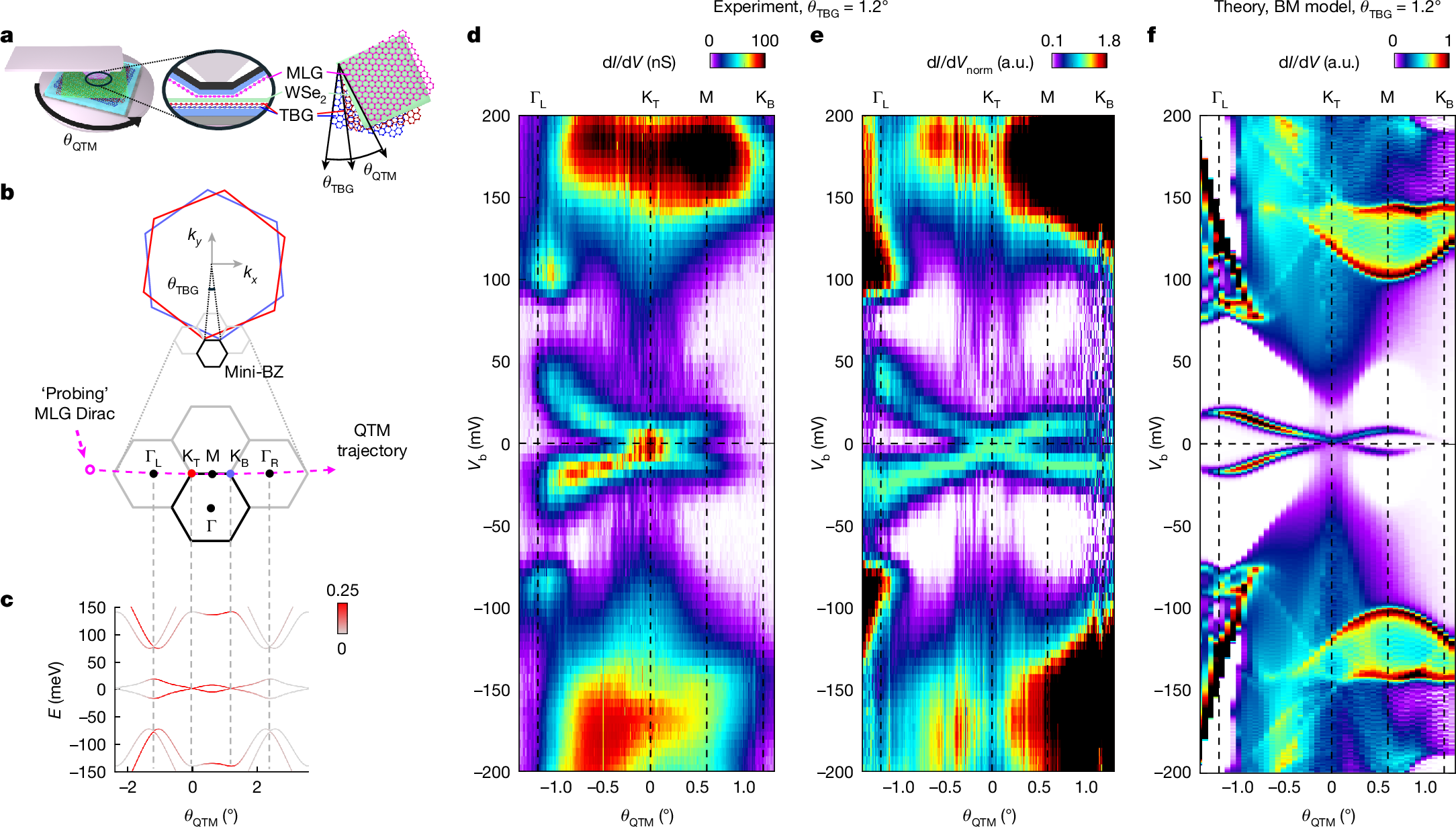
The 2026 team built a momentum-selective tunneling device. A rotating monolayer graphene probe acts as an electronic source or detector, with its Dirac cone sweeping through the target twisted bilayer's mini-Brillouin zone as the relative probe angle changes. A thin tunneling barrier separates the probe from the sample. The measured differential conductance responds to available states and tunneling matrix elements at selected energies and momenta. Unlike a simple transport resistance measurement, this gives an experimentally accessible map of which electronic states exist across the band. [3]
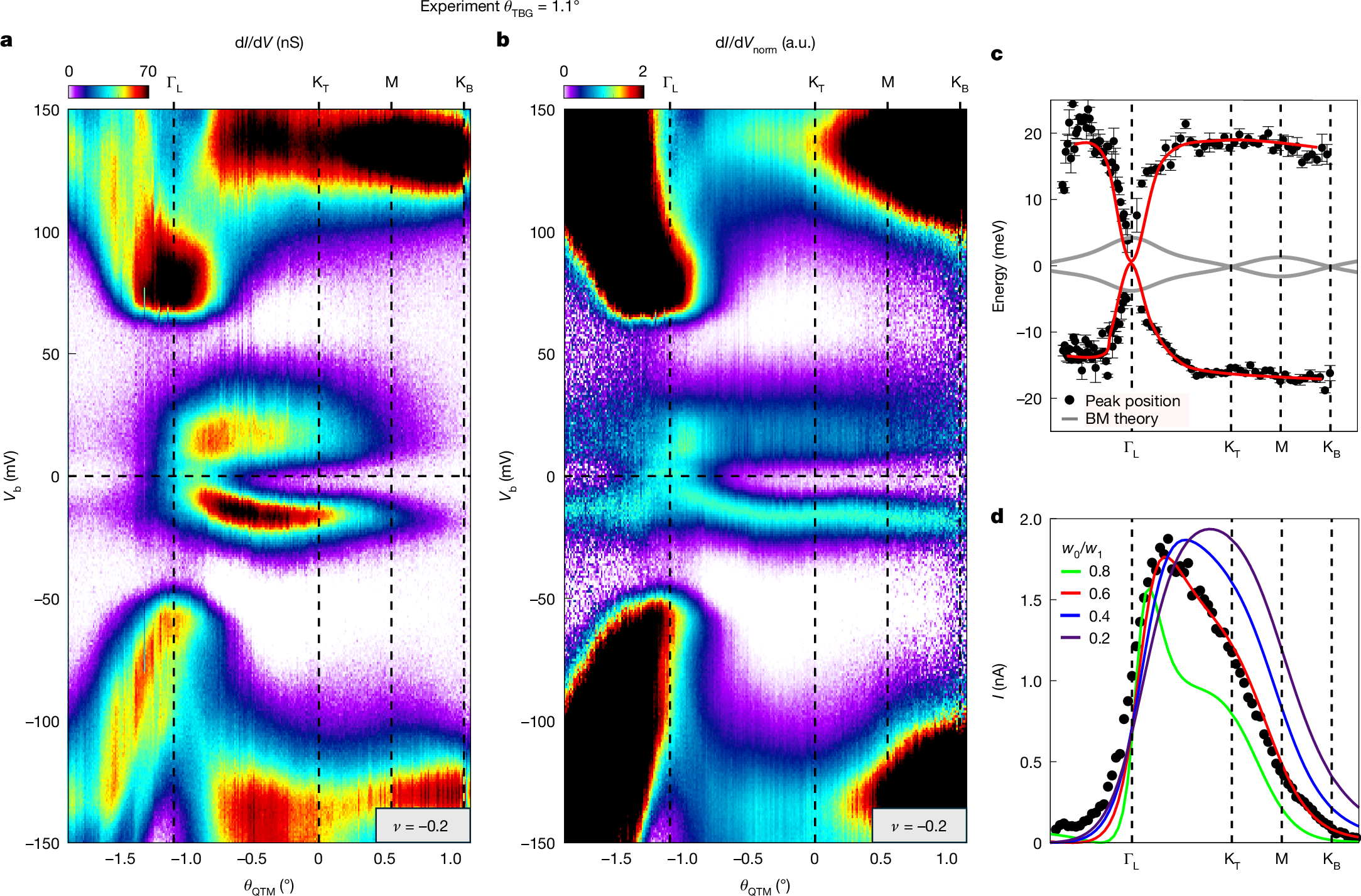
The researchers compared positions on the same device with slightly different twist angles. At about , measured bands resembled the continuum-model picture, with a recognizable dispersion and reduced Fermi velocity. In regions closer to the magic angle, the low-energy structure changed substantially: over most of the sampled momenta, the observed bands were flat to within approximately and separated by an interaction-shaped gap, while the states near the moiré point remained comparatively dispersive and gapless. This pattern cannot be accurately summarized as every electron becoming equally heavy. [3]
What does “heavy” mean in this context? For a simple isotropic quadratic band, the effective mass is related to the curvature of the energy dispersion:
When the band is almost flat, this curvature can be small, corresponding to a large effective mass in such a local quadratic approximation. The near- light-sector excitations are more naturally described through their dispersive or Dirac-like energy-momentum behavior than by assigning an identical quadratic mass everywhere. A strongly correlated spectrum also contains spectral weight and quasiparticle-lifetime information, so “heavy” and “light” are phenomenological labels rather than rigid species of electron.
One band, two electronic personalities
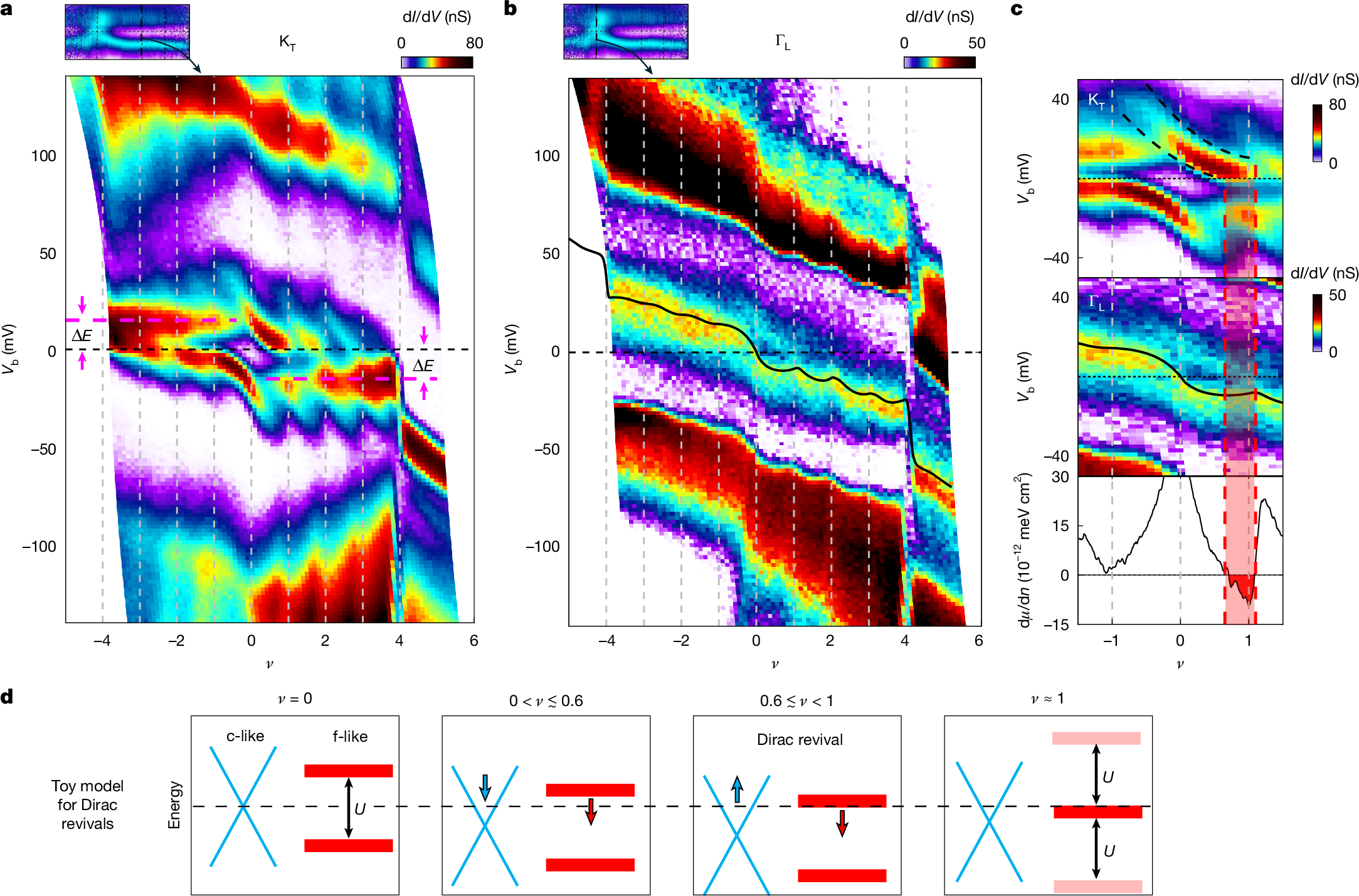
The 2026 measurements support an interpretation sometimes called topological heavy-fermion-like physics. Most of the moiré Brillouin zone hosts low-dispersion states with strong localization character. Near certain momenta, lighter mobile states remain. As carriers are added or removed, electron correlations redistribute occupation and energy between these sectors. The researchers observed Mott-like cascades of the heavy sector and what they describe as Dirac revivals of lighter states. Their model-data comparison also identified a persistent excitation around associated with the heavy sector that is not fully accounted for by existing descriptions. [3][5]
This is a striking example of why electronic structure is not just a collection of curves. The spectral function is a more detailed object,
where is the retarded single-particle Green function. Peaks in convey excitation energies, while widths and weights encode interactions and coherence. Tunneling conductance reflects a weighted view of these spectral properties and cannot be interpreted without considering the probe geometry and matrix elements. The observed momentum-dependent spectral weight helps reveal where the mobile and localized sectors enter the measured bands. [3]
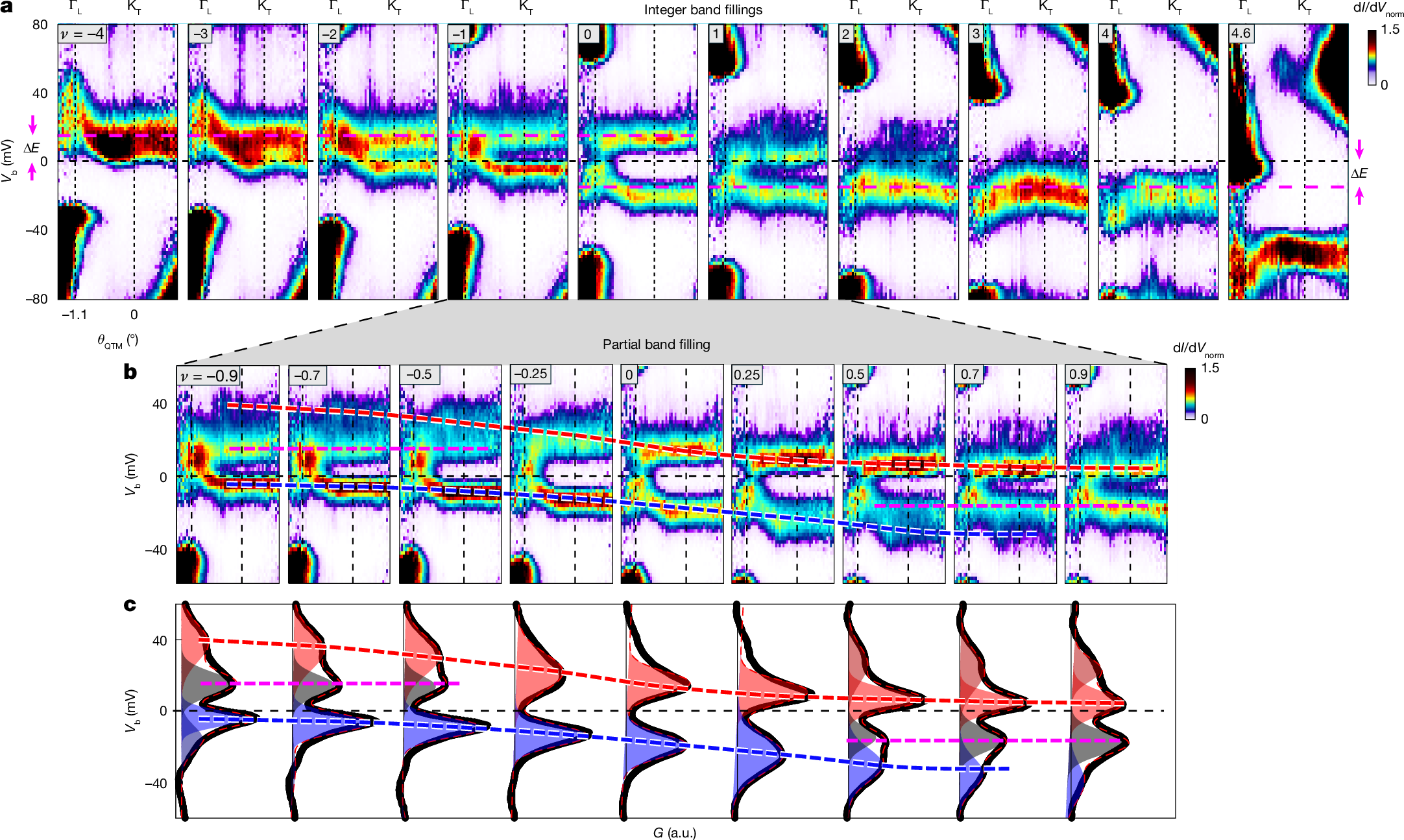
A rigid-band model would suppose that adding electrons simply raises the chemical potential through a fixed electronic spectrum. MATBG does something more intricate. Coulomb interactions reorganize the spectrum itself, and the wavefunctions involved at one momentum can respond differently from those at another. The result is a feedback loop between filling, band shape, localization and collective electronic behavior. In such a setting, measurements at a single density can miss much of the physics.
The hidden geometry of a Bloch wavefunction
In quantum mechanics, a normalized Bloch eigenstate changes as its crystal momentum changes. That change has geometry independent of the energy dispersion. The quantum geometric tensor may be defined using the component of the momentum derivative orthogonal to the state:
Its real part, , is the quantum metric. Its imaginary part is related, by sign and convention, to Berry curvature. The metric measures how quickly the physical quantum state changes in momentum space; the Berry curvature measures geometrical phase accumulation. Neither object is determined completely by plotting . [6][7]
This distinction is important for superconductivity. In a conventional clean single-band metal, the superfluid response often tracks electronic dispersion and charge transport. In flat-band systems, conventional band-curvature contributions can become small, but the geometry of the Bloch wavefunctions can still contribute to the superfluid weight. In idealized multiband mean-field treatments, the superfluid response can contain a term whose schematic form involves a momentum integral of weighted by pairing and band-population factors. The existence and size of that contribution depend on the model, gauge-consistent multiband structure and self-consistency. The 2026 microscopy experiment did not directly measure superfluid stiffness or demonstrate that a particular geometric term causes superconductivity; it motivates investigating these connections with better knowledge of the actual correlated bands. [6][7]
Geometry is not the same as topology
The quantum metric and Berry curvature are closely related pieces of the same geometric tensor, but they serve different purposes. Berry curvature integrated over a closed two-dimensional Brillouin zone can yield a Chern number for an isolated band,
The Chern number is quantized under appropriate regularity and band-isolation assumptions. The quantum metric is generally not quantized. It measures the shape of state variation rather than a discrete winding count. MATBG's relevant low-energy bands have symmetry-protected structures and nontrivial topology; any localized-orbital description must account for these constraints. That is part of the motivation for heavy-fermion-like models that keep both localized and extended ingredients. [5][6]
Nor should the moiré geometry be confused with geometrical warping of the physical graphene sheets alone. Atomic relaxation matters, but the quantum metric exists in the Hilbert-space structure of electronic eigenvectors. Its presence can be quantified in a model even for a mathematically flat lattice. One is a real-space pattern made by two twisted atomic nets; the other is a geometric structure assigned to momentum-dependent wavefunctions.
What the experiment resolves, and what remains open
The major 2026 achievement is direct momentum-resolved access to the interacting bands. Previous measurements revealed correlated insulators, anomalous Hall effects and superconductivity, and scanning probes produced useful local information. But resolving the detailed spectral structure across moiré momentum space was exceptionally difficult. Quantum twisting microscopy makes it possible to distinguish where interactions produce almost localized behavior from regions that retain mobile excitations. [3]
Several problems remain. The relation between this band duality and the pairing mechanism in superconducting MATBG is not fully established. The experimentally observed extra excitation requires theoretical explanation. Sample strain, disorder, local twist variations and dielectric environment can influence the details, and the relevant low-energy model may change across device geometries. Better momentum-resolved spectroscopy can constrain these possibilities, but a microscopic account must also reproduce measured gaps, compressibility, transport and pairing behavior.
The broad lesson reaches beyond graphene. Other twisted van der Waals heterostructures, strained lattices and designed flat-band systems can create interaction scales that overwhelm kinetic energy. Their phase diagrams depend not only on whether the bands are narrow but on the electronic wavefunctions that inhabit those bands. Magic-angle graphene is a particularly revealing laboratory because its kinetic energy is tunable by something as simple, in principle, as rotating one layer relative to another. A fraction of a degree changes the relation between electrons, geometry and collective order.
References
[1] Cao, Y. et al., Correlated insulator behaviour at half-filling in magic-angle graphene superlattices, Nature 556, 80–84 (2018). Original experiment.
[2] Cao, Y. et al., Unconventional superconductivity in magic-angle graphene superlattices, Nature 556, 43–50 (2018). Original experiment.
[3] Xiao, J., Inbar, A., Birkbeck, J. et al., Imaging the flat bands of magic-angle graphene reshaped by interactions, Nature 653, 68–75 (2026). 2026 quantum twisting microscopy study.
[4] Bistritzer, R. and MacDonald, A. H., Moiré bands in twisted double-layer graphene, PNAS 108, 12233–12237 (2011). Continuum model.
[5] Song, Z. and Bernevig, B. A., Magic-angle twisted bilayer graphene as a topological heavy fermion problem, Physical Review Letters 129, 047601 (2022). Heavy-fermion theory.
[6] Peotta, S. and Törmä, P., Superfluidity in topologically nontrivial flat bands, Nature Communications 6, 8944 (2015). Quantum geometry of superfluidity.
[7] Törmä, P., Peotta, S. and Bernevig, B. A., Superconductivity, superfluidity and quantum geometry in twisted multilayer systems, Nature Reviews Physics (2022). Review.
[8] Tarnopolsky, G., Kruchkov, A. J. and Vishwanath, A., Origin of magic angles in twisted bilayer graphene, Physical Review Letters 122, 106405 (2019). Magic-angle theory.
Cover illustration: overlapping graphene moiré lattices and electron pairs. Texas Materials Institute, University of Texas at Austin. Conceptual illustration, not an experimental image from the 2026 quantum twisting microscopy study.