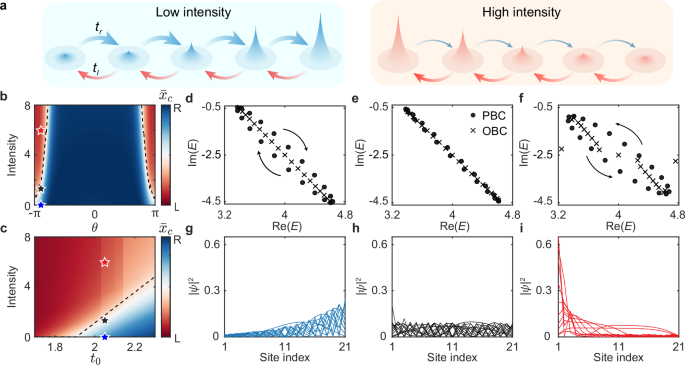

In an ordinary crystal, most bulk wave modes occupy the interior. In a non-Hermitian lattice, an extensive number of them can crowd against a boundary. Changing a distant connection can reshape the spectrum of the entire chain. Modern experiments show how to reverse this accumulation with input power, redirect harmonics and even observe boundary-localized waves in passive devices. These are manifestations of the non-Hermitian skin effect, where the direction of transport and the topology of a complex energy spectrum matter in ways absent from conventional Hermitian band theory.
A wave moves through a chain of coupled resonators. In an ideal lossless reciprocal system, transport to the left and to the right is balanced, and standing-wave modes occupy much of the sample. Reverse that symmetry of coupling, allowing waves to travel more strongly in one direction than the other, and the spatial structure changes. Under open boundary conditions, modes that would appear extended in a periodic description can instead acquire envelopes that grow exponentially toward one edge. The effect is not restricted to exotic quantum matter. It has been observed in systems built from ordinary electric components, acoustic resonators, photonic structures and active mechanical lattices. Its origin is captured by non-Hermitian wave dynamics. [1][2][3]
In June 2026, Junyao Wu and collaborators reported a notable extension in Nature Communications: an eleven-site microwave-resonator system where increasing the input power reversed the direction of the skin effect. The nonlinear response of an amplifier changed the effective nonreciprocal coupling, shifting mode localization from one end of the lattice to the other. The same experiment observed third-harmonic generation that inherited the spatial localization of the fundamental response. A separate January 2026 acoustic experiment showed how periodically modulated couplings can direct different harmonics toward different edges. Together, these results point to wave-control functions that go beyond static localization. [4][5]
What non-Hermitian actually means
For a closed quantum system, Hermitian Hamiltonians generate unitary evolution and have real eigenvalues. But an optical mode leaking through a waveguide, a resonator with gain and loss, or an acoustic array driven through active electronics is not closed. A reduced effective description may employ an operator that is not equal to its Hermitian adjoint. Its eigenvalues can be complex, with their imaginary parts controlling growth or decay under the chosen time-dependence convention. This is an effective dynamical description, not a claim that a fundamental isolated quantum Hamiltonian ceases to be Hermitian. [1][6]
Non-Hermiticity is sometimes equated with adding an imaginary onsite potential to model loss. The skin effect points to something deeper: nonreciprocal hopping, unequal couplings between neighboring sites or a nontrivial spatial arrangement of gain and loss can change how modes depend on the boundary. A lattice can exhibit skin localization even without each individual site amplifying energy. In passive devices, all physical energy may decay over time while the normalized distribution temporarily gathers toward an edge. [3]
The simplest calculation: a chain that prefers one direction
The Hatano–Nelson model provides a clean starting point. Label sites from to and let and be the real positive hopping strengths to the right and left. In a single-excitation representation, the Hamiltonian is
If , the matrix is Hermitian, and ordinary open-chain standing waves fill the lattice. When , the Hamiltonian is non-Hermitian. The right-eigenvector amplitudes obey away from the ends. Try a standing wave multiplied by an exponential envelope, . Choosing
makes the recurrence equivalent to a symmetric hopping problem with effective coupling . The complete open-chain solution is then
If , , and every right eigenvector has a growing envelope toward the right boundary. Reverse the asymmetry and those eigenvectors collect at the left. Their localization length in lattice-site units is
The result is stronger than finding one isolated edge state. A number of eigenvectors proportional to the system size display boundary accumulation. Their detailed nodal structures differ, but their envelopes all favor the same side in this simple positive-hopping model. The left eigenvectors of the non-Hermitian matrix generally localize toward the opposite edge; physical response functions must therefore distinguish right and left eigenmodes instead of assuming a single orthonormal basis. [1][2]
Why connecting the ends changes the spectrum
Close the chain into a ring and use periodic boundary conditions. Bloch waves then have complex dispersion
When , this traces an ellipse in the complex energy plane as ranges over the Brillouin zone. For open ends, by contrast, the positive-coupling model has the purely real eigenvalues shown earlier. The difference between the spectra is not a small edge correction. It is a global rearrangement that persists as the system grows. In an ordinary Hermitian chain, opening a weak link usually leaves most of the bulk spectrum largely intact in the thermodynamic limit. In a skin-effect system, the periodic and open spectra can differ qualitatively because the relevant eigenmodes are exponentially sensitive to the boundary condition.
One way to diagnose this difference is through the point-gap winding number around a reference energy outside the periodic spectrum:
For the asymmetric Hatano–Nelson chain and inside the spectral ellipse, the winding is nonzero, with sign determined by the hopping orientation. Such winding is related to the accumulation of open-boundary modes under appropriate assumptions. It is distinct from the invariant associated with familiar Hermitian topological insulators. A point gap is a spectral region excluding a reference point in the complex plane; a conventional Hermitian band gap separates real-energy bands. Confusing the two leads to incorrect claims about what is and is not protected. [1][2][6]

Why skin modes are not ordinary protected edge states
A topological edge state in a Hermitian Su–Schrieffer–Heeger-type chain is usually an exceptional boundary mode whose existence relates to a bulk topological invariant and an energy gap. The non-Hermitian skin effect instead describes a macroscopic fraction of modes shifting toward a boundary. A model can display either, both, or neither. In certain engineered lattices the two effects interact, producing corner localization or hybrid skin-topological behavior. The 2021 experiments of Deyuan Zou and collaborators used nonreciprocal two- and three-dimensional topolectrical circuits to demonstrate such hybrid localization structures. [7]
Calling all modes near a boundary “protected” would be misleading. Real non-Hermitian devices contain disorder, coupling fluctuations, nonlinearities and finite gain bandwidth. Skin localization can survive useful classes of perturbations, but its robustness depends on the point-gap topology, the kind of disorder, boundary conditions and the mode or observable being examined. The phrase “every state runs to the edge” captures the ideal one-dimensional model rather than a universal property of every non-Hermitian matrix.
How to see a skin effect in a device that only loses energy
A persistent steady-state measurement can hide skin localization in a purely passive system. Excitation far from the preferred edge may decay before an appreciable field reaches it. In 2022, Zhongming Gu and collaborators proposed and demonstrated a transient skin effect in an acoustic ring-resonator array. They used complex-frequency excitation to create a temporary spatial profile mimicking gain while every physical resonator remained passive. The field's overall energy still decayed, but for a controlled observation window its normalized spatial shape exhibited the predicted localization. [3]

This is an important experimental distinction. A right eigenmode can be concentrated at an edge without a continuously driven device automatically displaying a bright spot there at every frequency. The observed response depends on how the source excites the lattice, how loss channels operate and when the field is measured. Mode localization, energy flow and amplification are related but not interchangeable. In non-normal matrices, coherent interference between nonorthogonal eigenvectors can also produce transient growth or unexpectedly large responses without positive net eigenmode gain.
Reversing the skin effect by increasing the power
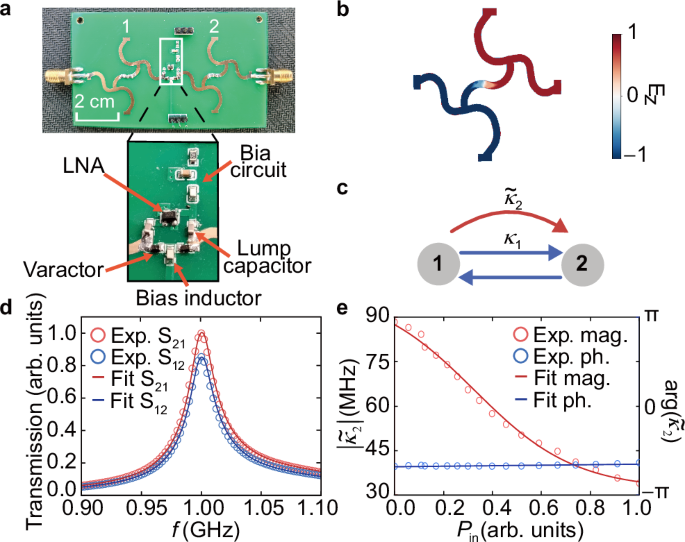
The 2026 nonlinear experiment by Wu and collaborators implemented nonreciprocal coupling through electronically controlled microwave-resonator links. At low input power, the amplifiers operated near their linear-response regime; their frequency-dependent gain and phase created an effective preferred hopping direction. At higher powers, gain compression and waveform distortion modified the nonlinear coupling. The effective asymmetry could diminish and change sign, causing modes that initially favored one end to migrate toward the other. [4]
In a chain of eleven resonators, the team compared measured site responses at input powers of , and . In the weak-input regime the response localized near the right edge. At an intermediate setting it became almost delocalized, and at higher input power the localized response accumulated at the left edge. Their calibrated coupling model and eigenfrequency analysis supported a power-dependent change in the corresponding point-gap structure. This was measured in a microwave-resonator network, not a direct observation of quantum particles physically piling up at the end of a wire. [4]
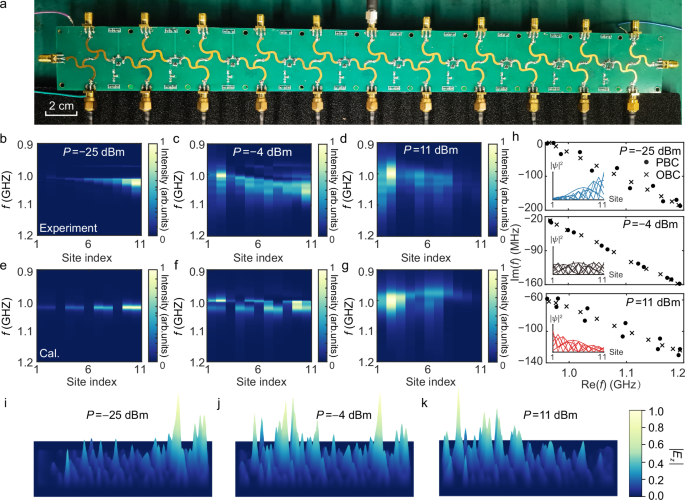
The result makes nonlinearity an additional control knob. Usually, a lattice designer must physically adjust couplings to redirect wave localization. Here a tunable input can alter the effective nonreciprocity through the components' nonlinear response. Such behavior suggests switching, routing and amplitude-selective wave concentration, though actual device applications would require demonstrations of bandwidth, dynamic range, insertion loss, stability and robustness against fabrication variation. A proof of controllable localization is not yet a finished communications switch.
Harmonics can inherit the direction of the skin modes
A nonlinear component can generate output at multiples of an input frequency. In the 2026 microwave experiment, the researchers detected a third harmonic near and measured its field distribution along the lattice. That harmonic inherited localization associated with the fundamental, and its preferred end changed as the nonlinear regime was tuned. This demonstrates a path toward spatially selective harmonic generation in engineered wave systems rather than merely shifting the response of a linear mode. [4]
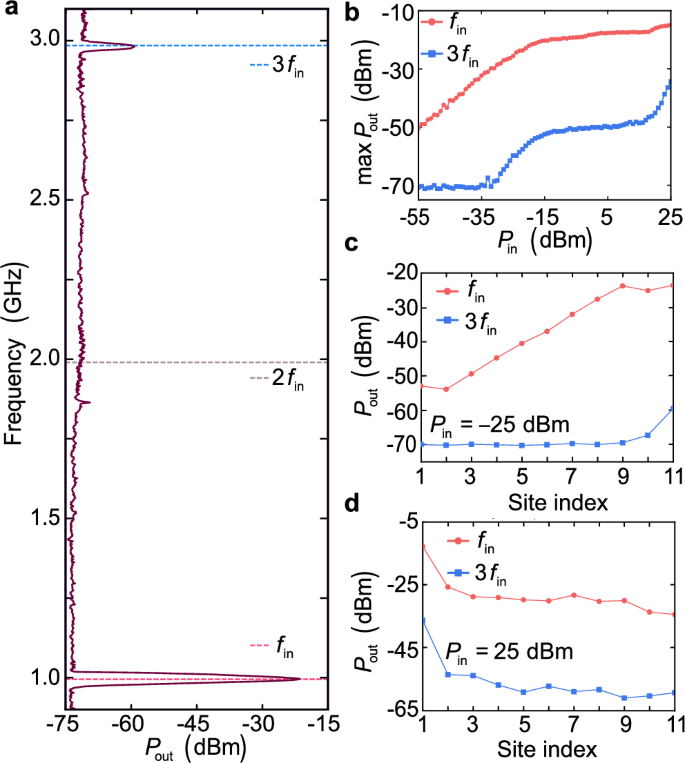
A separate January 2026 study by Qicheng Zhang and collaborators introduced harmonic non-Hermitian skin effects in periodically modulated acoustic lattices. Their dynamic couplings produced frequency harmonics with different spectral winding structures. Under suitable conditions the fundamental remained relatively extended, while other harmonics accumulated toward different boundaries; switching the excitation and modulation frequencies altered this behavior. Unlike the nonlinear microwave-resonator demonstration, that experiment used actively controlled time-dependent couplings in an acoustic platform. Both extend skin physics beyond static asymmetric hopping, but their physical mechanisms are different. [5]
Could a boundary-localized wave be a better sensor?
Non-Hermitian systems can respond strongly to a small perturbation because their eigenvectors are nonorthogonal and their spectra can be highly sensitive to changes in boundaries or couplings. This has motivated proposals for topological and non-Hermitian sensors. In simple lattice models, adding a weak link between the two ends can alter the spectrum dramatically, suggesting an enhanced response to a perturbation. But a large eigenvalue shift is not automatically an enhanced measurement precision. Noise, calibration error, gain saturation, amplifier fluctuations and the actual signal-to-noise ratio must enter the comparison. [8][9]
The engineering opportunity is therefore more specific than the slogan that the skin effect amplifies every signal. A designed waveguide could funnel energy to a detector, steer selected harmonics to different locations or produce a sensitive boundary-dependent scattering response. Its performance should be benchmarked against reciprocal structures of the same size and losses. Whether the enhancement survives realistic noise and fabrication tolerances will determine if it becomes useful hardware rather than an intriguing spectrum.
The boundaries of the theory are also its strength
The Hatano–Nelson chain makes the non-Hermitian skin effect unusually transparent: two unequal hopping amplitudes change extended standing waves into exponentially weighted ones. A ring exposes a complex spectral loop; cutting the ring makes almost the entire spectrum reorganize. These are exact consequences of a defined model, not an analogy. Real experiments then add physics beyond the model: frequency-dependent couplers, finite lifetimes, external drives, environmental modes and nonlinear gain compression.
The recent experiments demonstrate that skin localization can be engineered in acoustic and microwave networks, observed transiently in passive structures, and reversed or separated by harmonic content. They also make the scientific limitations visible. What accumulates at an edge is often the amplitude of classical waves, and the useful quantity in a sensor or communications device is the measurable response rather than the mathematical localization length alone. The frontier is learning to turn spectral topology into controllable wave behavior without letting losses and noise erase its practical value.
References
[1] Hatano, N. and Nelson, D. R., Localization transitions in non-Hermitian quantum mechanics, Physical Review Letters 77, 570–573 (1996). Foundational model.
[2] Yao, S. and Wang, Z., Edge States and Topological Invariants of Non-Hermitian Systems, Physical Review Letters 121, 086803 (2018). Non-Bloch correspondence.
[3] Gu, Z., Gao, H., Xue, H. et al., Transient non-Hermitian skin effect, Nature Communications 13, 7668 (2022). Passive acoustic experiment.
[4] Wu, J., Shen, R.-C., Zhang, L. et al., Observation of localization reversal and harmonic generation in nonlinear non-Hermitian skin effect, Nature Communications 17, 8028 (2026). Nonlinear microwave experiment.
[5] Zhang, Q., Xiong, L., Tong, S. et al., Harmonic non-Hermitian skin effect, Nature Communications 17, 2198 (2026). Modulated acoustic experiment.
[6] Bergholtz, E. J., Budich, J. C. and Kunst, F. K., Exceptional topology of non-Hermitian systems, Reviews of Modern Physics 93, 015005 (2021). Topological review.
[7] Zou, D., Chen, T., He, W. et al., Observation of hybrid higher-order skin-topological effect in non-Hermitian topolectrical circuits, Nature Communications 12, 7201 (2021). Topolectrical experiment.
[8] Budich, J. C. and Bergholtz, E. J., Non-Hermitian Topological Sensors, Physical Review Letters 125, 180403 (2020). Sensing proposal.
[9] McDonald, A. and Clerk, A. A., Exponentially-enhanced quantum sensing with non-Hermitian lattice dynamics, Nature Communications 11, 5382 (2020). Quantum sensing analysis.
Cover: schematic of a non-Hermitian resonator array and localization reversal from Wu et al., Nature Communications 17, 8028 (2026), Figure 1, CC BY 4.0.