

Light is normally described by its frequency, brightness, phase and polarization. An optical skyrmion gives it something more unusual: a structured vector field whose orientation wraps an entire sphere as one moves across a beam. Researchers are learning to use that global geometry to encode signals, measure minute displacement, diagnose damaged polarization optics and control interactions with matter. Recent experiments now extend the idea from classical beams into nanophotonic chips and entangled photons, although the phrase “topologically protected” deserves considerably more care than it often receives.
Imagine taking a tiny photograph of a laser beam and discovering that the polarization changes from point to point. Near the center it may point in one direction; farther out it tilts, rotates and points oppositely. If the changes are arranged so that the polarization direction sweeps all possible orientations on a sphere, the beam can form an optical skyrmion. The name comes from analogous topological structures in nuclear-field theory and magnetic materials, but the optical object is not literally a tiny particle of light, nor necessarily an individual photon. It is a configuration of a classical or quantum electromagnetic field that can be characterized by the way its vectors wrap a parameter space. [1][2]
The field has advanced beyond creating beautiful optical textures. A 2026 Nature Electronics study reported programmable skyrmionic electromagnetic structures used for multichannel wireless communication and recognition of twenty miniature target objects. Research published in Nature Communications demonstrated the persistence of classical and quantum skyrmion topology under experimentally simulated atmospheric turbulence. Other experiments have achieved picometre-scale displacement sensitivity, used skyrmionic fields to assess vectorial adaptive optics and encoded skyrmion topology on integrated photonic chips. They do not constitute one commercially deployed technology, but together they show why optical topology is becoming a practical design variable rather than only a mathematical curiosity. [3][4][5][6][7]
What is actually winding inside a beam?
A paraxial optical beam has two transverse polarization components. In a circular basis, denote their complex amplitudes by and . Their relative phases and amplitudes define a local normalized Stokes vector on the Poincaré sphere. Equivalently, a normalized two-component Jones vector defines
where comprises the Pauli matrices. The vector is a representation of local polarization, not a claim that the photon has become a microscopic magnetic dipole. For a field with nonzero intensity throughout the domain and well-defined polarization on its boundary, this unit vector can be a continuous map from a compactified transverse plane into the sphere . [1][2]
The topological charge counts its oriented wrapping:
Under suitable boundary conditions, the integral is an integer and cannot change continuously while the mapping remains smooth, normalized and nonsingular. For open experimental apertures, incomplete sphere coverage, intensity zeros and imperfect boundaries, a measured charge can depart from an integer. The result is more useful than classifying beams only by an intensity ring or polarization ellipse: it condenses a global field arrangement into an interpretable invariant. Yet an invariant is not the same as a complete description of the optical beam, and distinct vector fields can share its value.

There are multiple families of optical skyrmions. In a Néel-like texture the transverse vectors turn radially as one crosses the beam; in a Bloch-like texture they rotate azimuthally. Other arrangements generate anti-skyrmions, merons and more complicated configurations. The precise nomenclature depends on which field is chosen as the vector being mapped: normalized Stokes polarization, optical spin density, electric field or another electromagnetic quantity. This matters because different choices can yield different numerical topological charges for what looks like the same optical structure. The 2025 discussion by Chen, Forbes and Qiu even demonstrates that an optical skyrmion may fail to retain an asserted invariant under an apparently mundane transformation such as reflection from a mirror. Optical topology has real value, but it is not automatic immunity to every perturbation. [2][8]
How to build a skyrmion rather than merely picture one
One common route superposes spatial modes with orthogonal polarizations and different orbital angular momenta. In a simple idealized model, write
The spatially varying amplitude ratio determines the latitude of the local Stokes vector, while the relative azimuthal phase determines how often the polarization winds around the equator. With appropriate radial profiles and boundary conditions, the resulting beam covers the Poincaré sphere. The orbital-angular-momentum difference controls its azimuthal winding, although the full charge also depends on how the field evolves between the center and the boundary. Not every two-mode superposition is a skyrmion.
Such fields can be prepared with spatial light modulators, geometric-phase optics, metasurfaces, evanescent surface-plasmon fields and carefully engineered optical waveguides. A 2024 study generated skyrmions from a patterned metafiber, illustrating that the required vectorial structuring need not rely on a room-sized free-space setup. More recent work has demonstrated reconfigurable dielectric metaoptics and broadband optical topologies using ferroelectric structures on chips. These approaches promise better integration but face fabrication tolerance, bandwidth and collection-efficiency constraints. [9][10][11]
Communication: a topological alphabet for distorted channels
Most optical communications encode information in quantities such as amplitude, phase, polarization, time bins or spatial modes. Skyrmionic structured fields offer another set of symbols: the winding number, helicity and selected topology of the field can be programmed. A receiver can reconstruct or classify the polarization texture, allowing different transmitted structures to represent different data symbols. In principle, a discrete topological alphabet could be less sensitive to some smooth deformations than a receiver that depends on a precise local phase or pixel value. [3][4]
In April 2026, Chen and colleagues reported a programmable platform for plasmonic skyrmions with different topologies, including Néel-type structures and merons. Rapid modulation generated skyrmion-like harmonics in the time domain. The authors demonstrated multichannel wireless communication and an object-recognition task involving twenty animal figurines using a convolutional neural network. This was a programmable electromagnetic metasurface experiment, not a demonstrated commercial optical-fibre or satellite link, and the paper's stated success should not be reinterpreted as a universal data-rate improvement over conventional coherent optical formats. [3]
The physical reason for expecting some resilience is a distinction between field fidelity and topological classification. Atmospheric turbulence, scattering or polarization distortions may severely change a beam's detailed wavefront and still leave the map's overall degree unchanged. In a 2026 Nature Communications experiment, researchers transmitted both classical and quantum optical skyrmions through experimentally simulated turbulence and observed the persistence of relevant topological observables over a studied range of disturbance strengths. The same experiment documented significant local field distortions and loss of entanglement quality. The preserved winding number is therefore a robust observable, not proof that every bit of the original optical waveform survived. [4]

This distinction sets the correct engineering objective. A communication system needs distinguishable codewords, finite-error symbol decoding, good optical power efficiency and adequate spectral efficiency under realistic conditions. If two severely distorted beams retain the same topological charge, the charge cannot distinguish them. Conversely, if one transmitted charge remains measurable despite strong turbulence, it can supply a useful symbol feature. The next task is to benchmark bit-error rate, codebook capacity and information throughput at matched optical power against modern polarization-, spatial-mode- and coherent-detection schemes, including realistic finite receiver apertures.
Picometre motion from a changing spin texture
An optical skyrmion can also be useful not because its entire configuration stays unchanged, but because selected local quantities change sharply and predictably with position. Two interacting photonic spin skyrmions with opposite charges can produce a spatial interval in which a component of the optical spin changes almost linearly. If a nanoscale probe samples that interval, a minute translation becomes a detectable change in the polarization of its scattered light. [5]
Near a chosen working point , a polarization-derived signal can be linearized as
If the detector noise in has standard deviation , the corresponding local displacement uncertainty in a calibrated linear regime is approximately
This expression does not create sensitivity for free. Larger slopes help only if optical shot noise, detector noise, sample drift and calibration remain controlled. In 2023, Yang and colleagues designed and measured a photonic skyrmion-pair texture and demonstrated displacement sensing with picometre-scale sensitivity across a range of at least 100 nanometres. They used polarization analysis of light scattered from a nanoparticle rather than claiming to image atomic orbitals directly. [5]

Picometre displacement sensitivity is also not the same as resolving two objects spaced a picometre apart, and the presence of subwavelength optical polarization structure does not by itself defeat the diffraction limit in ordinary far-field imaging. The sensor works by estimating position from the response of a known field, with specific probe and measurement conditions. Potential uses include nanoscale positioning, instrument calibration and monitoring mechanical drift. General-purpose super-resolution biomedical imaging would require separate demonstrations of usable resolution, field of view, imaging depth and photodamage limits.
Adaptive optics: correcting what a lens does to polarization
Conventional adaptive optics often aims to compensate wavefront phase distortions. However, complex optical media also change polarization and can attenuate different polarization components unequally. A spatially varying optical system is therefore better described by a Jones matrix , where
In addition to retardance and spatial phase, the matrix may contain diattenuation, meaning different loss along different polarization axes. An incoming optical skyrmion samples many polarization states across the aperture. Tracking how its known Stokes texture is transformed provides a dense test object for the entire vectorial response of the optical system. In 2025, Ma and collaborators used this strategy to assess vectorial adaptive-optics performance, quantify aberrations including diattenuation and experimentally demonstrate correction in complex-media imaging. [6]

Its potential is especially interesting for polarimetric measurements, where information is encoded in polarization rather than only brightness. Aberrations that barely change a conventional intensity image can corrupt polarization-based material classification, biomedical contrast or inspection measurements. A skyrmionic probe can reveal whether a correction system preserves the vector field across the aperture, which is a stricter requirement than producing a visually sharp intensity focus. That is not yet equivalent to a single universal, real-time correction device that resolves any scattering tissue, but it opens a systematic route to characterizing and improving such devices.
Can structured light move a magnetic skyrmion?
Magnetic skyrmions are real spin textures in a magnetic material, stabilized by competing interactions and other energetic factors. Their dynamics are important for racetrack memory and magnetic logic, but guiding them reliably is difficult. Currents can induce transverse motion through the skyrmion Hall effect, and defects can trap the moving textures. Light offers a way to apply controlled fields without an electrical contact at the position being manipulated. Two related accomplishments must be kept separate. [12][13]
In December 2025, Kim and collaborators experimentally trapped, moved, created and annihilated individual magnetic skyrmions using a photothermal potential well generated by focused laser illumination. The light-induced temperature landscape acted as a controllable trapping environment, and the researchers combined it with electrical motion of the magnetic texture. This is a substantial optical-control experiment, but the tweezer did not require a skyrmion-polarized optical beam. It should not be conflated with direct coupling between an optical skyrmion and a magnetic skyrmion. [12]

That second idea received a striking theoretical treatment in September 2026. Bo, Chen, Zhang and collaborators simulated the interaction of a single magnetic skyrmion with a specially structured optical-skyrmion beam and found three kinds of trajectories: rotation, skipping and trochoidal motion. Different optical force contributions were associated with radial confinement, azimuthal drift and precession; the pattern could depend on polarization, orbital angular momentum and propagation-induced Gouy phases. Those predictions suggest helicity-selective steering of magnetic textures, but the reported study used micromagnetic modeling. It did not report an experimental skyrmion-beam-driven magnetic memory device. [13]
Forces on particles: beyond ordinary optical tweezers
Structured electromagnetic fields also exert optical forces and torques on small particles. In a simplified dipole regime, a conservative contribution to the force is proportional to the gradient of field intensity, while scattering, spin–momentum coupling and chiral electromagnetic response can produce additional nonconservative contributions. For example, with polarizability under one common phasor convention, an approximate gradient contribution is
Skyrmionic vector fields can sculpt gradients and local spin densities in ways unavailable to a simple Gaussian beam. Recent theoretical work on skyrmionic optical-force landscapes proposes particle transport and selective sorting of chiral nanoparticles. However, proposals for three-dimensional chiral sorting in a realistic microfluidic device still need experimental tests against Brownian diffusion, absorption heating, substrate interactions and the limits of particle polarizability. It would be premature to describe such sorting as a deployed nanofabrication process. [14]
Quantum skyrmions: robustness without an error-correcting code?
Optical topology can exist not only in a classical field's Stokes texture but also in quantum correlations between photons. A nonlocal skyrmion is a property of a joint state: two degrees of freedom belonging to spatially separated photons can be correlated such that a reconstructed vector map winds around a sphere. Unlike a bright classical skyrmion beam, the topology is extracted from measurements on a quantum state or its correlations. [15]
Experiments reported in 2024 created such nonlocal skyrmionic entangled states; a 2025 Nature Communications study showed that the topological observables can remain stable under selected noisy-channel models even as familiar entanglement witnesses weaken. This is an intriguing form of robust encoding of a discrete observable. It is not the same as proving that the arbitrary amplitudes of an unknown logical qubit retain high fidelity under noise. Maintaining a winding number does not automatically implement recovery operations, correct arbitrary Pauli faults or satisfy the requirements of fault-tolerant quantum computation. [15][16]
The more recent step was on-chip manipulation. In October 2026, Zhao and collaborators reported a silicon-nitride integrated platform that prepared skyrmionic single-photon states and transferred their topological characteristic into a nonlocal state shared by entangled photons. Their microring resonators, waveguides and interferometric circuitry allowed controlled preparation and transfer, while tests under added noise showed resilience of the topological observable even when the original entanglement measure vanished. This points toward photonic communication schemes based on conserved or resilient quantum observables, but the practical quantum information carried by those observables must be assessed protocol by protocol. [7]
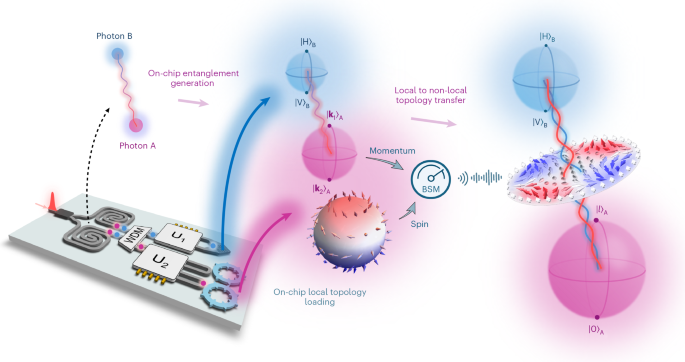
One mathematical form of a relevant correlated photon state is
where and are orbital-angular-momentum labels for photon A and denote polarization states of photon B. Correlation measurements across the relevant state space can reconstruct a map and its winding. The ability to transfer such a topological property between modes and chips is different from noiselessly transmitting the complete unknown bipartite quantum state. This distinction becomes decisive when comparing topology-assisted communication with conventional entanglement distribution and quantum error correction.
Where topology helps, and where it cannot
A skyrmion number is robust under certain continuous deformations only if the field remains well-defined on its domain and the boundary conditions stay appropriate. Spatial filtering can remove part of the required mapping; intensity zeros can make normalization singular; strong scattering can prevent reliable vector-field reconstruction; finite numerical apertures can truncate the optical texture. An optical system can also preserve its skyrmion number while losing optical power or transmitting its bits unreliably. Optical topological resilience must therefore be tested as a property of a specified observable and channel, not treated as a substitute for ordinary error budgets. [4][8]
Likewise, “subwavelength” describes particular near-field features and does not guarantee practical remote imaging beyond diffraction limits. “Room-temperature” refers to the accessibility of many classical structured-light implementations, not a proof that quantum-correlated photon sources, detectors and magnetic materials require no specialist operating conditions. And a proposed optical magnetic-control mechanism is not yet a magnetic-memory product. The applications are compelling precisely because they present experimentally answerable questions instead of universal marketing claims.
Across communication, sensing, adaptive optics and integrated quantum photonics, the common physical idea is to engineer not only what light carries at each point but how its entire vector field fits together. For a receiver, that may mean classifying a distorted global structure. For a sensor, it may mean exploiting a large calibrated local derivative. For a photonic chip, it may mean deliberately transferring a topological observable between quantum degrees of freedom. Optical skyrmions do not abolish scattering, loss or quantum noise. They give scientists a different set of degrees of freedom with which to confront them.
References
[1] Shen, Y. et al., Optical skyrmions and other topological quasiparticles of light, Nature Photonics 18, 15–25 (2024). Review.
[2] Cheng, C. et al., Navigating optical skyrmions—from historical origins to applications: tutorial, Advances in Optics and Photonics 18, 1–104 (2026). Comprehensive tutorial.
[3] Chen, L. et al., Programmable skyrmions for communication and sensing, Nature Electronics 9, 479–488 (2026). Programmable wireless platform.
[4] Topological robustness of classical and quantum optical skyrmions in atmospheric turbulence, Nature Communications 17, 2085 (2026). Experimental turbulence study.
[5] Yang, J. et al., Spin-Manipulated Photonic Skyrmion-Pair for Pico-Metric Displacement Sensing, Advanced Science 10, 2205249 (2023). Displacement-sensing experiment.
[6] Ma, Y. et al., Using optical skyrmions to assess vectorial adaptive optics capabilities in the presence of complex aberrations, Science Advances 11, eadv7904 (2025). Adaptive-optics experiment.
[7] Zhao, H. et al., Chip-mediated manipulation of photonic quantum skyrmions, Nature Physics (2026). Integrated quantum-skyrmion demonstration.
[8] Chen, J., Forbes, A. and Qiu, C.-W., More than just a name? From magnetic to optical skyrmions and the topology of light, Light: Science & Applications 14, 28 (2025). Limits of optical topological protection.
[9] Optical skyrmions from metafibers with subwavelength features, Nature Communications (2024). Metafiber photonics.
[10] Vogliardi, A. et al., Optical Skyrmions with Tunable or Reconfigurable Topology Using Spin-Decoupled Metaoptics, Laser & Photonics Reviews (2026). Integrated metaoptics.
[11] Broadband coloured skyrmions generated by on-chip ferroelectric spherulites, eLight (2026). Broadband on-chip generation.
[12] Kim, J. et al., Photothermal skyrmion tweezer: programmable optical manipulation of magnetic topological quasiparticles, Nature Communications 16, 11375 (2025). Experimental magnetic manipulation.
[13] Bo, L. et al., Magnetic Skyrmion Interacting with Optical Skyrmion, Physical Review Letters 137, 126701 (2026). Micromagnetic theory.
[14] Skyrmionic Topologies of Optical Forces for Stable Separation and Transportation of Chiral Nanoparticles, ACS Photonics (2026). Proposed chiral sorting.
[15] Ornelas, P. et al., Non-local skyrmions as topologically resilient quantum entangled states of light, Nature Photonics 18, 258–266 (2024). Nonlocal entangled skyrmions.
[16] Ornelas, P. et al., Topological rejection of noise by quantum skyrmions, Nature Communications 16, 2934 (2025). Topological observables under noise.
Cover illustration: SPIE, Photonics Focus (2026). Research figures are credited individually to their original publications.