

A chemical reaction is an event, not a molecule frozen at its lowest energy. Bonds stretch, electrons rearrange, and nuclei move along a potential-energy landscape that changes with every atomic displacement. In October 2026, researchers reported using sample-based quantum diagonalization to supply electronic information for molecular-dynamics trajectories reaching roughly 200 femtoseconds. It is an important step toward quantum-assisted simulations of chemistry in motion—and an opportunity to understand precisely what the quantum processor contributes.
Consider a proton shared between two water molecules. A chemical structure tells us where the atoms might be, and a conventional electronic-structure calculation can estimate the energy of a fixed geometry. A reaction trajectory asks something harder: which direction does the proton move, how quickly does the oxygen–oxygen separation respond, and what transient structures appear before equilibrium is restored? To follow that process from first principles, the forces on the moving nuclei must be evaluated repeatedly as the electronic environment changes. For molecules with strongly correlated electrons, calculating those forces can become one of the most expensive parts of the simulation. [1][2]
Sumit Kumar, Kalpak Ghosh, Deepak Kumar and Sharma S. R. K. C. Yamijala addressed this problem in Simulating Chemical Reaction Dynamics Using Sample-Based Quantum Diagonalization: A Quantum-Centric Supercomputing Approach, published online in the Journal of the American Chemical Society on October 12, 2026. They extended sample-based quantum diagonalization (SQD) from static electronic-structure calculations to vibrational frequencies, molecular forces and ab initio molecular dynamics. Their benchmarks include hydrogen vibrations, hydrogen-ion exchange, the chloride–chloromethane SN2 reaction and proton transfer between water molecules. The paper reports trajectories up to approximately 500 time steps (about 200 femtoseconds) across experiments involving noisy quantum hardware and noise models, with comparisons against classical electronic-structure calculations. [3]
The important qualification is that these are hybrid simulations. Quantum hardware provides samples of electronic configurations; classical computers extract low-energy solutions and use electronic information to move the nuclei. That is a different achievement from evolving the complete coupled electron–nuclear quantum wavefunction. Both approaches are active research topics, but they solve different versions of the chemical-dynamics problem.
From the electronic Schrödinger equation to a moving molecule
The Born–Oppenheimer approximation starts by separating the relatively fast electronic degrees of freedom from slower nuclear motion. At fixed nuclear coordinates collected in , the electronic Hamiltonian defines a collection of potential-energy surfaces through an eigenvalue equation:
The ground-state potential includes the relevant electronic energy and the nucleus–nucleus repulsion. In Born–Oppenheimer ab initio molecular dynamics, nuclei are treated classically and move under the force field obtained from the energy surface:
Those compact equations conceal repeated many-electron calculations. Each small nuclear displacement changes the Coulomb attraction to the nuclei, the relevant molecular orbitals and potentially the correlation structure of the electrons. The energy at a single geometry is therefore not enough to predict a trajectory. One needs a function over a continuous region of nuclear-coordinate space, or an algorithm capable of producing fresh energies and forces at successive geometries. Forces calculated with atom-centered basis functions also require the response of the basis to atomic motion, producing the familiar Pulay contributions when appropriate. [2][3]

The common reaction-coordinate diagram compresses an enormous geometry space into a curve. A local minimum corresponds to a relatively stable structure. A saddle point often represents a transition state along a reaction pathway, and the barrier height influences the reaction rate. Real trajectories need not follow a minimum-energy path exactly. Vibrations, thermal energy, solvent dynamics and collisions can steer the system around the landscape in ways that cannot be read from a single stationary picture. An error in the barrier or its derivatives can produce an incorrect reaction mechanism even when a method is accurate near equilibrium.
Why the electronic Hilbert space becomes difficult
In a basis of molecular spin orbitals, the electronic problem can be written in second-quantized notation as a combination of one-electron and two-electron interactions:
Each computational-basis bitstring can represent a particular electronic occupancy pattern. As the number of orbitals increases, the number of possible determinants grows combinatorially; exact diagonalization across all occupations rapidly becomes infeasible. Chemists therefore use approximations such as coupled-cluster methods, density-functional theory and selected configuration-interaction methods, each with different domains of reliability. Quantum computing is attractive because a register of qubits can represent amplitudes associated with many occupation strings without storing the full vector explicitly. But a measured quantum state yields samples, not direct access to all those amplitudes. [4][5]
Sample-based quantum diagonalization: what is really computed?
SQD treats measurement outcomes as candidate Slater determinants. A quantum circuit is prepared so that its output distribution favors chemically relevant electronic configurations. Repeated measurement produces occupation bitstrings, followed by filtering and recovery procedures designed to restore physical electron-number and spin constraints when noisy outcomes violate them. Those samples define a subspace in which a classical computer constructs and diagonalizes a reduced Hamiltonian:
The quantum processor selects a compact part of a vast electronic-configuration space; the classical computer solves the eigenvalue problem in that selected space. The workflow does not magically enumerate the full wavefunction. Important configurations can be missed, hardware errors can corrupt the sampling distribution, and the classical selected subspace can itself become expensive as its dimension grows. The quality of the result depends critically on the overlap between the sampled configurations and the electronically relevant states. A well-conditioned classical diagonalization cannot recover electronic correlation that the selected basis has never represented. [4][5]
In a conventional variational quantum eigensolver, a classical optimizer adjusts circuit parameters to minimize an expected electronic energy. Repeating that optimization for many successive molecular geometries can become prohibitively costly. SQD replaces that repeated circuit-parameter optimization with quantum-assisted configuration sampling and classical diagonalization. This is why the 2026 extension is interesting for dynamics: it aims to reduce an expensive inner optimization loop that would otherwise recur every time the nuclei move. It still relies heavily on classical electronic-integral calculations, selected-space solvers, nuclear-force extraction and trajectory propagation. [3]

Five hundred steps can contain a great deal of chemistry
Molecular dynamics advances atomic positions through discrete time steps, often using an integrator such as velocity Verlet. For nucleus , one part of the update reads
The new electronic forces are then evaluated and used to complete the velocity update. A trajectory lasting 200 femtoseconds at an average step of femtoseconds involves approximately 500 successive force evaluations or electronic-structure updates. A femtosecond is short compared with biological or laboratory reaction times, but it matches important intramolecular vibrations and proton-transfer motions. It is meaningful that quantum-assisted electronic calculations can now support this many correlated steps in benchmark studies, even though the simulations remain short and the examples relatively small. [3]
The new study begins with hydrogen molecular vibration, a clean test of the curvature of an electronic energy surface. It considers proton exchange, , a reactive three-nucleus problem. It then treats the SN2 exchange between chloride and chloromethane, where the carbon–chlorine bond arrangement changes along a substitution pathway. Finally, it studies proton transfer within a small hydrogen-bonded water cluster. Together these systems probe increasing chemical complexity, rather than demonstrating a universal simulation of arbitrary chemistry. The paper's agreement with classical reference methods is an important correctness benchmark; it is not a proof that a quantum computer already outperforms the best classical quantum-chemistry software.
The proton suspended between two water molecules
A useful model for proton transfer is the Zundel cation, , which contains two water molecules sharing an excess proton. A convenient reaction coordinate measures the difference between the proton's distances to the two oxygen atoms. With proton position and oxygen positions and , define
When is negative, the proton lies closer to one oxygen; when positive, to the other. Values near zero indicate approximate sharing. This coordinate is only one projection of the full motion, which also depends on oxygen separation, hydrogen-bond bending and other molecular degrees of freedom. In condensed water, collective solvent fluctuations complicate the story further, so a simulation of a two-water cluster should not be mistaken for a complete simulation of proton transport through liquid water. [3]

The underlying electronic energy profile may change substantially as a hydrogen bond stretches or compresses. Yet Born–Oppenheimer dynamics with classical nuclei still omits nuclear quantum tunnelling and quantum zero-point delocalization. Having a quantum processor involved in evaluating electronic energies does not make the nuclear propagation itself quantum. That distinction is especially important for light hydrogen nuclei, where the difference between a classical trajectory and a quantum nuclear wavepacket may become experimentally consequential.
Why molecular forces and vibrational frequencies are demanding tests
Derivatives of the energy surface matter at least as much as energy values. A gradient supplies forces; the Hessian measures local curvature and can be converted into harmonic vibrational frequencies after translational and rotational modes are accounted for. In mass-weighted coordinates, one writes
Finite differences of energies can estimate gradients and Hessians, but differentiation amplifies statistical fluctuations. Smaller displacements improve the leading truncation error until numerical and sampling noise begins to dominate the difference. Pulay forces from geometry-dependent basis functions can matter as well. A physically reliable trajectory needs forces that remain consistent as the geometry evolves; otherwise small local errors accumulate and may change the simulated reaction path. The October 2026 study's supporting material discusses force evaluation, numerical integration and Pulay contributions. [3]
A second 2026 paper tackled the related problem of obtaining accurate static surface reaction energies at larger electronic active spaces. Barroca and collaborators used density differences between reactant and product configurations to identify chemically important orbitals, followed by quantum-assisted SQD and extended SQD. The work examined oxygen reactions at a lithium surface, using configurations associated with as many as 80 qubits on IBM hardware and comparing results against sophisticated classical approximations. Its task was calculating reaction energies at selected structures, rather than generating a continuous nuclear trajectory. [5]

The relationship between these projects is useful. A chemistry simulation becomes more tractable when the highly correlated part of the electronic problem can be isolated in an active space, while the less demanding degrees of freedom receive a different treatment. Such partitioning also introduces assumptions about the environment and couplings across the boundary of that space. An 80-qubit calculation is a substantial electronic-structure experiment; the number of qubits does not directly quantify the time evolution of atomic nuclei or validate a reaction rate.
Another route: simulating electronic and nuclear motion together
Some important chemistry cannot be captured reliably by following a single adiabatic electronic surface. Near conical intersections and other strongly nonadiabatic regions, electronic states can exchange population while the nuclei move. These processes arise in photochemistry, charge transfer and many excited-state reactions. A fully coupled description includes nuclear kinetic energy as a quantum operator and, in general, entanglement between electronic and nuclear motion. [6][7]
In 2025, Navickas and colleagues published Experimental Quantum Simulation of Chemical Dynamics in JACS. They used a trapped-ion device combining electronic-like discrete states with bosonic motional modes to simulate model nonadiabatic dynamics. The platform demonstrated several molecular models and open-system scenarios using the same experimental resources. It was an experiment in the direct quantum simulation of a designed electron–vibration Hamiltonian, rather than an SQD-assisted Born–Oppenheimer trajectory. Comparing the two approaches demands attention to what is encoded, how faithfully the Hamiltonian represents a molecule and which observable is validated against classical calculations. [7]
The chemistry of real materials adds another layer
Molecules rarely react in isolation. A solvent, catalyst surface or solid electrolyte alters local electric fields, polarization and the available pathways for energy dissipation. A reaction-energy calculation can be a necessary ingredient in predicting chemical behavior without being sufficient to predict a rate. The relevant temperature, surrounding molecular configurations and free-energy barriers may be just as important. Open-system approaches and embedding methods therefore form an essential part of the longer-term ambition of quantum chemical dynamics. [8][9]
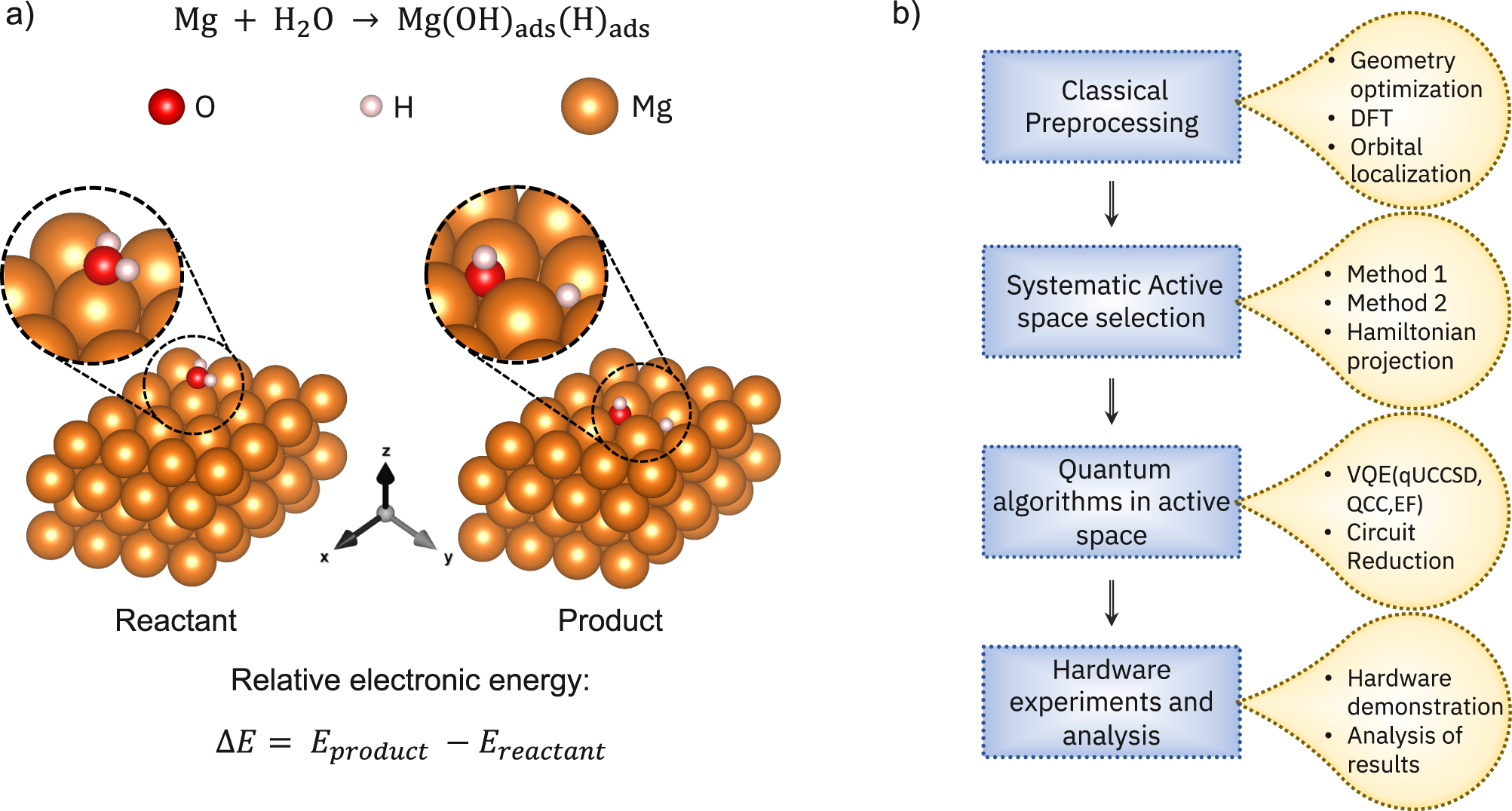
Earlier work on water dissociation at a magnesium surface illustrates the application of localized quantum electronic-structure calculations to a surface reaction. A reactant and product geometry can be used to evaluate a reaction energy, and intermediate structures can be studied to estimate a barrier. But a realistic surface reaction mechanism would also require thermal sampling, additional atoms, interactions with the environment and reliable dynamics. Such calculations are relevant to catalysis, corrosion, battery interfaces and energy conversion because electron rearrangement often controls what chemistry is possible. [8]
What would a real quantum advantage look like?
The standard should be end-to-end performance at specified chemical accuracy, not a headline based solely on circuit width or number of simulated time steps. State preparation, sampling, error mitigation, selected-space diagonalization, evaluation of forces and propagation of nuclei all consume resources. In small chemical systems, classical full configuration interaction, coupled cluster, multireference methods and density-functional approaches remain difficult baselines to surpass. SQD's promise is that hardware-generated samples might help identify correlated electronic configurations that are hard to obtain by classical sampling, but this advantage must be demonstrated under realistic cost and error accounting. [3][4][5]
The significance of the October 2026 experiment lies in a narrower and more valuable advance: it extends quantum-assisted electronic information beyond isolated stationary energies to motion, force curves and vibrational observables. The research gives a concrete route to testing quantum electronic-structure algorithms where chemistry becomes sensitive to errors in derivatives, not just to errors in a final energy. Longer and more chemically complex simulations will demand reliable forces across broader geometries and increasingly realistic environments. That challenge is also what makes molecular dynamics one of the most revealing frontiers for quantum computation.
References
[1] Born, M. and Oppenheimer, R., Zur Quantentheorie der Molekeln, Annalen der Physik (1927). DOI.
[2] Tuckerman, M. E., Ab initio molecular dynamics: basic concepts, current trends and novel applications, J. Phys.: Condens. Matter 14, R1297–R1355 (2002). DOI.
[3] Kumar, S., Ghosh, K., Kumar, D. and Yamijala, S. S. R. K. C., Simulating Chemical Reaction Dynamics Using Sample-Based Quantum Diagonalization: A Quantum-Centric Supercomputing Approach, Journal of the American Chemical Society, published October 12, 2026. DOI.
[4] Robledo-Moreno, J. et al., Chemistry Beyond Exact Solutions on a Quantum-Centric Supercomputer (2024). Research paper.
[5] Barroca, M. A. et al., Scaling active spaces in simulations of surface reactions through sample-based quantum diagonalization, Scientific Reports 16, 28514 (2026). Open-access article.
[6] Subotnik, J. E. et al., Understanding the Surface Hopping View of Electronic Transitions and Decoherence (2016). Review.
[7] Navickas, T. et al., Experimental Quantum Simulation of Chemical Dynamics, Journal of the American Chemical Society 147 (2025). Original experiment.
[8] Quantum computation of reactions on surfaces using local embedding, npj Quantum Information (2023). Open-access article.
[9] Kang, M. et al., Seeking a quantum advantage with trapped-ion quantum simulations of condensed-phase chemical dynamics, Nature Reviews Chemistry 8, 340–358 (2024). Review.
Cover: structural representation of the Zundel cation by Danielchemik, Wikimedia Commons, CC0.