

Quantum information usually spreads. A local disturbance introduced at one atom becomes encoded in complicated correlations among many atoms, and any one site gradually forgets what happened. But in a strongly interacting Rydberg-atom chain, researchers recently observed local information fading and reappearing in space and time. The resulting quantum echo is neither ordinary localization nor a reversal of every microscopic process. It is a consequence of kinetic constraints, and it offers a new way to study how complex quantum systems remember.
Imagine hiding one bit of information in the middle of a line of interacting quantum atoms. If the system is sufficiently chaotic, the bit does not simply hop to the next atom like a bead. Its distinction from another possible initial state spreads into the increasingly intricate many-body wavefunction. A measurement at the original location reveals less and less, even though unitary evolution preserves the global quantum state. This is the basic tension behind quantum information scrambling: globally reversible dynamics can make local information practically inaccessible. [1][2]
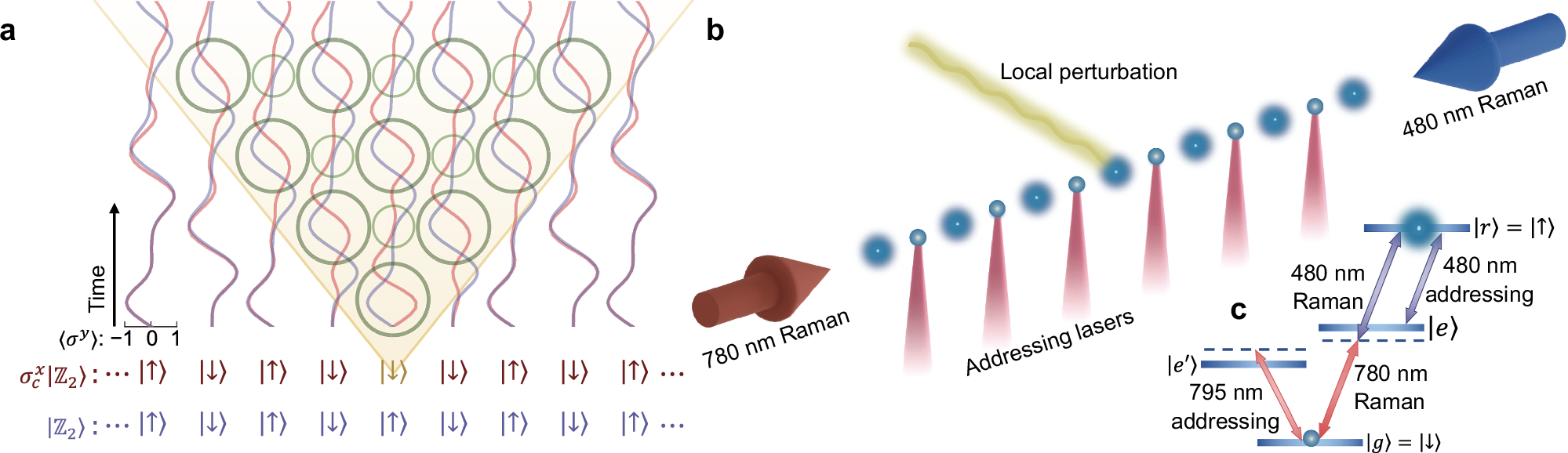
In 2026, De-Sheng Xiang and collaborators reported measurements of out-of-time-ordered correlators (OTOCs) and Holevo information in a strongly interacting Rydberg atom array. Instead of the monotonic-looking local loss of distinguishability often associated with generic ergodic systems, the experiment observed intervals in which initially encoded information became locally undetectable and then accessible again. These collapse-and-revival patterns occupied distinct locations and times across the chain. The experiment used an approximate reversal of many-body evolution and local state tomography to access two complementary views of information transport. [3]
The result does not establish that all scrambled quantum information will naturally reconstruct itself, and it is not a quantum memory whose lifetime is already suitable for a fault-tolerant processor. It shows that specially constrained many-body dynamics can repeatedly reorganize local accessibility of information. The physical mechanism can be expressed with a particularly transparent Hamiltonian.
A blockade that prevents neighboring excitations
Rydberg atoms are neutral atoms in which an electron is excited to a very high principal quantum number. Such excitations have large electric dipole responses, and nearby Rydberg atoms interact strongly. When one atom is excited, the interaction energy can shift a neighboring atom's resonance outside the bandwidth of the laser drive, making a simultaneous nearby excitation energetically unfavorable. This Rydberg blockade provides an experimentally tunable kinetic constraint: whether one spin can flip depends on the states of its neighbors. [4][5]
In an effective two-state representation, let denote the ground-like state and the Rydberg excitation. If the blockade forbids adjacent excitations, an idealized Hamiltonian can be written as
The projectors on either side of ensure that site flips only when both neighbors are in the permitted state. In the conventional notation, if is assigned the eigenvalue. The overall drive coefficient and boundary terms differ across experimental conventions; the essential point is that the Hilbert space is dynamically constrained rather than simply equipped with weak interactions. [3][5]
Contrast this with an unconstrained transverse-field model . Every site rotates independently, so a local flip has no mechanism for producing interacting many-body correlations. Add a nearest-neighbor blockade and an atom's dynamics depends on surrounding occupations. Perturbations spread in a correlated manner but the allowed trajectories through configuration space have a highly structured character. This is why PXP dynamics can host quantum many-body scars: atypical eigenstate and dynamical structures that fail to thermalize in the usual featureless way even though the system is not an ordinary noninteracting model. [5][6]
What exactly does it mean for information to disappear?
There are several inequivalent senses of disappearance. A local density matrix may lose dependence on an initial perturbation, making local measurements unable to infer it. A specific local observable may appear insensitive even though other measurements distinguish the states. Or coherent information may be transferred into long-range correlations, requiring measurements on many sites together. These distinctions matter because unitary evolution never simply destroys the global pure state of an isolated system. One must say which subsystem, measurements and initial states define the information being tracked. [1][2]
Take two initial states and differing by a local operation near a central site. After evolution , the states become , for . Reduced density matrices at a site or small region are
Even if the global states remain perfectly distinguishable, and may become almost identical. Then a measurement confined to cannot reliably identify which initial bit was encoded. If those reduced states separate again at a later time, accessible local information revives. That is the operational phenomenon the Rydberg experiment sets out to probe.
Out-of-time-ordered correlators: the effect of a distant perturbation
Quantum scrambling can also be tested through the growth of operators in the Heisenberg picture. Let be an operator initially supported near site , and let act near site . A commonly used OTOC is
For unitary Hermitian choices such as Pauli operators, a related squared commutator is , provided the same normalization and expectation are used. Initially, separated local operators commute and . As interactions spread the support of , it can fail to commute with , tracing an information-propagation front. [1][2]
An OTOC generally requires an unusual temporal ordering of operations. The Xiang experiment used a digital–analog echo approach: evolve the many-body array forward, apply a local perturbation, then approximately reverse the interacting evolution to read out its effect. An important property of the ideal PXP Hamiltonian makes this unusually natural. If , then each term of the form changes sign under conjugation, so
Consequently, for ideal PXP evolution. This identity enables an echo using appropriate global and local controls. It does not undo experimental errors, interactions beyond the model, atom loss or imperfect state preparation. [3]
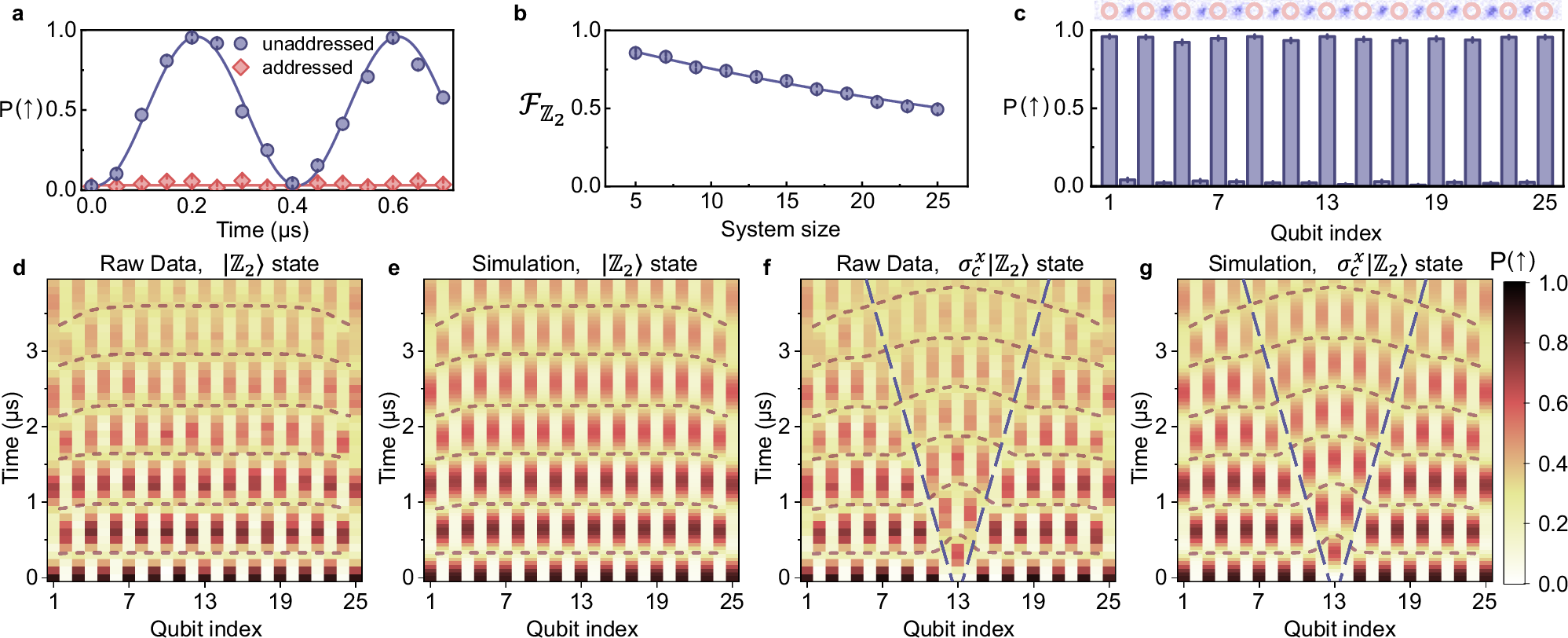
The researchers had to characterize how well the initial atom pattern was prepared and how faithfully time reversal operated. In their measurements, a nominal staggered state was reconstructed with approximately 78% fidelity before accounting for later control errors. That is an experimental input limitation, not a theoretical property of ideal PXP dynamics. The measured OTOC time traces were analyzed with numerical simulations including the experimentally characterized imperfections. [3]

The distinctive pattern: collapse, then revival
The OTOC measurements showed nontrivial spreading away from the initially perturbed site, punctuated by episodes of reduced disturbance and later recurrence. This spatial–temporal structure is unlike the simplest picture of ballistic scrambling in a generic chaotic chain, where information spreads across a light cone and local diagnostics tend toward long-time saturated values. It is also unlike strong many-body localization, where propagation can be extremely slow and a local disturbance remains confined or expands logarithmically. In the Rydberg chain, nearby occupation patterns dynamically obstruct and unblock rotations, producing structured information backflow rather than perpetual stasis. [3]
However, an OTOC alone can become insensitive at certain times for reasons unrelated to total information recovery. If the measured site approaches a nearly pure spin eigenstate, the chosen local Pauli perturbation may cease to provide a useful distinguishing action. In the 2026 data, this limitation occurred during specific approximately half-microsecond intervals. Observing a revival in one diagnostic is therefore not sufficient to conclude that a full qubit has returned. The researchers used a second, more direct measure of reduced-state distinguishability to address this point. [3]
Holevo information: can a local observer read the original bit?
Suppose a sender prepares one of two initial conditions with probabilities and . At a later time an observer is allowed to measure a subsystem . The Holevo information of the reduced ensemble is
where is von Neumann entropy. The Holevo quantity bounds the classical information obtainable from the quantum ensemble through local measurements; it is not identical to the accessible information for every measurement set. When the two local density matrices coincide, . When the states become more distinguishable again, the local Holevo information can increase. [7]
The Xiang experiment compared states prepared from a staggered initial pattern and a locally flipped variant. Local tomography allowed the reduced density matrices to be reconstructed, including off-diagonal components that ordinary occupation measurements cannot directly provide. The resulting space–time plots showed localized information flowing outward, temporarily diminishing and returning. Because this diagnostic depends on distinguishability of reduced states rather than the action of only one butterfly operator, it complements the OTOCs and more directly tests when the initially encoded classical bit is recoverable from a local region. [3]

There is a subtle conceptual boundary here. Measuring local Holevo information for two prepared pure states diagnoses local accessibility of one encoded classical bit. It does not demonstrate high-fidelity recovery of an arbitrary unknown quantum superposition, which would require testing preservation of phase coherence across a complete set of logical states or a suitable channel benchmark. The result nonetheless provides evidence for coherent, structured many-body information dynamics because the experiment combines state-sensitive tomography, echo control and comparison to a specified interacting model.
Many-body scars, thermalization and why this is not a universal memory
Quantum many-body scars are atypical eigenstates or collections of eigenstates embedded in an otherwise complicated many-body spectrum. They can produce revivals from special initial conditions even though generic states at comparable energies look thermal. The PXP model is famous for revivals from staggered initial product states and for near-periodic trajectories in selected parts of its Hilbert space. The experiment's information revivals are connected to kinetic constraints in this general landscape, but the detailed OTOC and Holevo dynamics should not be reduced to a statement that the system simply sits in a single scar eigenstate. [5][6]
Actual quantum memory has additional requirements: reliably encoding arbitrary logical information, retrieving it with fidelity above relevant thresholds, surviving realistic noise and ideally scaling favorably with system size. A kinetic constraint that delays or periodically reverses the loss of a selected classical bit might eventually inform memory architectures, but it neither supplies active quantum error correction nor establishes passive self-correction. Moreover, local recurrences at finite times can coexist with information spreading into the surrounding array between revivals. [3]
Can a quantum system remember without remaining still?
The most interesting distinction revealed by the Rydberg experiment is between suppression of motion and structured motion. Many-body localization impedes transport; the constrained array still permits information to spread across multiple sites and return in a recurring pattern. The information is not protected by permanent isolation. Instead the architecture of allowed transitions shapes its evolution, potentially making recurrence more prominent than expected in a generic strongly interacting system. [3]
This viewpoint has parallels elsewhere in physics. Conserved quantities constrain hydrodynamic transport. Fragmentation of Hilbert space can restrict which configurations communicate. Scar dynamics can select unusual periodic orbits amid generic thermalizing behavior. What makes the 2026 result experimentally substantive is that both operator growth and distinguishability were measured rather than inferred solely from return probabilities of a convenient initial state.
Open questions remain about scaling these patterns to larger arrays, their sensitivity to disorder and long-range interactions, and whether tailored driving can extend the lifetime or reliability of local revivals. The appropriate target may not be an autonomous error-free quantum memory at all. Kinetic constraints could instead supply a tunable test bed for controlled scrambling, quantum simulation benchmarking and dynamical protocols that deliberately steer information across a programmable lattice.
References
[1] Hayden, P. and Preskill, J., Black holes as mirrors: quantum information in random subsystems, Journal of High Energy Physics 2007, 120 (2007). Information scrambling.
[2] Swingle, B., Unscrambling the physics of out-of-time-order correlators, Nature Physics 14, 988–990 (2018). OTOC perspective.
[3] Xiang, D.-S., Zhang, Y.-W., Liu, H.-X. et al., Observation of quantum information collapse-and-revival in a strongly-interacting Rydberg atom array, Nature Communications 17, 6998 (2026). Original experiment.
[4] Saffman, M., Walker, T. G. and Mølmer, K., Quantum information with Rydberg atoms, Reviews of Modern Physics 82, 2313 (2010). Rydberg blockade.
[5] Bernien, H. et al., Probing many-body dynamics on a 51-atom quantum simulator, Nature 551, 579–584 (2017). Programmable Rydberg arrays.
[6] Turner, C. J. et al., Weak ergodicity breaking from quantum many-body scars, Nature Physics 14, 745–749 (2018). Many-body scar theory.
[7] Holevo, A. S., Bounds for the quantity of information transmitted by a quantum communication channel, Problems of Information Transmission 9, 177–183 (1973). Information bound.
[8] Mi, X. et al., Information scrambling in quantum circuits, Science 374, 1479–1483 (2021). Experimental comparison.
Cover photograph: dual-species neutral-atom arrays from a University of Chicago experiment. Chicago Quantum Exchange (2022). This experimental image illustrates programmable atom arrays; it does not depict the 2026 information-revival measurements.