

Autonomous drones already rely on classical computation to interpret sensors and navigate a changing world. Quantum machine learning raises a different possibility: can quantum circuits improve the way such systems learn, even if no quantum processor ever flies aboard the aircraft? The answer depends less on the glamour of quantum hardware than on a hard comparison of data, generalization, physical constraints, and the human responsibility that cannot be delegated to a model.
A remotely piloted aircraft can look autonomous from the ground. It follows a planned route, stabilizes itself against disturbances, and transmits a continuous stream of information from cameras and other sensors. Behind those functions are familiar control systems, communications links, and increasingly sophisticated software. Some functions can be automated without independent authority to use force. That difference matters profoundly: an aircraft capable of flying without constant joystick input is not thereby a weapon permitted to decide whom to attack. The International Committee of the Red Cross (ICRC) emphasizes that the defining concern in autonomous weapon systems is autonomy in selecting and applying force, not merely autonomy in movement. [1][2]
Quantum machine learning, meanwhile, has grown into a serious research discipline. Its models combine statistical learning ideas with quantum states, unitary operations, and measurements. Some employ parameterized circuits in a fashion loosely reminiscent of neural networks; others use quantum feature maps, kernels, or training data generated by a quantum device. These approaches invite questions about representation and computational advantage, but the word “quantum” has sometimes outrun what experiments can substantiate. A quantum neural network is not a miniature artificial brain, and the existence of superposition does not automatically make a classifier more intelligent. [3][4]
The intersection of these two technologies deserves attention for an unusual reason. Military aerospace systems face extreme demands on reliability and human oversight, while quantum processors today face severe demands of their own: environmental isolation, repeated sampling, control electronics, and error management. There is a deep mismatch between what an aircraft needs from its onboard software and what a noisy quantum computer can presently deliver. Understanding that mismatch offers a better entry into the future of quantum learning than imagining qubits mounted beside a drone's camera.
The word autonomous conceals several different decisions
Drone warfare is often discussed as though the machine's level of autonomy were a single property that could be increased by turning a dial. In reality, the distinction among automatic stabilization, supervised navigation, sensor interpretation, and the authorization of lethal force is foundational. Flight-control software can respond automatically to a gust of wind. A route manager can follow human-defined waypoints. A perception system can estimate what is present in a frame. None of these operations by itself establishes that the system makes an independent decision to attack a person or object. [1][2]
An autonomous weapon, as described in the ICRC's updated October 2026 explanation, is a system that, once activated, can select and apply force to targets without another human choosing the particular target. Some such systems may use machine learning, and others may operate using fixed rules. Conversely, a drone may employ sophisticated AI for navigation or environmental monitoring without being an autonomous weapon under that definition. The distinctions cannot be reconstructed from the aircraft's appearance, whether it has an onboard neural network, or whether a human pilot sits nearby. [1]
Any proposed quantum technology must therefore be assigned to a precisely defined role. For research into civilian or humanitarian aerial systems, that role might be improving scientific data analysis, learning physical patterns from measurements, or assisting operators in interpreting uncertainty. In the context of armed systems, computational assistance and autonomous weapon decision-making have radically different legal and ethical consequences. The scientific possibility of classifying a signal cannot on its own establish the legitimacy of acting on that classification.
What a quantum neural network actually computes
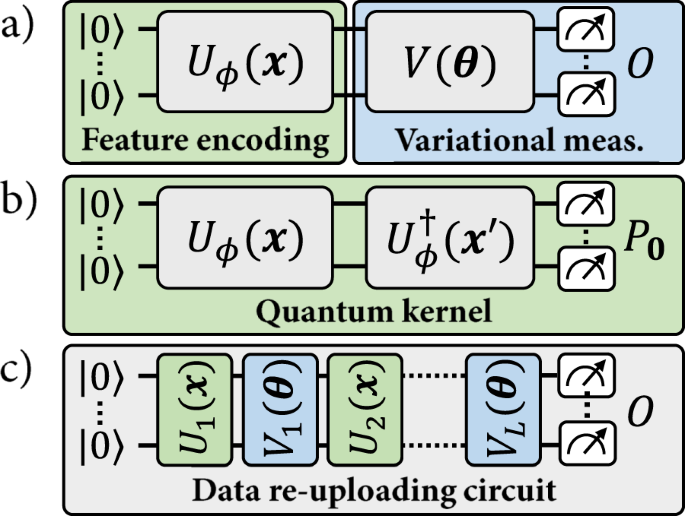
Most near-term quantum neural networks are hybrid constructions. An ordinary computer stores adjustable parameters, prepares an input description, and sends a sequence of operations to a quantum processor. The processor encodes the input into a quantum state, transforms that state using a parameterized circuit, and returns measurement outcomes. A classical optimizer compares the results with training labels and updates the parameters. This procedure is often called a variational quantum circuit or parameterized quantum circuit; it can serve as a component of a quantum classifier or regressor. [3][4]
A simplified prediction rule is written as an expectation value
The input vector is encoded using ; denotes a trainable quantum circuit; and is a Hermitian observable whose expectation supplies a real-valued output. This is a description of a computational model, not evidence that its internal dynamics imitate biological neurons. Training commonly attempts to minimize an empirical loss over labeled examples
There are important practical differences from conventional digital neural networks. Preparing a quantum feature state for a classical image is itself a computational task. The output expectation value must be estimated from measurements; a single circuit run supplies an outcome, not necessarily the desired high-precision prediction. The objective function may have gradients that are difficult to estimate when the circuit becomes large. Moreover, a quantum circuit with a hundred adjustable angles cannot simply be assumed equivalent to a classical network with a hundred trained weights; their representations, inductive biases, and costs are different. [3][5]
Why the data matters more than the word quantum
Aerial vehicles generate primarily classical data. Pixels, inertial measurements, range estimates, timestamps, and telemetry are numbers recorded by conventional devices. Quantum computation does not make these values quantum simply by accepting them as circuit parameters. Encoding a high-dimensional dataset into amplitudes or rotation angles can itself require substantial resources, and reading out a useful answer still produces classical measurement statistics. Claims of asymptotic speedups that assume data can be loaded into a quantum state for free may therefore omit an important part of the practical cost. [3][6]
There are computational problems for which quantum algorithms have provable advantages under their formal assumptions, and there are quantum datasets whose structure makes quantum learning especially attractive. Yet classical-image classification by a small variational circuit is not automatically one of those settings. Benchmarking is complicated by choices of model capacity, data preprocessing, training budget, noise model, and classical baseline. Bowles, Ahmed, and Schuld tested a broad set of popular quantum classifiers against classical alternatives and found that, on the small binary-classification tasks considered, out-of-the-box classical methods generally did better. Removing entangling gates from a quantum model sometimes improved or preserved its performance in the same study. Those findings do not prohibit future quantum advantages, but they rule out an easy inference from the presence of entanglement to practical superiority. [6]
In particular, it is misleading to describe a drone's cameras as an ideal input to quantum neural networks simply because images contain many pixels. The relevant questions concern structure and costs: does the proposed quantum feature map represent something that classical networks cannot efficiently capture; how much computation is needed to encode the data; how many measurements are required; and does the comparison survive after energy, latency, accuracy, and failure behavior are included? Without rigorous answers, “quantum-enhanced vision” remains a research label rather than a demonstrated engineering capability.
The physical computer that would have to fly
A drone's available mass, electrical power, thermal management, and computational latency are not abstract resources. Many current high-performance quantum processors rely on refrigeration stages, extensive microwave or optical control equipment, shielding, and carefully controlled laboratory environments. Their data-processing overhead is shaped by state preparation, repeated circuit execution, classical feedback, and often queueing or network access. This architecture is profoundly different from compact accelerators designed to evaluate a fixed classical neural network in real time.
An onboard prediction system must have a predictable worst-case execution time under the conditions for which it is approved. A variational quantum model instead produces sample-dependent estimates. When measuring an observable with bounded outcomes, the statistical uncertainty of a mean estimated from independent shots generally scales as
The formula illustrates the sampling issue; its constant factors and required confidence depend on the observable and estimator. Repeated measurements impose runtime and energy costs even before network communication or error mitigation. In safety-critical computing, a prediction that occasionally arrives too late or changes under repeated sampling is not equivalent to a reliable deterministic inference engine. The relevant operational metric is not the number of qubits or the apparent expressivity of a circuit but whether a complete validated system meets its requirements under all prescribed conditions.
Even a future fault-tolerant processor would not eliminate the need for a credible interface between sensors, encoded data, numerical output, and human interpretation. Moreover, the aircraft need not carry a quantum processor for quantum research to be relevant. The distinction between training and deployment is particularly promising, and more scientifically grounded, than the picture of a flying dilution refrigerator.
A more interesting possibility: quantum training, classical deployment
In 2024, Jerbi and collaborators published Shadows of quantum machine learning, a theoretical approach that challenges a common assumption about quantum learning. Instead of requiring the trained model to query a quantum device for every new input, their construction uses quantum resources during a preparation or training stage to produce a classical representation for subsequent predictions. The paper establishes complexity-theoretic separation results under specified computational assumptions, while also characterizing limits on what such classically deployed “shadow” models can learn. [7]
The conceptual significance is considerable. If an expensive quantum procedure can produce a useful representation that an ordinary processor later evaluates, then the expensive part of the computation might be separated from the point of use. This does not mean a quantum-trained model is already better at interpreting aerial images or that such an approach is suitable for military applications. It means the location of quantum computation in a learning workflow is a research variable, and the classical deployability of an inference rule can be studied mathematically.

For a responsible scientific research program, this changes the question from “Can a drone carry qubits?” to “Can quantum methods produce transferable computational knowledge that is useful when implemented as ordinary validated software?” A classical output model could, in principle, undergo familiar software testing and deployment controls. But its origin in a quantum training procedure would not relieve it of ordinary burdens of evidence. Generalization to new conditions, measurement bias, distribution shift, and the behavior of uncertain predictions would still require independent demonstration.
The neural network's hardest problem may be learning
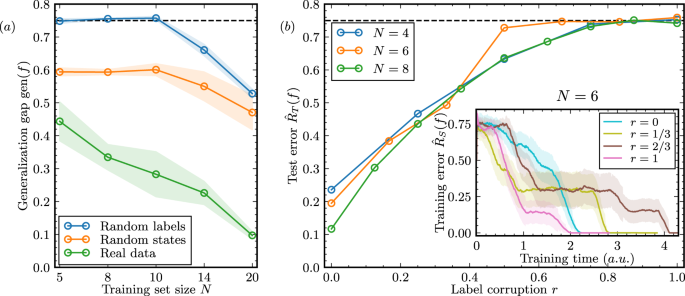
Quantum circuits are not exempt from statistical learning theory. They can overfit, memorize unrepresentative training data, and struggle to generalize beyond the data-generating conditions used to develop them. In one 2024 study, Gil-Fuster, Eisert, and Bravo-Prieto found that tested quantum neural networks could fit randomized labels and randomized quantum states, leading to significant generalization gaps. Their result challenges certain conventional forms of uniform complexity-based generalization reasoning for these model classes. It does not imply that every quantum neural network is incapable of generalizing, or that the same failure has been empirically demonstrated for every classical aerial-image dataset. [8]
Trainability adds another complication. The gradients of some parameterized circuits become exponentially small as their width or depth increases, a phenomenon commonly called a barren plateau. Its occurrence depends on choices of circuit structure, initial state, observable, loss, and noise. The 2025 review by Larocca and collaborators documents why trainability cannot be inferred from having a compact or physically motivated circuit alone. In a supervised prediction setting, a circuit that is expressive but impossible to train under the available shot budget is not a useful learning system. [5]
This expression illustrates exponential gradient-concentration scaling in regimes where the relevant assumptions hold; it is not a universal law for all quantum architectures. An additional statistical challenge is that errors in measured features and class labels can make apparently strong training-set performance irrelevant in a new environment. A robust report should therefore state the dataset, baselines, uncertainty intervals, device noise, sample costs, and tests on held-out conditions, rather than simply presenting an accuracy percentage detached from how it was obtained.
Reliability is not the same as classification accuracy
A scientific model is often judged by expected loss on a distribution of held-out examples. Safety-critical autonomy poses a broader problem. What happens outside that distribution? Can a system recognize that a sensor has failed or that an observation is ambiguous? Does it provide uncertainty estimates that remain meaningful when the environment changes? Can its operators understand the system's limitations, and can a valid decision be withheld when the evidence is insufficient? These concerns arise for classical neural networks as well as quantum ones, but additional sampling randomness and device-dependent behavior can make them harder to audit.
A useful conceptual separation is between prediction quality and decision authority. A classifier returns an output whose meaning is defined by its training labels and evaluation procedure. Authority to act—especially where people may be harmed—depends on human judgement, applicable rules, and responsibility, none of which follows mathematically from a model's confidence score. A system that correctly recognizes visual patterns on a laboratory benchmark has not thereby demonstrated compliance with international humanitarian law, nor has it resolved ambiguity over people, civilian objects, or the broader context of an armed conflict. [2][9]
The ICRC's 2026 briefing on autonomous weapons underscores the practical implications of unpredictability, civilian harm, and diminished human control over force. Its recommendations include excluding unpredictable autonomous systems, ruling out systems designed to autonomously target people, and imposing legally binding limits and supervision on others. States disagree about the precise future international rules, but existing international humanitarian law obligations do not disappear because a decision has been delegated to software. [9]
The overlooked quantum connection may be elsewhere
Quantum machine learning is frequently imagined as a replacement for familiar image classifiers. Yet some of its strongest theoretical motivations concern learning properties of quantum systems, quantum measurement data, and states whose correlations are difficult to describe classically. Rather than treating a military aircraft as a natural home for a quantum chip, one might ask where genuinely quantum data already exists. Quantum sensors, for example, exploit coherence or other quantum effects in metrology, although their measurements must eventually be processed, calibrated, and interpreted by classical instruments. The phrase “quantum sensor” does not mean that its readout demands a quantum neural network, and there is no reason to presume that every sensor dataset contains an exploitable quantum learning advantage. [3][10]
Another possible link lies in advanced scientific simulation and materials design, where quantum computers may someday provide data useful for training classical models of physical processes. These are separate research directions and have not been demonstrated as ways to make an autonomous armed drone's decisions more legitimate or reliable. Their value should be assessed through controlled benchmarks and domain-specific physical results, not through an assumed progression from quantum sensing to quantum targeting.
A useful taxonomy therefore distinguishes three questions. First, is the underlying data quantum or classical? Second, does the computation require a quantum machine during inference, or can the trained representation be evaluated classically? Third, does the scientific application demand an approximate statistical prediction, a provable physical property, or an accountable human decision? Mixing these categories makes otherwise sound research appear more revolutionary than its evidence warrants.
What a credible quantum-learning claim would have to demonstrate
A convincing advance would begin with a fully specified learning task and a defensible reason to suspect a quantum computational advantage. Classical comparators should be competent and tuned, not deliberately weak. Training time, input preparation, measurement shots, error mitigation, inference latency, total energy, and the robustness of deployment should all be included. There should also be independent evaluation on genuinely unseen datasets. In a safety-relevant context, the findings should describe how uncertainty or failure is recognized and why the output cannot be treated as an autonomous authorization to apply force.
Mathematically, the basic demand is end-to-end rather than restricted to a model's idealized internal computation. A useful advantage must persist after the entire cost of evaluation is included:
The expression is a bookkeeping identity for distinct cost categories, not a claimed universal physical metric: each term must be measured in compatible units such as elapsed time, energy, or monetary cost before summation. For models deployed entirely classically after quantum-assisted training, the per-inference quantum term may be absent, while the offline quantum development cost remains. That is precisely why separating training from inference, and specifying what advantage is being claimed, is essential.
A successful academic benchmark of quantum learning may be fascinating even if it never becomes a deployed aerospace component. Conversely, a classical neural network can be an excellent engineering solution without possessing any feature described as quantum. Quantum information research should be judged by what it proves and measures—not by whether it can be inserted into every fashionable application of artificial intelligence.
Where the question leads
The idea of quantum machine learning in drone warfare is interesting because it exposes two very different meanings of technological progress. One is computational: can a new learning architecture process information with demonstrable advantages under realistic physical costs? The other is institutional and moral: what decisions may legitimately be entrusted to a machine, how can its behavior be bounded, and who remains answerable when its output is wrong? Progress on the first does not settle the second.
Quantum neural networks offer a growing mathematical language for learning from quantum and classical data. The current literature also documents formidable obstacles in input encoding, trainability, generalization, and deployment. The more credible near-term vision is not a fleet of qubit-powered aircraft. It is research into where quantum resources provide genuine information-processing value, whether that value can be transferred into classical models, and how all learning systems are evaluated against their actual responsibilities. In a domain where errors can have irreversible human consequences, restraint in the claims made about a technology is part of scientific seriousness.
References and further reading
[1] International Committee of the Red Cross, Frequently asked questions: Autonomous weapon systems (October 8, 2026). https://www.icrc.org/en/article/faq-autonomous-weapon-systems
[2] International Committee of the Red Cross, ICRC Position on Autonomous Weapon Systems (2021). https://www.icrc.org/en/document/icrc-position-autonomous-weapon-systems
[3] Cerezo, M., Verdon, G., Huang, H.-Y. et al., Challenges and Opportunities in Quantum Machine Learning, Nature Computational Science 2, 567–576 (2022). https://doi.org/10.1038/s43588-022-00311-3
[4] Jerbi, S., Fiderer, L. J., Nautrup, H. P. et al., Quantum Machine Learning Beyond Kernel Methods, Nature Communications 14, 517 (2023). https://doi.org/10.1038/s41467-023-36159-y
[5] Larocca, M., Thanasilp, S., Wang, S. et al., Barren Plateaus in Variational Quantum Computing, Nature Reviews Physics 7, 174–189 (2025). https://doi.org/10.1038/s42254-025-00813-9
[6] Bowles, J., Ahmed, S. and Schuld, M., Better Than Classical? The Subtle Art of Benchmarking Quantum Machine Learning Models, preprint (2024). https://arxiv.org/abs/2403.07059
[7] Jerbi, S., Gyurik, C., Marshall, S. C. et al., Shadows of Quantum Machine Learning, Nature Communications 15, 5676 (2024). https://doi.org/10.1038/s41467-024-49877-8
[8] Gil-Fuster, E., Eisert, J. and Bravo-Prieto, C., Understanding Quantum Machine Learning Also Requires Rethinking Generalization, Nature Communications 15, 2277 (2024). https://doi.org/10.1038/s41467-024-45882-z
[9] International Committee of the Red Cross, Autonomous Weapon Systems and International Humanitarian Law: Selected Issues (March 2026). https://www.icrc.org/en/article/autonomous-weapon-systems-and-international-humanitarian-law-selected-issues
[10] Cho, G. and Kim, D., Machine Learning on Quantum Experimental Data toward Solving Quantum Many-Body Problems, Nature Communications 15, 7552 (2024). https://doi.org/10.1038/s41467-024-51932-3
[11] International Committee of the Red Cross, Artificial Intelligence and Machine Learning in Armed Conflict: A Human-Centred Approach, International Review of the Red Cross. https://international-review.icrc.org/articles/ai-and-machine-learning-in-armed-conflict-a-human-centred-approach-913
Cover photograph: U.S. Air Force / Staff Sgt. Brian Ferguson, MQ-9 Reaper in flight (2007), U.S. government public-domain photograph, used as editorial context. It does not depict a quantum-equipped aircraft or a validated autonomous weapon system. Research figures reproduce the original works under CC BY 4.0, credited individually. This article analyzes quantum-learning research and the governance of autonomous systems; it does not describe or endorse autonomous target selection or the use of force by machine-learning systems.