

Imagine constructing a universe from nothing more than a random arrangement of vertices, edges, and faces. As the network becomes enormous, its jagged geometry can approach a continuous random surface, complete with its own notion of distance, area, and diffusion. An October 2026 collection of mathematical manuscripts claims striking new results about this transition—including circumstances in which a quantum-gravity surface gives way to a tree. The mathematics offers a precise laboratory for asking how geometry can emerge from discrete relations.
In everyday physics, space enters first and everything else occupies it. Coordinates tell us where a particle is, a metric determines the distance between events, and curvature describes the gravitational field. But a different starting point is possible. Begin with a finite network whose connections define which points can be reached from which others. Let the network be random. Instead of measuring distance using a ruler already provided by geometry, declare that neighboring vertices are a unit apart. If we sample networks with more and more faces, rescale these graph distances appropriately, and watch what persists, a continuous notion of geometry may arise without ever having been inserted as a smooth background. [1][2]
This is one of the motivations for the mathematical subject of random planar maps. A planar map is an embedded graph considered up to orientation-preserving deformation. Its vertices and edges are combinatorial, but its embedding remembers which faces meet and how. Sampling a map randomly creates a discrete random surface. The result is not an artistic analogy for quantum gravity; in two-dimensional mathematical physics, ensembles of such maps provide concrete discretizations of fluctuating geometry. Their scaling limits are connected to Liouville quantum gravity (LQG), random conformal geometry, Brownian surfaces, and, in certain regimes, random trees. [1][3]
Family 211 of OpenAI's October 2026 mathematics release takes that relationship unusually far. Its manuscripts propose joint geometric and conformal limits of Fortuin–Kasteleyn decorated random planar maps, a critical quantum-sphere limit at , a surface-to-tree transition for , and convergence of diffusion and spectral observables for selected models. The collected manuscripts have different degrees of external validation; the repository's linked Lean documentation specifically formalizes a finite-volume continuum-random-tree claim, not the entire suite of announced surface, diffusion, and spectral theorems. That distinction is important because this is an active research frontier, not a set of already universally accepted new results. [4][5][6]
Building a surface without a smooth surface
Consider a collection of polygonal faces glued along edges. The faces form a connected planar graph; their adjacency encodes a surface's local combinatorics. Triangulations, quadrangulations, and maps with other face degrees are natural examples. Draw any individual map and it looks like a mesh placed inside the Euclidean plane. Yet the way the graph is drawn is not the geometry of interest. Stretching a face on paper or curving a drawn edge need not change the map at all. The intrinsic graph distance counts the minimum number of edges connecting two vertices, independent of how the picture was embedded. [1][2]
where denotes a map and is the number of edges in a path . Every particular realization is finite and discrete; the interesting geometry lies in the probability distribution over many realizations and what happens when the number of edges becomes large. A rescaled metric-measure space may have the form , where tends to zero and is a suitably normalized measure supported on vertices. If a sequence converges in a metric-measure topology, we obtain a continuous random object with intrinsic distance and mass distribution. Its geometry is not simply the Euclidean surface on which the original graph happened to be drawn.
The uniform random planar map is only one ensemble. An embedded statistical-mechanical model can change which geometries are favored. Suppose the map supports a collection of bonds, clusters, or interfaces. Weight maps according to the partition function of that matter system. The large-scale distribution of shapes may change even when the microscopic local rules still describe vertices and edges. This is a rigorous setting for the old physical intuition that matter and geometry affect one another. It also connects combinatorial enumeration, critical statistical mechanics, and two-dimensional conformal field theory. [2][7]

What makes Liouville quantum gravity different
Liouville quantum gravity is a theory of two-dimensional random geometry. The word quantum here does not mean that a laboratory qubit is literally being simulated, and the construction is not a completed theory of our universe's four-dimensional Lorentzian spacetime. Instead, it arises from the mathematical description of fluctuating two-dimensional surfaces, with roots in string theory, conformal field theory, and the quantum-gravity path integral. What makes the subject remarkable is the way a rough random field defines a notion of area and, through additional results, distance. [3][8]
A heuristic expression for a random metric starts from a Gaussian free field and a coupling parameter . If were a smooth function, one might imagine the line element
But is not a well-defined ordinary pointwise function; it is a log-correlated random distribution. Exponentiating it naïvely makes no mathematical sense. The rigorous construction of Liouville area measure uses regularized fields and a compensating normalization that removes the divergent variance. With conventional normalization, it takes the schematic form
The limit is understood in the appropriate sense of Gaussian multiplicative chaos, for suitable regularization and normalization of the field. The resulting measure is typically singular with respect to ordinary Lebesgue measure. Different regions can carry wildly different amounts of quantum area, even when they seem comparable in a Euclidean drawing. A corresponding intrinsic metric is a further nontrivial mathematical object, and the existence and uniqueness theory developed in the early 2020s made a substantial range of such metrics rigorous for subcritical . [8][9]
This leads to a surprising conclusion. A random surface can be topologically a sphere and still have a fractal metric structure very different from a smooth round sphere. In the special pure-gravity case , the resulting Brownian map or quantum sphere has Hausdorff dimension four in its intrinsic random metric, despite remaining a topological two-sphere. The number four here is not a claim that ordinary spacetime has four coordinates emerging from a two-dimensional surface. It measures how metric balls grow in a particular random geometry: its intrinsic area scales anomalously with radius. [8][10]
The heuristic relation highlights the distinction between topological dimension and metric dimension. A topological sphere always has dimension two in the relevant topological sense, but an intricate random metric changes the size and shape of its small balls. The Brownian-map dimension is a theorem for that model; it should not be freely assigned to every other LQG parameter, every decorated random map, or any physical spacetime. That discipline is what gives an otherwise poetic idea—“geometry emerges”—genuine explanatory force.
Two trees that encode a random surface
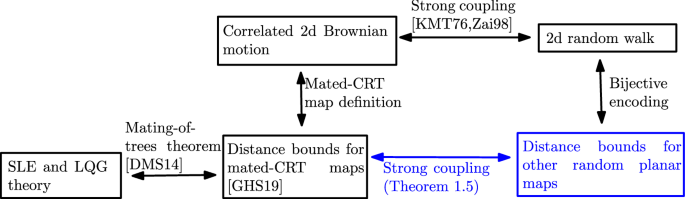
Another remarkable bridge is the mating-of-trees construction. A decorated planar map can often be encoded by a two-dimensional walk whose coordinates describe changes in two interlocking boundary structures. In a suitable scaling limit, these coordinates converge to correlated Brownian motions. Each coordinate can be viewed as encoding a continuum random tree; the two trees are then “mated” by matching their boundaries. The resulting random geometry can be related to a Liouville quantum surface decorated by a space-filling Schramm–Loewner evolution curve. [2][11]
For the standard mated-continuum-random-tree construction in the subcritical regime, a useful formula characterizes the correlation of the two Brownian coordinates and :
This equation does not say that time in our universe must be Brownian, or that every quantum spacetime is assembled from two biological-looking trees. It captures a specific encoding correspondence: correlations in a pair of random processes organize the adjacency and conformal structure of an entire random surface. There is an important theme here. A complex geometric object may be recoverable from a much simpler-looking informational description, provided the correlations retain the necessary structure.
The surface-to-tree transition
The Fortuin–Kasteleyn random-cluster model gives the October results a precise control parameter. Its parameter weights clusters and is related to the number of spin states in the associated Potts model for integer values of . In a typical random-cluster measure, a bond configuration on graph has relative weight proportional to
where controls occupied-bond weight, is the edge set, and counts connected components in the occupied configuration. When the underlying graph is itself random and weighted by its cluster partition function, the statistical physics of the decoration interacts with the probability distribution of geometry. Here is a cluster fugacity—not a qubit count, not an electromagnetic charge, and not the LQG field-coupling parameter . [7][12]
The October OpenAI family claims that a broad range of critical Fortuin–Kasteleyn maps with $0
One way to recognize the change is through the scaling of graph distance. The claim for finite weighted planar maps describes convergence after a deterministic factor of order when the map has edges, with the metric-measure limit given by the Brownian continuum random tree. The specific statement is the topic of the corresponding Lean comparator. The analogous surface regime involves LQG-dependent metric scaling, and one should not assume a single exponent or a smooth manifold for all values of . A topological surface in a finite combinatorial model can therefore approach a tree-like continuum metric object under scaling. [5][12]
The arrow denotes convergence in distribution of random metric-measure spaces under the hypotheses of the claimed finite-volume result; is a model-dependent positive scaling constant. There is no assertion that individual planar graphs become literal trees at finite size. Instead, cycles can become negligible in the macroscopic geometry as the graph grows. For a useful physical analogy, imagine a woven sheet whose threads are always connected into loops at microscopic scale, yet whose long-distance routes after rescaling become dominated by an effectively branching skeleton. [5][12]
The novelty should also be located carefully in the history. In 2025, Yuyang Feng proved a related infinite-volume continuum-random-tree limit for critical decorated planar maps. The OpenAI October manuscripts claim corresponding finite-volume results and additional geometric information. They should be compared with that existing work rather than described as the discovery that the tree regime exists at all. [12]
What happens at the critical value
The border has its own mathematics. In the conventional correspondence it is associated with critical LQG, for which and the ordinary subcritical Gaussian multiplicative-chaos normalization degenerates. Approaching this endpoint requires a critical renormalization and careful control of how area, interfaces, and conformal embeddings behave. A limiting construction that works for every fixed $q<4$ does not automatically extend to $q=4$ simply by substituting the endpoint into all formulas. [4][9]
The October family includes a manuscript on the critical Liouville quantum sphere and geometric limits of the Fortuin–Kasteleyn maps. The central mathematical appeal is continuity at a singular border: can the critical surface be constructed from well-controlled subcritical approximations, and can the limiting embedded maps retain both their geometry and nested interfaces? These are different questions from a finite graph simulation showing a rough-looking surface; they ask for distributional convergence across entire random geometric objects.
That distinction matters for how mathematical figures should be interpreted. Two images may look similarly jagged while representing sharply different random metrics. A visually branched object is not by itself proof that the limiting object is a continuum random tree, and a colored random triangulation is not by itself an LQG sphere. The relevant results concern the law of distances, areas, embeddings, and interfaces simultaneously.
Can diffusion tell us the shape of a universe?
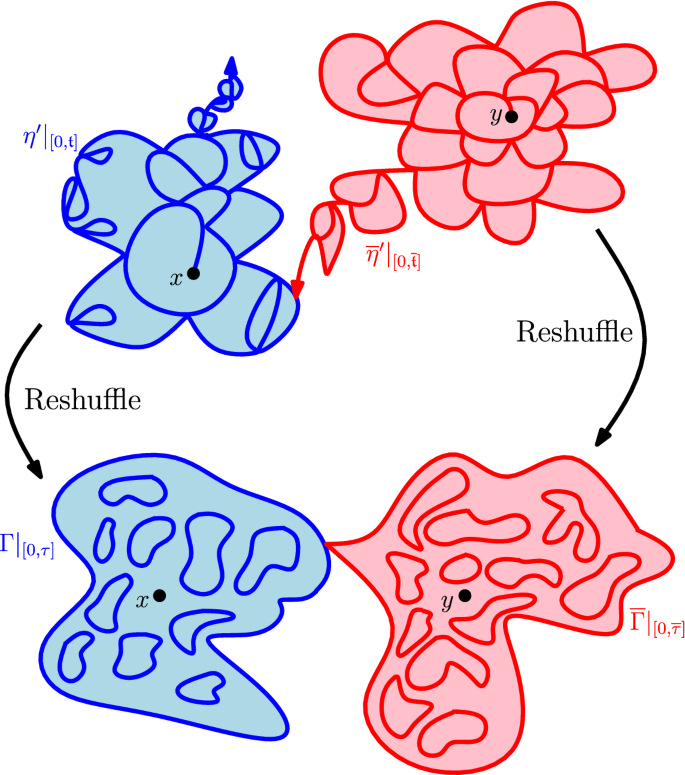
Geometry is not only a question of where points lie. It also determines how things move. A random walker follows edges on a discrete map, and the connectivity constrains how long it takes to travel between regions. If the map converges to an irregular continuum surface, does the random walk approach a continuous diffusion naturally determined by that surface? A strong affirmative result would connect graph distances and geometry with dynamics, not merely with shape. [4][13]
The October result family contains manuscripts proposing convergence of suitably accelerated random walks on selected random planar maps to Liouville Brownian motion. For the Fortuin–Kasteleyn–Ising example, it also claims convergence of spectral quantities associated with the discrete walk, conditional on the specified geometric and electrical inputs. A continuum Dirichlet form or Laplacian can be used to formalize the diffusion generated by the random geometry. On a compact random metric-measure space, an associated heat kernel describes the evolving distribution of a particle-like random walker. The short-time decay of heat return probabilities can reveal properties that geometric dimension alone does not capture. [4][13]
The displayed semigroup uses the conventional factor of one-half in the generator and is schematic: the definitions of and depend on the particular continuum random surface. Some of the October manuscripts derive a specific deterministic time acceleration from the edge count, rather than tuning the clock separately for each sample. Such normalization details are mathematically important; changing the speed of time can conceal a failure of convergence or alter physical comparisons. The rigorous convergence of heat traces and eigenvalues demands control far beyond a visually similar diffusion path. [4]
Geometry is emerging, but which spacetime?
The phrase emergent spacetime carries extraordinary philosophical appeal. If a smooth distance function can arise in the limit of a random combinatorial object, perhaps spacetime is less fundamental than the relations from which it can be reconstructed. But the mathematics developed for random planar maps answers a more precise and limited question: under which probabilistic assumptions do two-dimensional discrete random surfaces converge to specified random metric-measure spaces? [1][3]
Our universe is not described by a Euclidean two-dimensional random surface. General relativity is Lorentzian, four-dimensional at ordinary scales, and dynamically coupled to matter and causality. Planar-map scaling results do not derive Einstein's field equations, establish a microscopic origin for time, or reveal a new experimentally measured quantum-gravity effect. Their value lies in providing a controlled arena in which geometry can genuinely be recovered from a nongeometric-looking microscopic description, with proofs that state exactly which information must survive the limit. [3][8]
This nevertheless has important implications for foundational thinking. A discrete model often contains local adjacency, a probability rule, and observable quantities such as graph distance and random walks. A continuum description contains intrinsic distance, volume measure, conformal structure, and diffusion. Their correspondence shows how qualitatively new mathematical language can become appropriate at a larger scale. Equally important, it shows how different microscopic ensembles can enter the same universality class and why changing a statistical-mechanical parameter can move a model into a wholly different large-scale phase.
The scientific opportunity in a transition from surface to tree
A particularly useful line of future inquiry is to distinguish quantities that are invariant across a geometric scaling limit from those that depend on microscopic representation. Does the limiting object preserve geodesic connectivity, spectral dimension, local curvature in an appropriate generalized sense, and the statistics of critical interfaces? Which observables remain meaningful when an ostensibly surface-like network degenerates into a tree? How does information about a discrete model's loops survive, or fail to survive, at larger scales? The October manuscripts offer conjectural and claimed theorem-level answers for selected ensembles; the broader program remains open.
There is also a methodological lesson from the release itself. The public repository includes complete manuscripts, selected formal proof artifacts, and documentation that sometimes narrows the formalized claim relative to the most ambitious abstract. The finite-volume tree limit is a striking example: its linked Lean document describes a concrete metric-measure convergence result. Other announced geometric, diffusion, and spectral conclusions need to be assessed on their own terms. A release of many papers can expand the space of potentially useful mathematical tools while still requiring careful verification, comparison with prior literature, and repair where necessary. [4][5][6]
A continuous world from a discrete rule
A randomly assembled graph does not look like a smooth universe. It has edges, corners, uneven face sizes, and no distinguished notion of physical length beyond its connectivity. Yet suitable sequences of such graphs can converge toward the Brownian map or other Liouville quantum surfaces, and changes in statistical-mechanical parameters may drive transitions into tree-like geometry. It is a rare situation in which the phrase “geometry emerges from relations” can be made literal, quantitative, and testable in mathematics.
The reported October 2026 results aim to push that bridge further, connecting conformal embeddings and critical interfaces to intrinsic distances, diffusion, and spectra. They are not the final answer to the structure of physical spacetime. They show how much can be learned from a humbler but more rigorous question: if all we begin with is a random pattern of connections, what sort of space can those connections become?
References and further reading
[1] Gwynne, E., Random Surfaces and Liouville Quantum Gravity, Notices of the American Mathematical Society 67 (2020). https://doi.org/10.1090/noti2059
[2] Gwynne, E., Holden, N. and Sun, X., A Mating-of-Trees Approach for Graph Distances in Random Planar Maps, Probability Theory and Related Fields 177, 1043–1102 (2020). https://doi.org/10.1007/s00440-020-00969-8
[3] Miller, J. and Sheffield, S., Liouville Quantum Gravity and the Brownian Map III: The Conformal Structure Is Determined, Probability Theory and Related Fields 179, 1183–1211 (2021). https://doi.org/10.1007/s00440-021-01026-8
[4] OpenAI Mathematics, Mathematics Manuscript Collection: Result Family 211 — Geometric Phase Diagram, Diffusion, and Spectra of Random Planar Maps, catalogue (October 2026). https://github.com/openai/math/blob/main/CONTENTS.md
[5] OpenAI Mathematics, Brownian Continuum Random Tree Limits of Finite Fortuin–Kasteleyn Maps Above Four, manuscript (September 24, 2026). https://github.com/openai/math/blob/main/preprints/Brownian-continuum-random-tree-limits-of-finite-Fortuin-Kasteleyn-maps-above-four-September-24-2026/main.pdf
[6] OpenAI, Sharing AI Progress in Mathematics, release and verification qualifications (October 6, 2026). https://openai.com/index/sharing-ai-progress-in-mathematics/
[7] Feng, Y., Triviality of Critical Fortuin–Kasteleyn Decorated Planar Maps for q Greater Than Four, Probability Theory and Related Fields 194, 299–331 (2026). https://doi.org/10.1007/s00440-025-01424-2
[8] Miller, J. and Sheffield, S., Liouville Quantum Gravity and the Brownian Map I: The QLE(8/3,0) Metric, Inventiones Mathematicae 219, 75–152 (2020). https://doi.org/10.1007/s00222-019-00905-1
[9] Gwynne, E. and Miller, J., Existence and Uniqueness of the Liouville Quantum Gravity Metric for Gamma in (0,2), Inventiones Mathematicae 223, 213–333 (2021). https://doi.org/10.1007/s00222-020-00991-6
[10] Le Gall, J.-F., Uniqueness and Universality of the Brownian Map, Annals of Probability 41, 2880–2960 (2013). https://doi.org/10.1214/12-AOP791
[11] Duplantier, B., Miller, J. and Sheffield, S., Liouville Quantum Gravity as a Mating of Trees, preprint and associated developments. https://arxiv.org/abs/1409.7055
[12] OpenAI Mathematics, Selected Lean Formalization for Result Family 211, finite-volume random-tree comparator documentation. https://github.com/openai/math/blob/main/lean/docs/211.md
[13] OpenAI Mathematics, Random Walks on Critical FK–Ising Maps and Liouville Brownian Motion, manuscript (October 5, 2026). https://github.com/openai/math/blob/main/preprints/Random-Walks-on-Critical-FK-Ising-Maps-and-Liouville-Brownian-Motion-October-5-2026/fk-ising-walk-limit.pdf
Cover artwork: “Fractal space,” based on non-AI fractal-flame works by Jon Zander (Digon3), composite by KennethJorgensen, Wikimedia Commons, CC BY-SA 3.0. It is conceptual editorial art, not a computed sample of Liouville quantum gravity or a figure from the 2026 manuscripts. Research figures are credited to their original open-access papers; source and licensing information is supplied in the captions. Mathematical statements attributed to the October OpenAI release are described as reported claims where independent verification remains incomplete.