

Superfluids resist friction, while crystals resist deformation. A supersolid does both: its atoms arrange into a repeating density pattern without losing collective quantum coherence. In an unexpected 2026 prediction, rotating such a system can create the crystalline pattern, and the arrival of one quantized vortex can destroy it again. At the center of this reversible change is a roton—a finite-momentum excitation whose energy reveals when an apparently smooth quantum fluid is about to reorganize into a crystal.
In an everyday fluid, spinning the container stirs the contents. In a quantum fluid near absolute zero, rotation poses a harder question. The wavefunction describing the entire system must remain single-valued, so its circulation around a closed path cannot take arbitrary values. Vortices enter with discrete winding numbers. Meanwhile, in gases made from strongly magnetic atoms, long-range forces can favor periodic density patterns. What happens when quantized circulation meets the tendency to crystallize? [1][2]
In May 2026, Malte Schubert, Koushik Mukherjee, Philipp Stürmer and Stephanie Reimann answered that question theoretically in Physical Review Letters. They found that angular motion can drive a dipolar Bose–Einstein condensate into a supersolid phase, even when the atomic interaction strength remains fixed. When the system then nucleates a vortex or changes its persistent-current winding, the excitation responsible for density ordering can regain a positive energy gap, allowing the supersolid to return to an unmodulated superfluid. Further increases of the rotation frequency can recreate the crystalline pattern, forming successive supersolid windows. This is a numerical and analytical prediction, not a newly measured experimental alternation between phases. [3]
The surprising part is that the vortex does not merely decorate an existing supersolid. Within the model, it changes which state of matter is stable. To see why, one must connect Landau's original roton concept to the finite-momentum instabilities of ultracold dipolar gases and then account for the piecewise nature of quantum circulation.
The strange minimum in a superfluid's spectrum
Elementary excitations of a weakly interacting Bose gas are usually introduced as phonons: small, long-wavelength density and phase disturbances whose energy grows approximately linearly with momentum. In superfluid helium-4, however, experiments revealed a more intricate spectrum. At increasing momentum, a phonon-like branch first rises, passes through a local maximum called the maxon and then dips into a local minimum at a finite wavevector. The excitations near that dip are called rotons. They are quasiparticles of a correlated quantum liquid, not elementary particles added to the Standard Model. [4][5]
Near a roton minimum at momentum , the energy can be approximated by a quadratic expansion:
The parameters have distinct meanings. sets the characteristic spatial period, , of the associated density modulation. describes the local curvature of the excitation branch; it is an effective parameter, not the bare atomic mass. The roton gap is the minimum energy needed to create the excitation. A small but positive gap describes a soft and easily populated mode. A branch driven to zero energy can indicate instability toward a new configuration, although the actual order and pathway of a transition depend on nonlinearities, finite geometry and fluctuations.
A roton is therefore often a warning of imminent spatial order. When collective density oscillations at a particular wavelength become unusually inexpensive, the liquid is increasingly susceptible to forming a standing density pattern. That possibility has been studied in helium and fractional-quantum-Hall fluids and has become directly tunable in dipolar atomic gases. In 2018, an Innsbruck-led experiment observed roton-mode population in a magnetically dipolar condensate of erbium atoms. Following an interaction quench, peaks appeared at opposite nonzero momenta, with characteristic scaling linked to the confinement geometry. [4][6]
How atoms begin to crystallize while remaining coherent
Dysprosium and erbium atoms have substantial magnetic dipole moments. Besides short-range collisions, they exert anisotropic dipole–dipole forces on one another. In an idealized three-dimensional description, the interaction between aligned point dipoles separated by takes the form
where is the angle between the magnetic-moment direction and the interparticle separation. The interaction is attractive for head-to-tail alignment and repulsive side by side. External confinement reshapes the balance of those forces, while tunable contact scattering and quantum-fluctuation corrections help stabilize droplet and supersolid phases. A confined dipolar gas can therefore have an effective momentum-dependent interaction that makes a finite-wavevector density oscillation much softer than other modes. [2][7]
A schematic Bogoliubov spectrum for a uniform weakly depleted condensate is
Here is an effective interaction after any relevant transverse confinement has been accounted for. This expression is a useful illustration rather than the full extended-Gross–Pitaevskii calculation of a trapped supersolid. Realistic treatments include trap shape, dipolar anisotropy and Lee–Huang–Yang quantum fluctuations; their Bogoliubov–de Gennes modes need not have a single scalar dispersion. Nonetheless the central mechanism survives: if the interaction bracket becomes sufficiently small at , a roton-like minimum appears and can soften toward instability.
In a 2021 Physical Review X experiment, Hertkorn and collaborators measured density fluctuations across the superfluid–supersolid transition of a dipolar gas. Their images exposed spatial patterns associated with roton modes and a rising static structure factor at the relevant momentum. That directly connected a feature in excitation energy to the density fluctuations that precede crystallization. The experiment also probed the coexistence of superfluid and crystal-like sound in the supersolid state. [7]
Why a soft roton is visible in fluctuations
A static structure factor measures equal-time density correlations. With denoting a Fourier component of density fluctuations, a standard normalization is
In a regime where a single excitation branch dominates the dynamic structure factor, the Feynman–Bijl relation suggests
A decrease in excitation energy near finite is therefore associated with an enhancement of density correlations at that momentum. The relation is an approximation or upper-bound construction outside cases where one sharp mode exhausts the density response, especially in a trapped, multibranch supersolid. In the laboratory, the position of a peak in can indicate the preferred modulation scale even when the complete excitation spectrum is difficult to resolve. [5][7]
The roton becomes a bridge between microscopic motion and a macroscopic phase transition. It is neither simply a vortex nor the finished density crystal. It is a collective fluctuation that shows how cheaply the system can rearrange itself into a certain spatial pattern. This is what makes the 2026 rotation result so counterintuitive: rotation can push that mode toward instability, but a quantized change of circulation can pull it back away.
Put the quantum fluid in a rotating frame
Rotation enters many-body mechanics through a change of reference frame. The energy functional relevant to equilibrium in a frame rotating at angular frequency is
The term favors states with angular momentum aligned with the drive. In a dipolar condensate, contains kinetic and trapping energies, contact interactions, the nonlocal dipole interaction and corrections describing quantum fluctuations. Minimizing can yield qualitatively different ground states as varies, even if the contact scattering length and magnetic moment do not change. [3][8]
On a circular ring of radius , a persistent-current state has an integer phase winding . Single-valuedness of the order parameter requires , with the phase increasing by . The corresponding tangential circulation is quantized:
While external rotation varies continuously, changes in integers, subject to vortex nucleation, energetic competition and metastability. In the rotating frame a useful relative speed for a narrow-ring picture is . For a fixed winding sector this relative speed changes continuously as the drive increases. When the favored winding number jumps, changes discretely. Thus has a sawtooth-like structure instead of rising monotonically. [3][8]
The roton leans into the flow
For a Galilean-invariant branch in a locally uniform medium, background flow Doppler-shifts an excitation according to its propagation direction. A minimal one-dimensional expression is
with the sign and branch chosen so that propagation against the relevant flow reduces the excitation energy. More generally, rotation breaks the symmetry between clockwise and counterclockwise modes; a realistic trapped dipolar condensate requires a rotating Bogoliubov–de Gennes calculation. The simple expression captures the physical competition: a finite-momentum roton can be driven down to zero energy when its Doppler shift compensates its gap.
Landau's critical-velocity criterion formalizes the onset of energetic instability in an ideal homogeneous superfluid:
When a roton becomes the cheapest excitation at nonzero momentum per unit momentum, it can control the critical speed even though long-wavelength phonons remain available. This criterion alone does not prove that a stable supersolid will form. The nonlinear energy landscape determines which modulated state follows, and finite-ring excitations occur at discrete wave numbers. It does, however, explain why an initially uniform quantum fluid can suddenly favor a density wave when relative flow becomes sufficiently large. [3][5]
The vortex that undoes the crystal
The new mechanism predicted by Schubert and collaborators is a repeated competition between flow-induced roton softening and discrete changes of circulation. Start with a smooth dipolar superfluid in a narrow annulus. Increase within a fixed winding sector. The effective relative flow grows, and a roton-like branch loses energy. When density modulation becomes favorable, the ring develops an ordered supersolid pattern. Now increase the rotation further: the system can favor the next persistent-current sector, reached through the entry of a quantized vortex or a phase slip. The current changes by one unit of winding. That jump reduces the relative flow acting on the soft mode and can lift it back to a positive-energy roton, restoring an unmodulated superfluid. Further driving can soften the mode once more. [3]

The result is reentrant supersolidity: the supersolid occupies separate windows of the external control parameter rather than one continuous interval. A schematic sequence is superfluid, supersolid, superfluid, supersolid as the angular frequency crosses successive mode-softening and winding-transition thresholds. Such behavior is not guaranteed in every ring or trap. It requires a range of interactions and geometries for which the fluid remains stable while the rotational and density-ordering instabilities compete in the appropriate sequence. The 2026 paper demonstrated it through analytical arguments and numerical energy and excitation calculations in toroidal and more realistic oblate geometries. [3]
There is a subtle use of the term desoftening here. When a supersolid spontaneously breaks translational symmetry, collective phonons associated with shifting the density pattern can be gapless in an ideal infinite system. Restoring the continuous translationally symmetric superfluid phase removes that particular broken-symmetry Goldstone branch, and its precursor can reappear as a finite-energy roton. This does not mean that the overall superfluid phase Goldstone mode has mysteriously acquired a forbidden gap while its global symmetry remains spontaneously broken. The distinct phase and crystal sectors of a supersolid matter. [2][3]
The role of finite geometry and vortex nucleation
A real quantum-gas trap does not contain a perfect one-dimensional ring with a continuum of modes. The 2026 work therefore compared its effective-flow picture against three-dimensional numerical calculations in toroidal and oblate trapping potentials. Finite circumference quantizes accessible modulation wave numbers, droplet arrays can lock into different patterns and vortices need a physically allowed route into the gas. Metastability may cause a winding transition to occur later than an equilibrium phase diagram predicts. [3]
A practical diagnostic of crystallization is the density contrast, defined for neighboring maximum and minimum densities as
A smooth superfluid can have negligible periodic contrast, while a connected supersolid shows a finite repeating modulation. Very large contrast may also occur in nearly isolated droplets that no longer possess global coherence, so contrast alone cannot prove supersolidity. Measurements of coherence, interference and superfluid response are needed alongside density imaging. In 2024, Casotti and collaborators experimentally observed quantized vortices in a dipolar supersolid, demonstrating that rotating a density-modulated quantum state can produce the hallmark circulation of a superfluid. Their observation is important context for the 2026 proposal but does not constitute experimental verification of multiple reentrant windows. [9]
A 2025 Nature Physics study then examined synchronization in rotating supersolids, finding that vortex nucleation can lock the rotation of the supersolid structure to the external drive. Taken together, these experiments show that it is realistic to study rotational dynamics and vortices in ultracold supersolid gases. The specific prediction that vortices repeatedly restore the unmodulated phase remains an experimentally testable next step. [10]
Another surprise: heating can help a roton crystallize
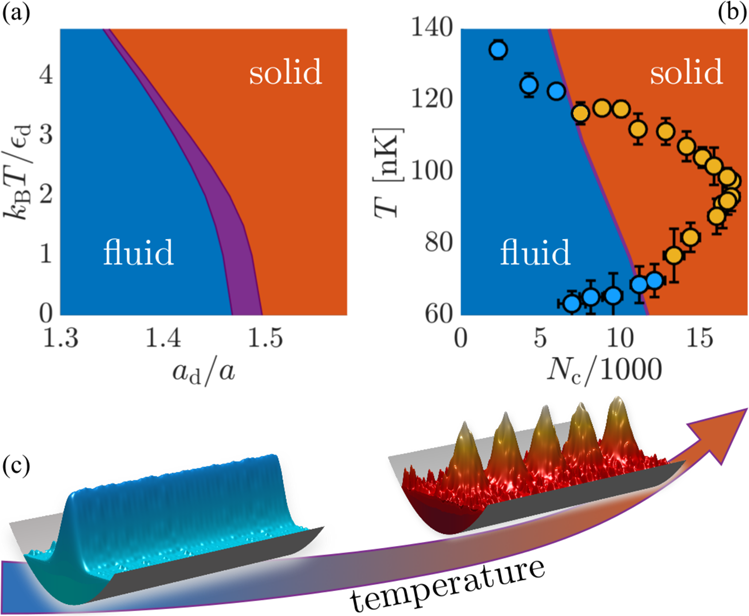
Temperature might seem to be the natural enemy of order. Yet dipolar gases offer a second, distinct mechanism for producing a density-modulated phase. In 2023, Sánchez-Baena and collaborators showed that thermal fluctuations in an ultracold dipolar fluid can lower the roton energy and favor a transition from an unmodulated condensate into a supersolid as temperature increases over a controlled range. The mechanism depends on how thermal excitations feed back into the condensate's effective nonlinear interactions. It is not conventional melting run in reverse for an arbitrary material. [11]

That result and the new rotation proposal illuminate different controls over the same spectral instability. Thermal fluctuations change the energetic preference for density modulations, while rotation tilts propagating modes and quantized circulation intermittently resets the relative flow. Both alter the roton gap, but neither should be represented by a universal formula applicable to every superfluid. The interesting possibility is to combine controlled heating, interaction tuning and rotation to trace different paths through the supersolid phase diagram, with vortex formation identified by interference and coherent flow response.
Rotons beyond magnetic atoms
The roton concept is no longer confined to helium or lanthanide Bose gases. A June 2026 Communications Physics study by Arnone Cardinale, Bland and Reimann predicted roton instabilities and supersolid regimes in microwave-shielded ultracold polar molecules. Molecular electric dipoles can be stronger and more tunable than magnetic atomic dipoles, but collisions and losses make these systems experimentally demanding. The authors benchmarked a specially adapted extended mean-field description against path-integral quantum Monte Carlo and found that elliptically polarized microwave shielding could adjust the anisotropy and promote finite-momentum instabilities. These are predictions in a molecular model, not an experimental observation of the vortex-driven reentrant phase. [12]

In the molecular case, the interaction itself can be reconfigured through microwave polarization; in the rotating atomic case, angular momentum changes the relative motion of the condensate's excitation spectrum. That distinction is useful: a roton is best thought of as a feature of collective response that can arise from quite different microscopic interactions. The same type of finite-wavevector softening can warn of density ordering in systems whose constituents, experimental controls and eventual crystalline patterns differ sharply.
What would convince an experimentalist?
An experimental demonstration of vortex-driven reentrance would require more than seeing a periodic density profile after stirring. The decisive evidence would be a reproducible sequence of phases at roughly fixed interactions while sweeping the rotation frequency, paired with independent observations of circulation changes. An experiment could image density contrast, reconstruct coherence or interference patterns, measure the onset of vortex cores and use spectroscopic probes to observe a roton branch softening and subsequently reopening. Crucially, the winding changes should coincide with the predicted restoration of the smooth superfluid rather than merely with loss of atoms or heating from an unstable rotating trap.
Repeated sweeps in both directions would help separate equilibrium reentrance from dynamical hysteresis, delayed vortex nucleation or transient fragmentation. Finite temperature and atom-number variation must be characterized because both can move transition locations. A spectrum with a finite-energy roton after the density modulation disappears would be especially persuasive evidence for the proposed desoftening mechanism, although extracting a trapped supersolid's full spectrum remains nontrivial.
The broader significance is that a topological defect, the quantized vortex, need not be a passive inhabitant of a crystal-like quantum fluid. It can help decide whether that crystalline order exists. Rotons expose the instability through the excitation spectrum, while winding-number jumps provide a discrete mechanism for turning the instability on and off with a continuous external control. This is a richer form of quantum-fluid engineering than merely spinning a condensate faster, and a particularly sharp experiment for testing how broken symmetries, collective modes and topological defects influence one another.
References
[1] Landau, L. D., The theory of superfluidity of helium II, Journal of Physics USSR 5, 71 (1941). Historical introduction of the superfluid excitation criterion.
[2] Recati, A. and Stringari, S., Supersolidity in ultracold dipolar gases, Nature Reviews Physics 5, 735–743 (2023). Perspective.
[3] Schubert, M., Mukherjee, K., Stürmer, P. and Reimann, S. M., Vorticity-Crystalline Order Coupling in Supersolids: Excitations and Reentrant Phases, Physical Review Letters 136, 183401 (2026). 2026 theoretical research.
[4] Chomaz, L. et al., Observation of roton mode population in a dipolar quantum gas, Nature Physics 14, 442–446 (2018). Roton observation.
[5] Pitaevskii, L. and Stringari, S., Bose-Einstein Condensation and Superfluidity, Oxford University Press (2016). Foundations of excitations and superfluid response.
[6] Petter, D. et al., Probing the roton excitation spectrum of a stable dipolar Bose gas, Physical Review Letters 122, 183401 (2019). Spectroscopy of rotons.
[7] Hertkorn, J. et al., Density Fluctuations across the Superfluid-Supersolid Phase Transition in a Dipolar Quantum Gas, Physical Review X 11, 011037 (2021). Experimental density fluctuations.
[8] Fetter, A. L., Rotating trapped Bose-Einstein condensates, Reviews of Modern Physics 81, 647–691 (2009). Rotation and vortices.
[9] Casotti, E. et al., Observation of vortices in a dipolar supersolid, Nature 635, 327–331 (2024). Experimental vortex observation.
[10] Poli, E. et al., Synchronization in rotating supersolids, Nature Physics 21, 1820–1825 (2025). Rotational synchronization.
[11] Sánchez-Baena, J., Politi, C., Maucher, F., Ferlaino, F. and Pohl, T., Heating a dipolar quantum fluid into a solid, Nature Communications 14, 1868 (2023). Thermal roton softening.
[12] Arnone Cardinale, T., Bland, T. and Reimann, S. M., Exploring supersolids of single-microwave shielded molecules via exact and mean-field theories, Communications Physics 9, 191 (2026). Molecular supersolid predictions.
Cover illustration: roton quasiparticles in a dipolar atomic gas, University of Innsbruck (2018). Scientific figures are individually credited to their original open-access publications.