
The molecule that links a spin to a photon
A useful quantum-network node must perform two tasks that are usually optimized in different materials. It must preserve a quantum state long enough for remote operations, and it must emit or absorb light whose properties depend coherently on that state. Electronic spins can retain information while optical photons can carry it, but a practical interface needs narrow and stable optical transitions, selective spin preparation, and reproducible readout. Colour centres in diamond and silicon carbide have supplied many of the strongest demonstrations. Molecular chemistry now offers a second route, in which the active quantum system can be designed atom by atom rather than created as a defect in a covalent crystal [1,5,6].
On 28 October 2026, Simon Roggors and collaborators reported a single organic molecule that combines optical addressability with coherent control of its ground-state spin [1]. Their active species is a triplet carbene embedded in a carefully matched molecular crystal. At 4.5 K, isolated molecules exhibit optical lines only 38(2) MHz wide, spectral centre-frequency fluctuations of roughly 2.4–2.6 MHz over an hour, and spin coherence lasting 2.2(3) ms under an XY8 dynamical-decoupling sequence. The spin-lattice relaxation time reaches 21(2) ms. The result moves molecular spin optics beyond ensemble-averaged signals to individually resolved, microwave-controlled emitters.
These numbers describe different physical resources and should be kept separate. An optical linewidth measures how sharply the molecule interacts with resonant light. A spin coherence time measures the persistence of phase information in a chosen spin superposition. Fluorescence contrast measures how strongly a measurement distinguishes spin populations; it is not automatically a single-shot readout fidelity. The central achievement is that all three capabilities can be examined on the same addressable molecular species.
Chemical structure as a quantum-control parameter
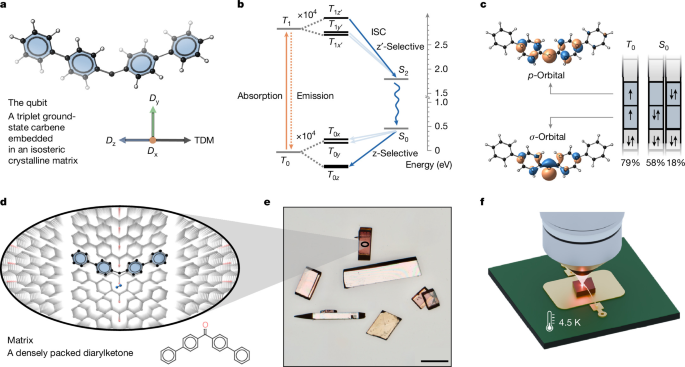
The molecule is di([1,1′-biphenyl]-4-yl)carbene. Its central divalent carbon and nearby aromatic orbitals support two unpaired electrons whose exchange interaction favours a spin-triplet ground state. The molecule is embedded substitutionally in a crystalline ketone host, di([1,1′-biphenyl]-4-yl)methanone, chosen because its geometry resembles that of the active carbene. A photoactivatable diazo precursor is incorporated during crystal growth; focused illumination releases nitrogen and creates the carbene at selected locations [1,2]. This lets the experimenters regulate the density of optically active spins without having to place every molecule individually.
The host is important for more than mechanical support. It constrains the biphenyl groups to an almost planar arrangement, reducing geometry changes during optical excitation, while its edge-to-face packing limits electronic overlap with neighbouring molecules. A more rigid, electronically isolated environment can concentrate emission into a zero-phonon line and reduce fluctuating perturbations to the transition energy. The paper combines crystallography, spectroscopy and multireference electronic-structure calculations to support this design. The calculations predict a triplet–singlet energy separation of about 0.47 eV, consistent with a robust triplet ground state under the experimental conditions [1].
For a dimensionless spin-one operator , a standard effective zero-field-splitting Hamiltonian in frequency units is Here and encode anisotropy and is the Zeeman energy. The triplet has three magnetic substates, making it possible to choose a pair as a qubit while exploiting the third in optical pumping. The experiment resolves transitions at 10.618 and 11.700 GHz, corresponding to ground-state parameters GHz and MHz [1].
The earlier ensemble study of the same carbene family demonstrated optically detected magnetic resonance and a 157(4) μs coherence time at 5 K [2]. The new single-molecule experiments use a related chemical strategy, but the reported millisecond coherence is obtained under a specified decoupling sequence. It must not be compared with an unprotected free-precession time as though the measurement protocols were identical.
Finding the optical transitions that carry spin information
At low temperature, ensemble fluorescence contains zero-phonon features near 594.18 and 595.04 nm, accompanied by a broader phonon sideband. About 19% of the total fluorescence lies in the zero-phonon features. The investigators concentrate on the longer-wavelength site and sweep a narrow laser across its optical resonance while collecting red-shifted fluorescence. Microwave fields resonant with ground-state spin transitions alter the intensities of selected optical peaks, establishing a connection between optical frequency and spin sublevel [1].
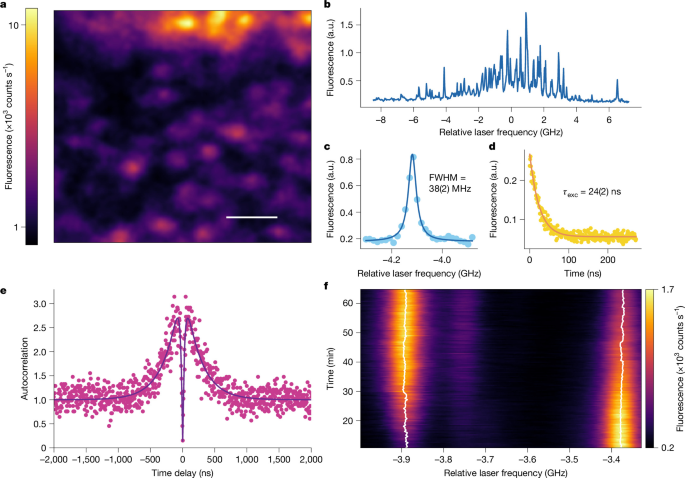
The relevant transition energy is . A narrow distribution of wavelengths corresponds to a narrow distribution of transition energies, but the measured ensemble width is affected by differences among molecular sites. The ensemble excitation lines have widths of order 3 GHz. Their much narrower single-emitter counterparts reveal how much of that broadening comes from molecule-to-molecule variation rather than rapid fluctuations of one molecule. This distinction matters for remote interference: separate emitters can be tuned into resonance only if each emitter is sufficiently stable once selected.
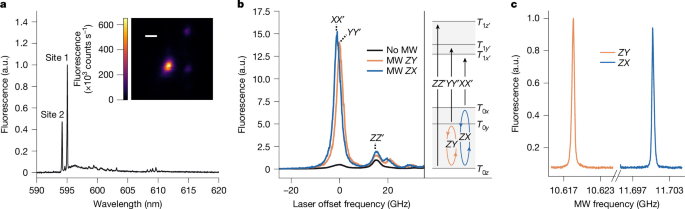
The mechanism uses intersystem crossing, a spin-dependent nonradiative pathway between electronic multiplets. Excitation and subsequent decay favour population of a particular triplet ground-state sublevel. A resonant microwave pulse can transfer population into a brighter optical cycling transition, changing the measured photon count. The resulting optically detected magnetic resonance supplies both an initialization mechanism and a route to reading out spin dynamics. The large separation between spin-selective optical transitions helps suppress unwanted excitation of neighbouring spin channels.
How to establish that one molecule is emitting
A diffraction-limited bright spot is suggestive, but it is not by itself proof of a single emitter. The decisive test is photon antibunching. The team sends fluorescence to a Hanbury Brown–Twiss correlation measurement and finds a zero-delay second-order correlation of [1]. In the ideal single-photon limit, simultaneous detections are suppressed because one isolated emitter cannot emit two photons in the same elementary decay event. For classical stationary light with a Poisson distribution, the benchmark is ; an observed value below 0.5 is commonly used to identify a predominantly single-emitter signal under the stated background model.
The normalized correlation can be written as where colons denote normal ordering of the detected intensity operators. The measured dip at zero delay, together with sparse spatial fluorescence and resolved optical lines, supports the single-molecule assignment. It does not imply that every detected photon is collected with unit efficiency, nor that all emitted photons are mutually indistinguishable.
The single-molecule optical resonance has a full width at half maximum of 38(2) MHz. A separately measured excited-state lifetime of 24(2) ns gives a lifetime-limited linewidth The observed resonance is therefore about 5.8 times broader than the lifetime limit. The authors attribute much of the additional broadening to coupling with low-energy vibrational modes, supported by temperature-dependent measurements. The molecule is optically stable on the scale of an hour, but its photons are not yet demonstrated to have transform-limited linewidths [1].
From fluorescence to coherent spin control
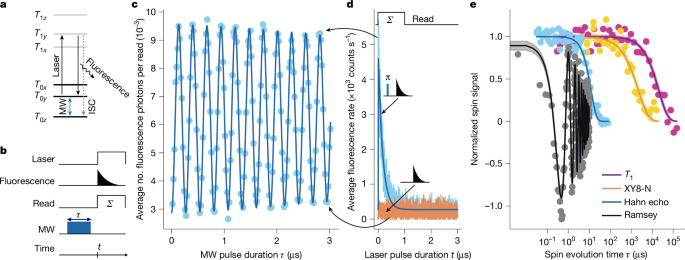
The experiment next uses resonant microwaves to rotate the selected electron-spin subspace. Following optical pumping into a preferential ground-state sublevel, a microwave pulse drives transitions between two triplet states. Varying its duration produces Rabi oscillations in the subsequent fluorescence, with a measured oscillation frequency of about 3.7 MHz [1]. This is the operational bridge from spectroscopy to quantum control: the spin can be initialized, rotated and interrogated using distinct optical and microwave stages.
In the rotating-wave approximation, an ideal resonantly driven two-level subspace obeys The measured oscillations are affected by finite optical contrast, decoherence and the fact that the physical system is a triplet rather than an isolated mathematical qubit. Nevertheless, their phase-coherent dependence on microwave-pulse duration demonstrates controlled population transfer. Optical pumping is not perfectly nondestructive: repeated excitation can itself depolarize the spin, which must be accounted for in any future readout protocol.
Different pulse sequences reveal different noise timescales. Free-precession Ramsey interferometry gives μs; a Hahn echo extends coherence to 12.2(6) μs; an XY8 sequence suppresses slowly varying environmental fields and yields ms. A separate relaxation measurement gives ms at 4.5 K. These are measurements of distinct processes, not four estimates of one universal memory lifetime. The echo and XY8 results show that a substantial part of the phase noise can be refocused by control pulses [1,7].
For a simplified phase-damping channel, the average storage fidelity of an equatorial superposition is often expressed as Taking the XY8 coherence time and μs gives approximately 99.1%, conditional on that exponential model and the use of the corresponding protection sequence. This is an estimate for memory preservation, not a demonstrated end-to-end fidelity for storing and retrieving a flying photonic qubit. In particular, spin–photon entanglement, remote interference and network heralding were not demonstrated in this experiment.
What a network node would still need
Quantum networking typically converts a local spin state into correlations with an emitted photon, interferes photons from distant nodes, and conditions subsequent operations on a heralding detection event. The success probability depends on how often the emitter produces a useful photon, how much light can be collected, how indistinguishable the photons are, and how long the spin remains coherent during repeated attempts [5,6,8]. A single stable molecular line is an essential ingredient, but it does not by itself implement a quantum repeater.
The measured photoluminescence quantum yield is 10.8%, while the zero-phonon fraction is about 19%. Their product is approximately or 2.1% of excitations producing photons in the zero-phonon channel under the experiment's accounting. Collection efficiency, optical coupling, detection losses and the probability of a successful entanglement protocol further reduce the usable rate. Typical detected counts were only about s for an isolated molecule. The authors discuss cavity enhancement, improved chemistry and integrated photonics as routes to a brighter interface [1].
Spin-selective transitions are separated by at least 1.555(1) GHz, considerably larger than the 38 MHz measured optical linewidth. This is promising for selective excitation and for future cavity engineering, where stronger light–matter coupling can increase useful emission while potentially modifying linewidth and branching ratios. The optical transition is in the visible, around 595 nm; long-distance fibre links generally favour telecommunications wavelengths. Frequency conversion could bridge that mismatch, but no such conversion of this molecular emitter was demonstrated in the new study.
Diamond-based nodes have already distributed entanglement across several network stations, and silicon-vacancy platforms have demonstrated memory-enhanced quantum communication [5,6]. The molecular result should be assessed against those operational benchmarks rather than interpreted as a completed network. Its distinctive advantage is the prospect of chemically defined emitters that could be deposited onto prefabricated photonic circuits with less aggressive processing of the optical host.
Two other ways chemistry is reshaping spin optics
Organic spin systems are not limited to one carbene architecture. In 2025, Chowdhury and collaborators studied a luminescent diradical formed from two trityl-based radical groups linked through a fluorene bridge [3]. Its electronic structure supports a bright triplet excitation and a charge-separated singlet excitation, producing photoluminescence bands near 640 and 700 nm. The authors measured spin-selective optical response and coherent microwave control, with photoluminescence contrast reaching about 8% at resonance. Those results concern a different molecular platform and do not establish the single-molecule performance or millisecond coherence measured by Roggors and colleagues.

The diradical experiment illustrates how a Hubbard-like charging energy and exchange interactions can shape which electronic excitations are optically bright. A schematic minimal model is The hopping and onsite interaction govern the balance between localized spins and charge-transfer configurations. Real molecules require a much richer orbital description, but this model explains why chemical bridges and substitution patterns can change the optical access to correlated spin states [3].

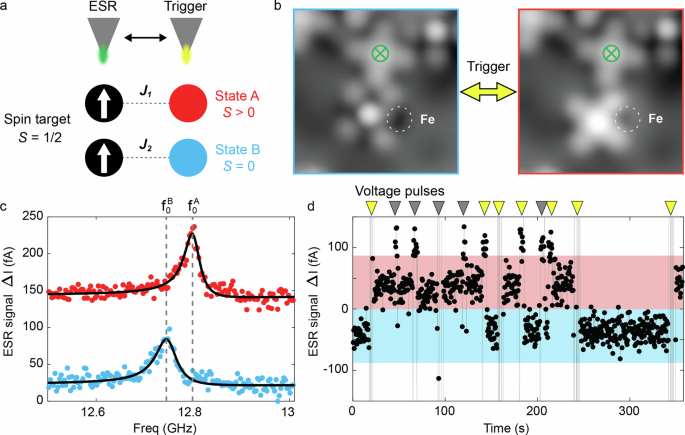
Another direction uses electrically switched molecular configurations to control magnetic coupling. Huang and colleagues assembled an Fe atom with an iron-phthalocyanine molecule on a magnesium-oxide surface, switching the complex between magnetic configurations using a scanning-tunnelling-microscope tip. The switch changed the electron-spin-resonance frequency of a nearby target molecule [4]. This operates at a very different temperature and with a different readout architecture from the carbene emitter, but it shows how molecular structure can be used to tune interactions between individual spins.
The remaining materials problem
A chemically defined molecule is reproducible in its bonding pattern, yet the surrounding crystal still matters. Different substitutional sites produce distinct zero-phonon lines; vibrational modes broaden the homogeneous optical resonance; and light exposure can eventually photobleach the emitter. The study reports an estimated continuous-illumination photobleaching lifetime of roughly 119 hours under the examined conditions [1]. That is encouraging for laboratory characterization but is not an endurance qualification for an integrated network device. Long-term stability under repeated initialization, readout and photonic coupling remains to be measured.
There is also a trade-off between spin isolation and optical brightness. Weak spin–orbit coupling in light-element organic molecules can protect spin coherence, while radiative transitions, intersystem crossing and photoluminescence efficiency must all be engineered to enable useful readout. The new system's large spin-selective frequency separation provides room for optimization, but increasing emission rates through a cavity or chemical substitution can alter the very dephasing and pumping channels that make the molecule attractive. A credible design programme must measure those quantities together.
The next decisive experiments would interfere photons from two independently prepared carbene molecules, quantify two-photon visibility and spin–photon entanglement fidelity, and establish heralded remote spin correlations. Integrated resonators could test whether optical enhancement raises the useful zero-phonon rate without destroying hour-scale spectral stability. Controlled isotope substitution and lower-temperature measurements could probe nuclear-spin and vibrational noise independently. None of these outcomes follows automatically from the present measurements; each is a separate engineering and physics milestone.
The significance of the 2026 experiment lies in making a molecular spin optically addressable at the single-emitter level while retaining coherent control on a millisecond scale. The chemistry determines the electronic structure, the crystal determines the local optical environment, and microwave control determines how long phase information survives. Bringing those three design variables into one measured system gives molecular quantum optics a concrete platform on which to test the requirements of a network node.
References
- S. Roggors, T. Unden, A. Aubele et al., “A single-molecule spin–photon interface,” Nature 658, 1153–1159 (2026; published 28 October). doi:10.1038/s41586-026-11147-6.
- S. Roggors, N. Striegler, T. Unden et al., “Optically Detected Magnetic Resonance on Carbene Molecular Qubits,” Journal of the American Chemical Society 147, 36383–36392 (2025). doi:10.1021/jacs.5c10272.
- R. Chowdhury, P. Murto, N. A. Panjwani et al., “Bright triplet and bright charge-separated singlet excitons in organic diradicals enable optical read-out and writing of spin states,” Nature Chemistry 17, 1410–1417 (2025). doi:10.1038/s41557-025-01875-z.
- W. Huang, K. H. Au-Yeung, P. Greule et al., “An electrically controlled single-molecule spin switch,” Nature Communications 16, 8242 (2025). doi:10.1038/s41467-025-63574-0.
- M. Pompili, S. L. N. Hermans, S. Baier et al., “Realization of a multinode quantum network of remote solid-state qubits,” Science 372, 259–264 (2021). doi:10.1126/science.abg1919.
- M. K. Bhaskar, R. Riedinger, B. Machielse et al., “Experimental demonstration of memory-enhanced quantum communication,” Nature 580, 60–64 (2020). doi:10.1038/s41586-020-2103-5.
- G. de Lange, Z. H. Wang, D. Ristè, V. V. Dobrovitski and R. Hanson, “Universal dynamical decoupling of a single solid-state spin from a spin bath,” Science 330, 60–63 (2010). doi:10.1126/science.1192739.
- S. Wehner, D. Elkouss and R. Hanson, “Quantum internet: A vision for the road ahead,” Science 362, eaam9288 (2018). doi:10.1126/science.aam9288.
- B. Hensen, H. Bernien, A. E. Dréau et al., “Loophole-free Bell inequality violation using electron spins separated by 1.3 kilometres,” Nature 526, 682–686 (2015). doi:10.1038/nature15759.
- L. R. B. Picard, A. J. Park, G. E. Patenotte et al., “Entanglement and iSWAP gate between molecular qubits,” Nature 637, 821–826 (2025; online 13 November 2024). doi:10.1038/s41586-024-08177-3.