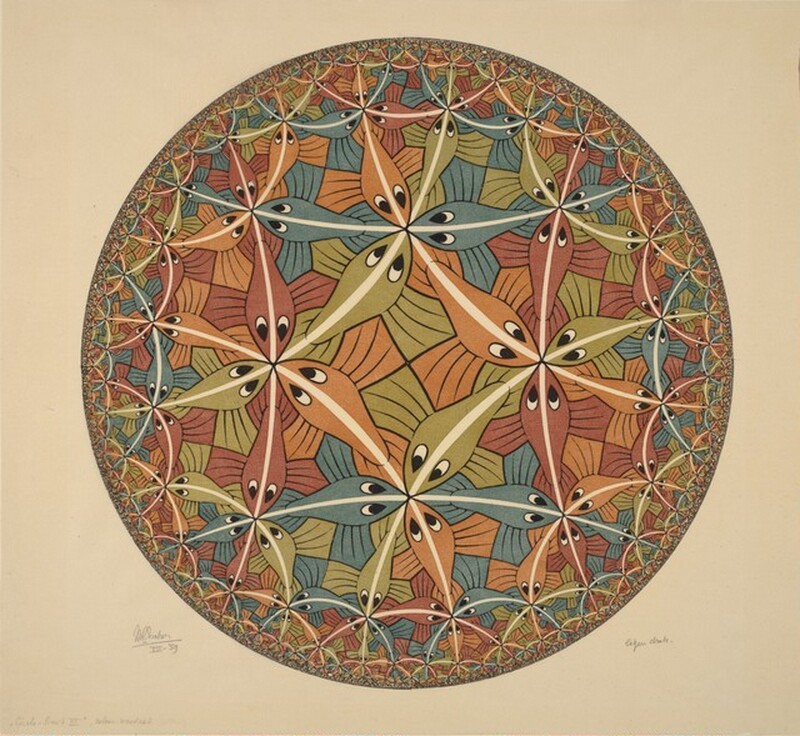

A surprising connection has emerged between the mathematics of protecting fragile qubits and the geometry of spacetime. In holographic models, information describing a region of gravitational space can be redundantly encoded in a quantum theory on its boundary. The resulting structure resembles a quantum error-correcting code—and it may explain why the location of an object is less fundamental than the information needed to reconstruct it.
A room appears to contain objects at definite distances from one another. A black hole appears to occupy a definite region of space. In ordinary geometry, position is taken as a primitive datum: one first constructs a manifold with a metric, and only then places physical systems inside it. Quantum gravity encourages a reversal of that logic. Perhaps the network of relations among quantum degrees of freedom comes first, while the geometric notion of 'inside' emerges as an efficient way of describing those relations. The most precise setting for studying that possibility is the anti-de Sitter/conformal field theory correspondence, or AdS/CFT, where a gravitational theory in a higher-dimensional bulk is dual to a lower-dimensional quantum theory without gravity. [1][2]
Something peculiar happens when the boundary theory is divided into pieces. A bulk operator can sometimes be reconstructed from one boundary region, but also from a different, overlapping or even appropriately disjoint collection of boundary degrees of freedom. There is no contradiction with quantum mechanics because the alternative boundary representations act identically only on a restricted set of allowed states, known as a code subspace. The mathematical idea closely resembles quantum error correction: logical information persists despite the erasure of some physical carriers. This observation provides the essential connection between an apparently geometric world and a non-geometric quantum encoding. [3][4]
The boundary holds more than a surface's worth of information
The holographic principle was motivated in part by black-hole thermodynamics. A black hole's entropy scales with the area of its horizon rather than its interior volume. For a nonrotating black hole in the standard semiclassical treatment,
The appearance of area here suggests that the gravitational capacity to store independent information is constrained in a way unlike an ordinary local field theory with independent degrees of freedom assigned throughout every tiny volume element. The formula alone does not prove a boundary computer is simulating a universe, but it supplied a crucial clue: the fundamental bookkeeping of gravity may not follow the naive counting of spatial points. In AdS/CFT this clue becomes a concrete duality between observables on a boundary and observables in a higher-dimensional gravitational bulk. [1][5]
The word dual is important. A boundary description need not be physically separated from a bulk description as though there were two machines, one producing a projection of the other. They are alternative descriptions of the same physical content, related by a sophisticated mathematical dictionary. The lower-dimensional theory is not simply a set of ordinary bits painted on a sphere. It contains strongly interacting quantum fields, entanglement, energy and operator algebras. In the regime where a smooth classical bulk emerges, the dual quantum theory has a particular large-system, strongly coupled structure. The central task is to understand how that structure supplies locality, distances and gravitational dynamics.
How an error-correcting code hides a particle in plain sight
Consider a logical quantum state encoded into many physical degrees of freedom by an isometry . The encoded state is . An erasure removes access to a known subsystem , but a successful code allows a recovery operation on its complement. If an operator acts on the logical system, a reconstruction of that operator on the surviving physical region obeys, for every allowed logical state,
This equality is restricted to the code subspace. Beyond it, need not be an operator with the same action throughout the full physical Hilbert space. This subtlety avoids a basic mistake: multiple reconstructions of a bulk operator are not multiple independently accessible copies of an unknown quantum state. The no-cloning theorem remains intact. Alternative representations of a logical operation need not be jointly usable as independent clones; they are equivalent ways to act on a protected subspace. [3][4]
Pastawski, Yoshida, Harlow and Preskill built a remarkably transparent toy model of this idea in 2015. Their holographic quantum error-correcting codes are often called HaPPY codes after the authors' initials. They placed special tensors in a negatively curved, or hyperbolic, tiling. Each tensor obeys strong entanglement constraints; composing them gives a map from interior bulk legs to degrees of freedom arranged near the outer boundary. The interior legs act like logical qubits and the boundary legs like physical qubits of a code. With appropriate tensors and a suitable code subspace, one can reconstruct an interior operation from different boundary regions whenever the corresponding reconstruction wedge contains the relevant logical input. [3]
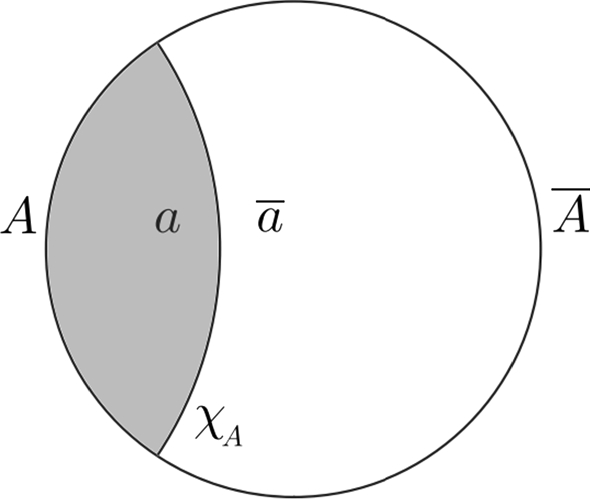
The connection between geometry and error correction becomes visible when we ask where information is stored. A central logical qubit does not sit on one boundary qubit with a hidden label. Instead, it is encoded nonlocally into correlations. Losing a small boundary region can leave the central logical information recoverable from what remains. In the geometric picture, the bulk location is deep enough that its operator lies in the entanglement wedge of the surviving region. These two statements—one about recovery and one about geometry—can describe the same structure. The model does not show that real spacetime is literally made of pentagons; it shows how redundancy can produce a mathematically meaningful notion of interior locality. [3][6]
Why entanglement begins to look like distance
Suppose we choose a connected region of the holographic boundary and calculate its quantum entanglement entropy . The Ryu–Takayanagi prescription states that, in a static semiclassical holographic regime, the leading contribution is set by the area of a codimension-two bulk surface anchored at the edge of :
Here conventional units with have been adopted, and corrections from bulk quantum fields are omitted for the moment. Thus an information-theoretic quantity defined in a boundary quantum state is related to an area measured in an emergent gravitational geometry. In a tensor-network code, the number and dimensions of bonds crossing a minimal cut often supply a discrete analogue of this relation: when each cut bond has dimension , the bound resembles . The match is exact only under specified assumptions; arbitrary tensor networks do not automatically saturate the minimal-cut bound. [2][3][7]
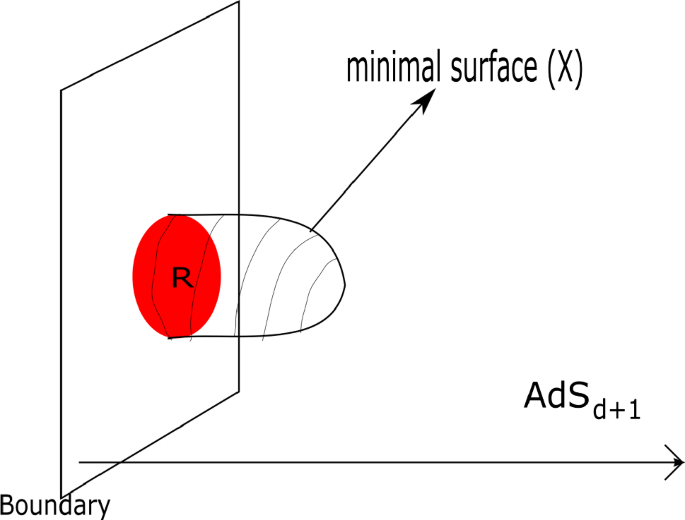
How can the pattern of entanglement suggest distance? Loosely, nearby parts of a semiclassical geometry share correlations that are organized differently from those of widely separated regions. In highly structured states, cutting the links across a partition measures how costly it is to separate the description into two parts. A network's layout can make this relationship visible, especially when hyperbolic tilings cause the number of degrees of freedom to expand toward the boundary. But entanglement is not a universally valid ruler. Highly entangled states can fail to admit a smooth geometric interpretation, and the emergent metric depends on much more than a single entropy value. Geometry requires consistent relationships among many subregions and their correlations. [2][7]
The area term also acquires a quantum correction. In an appropriate semiclassical bulk, the generalized entropy of a candidate surface includes the entanglement entropy of fields across it:
The quantum extremal surface prescription selects a suitable extremum of this combined quantity. This is important for black holes because the surface determining the entropy of a subsystem can change when quantum information is redistributed. The celebrated island constructions exploit precisely such changes; in tractable gravitational models they explain how fine-grained radiation entropy can follow a Page curve consistent with unitary evaporation. They should not be mistaken for direct observations of the interiors of astrophysical black holes. [8][9]
A location is a property of reconstruction
An especially provocative implication is that 'where' a bulk operator resides need not correspond to one uniquely distinguished boundary address. The appropriate boundary representation depends on which subsystem is available and which region of the bulk belongs to its entanglement wedge. This is a precise version of subregion duality. A black-hole interior operation, for example, can have an encoding relation to a distant radiation system in certain island models. The geometrical language and the algebraic language constrain one another: which observables can be reconstructed determines what a subsystem can meaningfully access. [4][6][8]
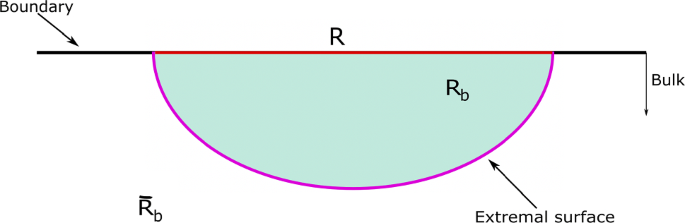
To see why the choice of subspace matters, imagine a family of low-energy excitations around one smooth geometry. An operator that creates a small excitation may have equivalent representations on several boundary regions while we restrict attention to that family. If we enlarge the set of allowed states to include geometries with drastically different black holes or energies, an operator that was easily reconstructable before need not retain the same simple representation. Some reconstructions are approximate, others state-dependent in carefully specified senses, and the code-subspace approximation itself has a domain of validity. Claims that one qubit contains an entire universe obscure these qualifications. [4][6]
Operator-algebra quantum error correction sharpens the point by allowing a protected algebra of observables instead of insisting that every subsystem factorizes into a simple collection of protected qubits. Gravitational theories have constraints and edge-mode subtleties that make naive tensor factorizations problematic. The algebraic formulation can naturally accommodate a center associated with area-like observables. In this setting, 'the same bulk operator' means equivalent action within a defined algebra and code subspace, not equality as two unrestricted boundary matrices. Harlow's work makes the link between algebraic recovery and the quantum-corrected entropy formula explicit. [4]
The black hole as a demanding stress test
Black-hole evaporation pushes the encoding picture to its limits. Hawking's semiclassical calculation gives a rising entanglement between emitted radiation and what remains behind the horizon. If the evaporation is exactly unitary and the initial state pure, the radiation's fine-grained entropy cannot increase forever; it must eventually fall to zero once the entire black hole has disappeared. The resulting Page-curve tension drove decades of work on quantum gravity. The island formula offers a rule for including candidate disconnected bulk regions in the entropy calculation and helps recover the unitary Page curve in solvable gravitational systems. [8][9]
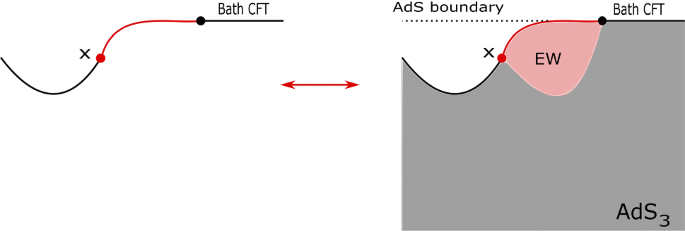
The deeper insight concerns ownership of information. Before and after the Page time, different extremal surfaces may dominate the entropy calculation. The information needed to reconstruct a portion of the black-hole interior can consequently become associated with Hawking radiation rather than being represented only by degrees of freedom near the black hole. This is a highly qualified, theory-dependent statement about operator reconstruction. It is not a proposal for reading an astronaut's diary out of thermal radiation with currently available technology. Computational complexity, the encoding structure, and the precise physical setting all matter. [8][9]
There is an interesting conceptual parallel with error-corrected computation. A logical qubit is not identified with a permanent physical carrier. Operations and measurements can redistribute its encoded support while its protected informational content persists. Similarly, in a holographic description, the region from which a bulk operator can be reconstructed may change as entanglement evolves. This analogy has explanatory power because it is backed by specific mathematical relations, not because gravity and quantum processors are literally the same machine.
Does information truly make spacetime?
The provocative title 'space as code' should not be interpreted as a finished microscopic theory of all spacetime. Holographic error-correcting codes are controlled models that reproduce selected structures of AdS/CFT. They illuminate the recovery of bulk operators, certain entanglement-entropy relations, and the protection of interior information. The emergence of fully dynamical Einstein gravity, generic cosmological spacetimes, time, and realistic matter sectors requires additional physics. AdS spacetime has negative cosmological constant and a special boundary structure; the expanding universe we observe is not simply AdS. Nor does the holographic correspondence tell us that every imaginable quantum code defines a smooth space. [1][3][6]
There are further unresolved questions about the physical meaning of the encoding map. Which properties of the boundary state single out a particular semiclassical geometry? How should background-independent gravitational constraints appear in a microscopic code? Can recovery and entanglement conditions determine not only areas and causal wedges but the complete dynamics of spacetime? Can models of evolving tensor networks capture local gravitational time evolution without abandoning the strong algebraic structures that make the static toy codes tractable? These are research questions on which concrete advances are possible.
The useful shift in perspective is already significant. Instead of treating spatial position as the primary identifier of information, the holographic picture asks which quantum subsystems can reconstruct which protected observables. Redundant information, quantum entanglement and error-correcting structure then become ingredients in defining what 'inside' a region means. At the boundary between quantum information and gravitational physics, geometry begins to look like the organization of recoverability.
References and further reading
[1] Maldacena, J., The Large N Limit of Superconformal Field Theories and Supergravity, Advances in Theoretical and Mathematical Physics 2 (1998). https://arxiv.org/abs/hep-th/9711200
[2] Ryu, S. and Takayanagi, T., Holographic Derivation of Entanglement Entropy from the Anti-de Sitter Space/Conformal Field Theory Correspondence, Physical Review Letters 96, 181602 (2006). https://doi.org/10.1103/PhysRevLett.96.181602
[3] Pastawski, F., Yoshida, B., Harlow, D. and Preskill, J., Holographic Quantum Error-Correcting Codes: Toy Models for the Bulk/Boundary Correspondence, Journal of High Energy Physics 2015, 149 (2015). https://doi.org/10.1007/JHEP06(2015)149
[4] Harlow, D., The Ryu–Takayanagi Formula from Quantum Error Correction, Communications in Mathematical Physics 354, 865–912 (2017). https://doi.org/10.1007/s00220-017-2904-z
[5] Bekenstein, J. D., Black Holes and Entropy, Physical Review D 7, 2333–2346 (1973). https://doi.org/10.1103/PhysRevD.7.2333
[6] Dong, X., Harlow, D. and Wall, A. C., Reconstruction of Bulk Operators within the Entanglement Wedge in Gauge-Gravity Duality, Physical Review Letters 117, 021601 (2016). https://doi.org/10.1103/PhysRevLett.117.021601
[7] Van Raamsdonk, M., Building up Spacetime with Quantum Entanglement, General Relativity and Gravitation 42, 2323–2329 (2010). https://doi.org/10.1007/s10714-010-1034-0
[8] Kibe, T., Mandayam, P. and Mukhopadhyay, A., Holographic Spacetime, Black Holes and Quantum Error Correcting Codes: A Review, European Physical Journal C 82, 463 (2022). https://doi.org/10.1140/epjc/s10052-022-10382-1
[9] Almheiri, A., Engelhardt, N., Marolf, D. and Maxfield, H., The Entropy of Bulk Quantum Fields and the Entanglement Wedge of an Evaporating Black Hole, Journal of High Energy Physics 2019, 63 (2019). https://arxiv.org/abs/1905.08762
The cover is an authentic holographic-reconstruction figure from Kibe, Mandayam and Mukhopadhyay (2022), Figure 9, not the pentagon-network image previously considered. Article figures are credited individually. Figures in the review are reproduced under the article's CC BY 4.0 terms, subject to any individual third-party credit indications in the source.