

A battery does not age uniformly. Individual particles react at different rates, currents shift through microscopic pathways, and the failure that eventually limits an entire cell may begin in a region that an ordinary voltage measurement cannot identify. A defect in a diamond lattice is now providing researchers with a different way to look: through the magnetic fields generated by electrochemical activity. The same physics is also being tested as a precision current sensor for electric vehicles.
When a rechargeable battery loses capacity, its condition is usually summarized by a few accessible numbers: voltage, current, temperature, cycle count and an estimate of state of health. These measurements are extraordinarily useful. They support safety controls, charging strategies and warranties, and they can reveal when the overall performance of a cell is drifting. Yet they are averages over enormous numbers of atomic events. Underneath the electrical terminals, electrode particles expand, contract, transport ions and exchange electrons in ways that are neither perfectly synchronized nor perfectly reversible. A battery pack can behave normally even as a few local regions become disproportionately stressed. [1][2]
One route to understanding those hidden changes is to dismantle cells and examine the materials afterward. Electron microscopy, diffraction and chemical analysis can reveal intricate damage, but removing a sample or cutting open a device inevitably changes what is being investigated. Operando techniques attempt a more demanding task: observing a working battery while its electrochemical processes are occurring. X-ray imaging, optical methods, neutron techniques and electrochemical probes already offer different views of this world. In 2024, researchers reported a particularly unusual addition: diamond nitrogen-vacancy centres placed close to active electrode particles, using their quantum spin response to sense local magnetic changes during cycling. [1][3]

The failure of a battery begins much smaller than the battery
A lithium-ion cell generally consists of porous positive and negative electrodes separated by an ion-conducting, electronically insulating medium. Charging moves lithium ions through the electrolyte while electrons flow through an external circuit. The solid particles within each electrode are not passive containers. Their compositions, local potentials, mechanical stresses and contact resistances evolve throughout the process. Two neighboring particles can experience different current densities even when the measured terminal current is steady. Over many cycles, the consequences can include particle cracking, interfacial degradation, loss of active lithium and spatially uneven lithiation. Those processes depend strongly on the particular cell chemistry and operating conditions; no single microscopic failure mode explains all batteries. [2][4]
A conventional battery management system can estimate a cell's remaining charge by integrating current, subject to calibration and model error. In its simplest form, the transferred charge is
For an idealized cell with reference capacity , a current-based change in state of charge is approximately when the sign convention takes discharge current as positive. Neither formula identifies where charge moved inside the electrode. The same terminal current can be distributed differently among thousands of microscopic regions, leading to different subsequent ageing. This gap between global electrical measurements and local reaction dynamics motivates imaging methods that follow physical signals close to individual particles.

Why a diamond is useful precisely because it is imperfect
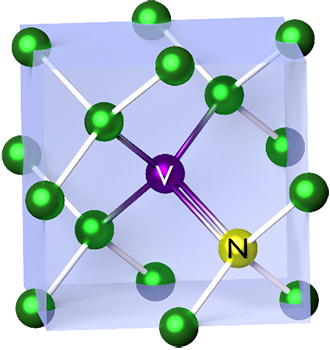
Perfect diamond is a rigid network of carbon atoms. Its useful sensor is a defect: one carbon is replaced by nitrogen, and a neighbouring lattice site is vacant. The negatively charged nitrogen-vacancy centre, commonly written NV⁻, has an electron spin whose energy levels can be manipulated with microwaves and read through light. Diamond's mechanical and chemical robustness can help preserve useful spin properties at room temperature, although performance depends on material purity, defect depth, surface treatment and experimental conditions. Researchers can work with a single centre near a surface or an ensemble of many centres viewed at once. [5][6]
Green laser illumination initializes the negatively charged NV centre preferentially into one spin population. It also produces red fluorescence. When a microwave drive matches a transition between spin levels, the fluorescence changes. The experiment therefore reads magnetic information as a change in a light signal: a method known as optically detected magnetic resonance (ODMR). No microscopic camera sees an electron orbiting the defect. Instead, photons reveal statistical properties of a quantum transition, and the transition frequency moves in response to a magnetic field. [5]
For an NV centre oriented along a chosen axis, the simplest effective ground-state spin Hamiltonian is
Here is the zero-field splitting expressed as a frequency, is the magnitude of the electron spin gyromagnetic ratio in frequency units, and collects effects such as strain and hyperfine interactions that matter in precise measurements. The dimensionless spin-one operators act on three ground-state sublevels. When transverse fields and perturbations are sufficiently small, the two resonances are approximately
Frequency splitting therefore becomes a magnetic-field measurement. The centre is sensitive to the projection along its own axis, not automatically to an entire three-dimensional field. Vector reconstruction requires several orientations, an appropriate geometry, or additional assumptions. Temperature and strain can shift resonances as well; careful calibration is essential if a changing spectral line is to be interpreted as evidence of a changing magnetic environment.
Reading a magnetic field with green light and red photons
The elegance of ODMR hides the practical instrument. A laser must excite the diamond, optics collect weak fluorescence, microwave electronics sweep or lock to resonance and detectors resolve small signal changes against photon shot noise and technical drift. A commonly used contrast measure is , where and are fluorescence rates away from and at resonance. Greater contrast, narrower spectral lines and more detected photons can improve magnetic sensitivity, but these quantities compete with one another as optical and microwave powers change. Ensemble sensors can collect more fluorescence, while a carefully positioned single centre can interrogate a much smaller region. [5][6]

A sensor's distance from its target is as important as the sophistication of its quantum readout. Magnetic fields from small, localized sources typically diminish quickly with separation. Buried centres too far below the diamond surface may miss the strongest spatial variations, while centres placed extremely close to the surface can experience additional magnetic and electric noise that degrades spin coherence. In a battery experiment the distance is also affected by binders, electrode roughness, protective layers and the way a sensing chip is integrated into an electrochemically functional device. Experimental sensitivity quoted for an isolated NV centre cannot simply be transferred to a complete working battery.
The 2024 experiment: watching different particles react differently
The most direct connection to battery chemistry comes from a 2024 paper in Device, Operando quantum sensing captures the nanoscale electrochemical evolution in batteries. The investigators incorporated a diamond NV-sensing platform into an electrode experiment and demonstrated the approach using a magnetite (Fe₃O₄) electrode. Its magnetic signal changes with the electrochemical evolution of the active particles. Rather than inferring every microscopic event from the total current alone, the team measured local magnetic stray fields and used their spatial structure to follow heterogeneous particle behaviour during operation. [1][3]
The material choice matters. Magnetite provides a particularly useful magnetic contrast. A magnetic image of Fe₃O₄ reacting is not equivalent to a direct movie of lithium ions in an ordinary graphite or layered-oxide electric-vehicle cell. Nor does the experiment show a commercial battery pack equipped with diamond sensors. The result establishes a convincing proof of concept for extracting particle-scale operando information through quantum magnetometry, while wider applicability to other chemistries demands new experiments, contrast mechanisms and packaging solutions.
A local magnetic measurement is connected to electric current by magnetostatics. In an idealized quasistatic description, the Biot–Savart relation is
This relation illustrates why current distributions can leave measurable external signatures. But the 2024 magnetite demonstration primarily exploited changes in magnetic stray fields associated with the reacting magnetic electrode material; it did not simply invert this integral to obtain a universal nanoscale map of lithium-ion transport. Interpreting NV images requires an explicit physical model for their source, whether magnetization, electrical currents or some combination of both. An informative field map is not automatically a chemically specific map.
From one bright spot to a spatial map
A single defect can resolve magnetic variations very locally, while a wide-field diamond microscope can read many centres in parallel. The optical arrangement illuminates an area and collects fluorescence on a camera. Magnetic resonance then creates spatial contrast, revealing how the projected field differs from one pixel to another. Such images can expose heterogeneity that average spectra obscure, but the usual optical diffraction limit and the distance between diamond and sample constrain resolution. [6][7]
Recent work has aimed to overcome those limitations by combining optical readout with magnetic-field-gradient encoding, conceptually related to magnetic resonance imaging. In 2024, Guo and collaborators reported wide-field Fourier magnetic imaging using NV spins, and demonstrated super-resolution magnetic imaging in a controlled sensor experiment. Their work improved spatial resolution beyond the optical diffraction limit and separately reported a roughly 35 nm single-centre localization demonstration in the described setup. These results show what an advanced diamond sensor can extract from magnetic signals; they do not by themselves establish the same performance through the mechanically and chemically complicated interior of a commercial battery. [7]

As the imaging techniques mature, the most useful scientific output may be a combination of measurements rather than one perfectly sharp picture. Magnetic imaging can constrain local magnetization or current; diffraction can track crystal structure; spectroscopy can identify chemical states; and microscopy can expose morphology. The relationships among these signals are what can distinguish an apparently active particle from one that is electrically isolated, chemically transformed or mechanically failing. A complete diagnosis requires both high-resolution sensors and credible models of what they measure.
The other application: turning a diamond into a car's ammeter
There is a separate and comparatively direct route from diamond magnetometry to an actual vehicle. A battery management system needs to estimate how much charge has entered or left a pack. That requires accurate current measurement over wildly different conditions: large acceleration or charging currents, small standby currents, a changing temperature and the magnetic interference of a moving vehicle. A sensitive magnetic sensor positioned near the pack's conducting busbar can infer current from the field around it. For an ideal long straight conductor of radius negligible compared with distance , the exterior field follows ; actual busbars have finite cross-sections and use calibrated field-to-current relationships. [8][9]
A 2023 Royal Society study, published in a 2024 journal issue, evaluated a diamond NV current-monitor architecture for electric vehicles. In laboratory tests it detected a 20 mA pulse while subjected to an 80 μT externally applied changing field, and the authors discussed charge-tracking accuracy under a standard driving profile. An associated technology program had previously reported operation across a broad current range. Those are promising results for sensor engineering, although they should not be represented as long-term proof that production vehicles will obtain a specific improvement in range or battery life. [8]

One clever part of the engineering is gradiometry. When two sensors are arranged on opposing sides of a conductor, the desired current-generated field can have opposite signs while much of the ambient interference is common to both. A differential readout of the form
gives in the ideal symmetric limit. Alignment errors, spatially varying interference and electronics still matter, but the principle makes an intrinsically sensitive quantum detector substantially more useful in an electrically noisy setting. In a 2025 study, researchers also explored heteroepitaxially grown, preferentially aligned (111) diamond NV material for a larger-area sensor platform, including dual-sensor busbar monitoring. [9]
Can it actually make batteries safer or longer-lived?
Three levels of claim are worth separating. First, the established experimental result: NV centres can measure magnetic signatures connected to electrode activity and can operate as high-sensitivity current sensors in laboratory EV-monitor prototypes. Second, the reasonable engineering opportunity: those measurements might reveal nonuniform reaction dynamics earlier, improve modelling of cell health or permit more accurate current integration. Third, the commercial promise: future cells might be safer, last longer or use a greater fraction of nominal capacity because their designers understand degradation mechanisms better. The third proposition is a goal, not a present experimental outcome. [1][8][9]
For materials researchers, understanding why some particles cycle faster than others can inform changes in electrode composition, particle geometry, conductive additives and manufacturing processes. A diagnostic technique does not need to be permanently built into every consumer battery to have value. It might be most useful in development laboratories, where operando magnetic maps are compared against electrochemical tests and post-mortem analysis across many samples. Once a pattern of degradation is identified, manufacturers can redesign the cell and test whether the proposed change actually improves lifetime or safety.

For vehicles, a practical current sensor faces a different certification and manufacturing problem. It must compete with Hall-effect sensors, shunts and existing battery algorithms on total system cost, calibrated accuracy, response time, thermal stability, reliability and maintainability. A quantum sensor's beautiful spectrum is only the beginning: optical sources age, alignment drifts, mechanical packaging changes, and temperature-dependent offsets accumulate. Long-term operation in a vehicle is a much stronger requirement than a short demonstration in a shielded—or deliberately disturbed—laboratory apparatus. The value of the sensor must be demonstrated against a competitive conventional baseline across the entire operating envelope.
The hidden difficulty is solving an inverse problem
A detector can measure a field accurately while the interpretation remains uncertain. Different distributions of current or magnetization may produce similar fields at the sensor. A reconstruction made at one distance can exaggerate small-scale features if noise is amplified, and an inverse solution may depend strongly on assumptions about sample thickness, geometry or material properties. For a cell containing many chemically heterogeneous components, separating magnetic contrast from changes in temperature, strain and background field is a central challenge. [5][7]
That does not diminish the importance of the advance. It defines the kind of science required to make the measurement convincing: controls with known magnetic sources, repeatability through charging cycles, comparison to independently characterized materials, quantified spatial resolution, and reconstruction models that state what can and cannot be inferred. The better experiment is not necessarily the one with the most colorful map. It is the one that connects a local signal to a reproducible physical mechanism.
A material with two extraordinary jobs
Quantum diamonds occupy an unusual position in emerging technology. The defect spins offer access to quantum-coherent measurements, while the diamond around them behaves as a sturdy solid that can be placed near ordinary matter. That combination is why applications span magnetic materials, electronic devices, biological samples and now electrochemical systems. Photonic integration, engineered defect orientation and improved readout are bringing the sensing platform closer to instrumentation that engineers can assemble and calibrate. [5][7][9][10]
There is something especially satisfying about their application to batteries. The battery is one of the defining devices of electrification, yet much of its microscopic operation remains invisible to its own control circuitry. Quantum sensing adds a way to ask more detailed questions without insisting that every answer come from the terminal voltage. In the research laboratory, a diamond can reveal magnetic changes near an electrode particle. In an electrical system, related spins can resolve tiny changes in current. Whether these become indispensable commercial tools will depend on evidence from working batteries, reproducibility and cost—not on the mere presence of a quantum state.
References and further reading
[1] Liu et al., Operando quantum sensing captures the nanoscale electrochemical evolution in batteries, Device (2024). https://doi.org/10.1016/j.device.2024.100521
[2] Xu, K., Electrolytes and Interphases in Li-Ion Batteries and Beyond, Chemical Reviews 114, 11503–11618 (2014). https://doi.org/10.1021/cr500003w
[3] Chinese Academy of Sciences, Operando Quantum Sensing Captures Nanoscale Electrochemical Evolution in Battery (2024). CAS research news
[4] Finegan, D. P. et al., Investigating lithium-ion battery materials during overcharge-induced thermal runaway: an operando and multi-scale X-ray CT study, Physical Chemistry Chemical Physics 18, 30912–30919 (2016). https://doi.org/10.1039/C6CP04251A
[5] Degen, C. L., Reinhard, F. and Cappellaro, P., Quantum sensing, Reviews of Modern Physics 89, 035002 (2017). https://doi.org/10.1103/RevModPhys.89.035002
[6] Schirhagl, R. et al., Nitrogen-Vacancy Centers in Diamond: Nanoscale Sensors for Physics and Biology, Annual Review of Physical Chemistry 65, 83–105 (2014). https://doi.org/10.1146/annurev-physchem-040513-103659
[7] Guo, Z. et al., Wide-field Fourier magnetic imaging with electron spins in diamond, npj Quantum Information 10, 24 (2024). https://doi.org/10.1038/s41534-024-00818-9
[8] Hatano, Y. et al., A wide dynamic range diamond quantum sensor as an electric vehicle battery monitor, Philosophical Transactions of the Royal Society A 382 (2024 issue; online 2023). Open-access paper
[9] Kajiyama, K. et al., Heteroepitaxial (111) Diamond Quantum Sensors with Preferentially Aligned Nitrogen-Vacancy Centers for an Electric Vehicle Battery Monitor, Advanced Quantum Technologies 8, 2400400 (2025). https://doi.org/10.1002/qute.202400400
[10] High-sensitivity nanoscale quantum sensors based on a diamond micro-resonator, Communications Materials (2025). https://doi.org/10.1038/s43246-025-00770-x
Cover photograph: Gavin Morley, 532 nm laser equipment used to control nitrogen-vacancy centres in diamond, Wikimedia Commons, CC BY-SA 4.0. It depicts a laboratory NV-centre optical setup, not a diamond sensor installed in a battery. Body figures are individually credited, and technical figures depict their cited experiments rather than the 2024 magnetite operando battery demonstration unless expressly stated.