

A triangle can lose most of its area and still retain a recognizable structure. In certain holographic models, something more surprising happens: access to a boundary region that becomes arbitrarily sparse can remain sufficient to reconstruct a quantum operator deep in the bulk. Yet an analogous construction can lose that property when the dimension of the boundary changes. The explanation involves competing extremal surfaces, fractal scaling and the peculiar way quantum information is represented across spacetime.
Imagine a laboratory in which the information describing a physical system is distributed over a sheet of many quantum degrees of freedom. Some sites become inaccessible. The surviving sites are not clustered in one place; they form small islands within larger islands, separated by gaps at progressively smaller scales. A conventional intuition says that the more of the sheet disappears, the less there is to recover. For particular observables in a holographic quantum code, that intuition is too coarse. The geometry of the surviving set, and the entanglement wedge it controls, can matter more than its total area. [1][3][5]
The underlying research is neither a proposal to store a real universe on a piece of plastic nor an experimental demonstration of an extraordinarily resilient memory. It concerns bulk operator reconstruction in the AdS/CFT correspondence and related tensor-network codes. The most intriguing result is a geometric threshold. Ning Bao and Joydeep Naskar showed in 2022 that a Sierpiński triangle-shaped boundary region in AdS₄/CFT₃ can preserve reconstructability of operators deep in the bulk in an appropriate regime. The analogous Sierpiński-gasket construction in AdS₅/CFT₄ does not have the same property under their analysis. Subsequent work asked how black holes, bulk entropy, other fractals and reconstruction complexity modify the picture. [6][8][9][10]
A boundary that keeps disappearing
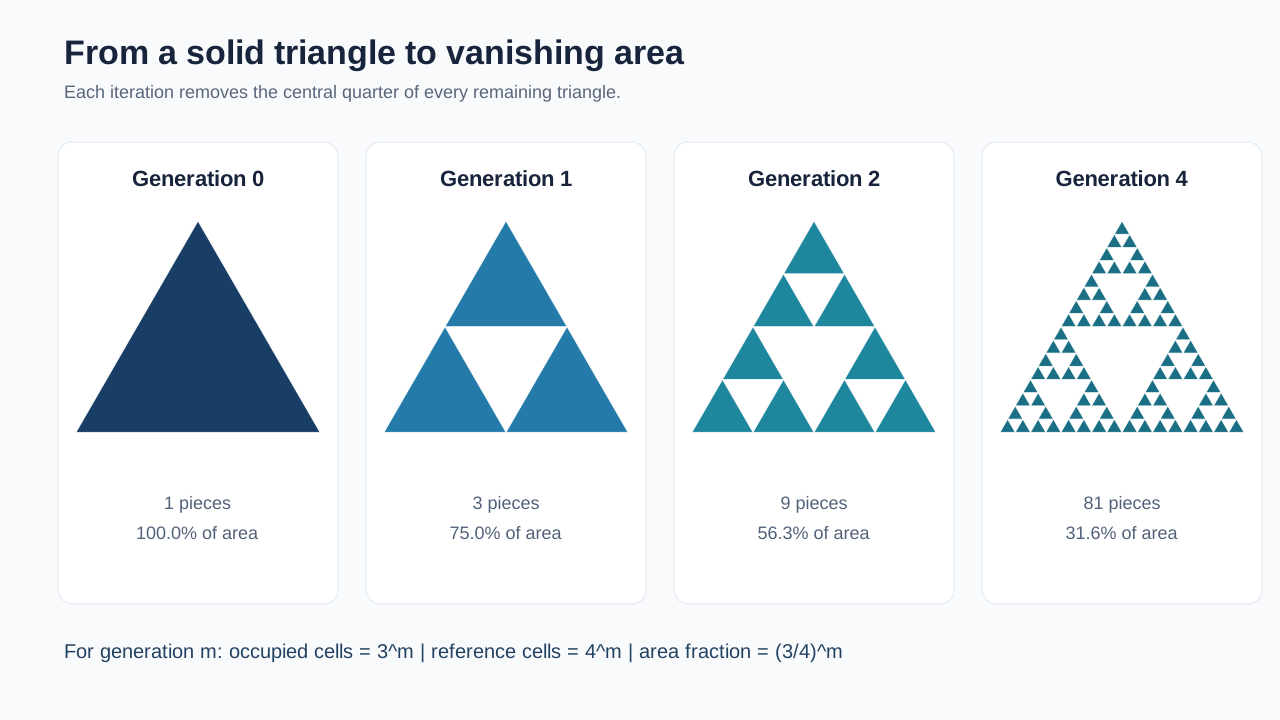
Begin with a solid equilateral triangle of side length L. Remove the open, inverted triangle connecting the midpoints of its sides. Three smaller triangles remain. Repeat the same removal operation within each surviving triangle. After m iterations the pattern contains 3m triangles of side length L/2m. Each is one quarter the area of its parent, which makes the total surviving area fraction exactly (3/4)m in this ideal construction. This fraction tends to zero, even though the number of disconnected pieces grows without bound. The limiting set is the Sierpiński triangle, with a noninteger fractal dimension. [6]
Fractal dimension is more informative here than a decorative description of irregularity. If a self-similar set consists of N copies scaled by a factor r in each direction, its similarity dimension D solves N rD = 1. For the triangle this gives
Its Hausdorff dimension lies strictly between a line and a surface. It is an uncountable set but occupies zero area in the mathematical continuum. Any physical system, by contrast, stops its recursive construction at a finite lattice spacing or ultraviolet cutoff. That distinction is essential in holographic error correction: no device has infinitely many resolved features, and the continuum conclusion is reached through a controlled limit of finite constructions.
What a boundary knows about the interior
The AdS/CFT correspondence relates certain gravitational theories in anti-de Sitter spacetime to conformal quantum field theories defined on their boundaries. In a frequently studied example, AdS₄ has three spatial dimensions and one time dimension, whereas its CFT₃ boundary has two spatial dimensions and one time dimension. An event or operator in the gravitational bulk may have representations in the boundary theory that do not resemble a local boundary event. Because the description is encoded nonlocally, different boundary subregions can support reconstructions of the same bulk operator when restricted to the relevant code subspace. [1][3][4]
Let V be an isometric encoding map from the low-energy bulk code space into the boundary Hilbert space. If a bulk operator Obulk is reconstructible from boundary subregion A, there is an operator OA acting on A that has the same effect on encoded states. An operator expression for this relationship is
This equality is intended within the specified code subspace. It is not an assertion that an arbitrary operator on the full gravitational Hilbert space can be measured anywhere on the boundary. The distinction avoids a familiar paradox: a single quantum operator apparently represented in several disjoint locations does not imply that unknown quantum information can be freely cloned. Different boundary reconstructions implement the same logical action on the encoded subspace, where the encoding has deliberately introduced redundancy. [3][4]
There is also a geometric way to express the recoverable region. The Ryu–Takayanagi prescription relates the leading entanglement entropy of a boundary region A to the area of a particular extremal surface γA anchored to its boundary. In a static semiclassical setting, the leading relation is
The corresponding entanglement wedge is the bulk domain associated with A and its selected surface. Under appropriate assumptions, bulk observables inside that wedge admit reconstruction on A. More elaborate quantum corrections add bulk matter entropy and require comparing generalized-entropy extremal surfaces rather than treating area as the complete answer. The geometry of the wedge can change sharply when A is broken into disconnected components. [2][3][8]
Two geometries compete for the same surviving fragments
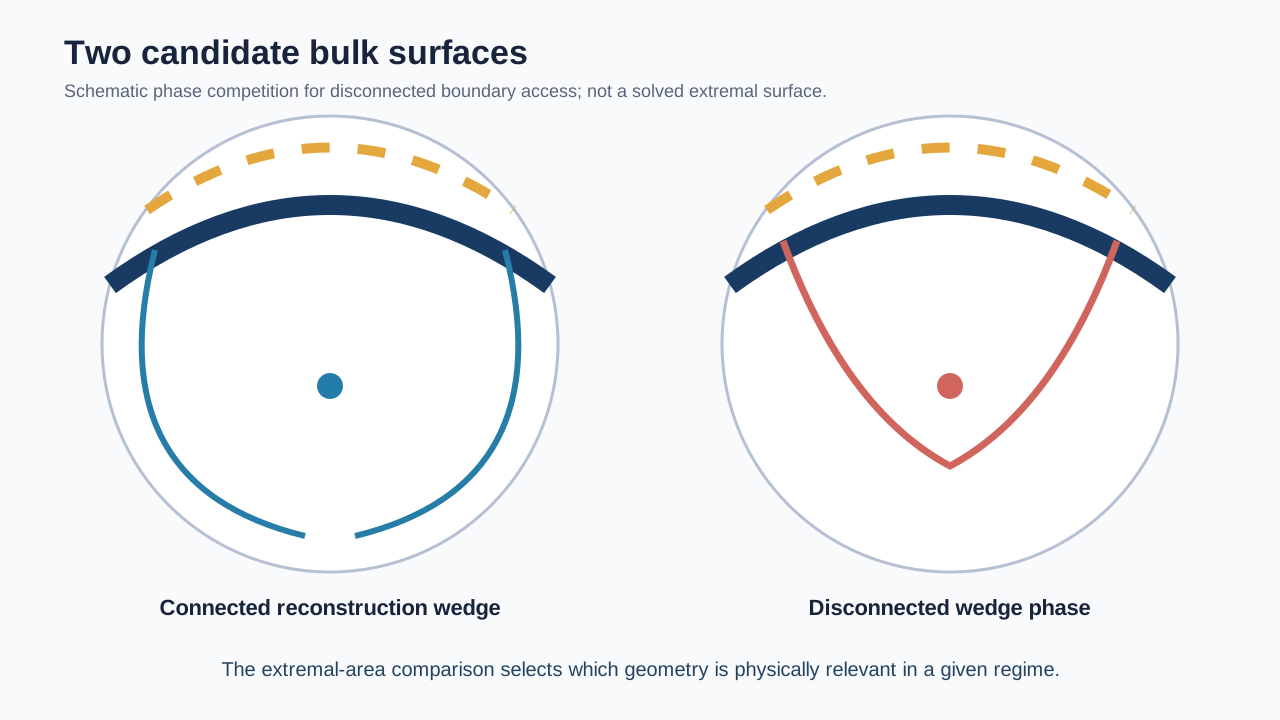
Consider a triangular boundary region R with a smaller triangular hole H cut out of its centre. The accessible subregion, R without H, consists of three triangular components, R₁, R₂ and R₃, at the simplest stage. The bulk contains at least two natural candidates for a surface anchored to this disconnected boundary. One candidate treats the three pieces separately: its area is approximately the sum of the extremal surfaces associated with R₁, R₂ and R₃. The other connects the reconstruction region around the hole; schematically, it combines an outer surface associated with R with an inner surface surrounding H. [6]
These are candidates in an extremal-surface competition, and the preferred phase is selected by the smaller appropriate area, subject to the homology constraints. In schematic notation,
If the connected phase wins, the entanglement wedge of the disjoint pieces can include a connected interior region, potentially encompassing a chosen deep-bulk operator. A small change in the relative size of the hole can change which phase minimizes area. That is a genuine geometric transition, not a declaration that fractals inherently resist all forms of information loss. The particular choice of triangle size and small regulator in Bao and Naskar's construction matters for the comparison. [6]
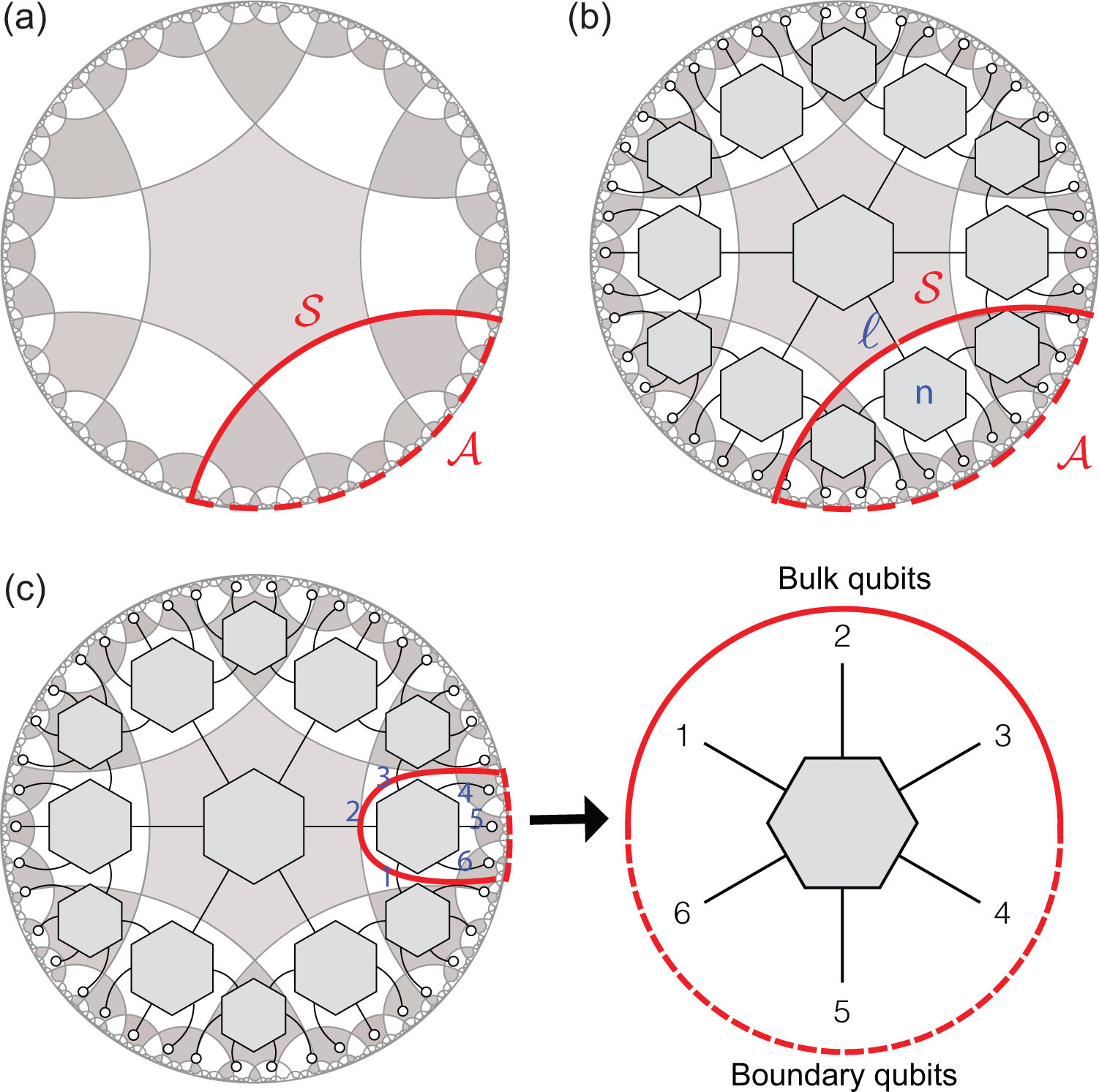
There is an accessible analogy with a network of islands connected below the water. Looking only at the surface suggests separate landmasses; the underlying geometry can connect them through a continuous structure. Holography is more precise and less pictorial: the connectedness in question is determined by quantum entanglement and extremal-surface geometry, not by a literal underground tunnel or material filament.
The exponent hiding inside the missing area
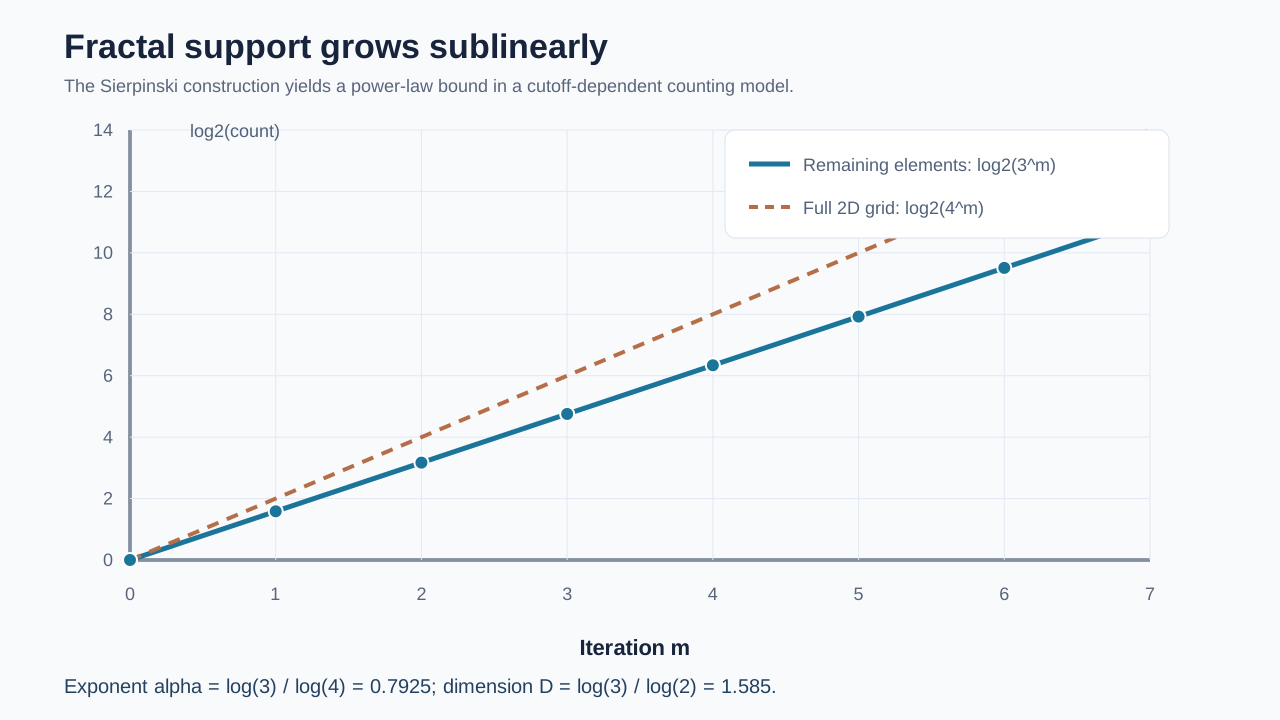
After m ideal Sierpiński iterations, the occupied cells number Nm = 3m. A full two-dimensional reference grid at the same resolution grows as nm = 4m. Eliminating m gives a sublinear power law: the surviving pieces grow as nmα with α = log 3 / log 4. Equivalently, the fraction of accessible cells is nmα-1, which vanishes as the cutoff is refined. The algebra makes a subtle point clear: the number of accessible elements increases with resolution, even while their fraction of the full boundary goes to zero.
The 2022 paper connects this scaling to an upper bound on the distance of a particular logical algebra in its holographic construction. The relevant claim is not that every holographic code has distance exactly n0.7925, or that the number of encoded qubits can be read off from the shape alone. Code distance, price and reconstruction depend on the logical region, available boundary region, assumptions about encoding and ultraviolet cutoff. The exponent above belongs to the triangular recursive geometry and its associated counting argument. [5][6]
Pastawski and Preskill called the broader possibility uberholography: a bulk logical algebra can be supported on a boundary subset with fractal structure and lower dimension than the ambient boundary. Earlier work constructed this phenomenon with Cantor-like subsets of a one-dimensional boundary in AdS₃/CFT₂. The Sierpiński example extends the investigation to two-dimensional spatial boundary slices. The important common ingredient is negative curvature and the geometric structure of reconstructible subalgebras, not a universal preference for one fractal. [5][6][9]
Why adding one dimension changes the outcome
The sharpest part of the story appears when the same reasoning is pushed into a higher-dimensional holographic setting. On a two-dimensional spatial boundary slice, the leading ultraviolet contribution to the area of an extremal surface depends on the perimeter of the boundary region. In Bao and Naskar's Sierpiński analysis, the leading contributions from competing surfaces can be arranged to match. Subleading terms, including effects of the corners, then select a connected phase in the relevant regime. Those subleading terms may look mathematically modest but determine whether a deep interior operator is included in the reconstruction wedge. [6]
The analogous construction in AdS₅/CFT₄ uses a three-dimensional spatial boundary slice and a higher-dimensional Sierpiński-type gasket. The corresponding leading divergence has a different dimensional dependence. For the construction analyzed, that change favors the disconnected competitor, so the same deep-bulk reconstruction mechanism no longer follows. There is no theorem here claiming that holographic reconstruction is impossible in AdS₅, nor that all three-dimensional fractals fail. The result is tied to a particular fractal geometry and the class of surface comparisons made in that study. Ageev's 2023 analysis showed how other Cantor-like structures in higher dimensions can yield different possibilities. [6][9]
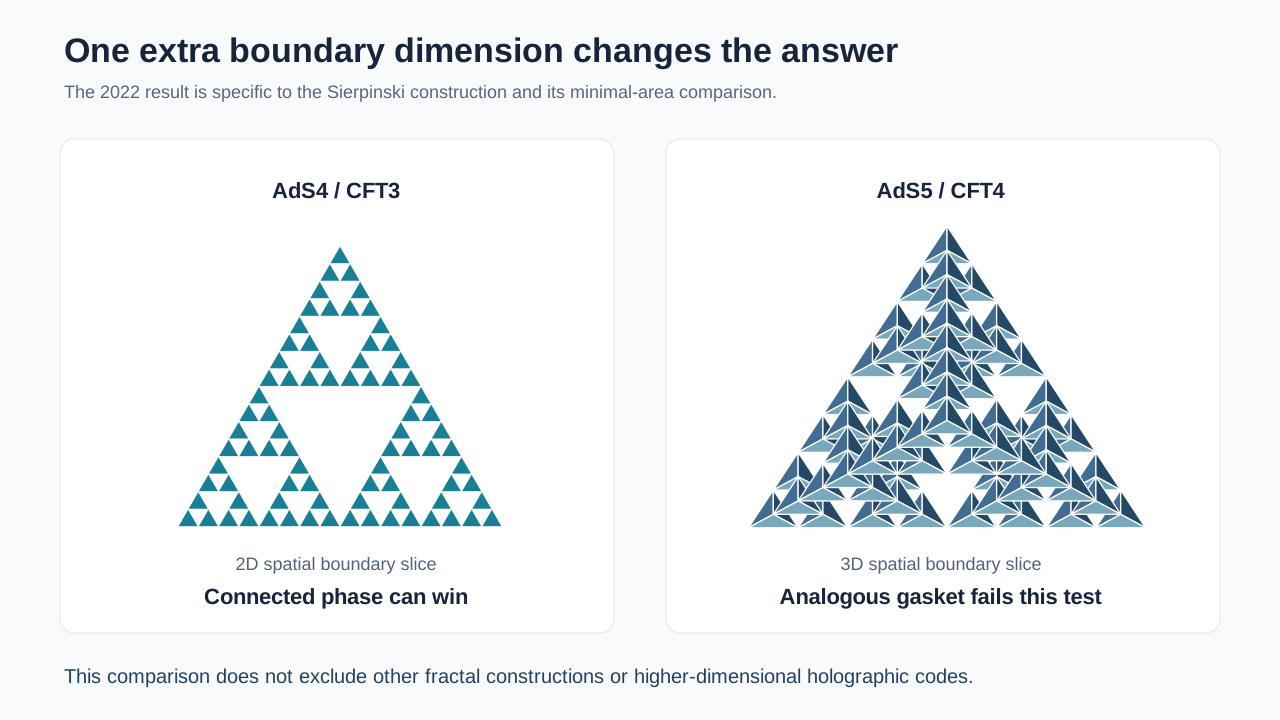
This dependence on dimension is scientifically instructive. A fractal dimension by itself does not specify how an extremal surface behaves. One must know the ambient dimension, the way holes are embedded, the geometric cutoff, the homology constraint and the state in which entanglement is evaluated. Two sets can have similar-looking voids and very different holographic reconstruction properties. More generally, geometric resemblance is not a substitute for calculating entanglement wedges.
A physical fractal makes the distinction visible
A three-dimensional Sierpiński tetrahedron can be fabricated as a sculpture, revealing recursion in a form that can be picked up and viewed from several angles. It is a useful visual model for a boundary geometry with holes at many scales. But a printed tetrahedron has no automatic relationship to entanglement entropy. Making the structure out of plastic, silicon or superconducting hardware would not establish that its quantum degrees of freedom realize a conformal field theory, let alone that they encode a gravitational bulk. A physical demonstration of holographic reconstruction would require a specified quantum encoding, preparation protocol, observable and decoder. [4][6]

That experimental distinction matters because the mathematics can inspire technological ideas without already proving them practical. Tensor-network encoders inspired by holography may distribute logical information across nonlocal patterns, and the interpretation of a missing boundary region as a known erasure offers a concrete kind of test. But genuine devices must contend with local connectivity, imperfect gates, stochastic faults, measurement costs and decoding complexity. A theoretically reconstructible operator may be inaccessible to a resource-limited laboratory if the reconstruction map requires an intractable operation.
What happens when the bulk contains a black hole?
The vacuum of AdS provides an unusually clean arena for extremal-surface reasoning. Black holes and mixed bulk states introduce an additional cost: the entropy of quantum matter inside the candidate wedge. Rather than selecting a surface solely because its area is smallest, one must consider the generalized entropy of the candidate quantum extremal surfaces, using an expression of the form
The relevant physical surface extremizes the generalized entropy and is selected among the admissible candidates. The entropy term can change a wedge phase even when the original geometric boundaries are unaltered. This is why it was important to test whether fractal reconstruction survives highly mixed states, rather than assuming a vacuum calculation settles the question. [8]
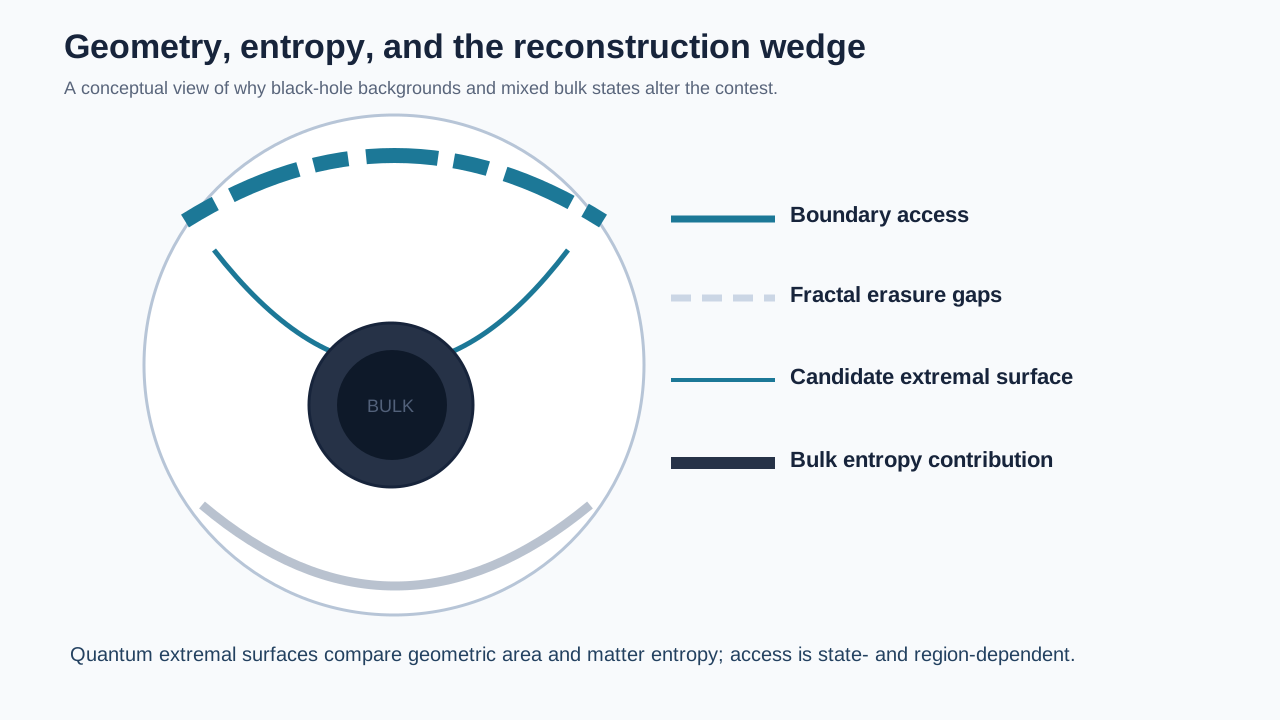
In 2023, Bao and Naskar found that their Cantor-like erasure construction in AdS₃/CFT₂ retained a code-distance result insensitive to bulk mixed-state entropy in the appropriate large-iteration limit. They also found regimes of Sierpiński-triangle bulk reconstruction in AdS₄/CFT₃ when the bulk contains highly entropic mixed states. Those statements depend on the limits and constructions studied; they do not say that the reconstruction wedge is immune to every possible black-hole configuration. A 2025 analysis by Bhattacharjee and Naskar returned to black-hole backgrounds and found qualitative agreement with the earlier vacuum-based generalized-entropy reasoning, while examining higher-dimensional strips and the relation of reconstruction to computational complexity. [8][10]
Fractal noise is not a single universal failure mode
Holographic reconstructions are often described in the language of erasure channels, where the missing subsystem is known. That is not equivalent to an unknown Pauli error acting at unknown sites. Furthermore, a fractal with carefully nested holes is only one family of erasure geometries. Arbitrary correlated losses, changes in the boundary state or finite-depth circuit constraints may behave differently. A full code benchmark must specify the error channel, the encoded algebra, the recovery accuracy, the system size and the computational cost of recovery. [4][5][6]
The comparison with topological quantum codes also needs precision. Zhu, Jochym-O'Connor and Dua established a no-go result for particular topological-order models on fractals embedded in two spatial dimensions, while also constructing higher-dimensional fractal topological codes with useful properties. It would therefore be incorrect to conclude that conventional topological coding fails against every fractal erasure pattern, or that holography automatically surpasses a well-engineered surface code on a laboratory chip. The rigorous difference is between specified mathematical constructions under specified geometric and physical assumptions. [7]
Even a finite holographic tensor-network code that successfully reconstructs a logical operator on a sparse boundary would not establish fault-tolerant computation. One must account for noise occurring during encoding, for the depth and locality of recovery circuits, and for how errors propagate through physical gates. The central result of the Sierpiński study is a geometric statement about supported reconstructions, not a quantitative demonstration of a higher fault-tolerance threshold on today's processors.
From sparse geometry to real quantum hardware
The most promising application may be as a design principle for structured erasure recovery. Photonic links are lost in bursts, distributed quantum networks may temporarily lose entire nodes, and modular processors can experience correlated failures in particular regions. It would be useful to determine which patterns of surviving access can preserve a selected logical algebra and how to implement the corresponding recovery operations. But the physical layout of those systems is rarely a smooth negatively curved manifold, so an actual hardware proposal must construct and analyze an encoder rather than relying on analogy to AdS geometry. [4][5]
One experimentally tractable route would begin with a small stabilizer or tensor-network encoder, choose a logical observable and systematically vary the erasure geometry. At each pattern the experiment could report whether the observable can be reconstructed, with what fidelity, and using what circuit depth. Comparing a nested fractal pattern against random and contiguous erasures of equal size would separate geometric organization from the mere quantity of data left over. This would be an interesting test of holography-inspired coding strategies, although no particular performance advantage is implied before the comparison is actually carried out.
A 2019 nuclear-magnetic-resonance quantum-simulation experiment by Li and collaborators demonstrated the entanglement properties of a six-qubit perfect tensor, a building block in holographic tensor-network constructions. It was a proof of principle for simulating holographic entanglement entropy, not an experimental realization of the Sierpiński reconstruction code or a test of its fractal-noise performance. The gap between an elegant building block and a functioning fault-tolerant memory remains substantial. [11]
How little boundary can still describe an interior?
There is a final conceptual consequence of the scaling argument. In a mathematical limit, a lower-dimensional boundary subset with vanishing ambient measure can retain access to certain bulk observables. The information is not crammed into infinitely small physical pixels. Instead, the reconstruction map changes with cutoff, and nonlocal correlations arrange for a logical action to be representable on an increasingly sparse support. Whether any analogous scaling survives finite resources is a separate engineering question.
The Sierpiński triangle is useful here because it makes that question exact enough to calculate. It exposes a competition between connected and disconnected extremal surfaces; supplies a concrete sublinear exponent; reveals an explicit dimensional limitation; and motivates extensions to mixed states, black holes and computational complexity. It is a small geometry with consequences for how physicists think about the location of information. In holography, the location of a recoverable operator is not determined by counting boundary sites alone. It is determined by the structure of the encoding and the geometry of the wedge those sites collectively control.
References
[1] Maldacena, J., The Large N Limit of Superconformal Field Theories and Supergravity, Adv. Theor. Math. Phys. 2, 231–252 (1998). arXiv:hep-th/9711200.
[2] Ryu, S. and Takayanagi, T., Holographic Derivation of Entanglement Entropy from AdS/CFT, Phys. Rev. Lett. 96, 181602 (2006). DOI.
[3] Almheiri, A., Dong, X. and Harlow, D., Bulk Locality and Quantum Error Correction in AdS/CFT, JHEP 04, 163 (2015). DOI.
[4] Pastawski, F., Yoshida, B., Harlow, D. and Preskill, J., Holographic quantum error-correcting codes: Toy models for the bulk/boundary correspondence, JHEP 06, 149 (2015). DOI.
[5] Pastawski, F. and Preskill, J., Code Properties from Holographic Geometries, Phys. Rev. X 7, 021022 (2017). DOI.
[6] Bao, N. and Naskar, J., Code properties of the holographic Sierpinski triangle, Phys. Rev. D 106, 126006 (2022). DOI.
[7] Zhu, G., Jochym-O'Connor, T. and Dua, A., Topological Order, Quantum Codes, and Quantum Computation on Fractal Geometries, PRX Quantum 3, 030338 (2022). DOI.
[8] Bao, N. and Naskar, J., Reconstruction wedges in AdS/CFT with boundary fractallike structures, Phys. Rev. D 107, 066014 (2023). DOI.
[9] Ageev, D. S., Exploring holography with boundary fractal-like structures, Phys. Rev. D 108, 026009 (2023). DOI.
[10] Bhattacharjee, A. and Naskar, J., Revisiting holographic codes with fractallike boundary erasures, Phys. Rev. D 111, 026012 (2025). DOI.
[11] Li, K., Han, M., Qu, D. et al., Measuring holographic entanglement entropy on a quantum simulator, npj Quantum Information 5, 30 (2019). DOI.
Cover photograph: a nylon Sierpiński tetrahedron designed and photographed by George W. Hart, Wikimedia Commons, released by the creator into the public domain. Five original diagrams were drawn for QuantumSpark and are explicitly schematic; the research figure is reproduced under CC BY 4.0 and the museum photograph under CC BY-SA 4.0 with individual credits. The holographic fractal results discussed in this article are mathematical constructions and should not be construed as demonstrations of an experimentally validated quantum-memory advantage.