
In May 2026, researchers built a cyclic heat engine whose working substance was a superconducting quantum circuit. A tunable transmon qubit was alternately heated, cooled and shifted in energy using engineered dissipation and magnetic flux. The experiment delivered positive output work—tiny in magnitude, but large in conceptual significance—because it made heat, work and thermodynamic efficiency measurable on the scale of a single artificial atom.
Heat is a familiar quantity when it flows through metal, water, or the working gas of an engine. At the scale of a superconducting qubit, the same thermodynamic ideas become more delicate. Energy arrives and leaves in discrete transitions. The populations of quantum levels change under noise and engineered reservoirs, while coherent controls shift the spacing between those levels. The distinction between a temperature change and a work-producing transformation must be made in the dynamics of the quantum state, not guessed from a thermometer attached somewhere nearby. These subtleties have made quantum heat engines both theoretically rich and experimentally demanding. [1][2]
On 5 May 2026, Tuomas Uusnäkki, Timm Mörstedt, Wallace Teixeira, Miika Rasola and Mikko Möttönen reported the first experimental demonstration of a cyclic quantum heat engine based on superconducting circuits. Their device used a flux-tunable transmon as its working medium and a voltage-controlled quantum-circuit refrigerator as an engineered reservoir. They measured the evolution of the qubit populations through a few quantum Otto cycles, reconstructed absorbed heat and net work, and found positive power output. The efficiency was small by ordinary engineering standards, but the agreement with thermodynamic simulations made the experiment a concrete test of a quantum engine model in a platform central to quantum computing. [1]
What it means for a qubit to have heat
For an approximately two-level system, the energy gap between ground and excited states is . Its Hamiltonian, up to a choice of reference energy, may be written as
If the excited-state population is , the mean energy is . A variation in can come from changing the occupation of the excited level at fixed spacing, or from moving the spacing while occupation is unchanged. In a simple energy-diagonal, weakly coupled model, these two contributions can be classified as heat and work:
The sign convention here is that is work done on the qubit; useful engine output is its negative over a complete cycle. This clean split applies to the stated two-level, energy-diagonal description. In more general coherent, strongly coupled or non-Markovian situations, definitions of quantum heat and work require additional care about the system boundary, Hamiltonian and measurement procedure. The 2026 study used its experimentally characterized, weakly anharmonic transmon levels and population data to reconstruct these quantities. [1][2]
Temperature is another conditional idea at the quantum scale. A two-level system in a thermal equilibrium state at positive temperature has . An arbitrary coherent superposition or population distribution across several transmon levels need not be summarized faithfully by one temperature. The experiment discusses effective temperatures under suitable fitting assumptions, but its central thermodynamic results rely on reconstructed level populations and energies, rather than assuming the qubit is always in equilibrium with a single physical bath. [1]
The four strokes of an Otto engine, now on a chip
The quantum Otto cycle has four idealized strokes. During a heating stroke, the level spacing is held fixed while the system is placed in contact with an effectively hot reservoir, increasing its energy through population changes. An adiabatic expansion then reduces the level spacing while ideally preserving populations, producing work output. A cooling stroke lowers the excited population at the smaller gap. Finally, an adiabatic compression returns the gap to its initial value at the cost of some work input. If the positive work extracted on expansion exceeds the work spent on compression, the net cycle produces work. [1][2]
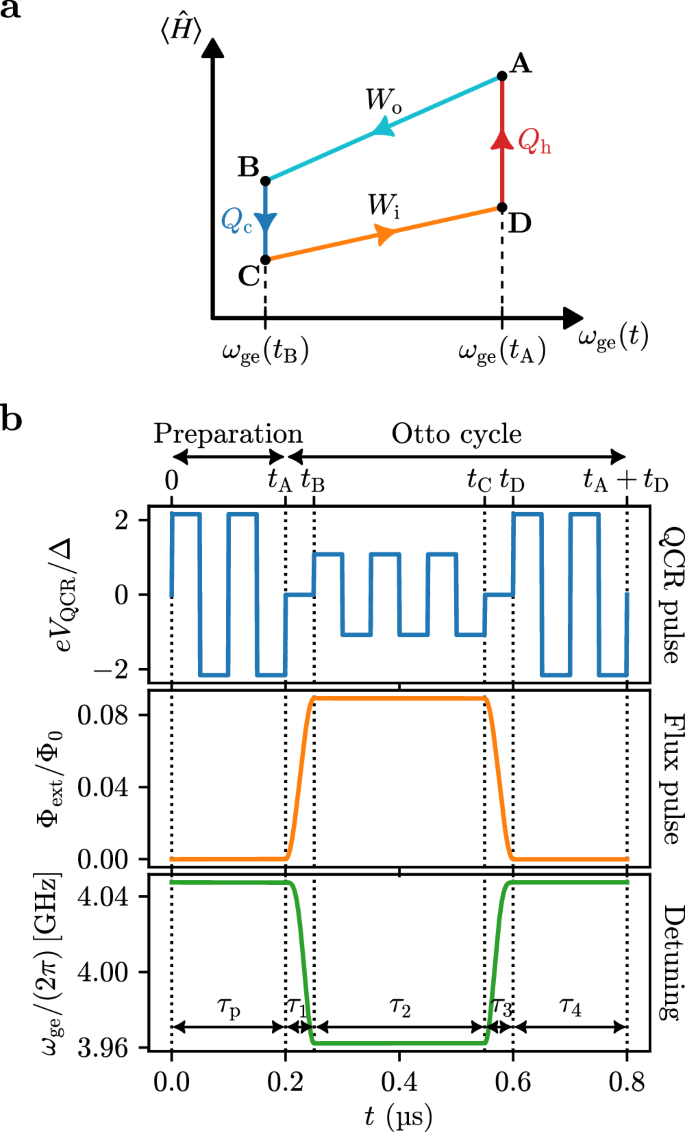
In an idealized two-level Otto engine with hot and cold transition frequencies and , where , the maximum frictionless Otto efficiency is determined by the ratio of those gaps:
It is tempting to mistake this for a universal upper limit of every quantum heat engine, but it describes the ideal Otto cycle under the relevant assumptions. Carnot efficiency, , provides the more general reversible upper bound for thermal engines between reservoirs at temperatures and . One must not identify the two expressions or expect the same engineering figure of merit for different cycles. The 2026 experiment used only modest frequency detuning, giving an ideal Otto efficiency of about 2 percent under its cycle parameters. [1][2]
The refrigerator that can act like a heater
The central engineering trick was a quantum-circuit refrigerator (QCR), a controllable dissipative circuit based on a normal-metal–insulator–superconductor junction. Voltage bias can stimulate photon-assisted electron tunneling and alter the effective dissipation and excitation rates seen by a coupled microwave mode. Through an auxiliary resonator, this makes it possible to drive the transmon toward states with different effective temperatures. The same physical component can therefore function as a cold or hot engineered reservoir by changing its operating conditions. The experimental use of one tunable apparatus does not eliminate the external electrical resources necessary to operate it. [1][3][4]
That caveat is essential for interpreting the word engine. The energy required to generate QCR bias pulses, flux tuning and control electronics was not supplied by the qubit itself, and the microscopic working medium's positive thermodynamic work output does not imply that the laboratory apparatus generates net electrical power. A quantum engine is a carefully bounded physical system exchanging heat and work; a full-device energy audit would require accounting for all control and refrigeration costs. The experimental advance lies in controllable cyclic thermodynamics at the quantum scale, not in practical power generation. [1]
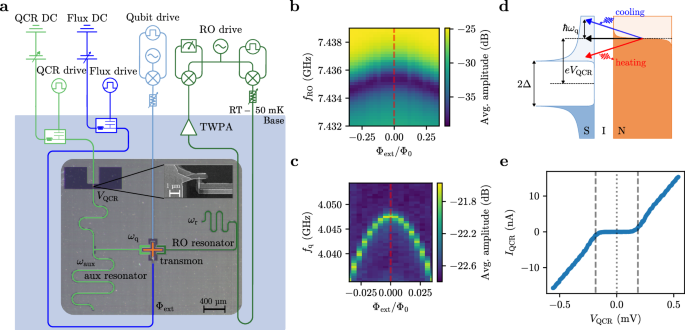
The sample operated in a dilution refrigerator near a 40 mK base temperature, but the relevant qubit energy distribution was altered dynamically through the engineered reservoir. Its lowest transition frequency at the quoted operating point was approximately 4.047 GHz, while the auxiliary resonator was near 4.670 GHz and the readout resonator near 7.436 GHz. The researchers used magnetic flux to shift the transmon transition and pulse the energy-level spacing. The maximum detuning employed for the reported work measurement was about 82.4 MHz. These are specific features of the studied device, rather than universal requirements for a quantum Otto engine. [1]
How the experiment inferred work instead of guessing
One difficulty in quantum thermodynamics is that the energy exchanged during a cycle is extremely small. The apparatus cannot meaningfully be attached to a tiny mechanical piston. Instead, the researchers measured the distribution over transmon eigenstates using dispersive readout. Repeated single-shot IQ outcomes were analyzed with a Gaussian-mixture model that distinguished the lowest levels and a group of higher-lying excitations. Characterizing both the instantaneous energy levels and their populations allowed the team to reconstruct the mean internal energy throughout each stroke. [1]
For a system with diagonal populations and instantaneous energies , the relevant weak-coupling energy balance takes the generalized form
Integrating the terms along the heating and cooling strokes yields the heat exchange; integrating along the flux-tuned strokes yields the work performed on the medium. Over a cycle with net negative work on the system, the output power and efficiency can be written using the authors' convention as
The measured work is therefore an inferred thermodynamic quantity from calibrated spectroscopy and population trajectories, consistent with the model's energy balance. It is not the directly harvested electrical output of an on-chip generator. The researchers also compared the population trajectories with an open-system simulation, which provided an independent check on the experimental interpretation. [1]
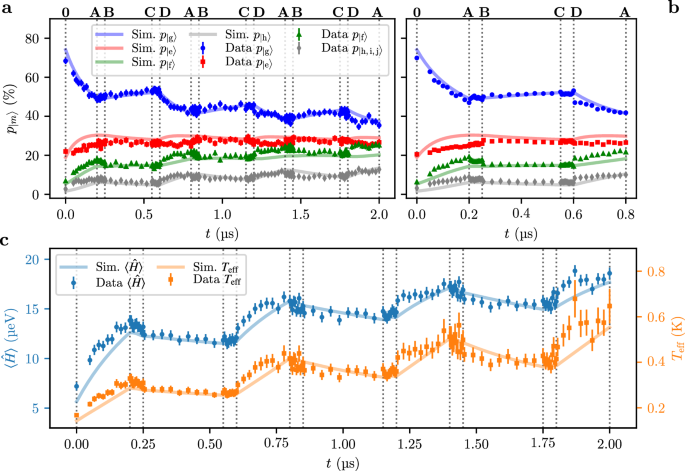
The size of the reported signal matters. For repeated first cycles, the mean absorbed heat was about , and the mean total work was approximately under the convention above. The corresponding mean output power was and mean efficiency , or about 0.55 percent. The average output power corresponds to roughly watts when converted to SI units. That is extraordinarily small, but a device that operates on the energy of a few quantum transitions was never designed to compete with a macroscopic turbine. This quantitative result is a validation of controlled thermodynamic cycles, not a commercially relevant power specification. [1]
The 0.55 percent result amounts to about 27 percent of the ideal Otto efficiency set by the experiment's gap variation. The authors attributed much of the discrepancy to the fact that their repeated measurements examined the first cycle before the system had reached a steady periodic state. Their simulations predict higher efficiency after the engine approaches a steady cycle, near the approximately 2 percent Otto value. Predictions for steady-state operation should remain distinct from the directly measured first-cycle figure. [1]
Coherence, irreversibility, and the price of finite time
Quantum engines invite a tempting claim: coherence automatically makes an engine more efficient. The 2026 experiment does not establish that. Its operation is dominated by controlled occupation changes and spectral tuning; the demonstration of positive work is already meaningful without invoking a uniquely quantum coherence advantage. Genuine quantum enhancement would require a precisely defined comparison to a suitable classical or incoherent engine under matched resources. Coherence can also introduce friction and extra entropy production if a rapid parameter ramp generates unwanted transitions. [2][5]
In the ideal Otto picture, adiabatic work strokes preserve instantaneous energy populations. Real pulses have finite rise times, imperfect isolation and leakage into higher transmon levels. The QCR can have residual coupling during nominally isolated intervals, and the qubit's dissipative environment never disappears completely. Each deviation modifies the path of the system through energy–population space. Because the power output is tiny, calibration of frequency excursions, thermalization times, single-shot discrimination and drift becomes part of establishing the result. The published work included spectroscopy, QCR characterization and independent simulation precisely to constrain these effects. [1]
The process also illuminates the relationship between heat and information. A resonator or qubit reset is a form of directed entropy removal, accomplished by coupling the system to a reservoir. That requires entropy to go somewhere else. Landauer's principle gives a fundamental lower bound on heat generated in idealized logically irreversible erasure at temperature , for one bit in the appropriate quasistatic setting. This should not be naively applied as an equality to each experimental qubit reset, but it reminds us that the information-processing architecture and its thermal environment are inseparable. In fault-tolerant processors, repeated measurement, decoding and reset operations generate dissipation across multiple temperature stages. [6][7]
What this changes for quantum computer engineering
The immediate value of an engineered heat engine is methodological. A QCR that can rapidly switch between effective reservoir conditions is relevant to state preparation, reset and controlled open-system dynamics. A tunable working medium provides a platform for testing models of finite-time quantum thermodynamics, stochastic trajectories, heat currents and reservoir engineering. Better engineered thermal couplings may also help researchers distinguish whether a qubit warms because of incoming noise photons, imperfect thermal anchoring, quasiparticle processes, or deliberate control. [1][3][4]
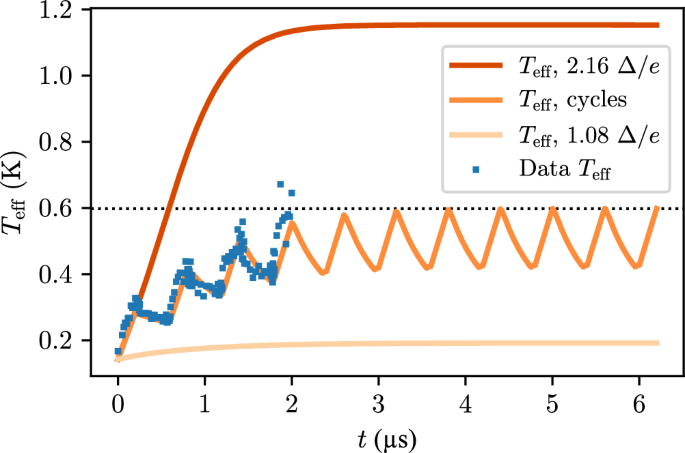
There are open questions at every scale. Can a superconducting quantum engine directly measure work and heat statistics at the trajectory level, rather than relying on mean populations? Could a carefully controlled coherence resource outperform an incoherent reference engine under fair energy accounting? Can multi-qubit or non-Markovian reservoirs reveal thermodynamic signatures inaccessible to a single nearly classical population cycle? How do controller power and cold-stage heat loads change as these microscopic operations are repeated thousands or millions of times? A measured positive output work is a beginning, not the answer to these larger questions. [1][5]
The accomplishment of the May 2026 experiment is striking precisely because it is modest in the right way. It takes the abstraction of a heat engine—a system that absorbs energy, changes its internal state, performs work, and returns to its starting condition—and realizes its thermodynamic cycle in a controllable superconducting device. The qubit is no longer only a carrier of information that engineers struggle to keep cold. It can also be a precisely measured working medium through which heat is directed and transformed. At that scale, the relation between quantum information, dissipation and the laws of thermodynamics becomes an experimental discipline.
References and further reading
[1] Uusnäkki, T., Mörstedt, T., Teixeira, W., Rasola, M. and Möttönen, M., Initial Demonstration of a Quantum Heat Engine Based on Dissipation-Engineered Superconducting Circuits, Nature Communications 17, 6054 (2026). https://doi.org/10.1038/s41467-026-72651-x
[2] Kosloff, R. and Levy, A., Quantum Heat Engines and Refrigerators: Continuous Devices, Annual Review of Physical Chemistry 65, 365–393 (2014). https://doi.org/10.1146/annurev-physchem-040513-103724
[3] Silveri, M. et al., Broadband Lamb Shift in an Engineered Quantum System, Nature Physics 15, 533–537 (2019). https://doi.org/10.1038/s41567-019-0449-0
[4] Aamir, M. A. et al., Thermally Driven Quantum Refrigerator Autonomously Resets a Superconducting Qubit, Nature Physics (2025). https://doi.org/10.1038/s41567-024-02708-5
[5] Vinjanampathy, S. and Anders, J., Quantum Thermodynamics, Contemporary Physics 57, 545–579 (2016). https://doi.org/10.1080/00107514.2016.1201896
[6] Landauer, R., Irreversibility and Heat Generation in the Computing Process, IBM Journal of Research and Development 5, 183–191 (1961). https://doi.org/10.1147/rd.53.0183
[7] Reeb, D. and Wolf, M. M., An Improved Landauer Principle with Finite-Size Corrections, New Journal of Physics 16, 103011 (2014). https://doi.org/10.1088/1367-2630/16/10/103011
[8] Uusnäkki, T. et al., Experimental Data and Analysis Codes for the Quantum Heat Engine Study, Zenodo (2026). https://doi.org/10.5281/zenodo.20023151
Cover and four in-article images reproduce actual experimental figures from Uusnäkki et al. (2026), under the article's CC BY 4.0 open-access license, with original research linked in each caption. All efficiencies, power figures and operation regimes are specific to the published superconducting-circuit experiment.