

Imagine collecting every photon that escapes an evaporating black hole. At first, the radiation seems to become more and more entangled with whatever remains behind. But if evaporation is unitary, the entropy of that radiation cannot increase forever. It must eventually turn around. The surprising tool that made this turnaround calculable was not a new particle or an escape tunnel. It was a different rule for where to draw a surface in spacetime.
The boundary of a black hole is usually introduced as a point of no return. Quantum gravity asks a less intuitive question: when we count the information belonging to some distant region, which parts of the gravitating universe should be included in the count? An answer began to emerge from holographic entanglement entropy, where an ordinary quantum-mechanical quantity in a boundary theory is assigned to a geometric surface deep in a higher-dimensional spacetime. In 2014, Netta Engelhardt and Aron Wall proposed that the relevant surface should make generalized entropy stationary, rather than merely making its area stationary. This quantum extremal surface, or QES, later became central to the island formula and the modern understanding of the black hole information problem. [5][6][9][11]
The chronology is important. Engelhardt and Wall's work, published in 2015 after appearing on arXiv in 2014, established a general quantum-corrected geometric prescription and developed its causal properties. The explicit black-hole island calculations and replica-wormhole justifications arrived in 2019 and 2020. Treating those later developments as the direct conclusions of the 2014 paper would obscure what made the original result significant: it converted a classical geometric variational problem into a quantum-information variational problem. [6][9][10][12]
Why black-hole evaporation poses an information problem
Hawking radiation follows from quantum fields in a curved background. In the semiclassical calculation, outgoing quanta are correlated with degrees of freedom behind the horizon. A black hole that begins in a pure quantum state can therefore appear to emit radiation described increasingly well by a mixed density matrix. A density matrix ρ carries fine-grained von Neumann entropy, which is zero for a pure state and positive when the state is mixed. This is distinct from a coarse-grained thermodynamic entropy that counts how many macrostates are compatible with incomplete observations. [1][2]
Suppose the combined black hole and outgoing radiation are a closed quantum system undergoing unitary evolution. If the global state is pure, the fine-grained entropy of all radiation should be zero once there is no remaining black hole or other system entangled with it. Long before the last stages of evaporation, typical-state arguments predict a characteristic rise and fall in the radiation entropy: the Page curve. Hawking's leading semiclassical reasoning, interpreted as independent pair production on a fixed background, appears to keep increasing the entropy. The tension is not that black holes radiate energy, but that an information-theoretic prediction and a semiclassical calculation seem to disagree about the same quantum state. [1][2]
A useful distinction is between the entropy of the Hawking radiation as a quantum subsystem and the entropy one would infer by treating each emitted particle as fresh thermal noise. The latter can keep increasing even in situations where the microscopic state evolves unitarily. The information paradox asks how gravity must be organized so that an appropriate fine-grained entropy calculation reflects that microscopic consistency without abandoning the local usefulness of semiclassical field theory.
The first geometric surprise: entropy looks like area
A black hole's Bekenstein-Hawking entropy is proportional to horizon area, not interior volume. In units where Boltzmann's constant is one, it takes the familiar form A/(4GNℏ), with factors of the speed of light suppressed. This suggests a remarkable compression: gravitational entropy can behave as though information were associated with lower-dimensional boundaries. The AdS/CFT correspondence sharpens that hint by relating gravity in an anti-de Sitter bulk to a nongravitational quantum field theory on its boundary. [3][4]
Ryu and Takayanagi identified a geometric way to calculate entanglement entropy for a static boundary region R: find the appropriately anchored bulk minimal surface and divide its area by four Newton constants in gravitational units. Hubeny, Rangamani and Takayanagi extended the prescription to time-dependent geometry using covariant extremal surfaces. These surfaces have codimension two: on a three-dimensional spatial slice they would be lines, while in higher dimensions they are higher-dimensional geometric objects. Their shapes depend on the chosen boundary region and on a homology constraint that links them to it. [3][4]
The equation is striking because the quantity on the left is computed from a density matrix in a nongravitational theory, while the leading term on the right is a geometric measurement in a gravitational spacetime. It does not say that every boundary in the universe encodes information through the same simple surface. It is a statement about particular holographic theories and controlled semiclassical limits. Even within that setting, quantum fields in the bulk contribute entropy beyond classical area.

The missing term is the entropy of the bulk itself
Faulkner, Lewkowycz and Maldacena showed that the first bulk quantum correction contains the entanglement entropy of quantum fields across the classical extremal surface. The corrected expression is called generalized entropy. Its area term counts the leading gravitational contribution; the bulk term accounts for quantum entanglement, and additional local counterterms must be handled consistently so that ultraviolet divergences do not make the physical result meaningless. The two pieces cannot be regarded as separate observable numbers independent of the renormalization scheme. [5][6]
Here ΣR is the bulk region bounded by the boundary subregion R and the candidate bulk surface X. In a pure global state one may sometimes interchange the inside and outside entropies, but for mixed states the choice of side matters. The counterterm notation is schematic: in a renormalized treatment, higher-derivative contributions and gravitational entropy corrections must be incorporated in the appropriate generalized functional. The conceptual gain is that a candidate surface is assigned a number that knows about both geometry and the quantum state. [5][6]
Engelhardt and Wall changed the order of the calculation. Rather than choose X by extremizing only its area and then evaluate the bulk entropy at that same classical location, they proposed finding a surface Χ at which the entire generalized entropy is stationary. Multiple solutions may exist, so the admissible stationary candidate with least generalized entropy is selected for the entropy calculation, subject to the holographic setup. The first step is a stationarity condition; the second is a comparison between competing solutions. Confusing these steps leads to incorrect interpretations of island transitions. [6][14]
That proposal reduces to the classical prescription when quantum contributions are negligible. It also agrees with the first bulk loop correction under the controlled perturbative assumptions of the Faulkner-Lewkowycz-Maldacena result. Their difference emerges at higher orders, once the shift in the extremal surface's location and the state dependence of the entropy functional are taken seriously. This is why the 2014 proposal was more than the instruction to add one quantum term to an old formula. [5][6]
A small calculation reveals why moving the surface matters
Take a single spatial deformation coordinate x for a simple toy model. Assume the classical area A(x) has a nondegenerate minimum at x0, and that the bulk entropy changes with x. These assumptions do not capture every Lorentzian extremal surface, which can be a saddle, but they make the leading perturbative mechanism transparent. The corrected stationary location x* is determined by balancing the area gradient against the entropy gradient.
Expanding about the area extremum A'(x0)=0 and treating the bulk entropy as order one while the area term scales as 1/GN gives
The displacement is order GN in this controlled example. At first order in the entropy expansion, evaluating the correction on x0 is enough, because the unperturbed area is already stationary there. At the next order the displacement feeds back into the value of generalized entropy, producing a genuine difference between “correct the value at the old surface” and “re-extremize the corrected functional.” In realistic spacetimes the deformation is a field on a codimension-two surface and the required Hessian is an operator; the one-variable formula is an analogy, not the complete gravitational derivation.

The causal wedge is not the information wedge
Classical general relativity defines a causal wedge for a boundary region: the bulk points that can both send signals to and receive signals from the boundary domain of dependence. A holographic entanglement wedge is defined differently, using the appropriate bulk region between the boundary region and its extremal surface. The two constructions need not select the same region. The distinction becomes profound when one asks what can be reconstructed from a boundary quantum state, as opposed to what can be contacted with a classical light signal. [6][8][15]
Engelhardt and Wall proved that, under their stated semiclassical assumptions including a generalized second law, quantum extremal surfaces lie outside the causal domain of influence of the associated boundary subregion and its complement, in the relevant geometric sense. They also described barriers that such surfaces cannot cross. These results are consistency constraints on the shape of the QES and the region potentially encoded by boundary data. They do not mean that an observer can send signals through a QES or that entropy carries messages faster than light. [6][7]

This is also where the language of quantum error correction becomes useful. In holographic codes, a logical operator describing a bulk degree of freedom can sometimes be reconstructed from more than one overlapping boundary region, without cloning quantum information. The apparent redundancy resembles an error-correcting code that embeds logical information into physical degrees of freedom. If a QES changes the entanglement wedge associated with a subsystem, it can change which bulk operators that subsystem can reconstruct. This mathematical sense of “access” is not equivalent to visiting the corresponding bulk point. [8][15]
The decisive turn: a piece of the interior joins the entropy calculation
The 2019 computations made the variational rule unexpectedly concrete. In tractable evaporating black-hole models, one considers a distant, often nongravitating radiation region R coupled to a gravitating region. At early times, the relevant fine-grained radiation entropy can be evaluated without assigning any interior island to R. At sufficiently late times, a different admissible saddle becomes dominant. That saddle contains an interior region I whose quantum fields must be included when calculating the entropy of the radiation. [9][10][11]
This is the island formula, written schematically with local gravitational corrections suppressed by the ellipsis. The extremization applies to the island boundary, while the outer minimization compares admissible saddles, including the empty-island candidate. The union R ∪ I is an information-theoretic subsystem appearing inside a semiclassical entropy rule. It does not describe Hawking particles physically entering an island, nor a classical observer opening an escape route through the horizon. [10][11][12]

The crucial intuition is that tracing out the black hole interior and then assigning every mode near the horizon to an independent inaccessible system is not always the correct way to identify the radiation's effective degrees of freedom in gravity. After the transition, the semiclassical entropy formula already includes the island degrees of freedom when it evaluates the radiation subsystem. That changes the entropy count. In special holographic setups, entanglement-wedge reconstruction gives the stronger statement that certain interior logical operators are encoded in the radiation degrees of freedom. This is a property of the code and its quantum state, not a classical signal travelling outward from the singularity. [8][9][11]
How two candidate surfaces produce the Page curve
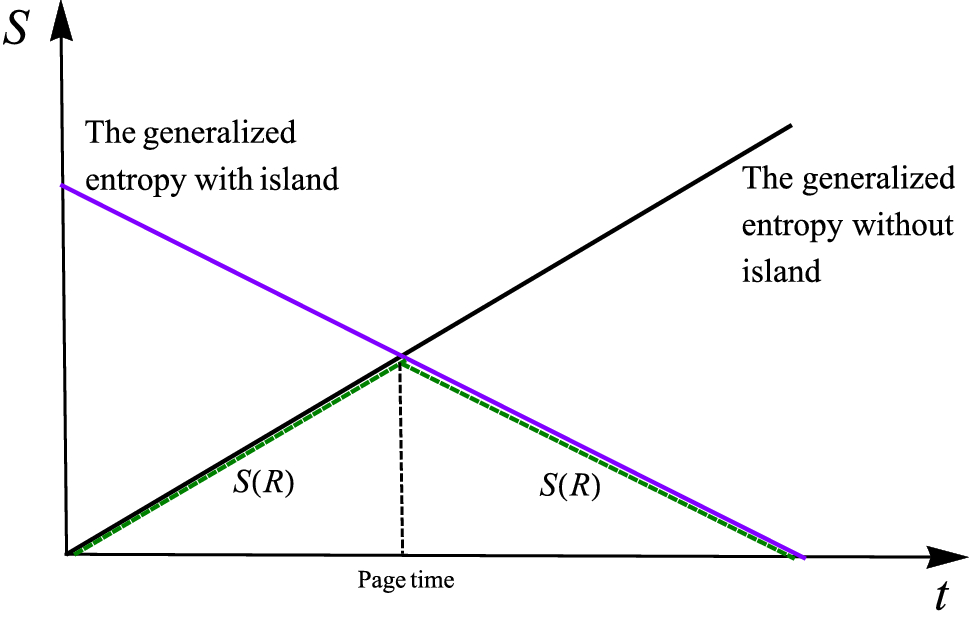
The calculation's dramatic consequence can be understood by comparing two time-dependent candidates. The no-island contribution approximately follows the entropy accumulated in emitted modes and rises while Hawking radiation is produced. The island contribution includes a gravitational area-like term that decreases as the black hole shrinks. Their relative dominance can exchange near the Page time. The fine-grained entropy follows the appropriate lower branch in the controlled semiclassical calculation, producing the characteristic rise and fall that unitarity demands. [9][10][11]
As an elementary illustration, imagine that the early branch grows approximately as αt and the competing branch decreases approximately as S0 − βt, with positive coefficients α and β. Their crossing occurs at tPage = S0/(α + β). The coefficients are deliberately invented for this toy line-crossing example and should not be mistaken for universal evaporation rates. Real calculations depend on the spacetime, quantum state, matter content and boundary conditions, and can involve more complicated phases and corrections.
The important result is narrower, and more impressive, than the popular claim that the black-hole paradox has been completely solved. These calculations recover unitary-looking fine-grained entropy curves in a rich collection of controlled models using semiclassical gravitational methods. They do not provide a complete microscopic description of an astrophysical black hole evaporating to nothing in realistic four-dimensional gravity. Nor do they automatically supply an explicit, experimentally implementable decoding algorithm for an arbitrary Hawking-radiation state. These are meaningful achievements and meaningful limitations.
Replica wormholes explain why the island contribution appears
The island formula would be harder to trust if it were only a rule chosen because it produces a pleasing graph. A second line of work gave a path-integral explanation. To calculate the von Neumann entropy, one can first calculate integer moments Tr(ρn) using n replicas of an auxiliary spacetime and then analytically continue the result toward n=1. In an ordinary nongravitating theory, the replicas can be treated as separate copies connected only by specified boundary gluing. In gravity, additional saddle-point geometries can contribute, including configurations in which copies are linked by replica wormholes. [12][13]
The replica trick is a mathematical method of evaluating a nonlinear function of a density matrix. A replica wormhole is therefore a saddle in the auxiliary entropy computation, not a tunnel that an astronaut or photon can traverse from one black hole to another. When the new saddle dominates, its contribution reproduces the island-type gravitational entropy calculation. The precise range of validity of replica symmetry, analytic continuation and potential ensemble interpretations remains an active technical subject. [12][13]

A deeper connection to quantum error correction
Quantum extremal surfaces and islands have become inseparable from the problem of bulk reconstruction. If a boundary region's entanglement wedge includes a bulk operator, one can seek a corresponding operation on boundary degrees of freedom that reproduces its action inside an appropriate code subspace. The bulk location of information is therefore not uniquely associated with a local classical wire. It depends on the encoded state and on which subset of degrees of freedom one controls. This relation was explored in holographic quantum error correction and sharpened by bulk-boundary relative entropy identities. [8][15]
The island picture invites a concrete question: after the Page transition, how much of the interior can be reconstructed from radiation, and what prior knowledge of the black-hole state does that recovery require? In controlled models, the answer depends on the size of the code subspace and on nonperturbatively small reconstruction errors. A statement that the radiation “contains the interior” does not mean that every late Hawking photon independently stores a complete copy. A more precise formulation is that certain logical observables admit representations on the radiation subsystem within the specified holographic code. [8][9]
This connection also clarifies why the QES prescription matters to quantum memory research. A threshold between correctable and uncorrectable erasure patterns can be reflected geometrically by a change in the preferred extremal surface. In a holographic code, the geometric transition can act as a boundary between regions where a logical operator can or cannot be reconstructed. Those examples are mathematically useful analogies, not evidence that ordinary laboratory quantum codes literally contain miniature black-hole interiors.
The unfinished physics behind the elegant entropy rule
One challenge concerns the generality of the semiclassical expansion. In the simplest arguments, quantum matter corrects a classical spacetime only perturbatively. But entropy gradients may be large enough to move a QES far away from its naive classical position, especially in time-dependent evaporation. This is precisely the kind of effect studied in the 2019 developments. A formula that is perturbatively controlled in one regime cannot be applied indiscriminately to every strongly fluctuating quantum geometry. [10]
A second challenge is the causal and consistency structure. Quantum focusing conjectures and the quantum maximin construction supply powerful ways to reason about generalized entropy, nesting and inequalities between regions. Such results rely on hypotheses about the state, geometry, regularity and effective theory. Their success makes the geometric picture sharper, but does not justify assuming all candidate surfaces or all exotic spacetimes obey the same inequalities without qualification. [7][14]
A third challenge is interpretational. Replica wormhole calculations can involve subtleties regarding ensembles, topology sums and the meaning of factorization in gravity. The microscopic origin of gravitational Hilbert-space structure is not settled by drawing disconnected and connected replica manifolds. What the semiclassical calculations show is that omitting the gravitationally allowed saddles can give the wrong fine-grained entropy. Understanding exactly which microscopic theory and observable are being computed remains part of the research program. [12][13]
The idea that survives
There are at least three boundaries in this story, and confusing them creates much of the mystery. The event horizon separates causal futures, the classical extremal surface solves a geometric area problem, and the quantum extremal surface solves a state-dependent entropy problem. None is automatically interchangeable with another. Yet the last of these can determine which degrees of freedom contribute to the entropy of a boundary quantum system, even when the corresponding bulk region lies where ordinary causal intuition would never have placed it. [6][9]
The original paper by Engelhardt and Wall did not announce islands or calculate the Page curve of an evaporating black hole. It provided a more general and ultimately fertile idea: once quantum fields carry information, geometry must be extremized with respect to information as well as area. Later work showed that changing this variational principle can change the shape of an entire information-theoretic phase transition. In this sense, the frontier of black-hole physics is no longer simply the question of what happens at a horizon. It is the question of how quantum information tells spacetime where its relevant boundaries are.
References
[1] Hawking, S. W. (1975), Particle Creation by Black Holes. Original publication.
[2] Page, D. N. (1993), Information in Black Hole Radiation. Original publication.
[3] Ryu, S. and Takayanagi, T. (2006), Holographic Derivation of Entanglement Entropy from AdS/CFT. Original publication.
[4] Hubeny, V., Rangamani, M. and Takayanagi, T. (2007), A Covariant Holographic Entanglement Entropy Proposal. Original publication.
[5] Faulkner, T., Lewkowycz, A. and Maldacena, J. (2013), Quantum Corrections to Holographic Entanglement Entropy. Original publication.
[6] Engelhardt, N. and Wall, A. C. (2015), Quantum Extremal Surfaces: Holographic Entanglement Entropy beyond the Classical Regime. Original publication.
[7] Bousso, R., Fisher, Z., Leichenauer, S. and Wall, A. C. (2016), A Quantum Focussing Conjecture. Original publication.
[8] Almheiri, A., Dong, X. and Harlow, D. (2015), Bulk Locality and Quantum Error Correction in AdS/CFT. Original publication.
[9] Penington, G. (2020), Entanglement Wedge Reconstruction and the Information Paradox. Original publication.
[10] Almheiri, A., Engelhardt, N., Marolf, D. and Maxfield, H. (2019), The Entropy of Bulk Quantum Fields and the Entanglement Wedge of an Evaporating Black Hole. Original publication.
[11] Almheiri, A., Mahajan, R., Maldacena, J. and Zhao, Y. (2020), The Page Curve of Hawking Radiation from Semiclassical Geometry. Original publication.
[12] Almheiri, A., Hartman, T., Maldacena, J., Shaghoulian, E. and Tajdini, A. (2020), Replica Wormholes and the Entropy of Hawking Radiation. Original publication.
[13] Penington, G., Shenker, S. H., Stanford, D. and Yang, Z. (2020), Replica Wormholes and the Black Hole Interior. Original publication.
[14] Akers, C., Engelhardt, N., Penington, G. and Usatyuk, M. (2020), Quantum Maximin Surfaces. Original publication.
[15] Jafferis, D. L., Lewkowycz, A., Maldacena, J. and Suh, S. J. (2016), Relative Entropy Equals Bulk Relative Entropy. Original publication.