
One logical state, two separate machines
A quantum computer assembled from independent processors must do more than exchange entanglement. If a protected quantum state spans several modules, the machine must determine whether that state has suffered an error without measuring the information it is meant to preserve. This is the purpose of a stabilizer measurement: it asks a carefully chosen question about a collection of qubits while leaving their encoded amplitudes intact. When the qubits occupy different vacuum chambers, that question must cross an optical network.
On 11 September 2026, E. M. Ainley and collaborators at the University of Oxford reported the first experimental extraction and use of error syndromes from data qubits in separate quantum processors. Their revised preprint, dated 15 October, describes two demonstrations: repeated detection of phase errors in a distributed two-qubit code, and active correction of Pauli errors on a Bell state shared between two modules [1]. The nodes were approximately two metres apart. This is not yet a fault-tolerant distributed logical computer, but it establishes a missing physical operation on which such a computer would depend.
The advance matters because quantum networking and quantum error correction have developed along separate experimental paths. Researchers could generate entanglement across optical links, teleport gates and run small distributed algorithms. Within a single processor, error-correcting codes could repeatedly extract syndromes. Combining those capabilities requires photon generation, heralding, local entangling gates, mid-circuit measurements, classical communication and conditional recovery. Each stage must work while the data qubits retain their state. The important result is a measurement that can be used to protect quantum information stored in two different machines.
Why quantum codes require connections
A conventional surface code places data and measurement qubits on a two-dimensional local layout. Its geometric locality is valuable for fabrication and repeated parity measurements, but the code typically stores relatively little logical information per physical qubit. Quantum low-density parity-check codes, or qLDPC codes, offer another trade-off. They can encode several logical qubits in one block while keeping each stabilizer supported on a bounded number of data qubits. Their Tanner graphs often contain connections that are difficult to realize with nearest-neighbour gates [2,3].
Code parameters are written : physical data qubits, encoded logical qubits and distance , the minimum weight of a nontrivial logical operator. A distance- code can correct arbitrary errors on at most physical qubits in the usual Pauli-error setting. But parameters alone do not describe a functioning device. Syndrome-circuit depth, connectivity, decoder quality, correlated faults, gate noise and waiting-time errors determine whether nominal protection can be realized.
Bravyi and colleagues showed in 2024 that bivariate bicycle codes can offer substantial memory-overhead reductions under specified circuit-level noise models [3]. In one numerical example, twelve logical qubits can be preserved using 288 physical qubits for nearly a million syndrome cycles at physical error rate , whereas the comparison surface-code implementation requires roughly an order of magnitude more qubits. These are simulations, not measured lifetimes. The architectural challenge is that the corresponding Tanner graph requires interactions that cannot all be placed on a simple nearest-neighbour plane.

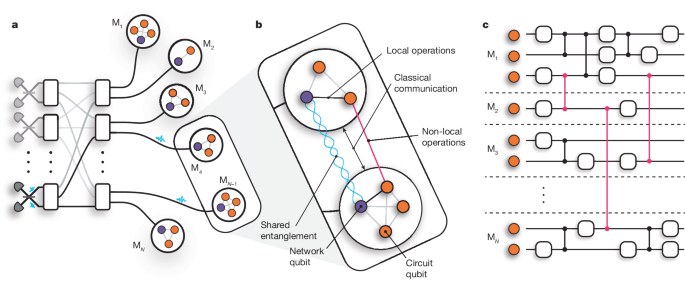
A network changes the geometry. Instead of fabricating every connection on one chip, several smaller processors can host different portions of the code. Photons establish entanglement between interface qubits, and local gates use that shared resource to measure stabilizers spanning multiple modules. This does not make connectivity free. It replaces difficult on-chip couplers with probabilistic links, extra memories, classical control and slower syndrome cycles. Whether the trade is favourable depends on link success rate, available parallelism and how long stored qubits survive.
Inside the Oxford two-node processor
The Oxford apparatus uses two mixed-species trapped-ion nodes called Alice and Bob. Each contains one ion and one ion. Strontium serves as the optical interface; calcium supplies a long-lived data qubit in its hyperfine manifold and an auxiliary qubit used temporarily for local mixed-species gates. The auxiliary and data qubits are different encodings in the same calcium ion, not separate calcium ions. This division of labour lets the optical link be retried while quantum information remains stored [1,5].
The same group previously demonstrated deterministic quantum gate teleportation across its optical link, reporting a teleported controlled- gate with approximately 86% average fidelity and a small distributed Grover search with about 71% success probability in a Nature paper published on 5 February 2025 [5]. Those experiments established networked computation, but a nonlocal gate and a nondestructive stabilizer measurement solve different problems. A gate transforms the data; a stabilizer measurement extracts information about an error subspace without revealing the encoded logical amplitudes.

Remote entanglement begins when each strontium ion emits a photon entangled with its internal state. Photons from the two modules interfere at a Bell-state analyser. A suitable detector pattern heralds the preparation of an entangled state of the remote strontium ions. Local operations then couple each strontium network qubit to its calcium data qubit. The two modules exchange measurement outcomes through a classical link, obtaining the remote stabilizer eigenvalue. Although the optical event is probabilistic, the stored data need not be discarded after every unsuccessful photon attempt.
Memory lifetime is therefore a systems-level resource. Drmota and colleagues previously transferred ion–photon entanglement into a robust calcium memory and measured fidelity after ten seconds with dynamical decoupling [6]. In the 2026 protocol, the relevant contrast is approximately ten seconds of memory coherence against around a tenth of a second to obtain a remote Bell pair. The precise numbers depend on operating conditions, but their separation permits repeated checks before the stored state is overwhelmed by idling errors.
A Bell pair used as a measuring instrument
Consider data qubits and in separate modules. The desired observable may be , whose eigenvalues are and . Measuring each data qubit separately in the basis would generally destroy an unknown logical superposition. Instead, an entangled network pair acts as a shared ancilla. Local controlled operations correlate the ancilla with the data parity; measurements of the ancilla reveal only the joint stabilizer eigenvalue.
The associated projectors are For a state , an ideal stabilizer measurement returns outcome with probability and conditioned state . If already belongs to the code space, that measurement leaves it unchanged. The distinction between learning a parity and learning two individual outcomes is the mathematical core of syndrome extraction. The former can detect an error while preserving encoded quantum information.
In the experiment, the heralded network Bell pair is mapped through local mixed-species gates onto the data parity. The researchers verify the operation by preparing four -basis product states and scanning the phase of a final network-qubit analysis pulse. Even- and odd-parity states yield fringes separated by approximately . Each plotted data point is based on 1,000 experimental repetitions [1]. The experiment therefore characterizes an observable carried by the two data qubits, rather than merely confirming that the interface ions are entangled.

Coherent errors in the local entangling gates complicate the fringes. The paper models controlled- miscalibrations as phase offsets and . Prepared product states acquire different small phase shifts, reducing the contrast of syndrome assignment. A remote measurement can fail because of local gate calibration even when the photons form a relatively high-fidelity Bell pair. This is why a component-level fidelity is insufficient to characterize a full stabilizer instrument.
Experiment one: detecting phase errors
The team first encodes one logical qubit into two remote calcium data qubits in an -basis repetition code, Its stabilizer is . One choice of logical operators is and . These commute with the stabilizer, anticommute with one another on the code space and act nontrivially on the logical basis. A physical error on either data qubit reverses the stabilizer eigenvalue.
This code cannot correct arbitrary errors: its distance is one because a weight-one physical can act as a logical operator. It is nevertheless useful for isolating dephasing, a significant trapped-ion noise channel. The team deliberately injects independent phase flips with probability and measures the remote stabilizer [1]. A single parity bit identifies whether the state has left the code space, although it cannot identify which data qubit suffered the phase error.
The probabilities of zero, one and two flips are , and . A single flip reverses parity, whereas zero or two preserve it. Thus the unconditioned expectation is An ideal even-parity filter rejects single-error events. Its acceptance probability is , while the conditional probability of a two-flip logical error is Two flips can therefore evade the parity check and act as a logical error.
The researchers implement the conditioning in real time. An odd syndrome causes the attempt to be aborted and the logical state re-prepared; an even syndrome permits the sequence to continue. Repeated checks progressively increase measured occupation of the intended code space without a measurable rise in logical error probability over the tested range. This is error detection with restart, rather than deterministic correction of an unknown logical qubit. Postselecting favourable outcomes incurs a success-probability and timing cost that must be included in any practical architecture.

At zero deliberately injected phase error, the measured probability of obtaining the target outcome after the remote stabilizer measurement is , corresponding to error. The independently characterized error budget predicts , consistent with that observation [1]. This is a probability for one measurement procedure, not a universal remote-gate fidelity or a fault-tolerance threshold. The largest modeled contributions come from the two local mixed-species gates, not the optical Bell-pair infidelity.
From remote gates to remote recovery
The earlier optical-network demonstration showed that the same hardware family could execute nonlocal gates repeatedly rather than distribute only one Bell pair. Main and collaborators implemented teleported controlled-, iSWAP and SWAP operations, followed by a two-qubit Grover search [5]. Their reported average gate fidelities were approximately 86%, 70% and 64%, respectively. The longer compiled operations accumulated more error, revealing the cost of repeated local and remote operations.
Remote syndrome extraction is a specialized network-assisted operation whose output is a stabilizer eigenvalue. Its purpose is to diagnose and repair errors rather than perform a general computational gate. The new experiment combines heralded links, local gates, mid-circuit measurement and feedforward while data remain in memory. In a larger code, the decisive benchmark will be the error of a complete repeated syndrome cycle, not the fidelity of a single remote gate.

Experiment two: correcting a distributed Bell state
Detection alone does not restore a damaged state. For active correction, the team prepares the two remote data qubits in a known Bell state, This state is stabilized by both and . A bit flip changes the eigenvalue; a phase flip changes the eigenvalue; a error changes both. The two syndrome bits distinguish the four Bell states and identify a suitable Pauli recovery on either node.
The researchers transfer entanglement from a heralded strontium pair into the calcium data qubits using local error-detected iSWAP operations. The prepared distributed Bell state has measured fidelity [1]. They then apply independent depolarizing noise, described for one qubit by At this maps an individual qubit to the maximally mixed state. The deliberately injected channel tests whether the correction sequence can counter known error classes.
Two further network Bell pairs are consumed to measure and in sequence. The classical outcomes select recovery operations on Bob's calcium qubit. An correction is a physical rotation; a correction is implemented through an update to the tracked phase reference. Each experimental shot therefore requires three rounds of remote entanglement generation: one for state preparation and one for each stabilizer [1]. Frame updates and physical rotations have equivalent ideal logical effects, but different control overheads.
The Bell-state fidelity follows from the Pauli correlators, Without correction, fidelity decreases as the injected noise grows. With remotely measured syndromes and feedforward, fidelity remains approximately constant over the tested range. At zero injected noise, the corrected procedure starts below the uncorrected baseline because additional gates and measurements introduce their own errors. Correction is useful only when the noise it removes outweighs the cost of implementing it.

There is a fundamental qualification. The experiment stabilizes a specified, known Bell state. Its two commuting generators define a one-dimensional state space, so the procedure does not protect an arbitrary unknown logical qubit against arbitrary single-qubit errors. Larger encodings are needed for that task. The proof of principle is still substantial: remote syndrome extraction, classical communication and conditional recovery are all performed on a state shared by physically separated processors.
The error budget and the latency problem
For the remote measurement, the paper reports raw entanglement error , whose modeled contribution to the final error is only . Mixed-species gate errors contribute in Alice and in Bob [1]. Raw component infidelity and its contribution to a specific observable are different quantities. Adding component error percentages without propagating them through the circuit does not produce a reliable logical failure estimate.
Previous work on the same ion pair achieved Bell-state gate fidelity in a different optimized operating regime [7]. This demonstrates a plausible route to better local operations, not that the current two-node system already reaches that fidelity. Earlier theory on noisy network links likewise suggests that sufficiently reliable local operations and appropriate purification can tolerate significant intermodule errors [8]. Such thresholds depend on architecture and noise model; they cannot simply be assigned to this experiment.
Latency is another bottleneck. If a Bell pair requires mean preparation time and a stabilizer cycle consumes sequential pairs, a simple timing estimate is . During this interval, memories accumulate idle errors. Under Markovian dephasing with rate , coherence falls as . Parallel link generation, entanglement buffering, improved photon collection and better check scheduling can all change this balance. A code with greater nominal distance may still perform worse if remote checks force its data to wait much longer.
From a two-qubit check to fault-tolerant computing
A practical distributed code needs repeated measurements of a complete stabilizer set, fault-tolerant circuits, decoding and demonstrable suppression of logical errors as resources increase. Measuring one remote parity operator is a necessary primitive, but it is not equivalent to implementing a high-distance code. Attractive asymptotic qLDPC rates do not guarantee that a physical network can execute all checks quickly enough to preserve the encoded state [2,3,9].
The syndrome circuit itself matters. In bivariate bicycle codes, each data qubit participates in several - and -type checks. Bravyi and colleagues studied shallow circuits and decoders under circuit-level noise [3]. When some gates become Bell-pair-mediated operations, correlated faults, photon loss and idle periods must be included in the decoder's model. A mathematically attractive Tanner graph can become an unattractive hardware schedule. The relevant optimization includes graph partitioning, optical routing, measurement order and error propagation.

A separate preprint submitted on 1 October 2026 studies distributed lattice surgery with photonic fusion networks [10]. Burt and collaborators construct hybrid syndrome-extraction protocols using ZX-calculus transformations and find a 50% interface-erasure threshold in certain idealized limits without local noise. Their simulations also show that interface-distance improvements can be obscured by local circuit errors around . These are theoretical results, not measurements on the Oxford apparatus. Together with the new experiment, they show why the network interface must be designed jointly with the code and its fault model.
The architectural vision predates both studies. Monroe and collaborators analyzed modular ion-trap processors connected by photons in 2014 [11], and Nickerson, Li and Benjamin investigated correction across noisy network links in 2013 [8]. What changed in 2026 is the experimental status of a critical interface: remote stabilizer outcomes can now be extracted from data qubits, interpreted in real time and used to determine subsequent quantum operations. The next decisive benchmark is a distributed logical memory that survives longer or exhibits lower logical error as additional physical resources are supplied.
The significance of a measurement that travels
Two kinds of scalability are at stake. Hardware scalability means building many modest processors rather than one device containing every qubit and coupler. Coding scalability means implementing useful error-correcting codes whose connectivity and encoding rates do not fit neatly on one planar chip. Neither advantage is automatic. The optical network must supply entanglement at adequate fidelity and rate, while memories must survive the wait and local gates must preserve the state during every check.
The Oxford result changes what two quantum processors can experimentally ask of their shared state. Earlier work could demonstrate entanglement or execute a nonlocal gate. The 2026 experiment asks whether remote data have left a protected subspace and uses the answer to reject or correct an error. That is the operational language of quantum error correction. Extending it from two ions to many protected logical qubits remains a major challenge, but the first remote syndrome has now been measured.
References
- E. M. Ainley, A. Agrawal, T. Araki, A. R. Martínez, D. Main et al., “Error Correction in a Distributed Quantum Computer,” arXiv:2609.13065v2 (15 October 2026; submitted 11 September 2026). Source.
- N. P. Breuckmann and J. N. Eberhardt, “Balanced Product Quantum Codes,” IEEE Transactions on Information Theory 67, 6653–6674 (2021). Source.
- S. Bravyi, A. W. Cross, J. M. Gambetta, D. Maslov, P. Rall and T. J. Yoder, “High-threshold and low-overhead fault-tolerant quantum memory,” Nature 627, 778–782 (27 March 2024). Source.
- D. Gottesman, “Stabilizer Codes and Quantum Error Correction,” PhD thesis, California Institute of Technology (1997). Source.
- D. Main, P. Drmota, D. P. Nadlinger, E. M. Ainley, A. Agrawal et al., “Distributed quantum computing across an optical network link,” Nature 638, 383–388 (5 February 2025). Source.
- P. Drmota, D. Main, D. P. Nadlinger, B. C. Nichol, M. A. Weber et al., “Robust Quantum Memory in a Trapped-Ion Quantum Network Node,” Physical Review Letters 130, 090803 (3 March 2023). Source.
- A. C. Hughes, V. M. Schäfer, K. Thirumalai, D. P. Nadlinger, S. R. Woodrow, D. M. Lucas and C. J. Ballance, “Benchmarking a High-Fidelity Mixed-Species Entangling Gate,” Physical Review Letters 125, 080504 (18 August 2020). Source.
- N. H. Nickerson, Y. Li and S. C. Benjamin, “Topological quantum computing with a very noisy network and local error rates approaching one percent,” Nature Communications 4, 1756 (23 April 2013). Source.
- L. J. Stephenson, D. P. Nadlinger, B. C. Nichol, S. An, P. Drmota et al., “High-Rate, High-Fidelity Entanglement of Qubits Across an Elementary Quantum Network,” Physical Review Letters 124, 110501 (16 March 2020). Source.
- F. Burt, K. K. Leung, K.-C. Chen, M. S. Kim, M. Hanks, R. Meister, R. Bondesan and S.-K. Lin, “Loss-tolerant distributed lattice surgery using fusion networks,” arXiv:2610.01923 (1 October 2026). Source.
- C. Monroe, R. Raussendorf, A. Ruthven, K. R. Brown, P. Maunz, L.-M. Duan and J. Kim, “Large-scale modular quantum-computer architecture with atomic memory and photonic interconnects,” Physical Review A 89, 022317 (13 February 2014). Source.
- E. Dennis, A. Kitaev, A. Landahl and J. Preskill, “Topological quantum memory,” Journal of Mathematical Physics 43, 4452–4505 (2002). Source.