
“The dog chased the cat” and “The cat chased the dog” contain exactly the same words. Yet one describes a pursuit and the other reverses it. A mathematical theory of language must capture that distinction without merely memorizing entire sentences. Quantum natural language processing begins with an unexpected observation: the diagrams used to describe grammatical composition are closely related to those used in quantum information theory. The result is not a claim that language is mysteriously quantum, but a precise way to ask how words become meaning.
A word can be represented as a vector, a verb as a higher-order transformation, and a sentence as the result of contracting those objects according to grammar. A related family of quantum-inspired models uses density matrices to represent ambiguity and mathematical operators to describe contextual interpretation. Neither idea necessarily requires a quantum computer. The interesting problem is whether these structures preserve information that simpler representations lose, and whether that gain can be demonstrated experimentally. [1][3][4]
QNLP is therefore two overlapping research programs. One studies compositional semantics through mathematical structures inherited from quantum theory, often on ordinary computers. The other attempts to implement selected language-processing models on genuine quantum hardware. Their distinction is essential: a tensor network, a density operator and a parameterized quantum circuit can share a mathematical vocabulary while having entirely different computational costs and evidentiary standards.
Why ordinary word vectors are not enough
Distributional semantics learns the meaning of words from the contexts in which they appear. This explains why “river” can occupy a nearby region of an embedding space to “stream,” whereas “loan” tends to inhabit a different region. The approach is powerful because meanings are learned from real usage rather than defined only by hand. But finding a location for every word does not by itself tell us how the meaning of an entire sentence should be composed.
A particularly crude construction is to average the vectors of a sentence’s words. It may work surprisingly well for some retrieval tasks, but it destroys the distinction between subject and object. “Scientists study atoms” and “atoms study scientists” become identical after reordering. Modern transformers include positional and contextual interactions, so they are not limited to this failure. The example instead isolates a fundamental demand: a semantic composition rule should know which grammatical role each concept occupies. [2][3]
A structure-sensitive model asks which operations are necessary to combine those vectors. It treats a relational word differently from an object noun, and it allows the same vocabulary to yield different sentence meanings when its syntactic connections change. One of the most mathematically systematic answers is the categorical compositional distributional framework, known as DisCoCat.

The grammar hiding inside a quantum diagram
In 2010, Bob Coecke, Mehrnoosh Sadrzadeh and Stephen Clark described a connection between grammatical type systems and the mathematics of compositional quantum processes. A pregroup grammar assigns types to expressions. A noun has type n; a complete sentence has type s; and a transitive verb can have the compound type nr s nl. The superscripts denote adjoints that allow the two noun arguments to be consumed in the proper positions. [1]
The grammatical reduction says that “Alice admires Bob” is a sentence when the subject and object are combined with the verb. Now assign nouns a vector space N and sentences a possibly different vector space S. The verb is represented by a tensor in N ⊗ S ⊗ N after choosing bases and identifying the required dual spaces. A subject vector contracts with one noun index and an object vector with the other, yielding an element of the sentence space. The syntax has become an instruction for a calculation.
This is not just a picturesque rewriting of vector addition. A transitive-verb tensor need not be symmetric under exchanging its arguments. The result of applying it to “dogs chase cats” can therefore differ from applying it to “cats chase dogs.” More elaborate reductions can describe adjectival modification, relative clauses and nested constructions. The categorical formulation provides a disciplined explanation of why these calculations have the shapes they do. [1][3]
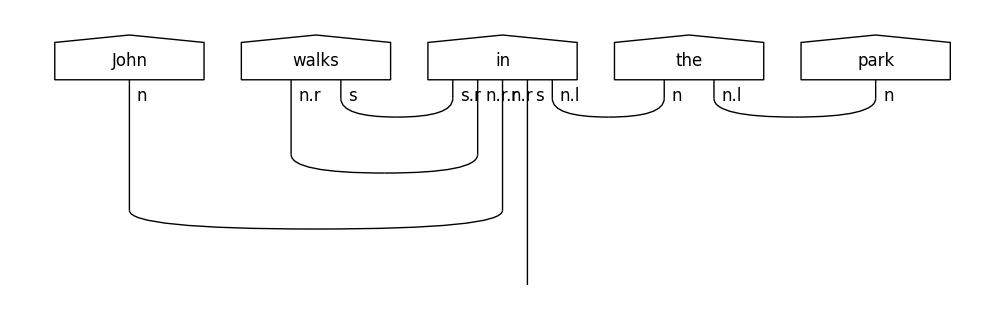
The deeper surprise is that the same kind of diagram describes networks of quantum operations. In categorical quantum mechanics, boxes can denote physical processes and wires can denote systems or types. In compositional linguistics, boxes denote meanings and wires encode grammatical interfaces. The agreement is structural, not metaphysical. It means a common graphical calculus can represent both systems while preserving their distinct interpretations.
What happens when we actually build a quantum circuit
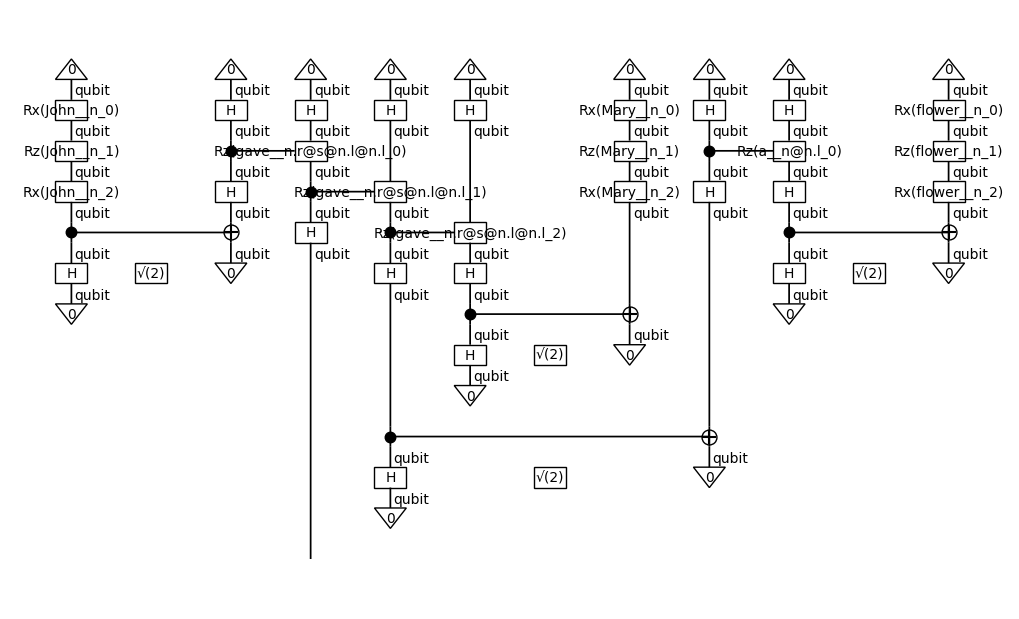
A complete hardware-oriented QNLP system must do more than draw a sentence. It parses the text, obtains a diagram, simplifies it under valid rewriting rules, and chooses an ansatz that maps the resulting structure to a parameterized circuit. A hardware circuit may encode words with rotations, connect their representations through entangling gates and read task-specific labels through measurements. The open-source lambeq library implements much of this pipeline, along with classical tensor alternatives. [5][6]
For sentence classification, a circuit prepares an initial state, applies trainable operations and estimates measurement probabilities. A classical optimizer then adjusts the parameters against labeled examples. In a simplified notation, a label probability can be written as a Born-rule expectation value. This is an actual quantum computation only when the operations and measurements are executed by quantum hardware rather than simulated numerically.
Here x identifies an input-dependent encoding, θ is a vector of trainable parameters, ρ0 is the initial state and My is the measurement operator associated with a candidate label. Different QNLP architectures choose different encodings, gate families and outputs. This equation illustrates the classifier mechanism rather than specifying all implementations. It also reveals a practical fact: obtaining the probability generally takes repeated circuit executions, not a single perfect observation.
A semantic model can borrow quantum mathematics without borrowing quantum hardware
The quantum-inspired approach can be more surprising than the hardware experiments because it is immediately testable on ordinary computers. Instead of insisting on pure vectors as the sole representation of meaning, researchers can use positive semidefinite operators to represent mixtures, uncertainty or correlations between latent features. Classical tensor networks still perform the grammatical contractions. The goal is to import a useful mathematical organization of uncertainty and composition, not to claim an exponential speedup. [4][13]
Consider “bank.” A simple vector may blend the financial and geographical meanings into one location. A density-matrix representation can explicitly encode the two alternatives and their relative uncertainty. For example, let the normalized vectors briver and bfinance denote the two senses. A valid density matrix can represent a classical probabilistic mixture of them:
The coefficient p lies between zero and one, and the matrix has unit trace. A phrase such as “the bank approved the mortgage” should increase the relevance of the financial reading, whereas “the bank eroded after the flood” should favor the geographical reading. This can be formalized as a context-dependent operation on the density matrix. A corresponding query can be represented by a measurement effect, producing a nonnegative probability. [4][13]
Here K filters the current semantic representation using contextual evidence, and Eq corresponds to a question about that representation. The update is a useful model of conditional interpretation, not an assertion that neurons undergo quantum measurement. A diagonal density matrix may encode nothing beyond an ordinary classical mixture. Off-diagonal coherence and noncommuting context operators must be given separate semantic justifications, and any empirical advantage must be tested rather than assumed.

Why order and context can change the answer
In quantum theory, the mathematical operator used to ask a question matters. Quantum-inspired semantics uses that observation to investigate contextual dependence. If two contextual filters A and B do not commute, applying one before the other can differ from reversing their order. That can be a useful hypothesis for words whose interpretations evolve as a reader proceeds through a phrase or passage. It is not evidence that linguistic ambiguity requires quantum physics; conventional Bayesian and neural models also capture contextual uncertainty.
The real contribution is a particular, testable design for how different contexts interact. For instance, one might compare a model in which senses are a static mixture with another in which context is represented by noncommuting transformations. If the latter does not improve generalization on controlled data, its extra machinery has not earned its cost. The same discipline should govern claims about quantum-inspired negation, entailment and metaphor. [4][9]
How a story becomes a circuit
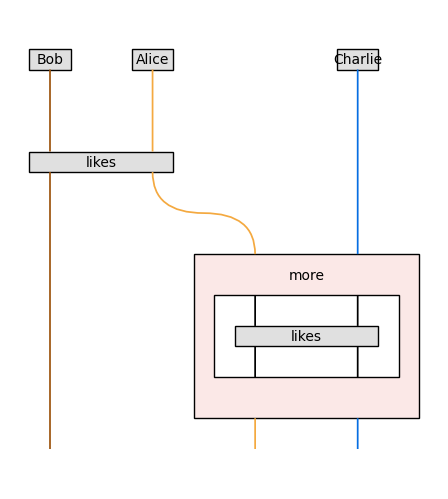
Meaning does not stop at punctuation. In “Alice lent Bob a book. He returned it,” successful interpretation requires carrying the identities of Bob and the book into a second sentence. DisCoCirc extends diagrammatic compositional semantics from individual sentences to discourse. Entities persist as wires, while successive actions update the relationships between those entities. Its experimental implementations can combine text parsing with coreference resolution to construct a larger diagram. [8]
The important change is structural. A sentence embedding normally summarizes a sentence into a representation. A discourse circuit can explicitly preserve which entities survive into later sentences and which transformations affect them. This is potentially useful for scientific procedures, legal passages and multi-step instructions, where losing an argument or confusing a referent can change an entire interpretation. But the method inherits errors from parsing and entity resolution; a perfectly valid diagram can still encode the wrong reading.
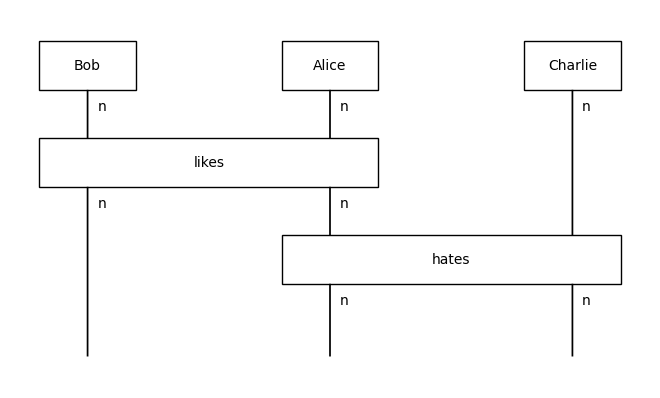
A second example in the lambeq tutorial uses a pronoun that refers back to a named person. The model attempts to connect the pronoun to the earlier entity rather than introducing a fresh, disconnected one. This small diagram exposes a general computational-linguistics challenge: syntax, semantics and reference resolution cannot be evaluated in isolation if the intended output is understanding of a passage rather than a single sentence.
The engineering problem hidden behind beautiful diagrams
A dense transitive-verb tensor can become expensive. If the noun space has dimension d and the sentence space has dimension k, the simple N ⊗ S ⊗ N representation requires d²k scalar parameters. Additional arguments grow the tensor order still further. Tensor-network factorization, low-rank approximations, diagram rewriting and parameter sharing can mitigate the cost, but their accuracy and expressivity must be measured. A legible string diagram does not guarantee a cheap tensor contraction.
Similarly, the observation that a state of dimension d can be encoded in roughly log2(d) qubits is not an end-to-end complexity advantage. Preparing arbitrary classical data, estimating measurement outcomes, coping with physical errors and optimizing a noisy circuit may dominate the workload. Fewer trainable parameters are not proof of faster inference or better semantic understanding. Reviews of the field consistently emphasize the difficulty of fair comparisons on genuinely challenging datasets. [10][11][12]
A serious benchmark would separately evaluate three questions. Does explicit grammar improve performance relative to equally strong classical encoders? Does the density-matrix representation improve on ordinary probabilistic mixtures or neural alternatives? Does a real quantum implementation execute a useful end-to-end task more efficiently than the strongest classical method, with data loading and measurements counted? These questions should not be collapsed into a single claim of quantum advantage.
An experiment that would actually test semantic composition
Consider constructing a dataset of matched sentence pairs that preserve most of their vocabulary but change grammatical roles. “The technician warned the operator” should not be conflated with “The operator warned the technician.” Add contextual ambiguity, negation, relative clauses and short stories that require resolving pronouns. Evaluation should separate lexical familiarity from compositional generalization by holding out particular noun-verb combinations and structural templates. The challenge is to show that a model has learned how an unfamiliar combination works, not merely seen similar strings in training.
The baselines must be competent: a bag-of-vectors control, a syntax-sensitive classical model, a small transformer, a tensor-network DisCoCat implementation, a density-operator extension and, only when justified, a hardware-oriented circuit model. Report accuracy, generalization under distribution shifts, parameter counts, training cost, inference latency and uncertainty across multiple runs. Ablations should remove syntax, operator order or off-diagonal structure to determine what is causally contributing. A research result becomes meaningful when the representation earns its complexity.
A different way to think about meaning
The lasting promise of QNLP may be less about replacing transformers with qubits than about exposing the algebra of meaning. A noun can be an input to a relation; a verb can be a typed transformation; ambiguity can be represented as uncertainty over possible senses; a passage can be an evolving network of entities and events. Category theory offers one precise account of how these pieces connect. Quantum information theory offers a related graphical language, and classical computation can already explore much of that space.
None of this makes language reducible to matrix multiplication. Social context, world knowledge and pragmatic inference do not materialize simply because we draw a wire from one word to another. What the approach offers is a falsifiable architectural principle: sentence meaning should be constructed by transformations whose interfaces reflect grammatical and semantic roles. That is a richer research question than whether quantum computers will someday understand English. It is a proposal about what understanding might require us to compute.
References
[1] Coecke, Sadrzadeh and Clark (2010), Mathematical Foundations for a Compositional Distributional Model of Meaning. https://arxiv.org/abs/1003.4394.
[2] Grefenstette and Sadrzadeh (2011), Experimental Support for a Categorical Compositional Distributional Model of Meaning. https://aclanthology.org/D11-1129/.
[3] Grefenstette and Sadrzadeh (2015), Concrete Models and Empirical Evaluations for the Categorical Compositional Distributional Model of Meaning. https://direct.mit.edu/coli/article/41/1/71/1501/.
[4] Piedeleu, Kartsaklis, Coecke and Sadrzadeh (2015), Open System Categorical Quantum Semantics in Natural Language Processing. https://doi.org/10.4230/LIPIcs.CALCO.2015.270.
[5] Meichanetzidis et al. (2020), Quantum Natural Language Processing on Near-Term Quantum Computers. https://arxiv.org/abs/2005.04147.
[6] Kartsaklis et al. (2021), lambeq: An Efficient High-Level Python Library for Quantum NLP. https://arxiv.org/abs/2110.04236.
[7] Quantinuum, lambeq documentation, The QNLP pipeline. https://docs.quantinuum.com/lambeq/guide/pipeline.html.
[8] Quantinuum, lambeq documentation, DisCoCirc: From text to circuit. https://docs.quantinuum.com/lambeq/tutorials/discocirc-basics.html.
[9] Sadrzadeh, Kartsaklis and Balkır (2018), Sentence entailment in compositional distributional semantics. https://doi.org/10.1007/s10472-017-9570-x.
[10] Nausheen, Ahmed and Khan (2025), Quantum Natural Language Processing: A Comprehensive Review of Models, Methods, and Applications. https://arxiv.org/abs/2504.09909.
[11] Vats et al. (2025), A Systematic Survey of Quantum Natural Language Processing. https://aclanthology.org/2025.quantumnlp-1.8/.
[12] Phukan and Ekbal (2025), A Survey of Quantum Natural Language Processing: From Compositional Models to NISQ-Era Empiricism. https://aclanthology.org/2025.quantumnlp-1.9/.
[13] Engineering Applications of Artificial Intelligence (2025), Quantum-inspired semantic matching based on neural networks with the duality of density matrices. https://doi.org/10.1016/j.engappai.2024.109667.