
A crystal driven by the timing of light
Optical control of a crystal is often described as a problem of delivering enough energy to move its atoms. For a coherent vibration, however, the phase of the motion matters as much as the amount of deposited energy. A second pulse can arrive while the lattice is already moving, reinforce the displacement, or oppose it. The distinction becomes especially important when intense excitation changes the electronic forces that launch the motion in the first place. In that regime, increasing laser intensity can produce a smaller structural response.
In a study published on 21 October 2026, Jan Gerrit Horstmann and colleagues investigated this counterintuitive behavior in tungsten ditelluride, WTe₂, a layered semimetal whose electric polarization is coupled to the relative sliding of adjacent atomic planes [1]. Their time-resolved second-harmonic measurements show that a low-frequency interlayer vibration initially grows with pump fluence, reaches a maximum, and then weakens. A pair of weaker, carefully delayed optical pulses can instead increase the sliding amplitude by as much as 50% relative to a single pulse carrying the same total absorbed energy. The result opens a way to interrogate strongly driven lattice dynamics without simply raising the optical fluence.
The experiment is also a useful test of a broader assumption in ultrafast solid-state physics: that photoexcited electrons exert a force proportional to their number. The WTe₂ data, interpreted with electronic-state-resolved calculations, show why that proportionality fails. Different parts of the electronic spectrum push the same phonon coordinate in opposite directions. Pulse timing changes which contributions dominate when the lattice responds.
Why a sliding displacement carries polarization
WTe₂ belongs to the transition-metal dichalcogenide family, but its low-temperature orthorhombic Td structure differs sharply from the familiar hexagonal monolayers. Stacked tungsten and tellurium layers lack inversion symmetry, allowing an out-of-plane polar response. Experiments on two- and three-layer WTe₂ established electrically switchable polarization even though the material is metallic, an unusual coexistence made possible by its atomically thin geometry [2]. In bulk Td-WTe₂, opposite contributions from neighboring layers and electronic screening make the measured polar response especially sensitive to the near-surface structure.
The relevant collective coordinate is an interlayer-sliding phonon with frequency approximately . Its period is therefore , far longer than the 130-femtosecond pump pulses used in the new experiment. A femtosecond excitation is effectively impulsive on the scale of this vibration, while two excitations separated by a few picoseconds can be timed to a chosen phase of the moving lattice. The displacement changes the inversion-breaking structure and hence the polarization-sensitive optical response [1,3].
There is an important symmetry distinction in the structural landscape. The polar Td phase has space group , whereas the nonpolar 1T′ polymorph has . The 2026 calculations identify a centrosymmetric reference from which different symmetry-lowering distortions lead toward the two structures. Interlayer sliding alone is not a complete symmetry-allowed Td-to-1T′ path; an intralayer distortion is also involved. Calling every low-frequency relative displacement a shear mode can obscure that distinction, so the experiment consistently separates the sliding coordinate from the higher-frequency intralayer mode [1].
 Figure 1. The lattice and electronic structure of polar Td-WTe₂, including the momentum cut used in time-resolved photoemission experiments. Source: P. Hein et al., Nature Communications 11, 2613 (2020). CC BY 4.0; reproduced without modification.
The potential-energy landscape of two coupled modes
A minimal lattice description introduces a sliding normal coordinate and a second intralayer coordinate . Near a chosen structural minimum, the free energy can contain harmonic terms and an anharmonic coupling, schematically The coefficient expresses how one displacement modifies the restoring force experienced by the other. This expression is a local expansion, not a complete global description of the energy surface connecting distinct polymorphs. The 2026 calculations find the intralayer mode near 2.7 THz and a low-frequency sliding coordinate close to the observed 0.24 THz oscillation [1].
To first order in a small displacement, a polar observable may be written . This does not imply that the measured second-harmonic intensity is itself a direct, linear readout of absolute polarization. Optical susceptibility, interference between tensor components, pump-induced electronic changes, and the finite probing depth all enter the signal. The experiment uses polarization-resolved data and model fits to isolate the coherent sliding contribution from these other effects.
Earlier ultrafast photoemission measurements found that low-frequency lattice motion in Td-WTe₂ modulates electronic bands in the region associated with its proposed type-II Weyl character [3]. Thus the coordinate is consequential for more than ferroelectricity: changing the atomic geometry also changes orbital hybridization, band splitting, and potentially topological band features. Whether a particular pulse actually switches a topological phase must nevertheless be demonstrated rather than inferred from the presence of coherent oscillations.
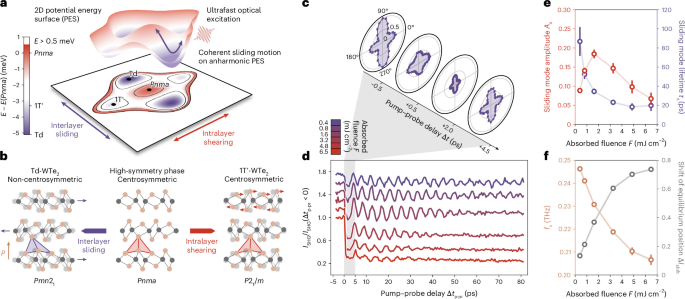 Figure 2. The structural energy landscape and measured second-harmonic response of Td-WTe₂. The sliding-mode amplitude rises and then declines as absorbed fluence increases. Source: J. G. Horstmann et al., Nature Physics (2026), Fig. 1. CC BY 4.0; reproduced without modification.
Why a stronger pulse eventually drives less motion
Displacive excitation of coherent phonons begins when a laser pulse changes the electronic distribution faster than the nuclei can move. The electronic redistribution shifts the lattice's instantaneous equilibrium position. A damped coordinate then oscillates around that displaced minimum. In a simplified description, where , is a damping parameter, and is the force generated by the nonequilibrium electrons. In the usual linear limit, the drive grows approximately with absorbed pump energy, so the initial oscillation amplitude grows with fluence [4].
The measurements in WTe₂ depart from that limit. For absorbed fluence increasing from roughly 0.4 to 6.5 mJ cm⁻², the sliding-mode amplitude reaches a maximum near and then decreases. Meanwhile, other higher-frequency modes continue to gain amplitude over the same range. The nonmonotonic response is therefore mode-specific, rather than a universal saturation of all lattice motion. The fitted sliding frequency also softens, and the average coordinate shifts toward a more symmetric structure as excitation increases [1].
At first sight, one might attribute the decline to optical absorption saturating or to the lattice simply becoming too hot. Those possibilities cannot explain the full mode-selective behavior. Horstmann and colleagues instead calculate the force contributed by different occupied electronic states. Near the Fermi energy, redistributed carriers favor motion toward the high-symmetry reference. More energetic states exert an opposing force. Raising fluence fills more of those counteracting states, so the net force driving the selected coordinate becomes smaller even while the total deposited energy rises.
 Figure 3. Electronic contributions of opposite sign compete to drive the sliding mode. The calculated response and experiment show a maximum near 1.6 mJ cm⁻². Source: J. G. Horstmann et al., Nature Physics (2026), Fig. 2. CC BY 4.0; reproduced without modification.
The electronic force is a weighted sum, not a single number
The microscopic mechanism can be written in terms of the occupation of electronic bands. For a normal coordinate and instantaneous occupations , a useful Born–Oppenheimer contribution is with the equilibrium force removed and additional self-consistent terms included in a full calculation. The derivative of the band energy with respect to displacement is the mode-resolved electron–phonon coupling. Its sign can differ among bands and momenta. Exciting more electrons does not guarantee that all of them push the lattice in the same direction.
The calculations in the 2026 study compare electronic temperatures of 2,000 and 4,000 K as effective descriptions of different transient carrier distributions. They find opposing state-resolved contributions and predict a sliding-amplitude maximum around , corresponding in the experimental calibration to approximately 1.6 mJ cm⁻². This is an electronic excitation parameter, not a claim that the crystal lattice itself has equilibrated to 3,100 K. Electron and nuclear degrees of freedom remain out of equilibrium on the femtosecond-to-picosecond timescale [1].
The distinction between electronic temperature and lattice temperature is essential. A pulse can create a broad, hot carrier distribution while the atoms have barely begun to move. The electronic distribution then relaxes on a timescale of order picoseconds, whereas the low-frequency sliding oscillation persists for several cycles. That separation gives the experiment a narrow but useful opportunity: a second excitation can arrive after the most counterproductive electronic population has relaxed, yet while the coherent lattice wave remains phase-addressable.
Reading the motion with second-harmonic light
The principal probe is time-resolved second-harmonic generation, or trSHG. A probe field at angular frequency produces a nonlinear polarization at , schematically In the electric-dipole approximation, the bulk second-order susceptibility vanishes in an inversion-symmetric medium. A polar crystal therefore offers a particularly sensitive way to monitor transient changes in inversion-breaking atomic geometry. Polarization analysis separates different tensor components and helps connect changes in intensity to the moving lattice.
The experiment excites the sample with 130-fs pump pulses of photon energy 0.82 eV and probes with light at 1.55 eV [1]. The initial response contains a prompt electronic contribution, followed by oscillations at the sliding frequency. By varying pump–probe delay and the optical polarization, the authors extract a fitted amplitude, damping time, and frequency. A trace of SHG intensity alone should not be interpreted as a direct movie of every atomic coordinate: it is an optical observable whose oscillatory components are related to lattice motion through the symmetry and response model.
Complementary time- and angle-resolved photoemission experiments by Hein and colleagues provide a different perspective. Their momentum-resolved data track periodic electronic-band changes correlated with coherent low-frequency motion, including changes in regions relevant to the Weyl-semimetal electronic structure [3]. The two experimental approaches are complementary: trSHG is acutely sensitive to broken inversion symmetry, while photoemission resolves electronic energy and momentum. Together they show why a sliding vibration can be both an optical control target and an electronic-structure perturbation.
 Figure 4. Momentum-resolved photoemission reveals how coherent lattice motion perturbs electronic states near the Weyl-semimetal regime. These are measurements from an earlier, separate experiment. Source: P. Hein et al., Nature Communications 11, 2613 (2020), Fig. 4. CC BY 4.0; reproduced without modification.
Two pulses and the phase of a four-picosecond oscillator
The central intervention is to divide a fixed optical energy budget into two pulses separated by a controllable delay . If each pulse launches a coherent displacement of comparable magnitude , a linear oscillator predicts the complex amplitude after the second excitation to scale as Equal excitations reinforce each other when is near an integer multiple of , and oppose each other near an odd multiple of . Damping, time-dependent frequency shifts, and the nonlinear electronic drive modify this simple interference picture, but it provides the correct starting point for interpreting a delay scan.
For , two oscillation periods correspond to approximately 8.3 ps. That delay is long compared with the initial hot-carrier relaxation yet short enough for the coherent sliding motion to remain visible. The study compares simultaneous excitation with a two-pulse sequence separated by about 8.3 ps at equal total absorbed fluence. Under the reported conditions, the separated pulses yield up to 50% larger sliding-mode amplitude [1]. The gain is an experimentally measured amplitude comparison, not a 50% increase in polarization switching speed or a universal improvement in device energy efficiency.
The delay map also reveals an instructive failure of the ideal linear-oscillator model. For nearly overlapping pulses, the response is suppressed relative to the naive coherent sum. The suppression persists for delays of order two picoseconds, consistent with the lifetime of the electronically excited states responsible for opposing the sliding force. Waiting before delivering the second pulse changes the electronic distribution that determines the force while preserving the phase information stored in the slower lattice motion.
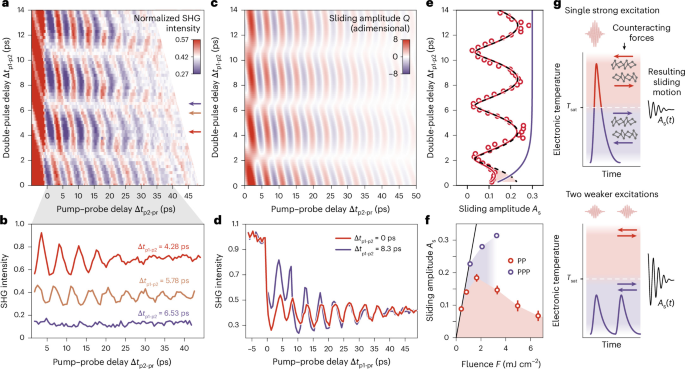 Figure 5. The two-pulse delay controls constructive and destructive phonon interference. At equal total absorbed fluence, timed excitation produces a larger sliding response than overlapping pulses. Source: J. G. Horstmann et al., Nature Physics (2026), Fig. 3. CC BY 4.0; reproduced without modification.
Keeping energy fixed while changing amplitude
The two-pulse method provides a valuable experimental control variable because the same total absorbed fluence can produce different coherent amplitudes. In a conventional fluence scan, changing the phonon amplitude simultaneously changes carrier excitation, electronic heating, and often lattice heating. Correlations between amplitude and damping then become difficult to interpret. By adjusting pulse delay instead, the experiment varies the coherent sliding response within a more closely matched excited-state environment [1].
This is why the reported amplitude enhancement matters beyond achieving a larger oscillation. It creates a way to study anharmonicity directly. The frequency of a perfectly harmonic mode is independent of its amplitude; its restoring force is exactly linear in displacement. In a real crystal, higher-order terms in the potential change the instantaneous restoring force, so the oscillation frequency can shift as the coherent excursion grows. The two-pulse scans reveal a pronounced anticorrelation between sliding amplitude and frequency, consistent with intrinsic lattice anharmonicity in the excited state.
The damping also increases with sliding amplitude. A useful phenomenological summary over the measured range is , with a slope that itself depends on the overall fluence. This is an empirical local relation rather than a universal law of phonon decay. The experiment finds that a larger coherent sliding wave is more strongly damped, and that increasing total excitation can enhance the damping even at similar initial amplitudes. These are two distinct dependences that a microscopic theory must explain.
 Figure 6. Amplitude-resolved spectroscopy isolates a softened sliding frequency and increased damping. The phonon bands illustrate an allowed decay into acoustic excitations. Source: J. G. Horstmann et al., Nature Physics (2026), Fig. 4. CC BY 4.0; reproduced without modification.
Where the phonon energy goes
One plausible microscopic channel is a Klemens-type decay, in which an optical phonon converts into two lower-energy acoustic phonons with opposite crystal momenta. Energy and momentum conservation require , while the phonon momenta sum to a reciprocal-lattice vector, usually zero for a zone-center excitation. The final-state populations enter the scattering probability through bosonic enhancement factors. A nonequilibrium population of the receiving acoustic modes can therefore increase the effective decay rate of the coherent optical mode.
The 2026 study identifies stimulated phonon decay as a physically consistent explanation for its amplitude- and fluence-dependent damping. The phonon dispersion permits channels of the required type, and the trends agree qualitatively with enhanced scattering in a driven phonon population [1]. The data do not uniquely isolate every microscopic decay pathway. Defect scattering, other anharmonic channels, and coupling to electronic degrees of freedom can contribute in different regimes. A mode-resolved measurement of the daughter acoustic populations would offer a more discriminating test.
For coherent control, increased damping creates a natural optimization problem. A sequence that maximizes the first oscillation need not maximize the time-integrated displacement or the duration of a desired transient structure. A useful control objective could weigh peak amplitude, phase, and lifetime separately. In a device, those quantities may matter differently: a short, large displacement could help cross a structural barrier, while a long-lived smaller oscillation could provide a narrowband modulation of an optical or electronic signal.
Electronic topology is coupled to the lattice, but not guaranteed to switch
WTe₂ is also studied for its unusual electronic bands and candidate type-II Weyl physics. Earlier first-principles work by Guan and colleagues predicted that the polarization of incident light could selectively excite orbitals and drive interlayer motion, changing the separation or annihilation of Weyl nodes in calculations [5]. Time-resolved photoemission has independently shown that coherent low-frequency vibrations perturb bands associated with the Weyl-semimetal regime [3]. These results motivate the possibility of optically steering topological electronic properties through atomic motion.
That possibility must be distinguished from what the new experiment directly establishes. Horstmann and colleagues measure coherent sliding dynamics and a polarization-sensitive optical response in bulk Td-WTe₂. They do not demonstrate deterministic electrical polarization reversal in a few-layer device, nor do they directly measure a light-induced change of a topological invariant during the two-pulse sequence. The new result supplies a stronger structural drive and a more selective spectroscopy tool. Connecting it to nonvolatile switching or controlled Weyl-node manipulation remains a separate experimental challenge.
 Figure 7. Earlier time-dependent first-principles calculations predict polarization-selective lattice displacements and changes in Weyl-point topology; these panels are theoretical predictions, not measurements of the 2026 two-pulse experiment. Source: M.-X. Guan et al., Nature Communications 12, 1885 (2021), Fig. 5. CC BY 4.0; reproduced without modification.
What the experiment changes about ultrafast control
Classical displacive excitation assumes that a rapidly changed electronic population shifts the nuclear equilibrium position, launching coherent motion. That framework remains useful, but the WTe₂ result shows why its driving force cannot always be reduced to a constant times carrier density. The sign and magnitude of the electron–phonon coupling vary throughout the bands, and carrier redistribution evolves during the first few picoseconds. A pulse sequence can therefore be designed around both the lattice period and the electronic relaxation time [1,4].
The practical constraints are specific. The reported gain was measured in bulk WTe₂ at selected absorbed fluences, wavelengths, and delays. The result depends on maintaining phase coherence of the sliding mode between pulses and on the presence of electronic states that generate opposing forces at high excitation. A different material with much faster phonon dephasing, a different electronic relaxation spectrum, or dominant irreversible heating might not exhibit the same improvement. Stronger lattice displacement also does not automatically mean reversible, fatigue-free polarization switching.
There are nevertheless clear next experiments. One is to repeat the two-pulse protocol on bi- and trilayer ferroelectrics while measuring electrical polarization directly, not solely its optical proxy. Another is to combine phase-resolved trSHG with ultrafast diffraction or photoemission under the same pulse sequence, tying atomic displacement to changes in electronic structure. A third is to extend from two pulses to an optimized train that explicitly includes time-dependent electronic occupations, phonon damping, and heating. Such tests would establish when the extra coherent displacement is useful for controlling a material property rather than only for observing it.
The deeper result is a change in what constitutes the optical control variable. A fixed amount of absorbed light can generate substantially different nuclear motion depending on when its energy is delivered. In WTe₂, the electronic distribution remembers the first pulse for a few picoseconds, and the lattice remembers its phase for longer. Designing around those two clocks turns a nonlinear limitation into a controllable feature of the material's dynamics.
References
- J. G. Horstmann, C. Emeis, A. Caviezel et al., “Coherent phonon control beyond amplitude saturation in a sliding ferroelectric,” Nature Physics (published 21 October 2026). doi:10.1038/s41567-026-03491-1.
- Z. Fei, W. Zhao, T. A. Palomaki et al., “Ferroelectric switching of a two-dimensional metal,” Nature 560, 336–339 (2018). doi:10.1038/s41586-018-0336-3.
- P. Hein, S. Jauernik, H. Erk et al., “Mode-resolved reciprocal space mapping of electron-phonon interaction in the Weyl semimetal candidate Td-WTe₂,” Nature Communications 11, 2613 (2020). doi:10.1038/s41467-020-16076-0.
- H. J. Zeiger, J. Vidal, T. K. Cheng, E. P. Ippen, G. Dresselhaus and M. S. Dresselhaus, “Theory for displacive excitation of coherent phonons,” Physical Review B 45, 768–778 (1992). doi:10.1103/PhysRevB.45.768.
- M.-X. Guan, E. Wang, P.-W. You, J.-T. Sun and S. Meng, “Manipulating Weyl quasiparticles by orbital-selective photoexcitation in WTe₂,” Nature Communications 12, 1885 (2021). doi:10.1038/s41467-021-22056-9.
- B. He, C. Zhang, W. Zhu et al., “Coherent optical phonon oscillation and possible electronic softening in WTe₂ crystals,” Scientific Reports 6, 30487 (2016). doi:10.1038/srep30487.
- D. M. Juraschek, M. Fechner and N. A. Spaldin, “Ultrafast structure switching through nonlinear phononics,” Physical Review Letters 118, 054101 (2017). doi:10.1103/PhysRevLett.118.054101.
- E. Greil, A. de las Heras, A. Rubio and A. Galler, “Probing sliding ferroelectricity in bilayer Td-WTe₂ with high-harmonic generation,” npj 2D Materials and Applications (published 7 October 2026). doi:10.1038/s41699-026-00743-9.
- Y. Bai, Z. Yu, Z. Guan et al., “Sub-nanosecond polarization switching with anomalous kinetics in vdW ferroelectric WTe₂,” Nature Communications 16, 7221 (2025). doi:10.1038/s41467-025-62608-x.
- J. Zhou, “Photo-magnetization in two-dimensional sliding ferroelectrics,” npj 2D Materials and Applications 6, 15 (2022). doi:10.1038/s41699-022-00297-6.