
Could quantum information survive without a machine continually repairing it? In fracton matter, certain disturbances cannot move freely, and the same restrictions can make an otherwise orderly system relax like a glass. These strange excitations expose both the promise and the limits of a long-standing dream: a quantum memory whose own physics prevents errors from spreading.
Imagine cooling a material, encoding a quantum state in it, and switching off the hardware that repeatedly checks for mistakes. In most present-day quantum error-correction architectures, that would be a dangerous experiment. Stray interactions and thermal fluctuations continue to occur even when no computation is being performed. If the resulting defects wander, multiply, and combine into a nontrivial logical operation, the stored information will eventually be lost. The familiar solution is an active one: measure error syndromes, infer what happened, and correct the damage before it becomes fatal. The more ambitious possibility is a material that makes the fatal processes intrinsically difficult. This is the dream of a self-correcting quantum memory. [1][2]
Fracton phases are unusually compelling in this setting because they rearrange the rules governing motion. Their excitations can be pinned by the structure of the Hamiltonian rather than by impurities or a strong externally imposed trap. Some cannot move at all through an isolated local process; some can only move along a line, and others are confined to planes. The restrictions have implications well beyond transport. A process that cannot move a defect by one lattice spacing may also have difficulty assembling a large error. At finite temperature, the same bottleneck can force a system to approach equilibrium extraordinarily slowly. Fracton physics therefore connects a microscopic question about excitations to two macroscopic questions: how a system forgets, and whether a quantum state can be kept safe without an active guardian. [3][4]
When a particle has no direction in which to go
In the X-cube model, one of the canonical examples, qubits occupy the edges of a three-dimensional cubic lattice. The Hamiltonian is built from commuting multi-qubit operators associated with cubes and oriented crosses at vertices. In one common convention, cube operators involve twelve Pauli operators and cross operators involve four; their simultaneous eigenvalues define the ground-state constraints. An excitation is a violation of one of those local terms. Unlike an ordinary mobile quasiparticle, a single violated cube constraint cannot simply be translated by a short sequence of local operations that leaves all other constraints unviolated. [3][5]
Acting with an appropriate membrane-shaped product of Pauli operators produces four fracton excitations at its corners. Enlarging the membrane separates its corners, but no local operator can translate just one isolated corner while keeping the others absent. The system nonetheless supports mobile composites. Depending on the excitation type, a pair may form a planon that travels within a plane; certain vertex excitations behave as lineons restricted to a line. The important distinction is between mobility that is forbidden for a specific superselection sector and mobility that becomes possible after constructing a different composite. It would be inaccurate to say that absolutely nothing in a fracton material can move.
One way to express the organizing principle comes from higher-rank gauge theories. Suppose a conserved charge density is described by a total charge and dipole moment:
If both and the components of are conserved in an isolated system, translating a lone charge by would change the dipole moment by . Without another compensating rearrangement, the move is forbidden. A neutral bound pair can move while preserving the total dipole moment, and additional moment constraints can restrict it further. This continuum argument illuminates why restricted mobility appears naturally in some fracton theories, although the exact conservation laws and mobility rules of a lattice stabilizer model cannot always be reduced to the same single continuum formula. [3][4]
In a conventional particle description, spatial separation is often a continuous freedom limited by energy and speed. In a fracton theory, a particle's capacity to change its position may depend on the simultaneous displacement of other excitations. Mobility becomes a property of the allowed many-body operators. That is the elementary fact from which the unusual memory and relaxation phenomena follow.
The difference between a stable state and a self-correcting memory
To understand why this matters, first separate three levels of protection. A ground state may be robust against sufficiently small static perturbations because a spectral gap separates it from excited states. A quantum error-correcting code may protect logical information against a bounded set of local errors because different encoded states are locally indistinguishable. A self-correcting memory must also survive the continual, stochastic action of a thermal environment for a time that improves appropriately as the device becomes larger, without repeated externally controlled syndrome extraction and feedback. The third property does not follow merely from the first two. [1][2]
The classic analogy is a ferromagnet. Its two ordered orientations store a classical bit. Below the ordering temperature, changing the orientation of the whole sample requires assembling a macroscopic domain wall, so the energetic cost increases with system size. For a quantum memory, information must be retained in noncommuting observables: protecting only a classical bit is not enough. An environment capable of performing local Pauli errors can destroy relative phase information even when populations remain apparently stable. The challenge is to engineer a Hamiltonian whose thermal error pathways protect the entire encoded quantum state.
For a commuting stabilizer Hamiltonian, one can write schematically
The stabilizers are local products of Pauli operators, and positive couplings penalize violated constraints. An encoded logical state belongs to a subspace satisfying the stabilizers. A thermal environment induces local moves that create, move, or annihilate violations. Whether a sequence of such moves implements a logical operator depends on the structure of the code. Therefore the physically important quantity is not only how much energy one final logical operator costs—which can be zero inside a degenerate ground space—but the maximum additional energy encountered along a path of local errors leading to that logical operator.
If a constant-energy route exists regardless of system size, cooling can suppress its rate but increasing the size need not make it much harder. A three-dimensional code without stringlike logical operators can behave differently. The system may be forced to generate a growing hierarchy of intermediate defects before a large logical operation is complete. Fracton constraints become valuable because they alter the energy landscape through which errors must travel. [2][6]
Haah's cubic code: a logical error built as a fractal
Jeongwan Haah's 2011 cubic code transformed the conversation about three-dimensional quantum memories. Its lattice carries two qubits at each site, with stabilizers supported on the eight corners of neighboring cubes. Its essential novelty is the absence of stringlike logical operators. Rather than generating an extended logical process through a thin string that can grow at nearly constant defect energy, the code permits more intricate, scale-dependent operator support. Particular excitation-creation patterns resemble fractals. [7]
A fractal is not automatically an error-correcting code, and a code containing fractal shapes is not automatically self-correcting. What matters is the algebra of local constraints and the energy of intermediate states. In the cubic code, building a separated configuration of defects may require passing through recursively larger groups of additional excitations. Bravyi and Haah proved a logarithmically growing energy barrier under appropriate hypotheses for this class of three-dimensional stabilizer Hamiltonians without string logical operators. A representative asymptotic form is
where is a linear size measured in lattice units, sets a characteristic local energy scale, and is a positive constant set by the model and the hypotheses of the bound. The statement is about the least expensive local error sequence that implements a nontrivial logical transformation, not about the excitation gap or the total energy of the final ground state. The barrier grows, but slowly. [6]
This leads to a striking prediction. When activated transitions dominate, a barrier suggests a characteristic suppression of the form
where is the bath temperature and is a microscopic timescale. Substituting a logarithmic barrier suggests a lifetime scaling as a power of , with a temperature-dependent exponent. But this back-of-the-envelope estimate does not establish a memory lifetime by itself: combinatorial proliferation of error paths, bath coupling, state preparation, and the final decoding procedure also matter. The rigorous analysis is more specific—and more revealing.
Bravyi and Haah studied the cubic code coupled to a thermal bath under a Davies-type Markovian description. Their lower bound has the form , with the inverse temperature in appropriate energy units, for sizes restricted to a temperature-dependent window. In the formulation of their result, the allowed size remains below a critical scale of order . The study also found numerical evidence consistent with the general scaling. Optimizing within that window gives characteristic behavior of the form : remarkable low-temperature enhancement, but not a proof of an indefinitely improving lifetime as at a fixed nonzero temperature. That is why the authors described the behavior as partially self-correcting. [8]
This is the dream in a scientifically precise form. One would like a passive memory whose lifetime becomes arbitrarily long as the device is made larger at a temperature below a fixed threshold, under realistic local thermal noise. The cubic code demonstrates that removing string operators can create qualitatively stronger barriers and enormously slow logical decay over a useful regime. It does not, on the evidence just described, certify a fully thermally self-correcting three-dimensional quantum memory at arbitrary sizes and finite temperature. The distinction is an engineering requirement, not a semantic technicality.
Glassy dynamics in a perfectly ordered lattice
The same restrictions that frustrate errors also obstruct ordinary relaxation. A glassy material can take a very long time to forget how it was prepared. In traditional structural glasses, that behavior is often discussed in terms of frustration, rough energy landscapes, metastable states, and disorder. Fracton models offer a different route. The Hamiltonian may be translation invariant and contain no quenched disorder, yet local rearrangements remain severely constrained by the excitation structure. Two defects can be close in space but separated by a complicated sequence of permitted moves. [9]
Prem, Haah, and Nandkishore examined this possibility in their 2017 study of glassy quantum dynamics in translation-invariant fracton models. For representative type-I systems, the mobility of isolated charges at low temperature is strongly suppressed, with an activation scale that produces an exponential dependence on inverse temperature. When the zero-temperature system is exposed to a finite-temperature bath, the approach to equilibrium can be logarithmic in time across a parametrically wide window. In type-II models, the authors found anomalously slow, subdiffusive relaxation and a characteristic timescale that can grow super-exponentially as temperature falls. The mechanisms and scalings are model-dependent, but the qualitative conclusion is powerful: disorder is not necessary to obtain relaxation reminiscent of a glass. [9]
The reason is a hierarchy of access. An elementary excitation may lack a direct path to the next location. It can borrow mobility from a thermal cloud of complementary defects, but those auxiliaries must first appear at an energetic cost. Other excitations can only rearrange through correlated multi-particle moves. As temperature decreases, the abundance of enabling defects falls; processes that were merely slow become effectively frozen during an experiment. The state may retain information about how it was prepared long after ordinary local observables in a less-constrained system would have relaxed.
There is no universal mathematical identity between being glassy and being a protected quantum memory. Long-lived local imbalances may remember a classical preparation while fragile quantum coherences have already been lost. Conversely, a topological memory can protect encoded observables without requiring every local excitation to relax slowly. To evaluate a proposed memory, one must measure logical storage fidelity and establish which types of noise it resists. A slowly changing microscope image, by itself, is not a demonstration of protected logical qubits.

A fragmented Hilbert space can remember its beginnings
A complementary idea is Hilbert-space fragmentation. Many-body evolution is often studied inside a sector fixed by obvious conserved quantities such as total particle number. In fragmented systems, even after these global quantum numbers have been fixed, the local rules divide the available states into smaller subsets that cannot reach one another dynamically. Two states with the same energy and particle count may therefore display radically different relaxation simply because the Hamiltonian connects them to different networks of configurations.
Formally, a useful idealization is a decomposition
where the subspaces are dynamically invariant under the idealized Hamiltonian. Their dimensions can vary dramatically. A sector containing only a few connected configurations may preserve a conspicuous memory of the initial state, while a much larger sector admits substantial relaxation. The decomposition is a statement about what the dynamics can reach, not necessarily a claim that every sector is a stable encoded logical subspace after uncontrolled perturbations. [10]
This difference moved from theory into the laboratory in 2024. Daniel Adler and colleagues prepared a tilted two-dimensional Bose–Hubbard system using quantum gas microscopy and compared initial arrangements that shared basic conserved quantities. Under the engineered constraints, a chequerboard pattern and a dimer pattern behaved very differently. Localized defects exhibited strongly anisotropic motion along restricted directions, providing direct evidence of fractonic dynamics associated with fragmentation. It was a consequential experimental result because it turned a mathematical statement about disconnected dynamical sectors into patterns of motion that could be prepared, imaged, and distinguished in time. [10][11]

The lesson for memory research is methodological. Long-lived preparation-dependent behavior can be studied experimentally without fabricating an entire autonomous quantum computer. Yet moving from fragmentation to self-correcting storage requires further evidence: resilience to perturbations that violate the ideal conservation laws, protection of relative phase and entanglement, scalable readout, and logical fidelity for experimentally relevant bath couplings. A system can be highly nonergodic without being a useful quantum error-correcting code.
When conservation laws become a theory of motion
The deeper connection between immobility and conservation extends beyond cubic stabilizer models. Rank-two tensor gauge theories express mobility constraints through generalized charge conservation, often including dipole or higher-multipole moments. Under such rules, a charge cannot be moved without changing a conserved spatial moment. This provides a common language for fracton excitations, unusual elasticity, and constrained hydrodynamics, even though the precise effective degrees of freedom differ between those settings. [3][4]
Doshi and Gromov illustrated this kinship using vortices in two-dimensional superfluids. For their point-vortex model, the conserved combinations of vorticity moments constrain the motion of isolated vortices and their composites in a manner analogous to fracton rules. An isolated vortex in that idealized Hamiltonian description is stationary, while a neutral vortex dipole translates perpendicular to its separation. The result is a theoretically controlled analogy to constrained fracton kinematics, not proof that any everyday turbulent vortex realizes a fault-tolerant fracton quantum memory. [12]

This viewpoint is attractive because it separates the spatial symmetry of the medium from the dynamics available to a particular excitation. A crystal can have sites extending in all directions while a defect is confined to one dimension; a two-dimensional fluid can have trajectories limited by multipole conservation; a lattice code can have operators with support spread through a fractal set. In every case, the ambient dimension is a poor predictor of the freedom actually available to its excitations. But no single conservation principle automatically guarantees all of the thermal properties attributed to fracton topological phases, and analogous dynamics should not be conflated with equivalent protected phases.
Why the dream remains unfinished
A practical device would face several obstacles simultaneously. An ideal stabilizer Hamiltonian is never exactly what a fabricated apparatus realizes. Perturbations can introduce weak processes absent from the solvable limit, some of which restore mobility to otherwise constrained excitations. Thermal defects are present at nonzero temperature, and a finite density of them can enable collective motion that an isolated excitation could not perform. Boundaries and defects in the lattice can supply easier error pathways. Furthermore, the preparation and measurement circuitry used to access encoded information may disturb the very protection that the material is meant to provide.
One must also specify what “increasing the system size” means. The code distance, barrier height, bath correlation spectrum, number of logical qubits, and probability of successful readout can scale differently. A growing energy barrier is a promising ingredient, not a general theorem that a quantum memory will survive for arbitrarily long times. The entropic number of available paths can compete with barrier growth, and a material that retains one observable for many seconds may lose an encoded phase much sooner. [2][6][8]
This is why a finite-temperature memory test should have a carefully defined observable. A useful target is the lifetime of an arbitrary logical qubit after encoding, subject to specified physical noise, followed by an explicitly described decoding procedure. It should include both logical Pauli channels and verify preservation of entanglement with an external reference when feasible. Evidence for slow local relaxation, robust static order, and enhanced logical lifetime belongs in the same research program, but each addresses a different question.
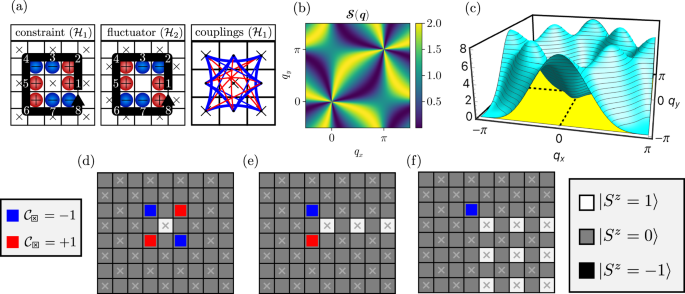
The latest research widens the experimental possibilities. In 2026, Niggemann and collaborators studied a two-dimensional spin-1 “spiderweb” model exhibiting signatures of a gapless fracton quantum spin liquid and emergent gauge excitations in numerical simulations. The paper developed a microscopic candidate for a phase that had often been discussed through effective field theories. This is exciting progress in the study of fracton phases, but it is not a demonstration of a passive, thermally self-correcting memory. Even a convincing fracton quantum spin liquid would still have to be engineered, coupled, measured, and tested for fault-tolerant storage. [13]
The dream of a memory that corrects itself
There are two ways to respond to error in a quantum computer. One can watch the system carefully enough to discover a mistake and reverse it, or one can try to engineer the system so that the dangerous mistake rarely becomes possible. Modern quantum architectures have made remarkable progress with the first strategy. Fracton models broaden the second by showing that the local structure of a Hamiltonian can obstruct the transport of defects and complicate the assembly of logical errors. The resulting materials can be glassy, information-retaining, and mathematically beautiful for reasons that have nothing to do with random pinning or a carefully chosen external correction schedule.
The distinction between slowing and preventing logical failure is the central unresolved issue. A large but finite lifetime is useful; a passive lifetime that systematically grows with size at a fixed nonzero temperature would be a much more radical achievement. Haah's cubic code shows how the absence of string operators changes the energy barrier and produces partial self-correction. Glassy fracton dynamics demonstrates that an ordered Hamiltonian can retain the imprint of its history. Experiments on constrained quantum gases now show aspects of those unusual dynamics directly. Together, they establish a coherent set of physical ideas, not yet a completed quantum-memory technology.
The dream is therefore specific enough to guide research: find a local, controllable quantum system whose permitted thermal rearrangements become increasingly unable to alter the encoded logical state as the system grows. The most interesting question may be whether an apparently severe restriction on motion can be turned into an enduring protection of quantum coherence. Fractons have made that question impossible to ignore.
References and further reading
[1] Nandkishore, R. M. and Hermele, M., Fractons, Annual Review of Condensed Matter Physics 10, 295–313 (2019). https://doi.org/10.1146/annurev-conmatphys-031218-013604
[2] Brown, B. J., Loss, D., Pachos, J. K., Self, C. N. and Wootton, J. R., Quantum Memories at Finite Temperature, Reviews of Modern Physics 88, 045005 (2016). https://doi.org/10.1103/RevModPhys.88.045005
[3] Vijay, S., Haah, J. and Fu, L., Fracton Topological Order, Generalized Lattice Gauge Theory, and Duality, Physical Review B 94, 235157 (2016). https://doi.org/10.1103/PhysRevB.94.235157
[4] Pretko, M., Chen, X. and You, Y., Fracton Phases of Matter, International Journal of Modern Physics A 35, 2030003 (2020). https://doi.org/10.1142/S0217751X20300033
[5] Gromov, A. and Radzihovsky, L., Colloquium: Fracton Matter, Reviews of Modern Physics 96, 011001 (2024). https://doi.org/10.1103/RevModPhys.96.011001
[6] Bravyi, S. and Haah, J., Energy Landscape of 3D Spin Hamiltonians with Topological Order, Physical Review Letters 107, 150504 (2011). https://doi.org/10.1103/PhysRevLett.107.150504
[7] Haah, J., Local Stabilizer Codes in Three Dimensions without String Logical Operators, Physical Review A 83, 042330 (2011). https://doi.org/10.1103/PhysRevA.83.042330
[8] Bravyi, S. and Haah, J., Quantum Self-Correction in the 3D Cubic Code Model, Physical Review Letters 111, 200501 (2013). https://doi.org/10.1103/PhysRevLett.111.200501
[9] Prem, A., Haah, J. and Nandkishore, R., Glassy Quantum Dynamics in Translation Invariant Fracton Models, Physical Review B 95, 155133 (2017). https://doi.org/10.1103/PhysRevB.95.155133
[10] Adler, D., Wei, D., Will, M. et al., Observation of Hilbert Space Fragmentation and Fractonic Excitations in 2D, Nature 636, 80–85 (2024). https://doi.org/10.1038/s41586-024-08188-0
[11] Will, M., Moessner, R. and Pollmann, F., Realization of Hilbert Space Fragmentation and Fracton Dynamics in Two Dimensions, Physical Review Letters 133, 196301 (2024). https://doi.org/10.1103/PhysRevLett.133.196301
[12] Doshi, D. and Gromov, A., Vortices as Fractons, Communications Physics 4, 44 (2021). https://doi.org/10.1038/s42005-021-00540-4
[13] Niggemann, N. et al., Gapless Fracton Quantum Spin Liquid and Emergent Photons in a 2D Spin-1 Model, Nature Communications 17, 6131 (2026). https://doi.org/10.1038/s41467-026-74797-0
Figures reproduced from the original open-access publications under CC BY 4.0, with source and authors attributed in the respective captions. Some depicted systems are analogues or candidate phases rather than implementations of Haah's code or demonstrated quantum memories. The discussion distinguishes analytically established properties of idealized models, numerical predictions, and experimental observations.