
Today's quantum error correction usually asks a classical processor to interpret an entire pattern of measured defects. An alternative is emerging: local rules that let errors interact, move, and disappear through repeated neighborhood updates. New results on cellular-automaton decoders and three-dimensional layer codes suggest several ways to preserve quantum information—but they also expose the difficult distinction between actively repairing a memory and constructing one that protects itself at finite temperature.
A conventional digital bit can be stored in a magnet whose microscopic constituents collectively favor a stable orientation. An isolated defect costs energy, and reversing the whole magnet usually requires assembling an improbable collective fluctuation. Quantum information poses a harder challenge. A logical qubit must preserve not only one classical distinction but coherent relationships among basis states. Thermal excitations can move, braid and accumulate into operations that change the encoded quantum state without leaving a locally obvious trace. The hope of a quantum memory that repairs itself has therefore led researchers in two different directions: codes with physical energy barriers that inhibit errors, and local algorithms that continuously correct errors before they develop into logical faults. [1][2]
In 2026 these directions met at a particularly productive moment. Louis Paletta and collaborators introduced new signal-based local decoders for a one-dimensional quantum repetition-code setting, with provable suppression in one noise model and strong numerical performance in another. Shankar Balasubramanian, Margarita Davydova and Ethan Lake developed a local quantum automaton for the two-dimensional toric code, with exponentially long preservation under specified circuit-level noise despite only local operations. Meanwhile, independent work on three-dimensional layer codes established forms of partial self-correction, strengthening a line of research distinct from active decoding. [3][4][5][6]
Why defects, rather than damaged qubits, are what the decoder sees
A stabilizer code protects a logical state inside the simultaneous eigenspace of commuting parity checks. An error can flip some check outcomes from to ; those anomalous outcomes form the syndrome. In a simple one-dimensional repetition code with neighboring checks, an error on a consecutive string of qubits creates defects at the two endpoints of the string. The syndrome reveals the boundary of the error, not its complete history. If the chain is periodic, more than one error string can have the same boundary. A correction that joins the wrong endpoints can produce a logical failure even though all local check values are restored. [3]
Symbolically, a set of affected edges in a lattice can have syndrome
where is the boundary operator. A candidate correction with the same syndrome, , removes the observed defects, but the combination may form a nontrivial logical cycle. That is the central danger. A decoder must infer an appropriate recovery using incomplete, noisy local information. The success or failure of the algorithm is not determined solely by whether the last syndrome is zero; it depends on whether the residual operation acts trivially on the encoded logical information. [3][7]
The well-known minimum-weight perfect-matching decoder collects a global set of defects and finds a likely pairing. It is powerful and useful for surface codes, but the syndrome must reach suitable classical processing resources, and the recovery decision must return on time. As the number of physical qubits grows, wiring, latency, communication bottlenecks and real-time feedback become architectural concerns. A local decoder attacks those constraints directly. Each small controller inspects only nearby data, updates a few internal variables, and optionally requests an equally local correction. A large code then runs many tiny rules in parallel. [3][7]
A cellular automaton is a physical theory of locality made executable
A cellular automaton consists of sites whose states evolve through repeated local transition rules. One writes a configuration , chooses a neighborhood for each site , and updates in parallel:
The measured syndrome may enter the rule, while can represent short-lived classical signals, counters or internal states. Locality does not prevent complicated behavior over time: repeated short-range updates can propagate information across the code, form growing regions of influence, and create effective attractions between defects. Their practical advantage is that a local processor does not need a global address book of every defect at each cycle. Their disadvantage is equally clear. A local controller must somehow distinguish harmless nearby fluctuations from dangerous long-distance error patterns without being told the global answer. [2][3]
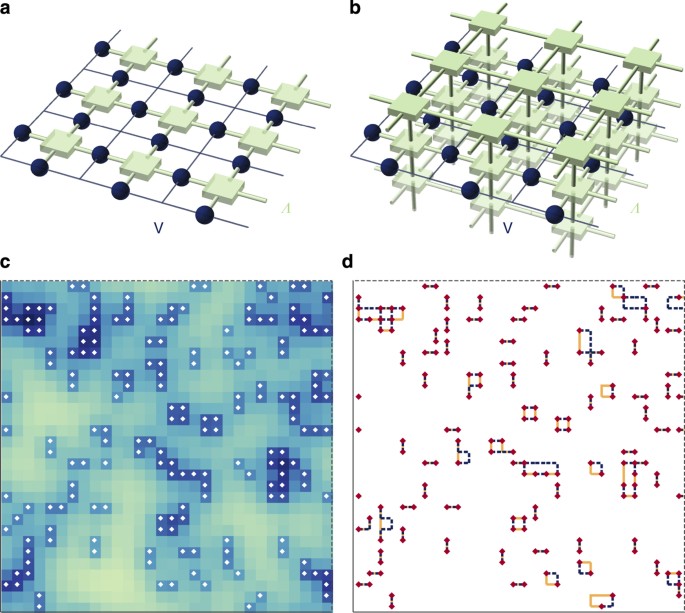
An influential early approach simulated an auxiliary scalar field on the same lattice as the anyons. Charges associated with defects act as sources, the field spreads through repeated local averaging, and defects move along effective gradients. One can view it as an approximate discrete Poisson problem implemented dynamically through neighborhood operations. There is no global field solver in the idealized update loop. Instead, the information needed for attraction propagates step by step. The difficulty is that local fields can equilibrate too slowly over long distances, and a finite speed of propagation can impose unfavorable scaling unless communication resources increase with system size. [2]
Signals that chase defects until the error disappears
The 2026 work of Paletta, Leverrier, Mirrahimi and Vuillot proposes a different mechanism for a repetition-code memory. The asymmetric signal-rule (ASR) and symmetric signal-rule (SSR) treat defects as dynamical objects that exchange traveling classical signals. A defect emits a forward signal; when it reaches another defect, the receiving defect moves toward its partner, while returning signals and counter-signals keep the protocol's state from accumulating indefinitely. The SSR combines rules pointing in both directions. The authors also study a memory-light two-row shearing rule. These protocols do not infer an entire defect matching in a single global optimization step. They implement the matching through repeated local dynamics. [3]

One of the paper's strongest statements is a threshold theorem for the ASR under code-capacity noise: independent data flips are inserted initially, with no ongoing measurement noise during the decoding phase. There exist positive constants and for which sufficiently low initial physical error rate permits a number of local update steps proportional to the code length and yields an asymptotic bound of the form
This is a real analytical guarantee, but its scope matters. A proof for one-dimensional code-capacity noise is not automatically a fault-tolerance theorem for arbitrary higher-dimensional circuits with defective measurements, correlated gates and leakage. The study also reports numerical evidence for strong logical-error suppression by SSR under a phenomenological model with noisy data and noisy measurements at every cycle. The shearing rule requires fewer local classical memory resources and performs competitively for relatively small systems, but the authors find that its effective distance saturates at larger sizes. [3]

The physical intuition behind the failure modes is as important as the favorable scaling. Long, sparse, fractal-like patterns can mislead a decoder even when most small clusters are removed correctly. The price of limited communication may appear as a suboptimal effective distance, additional rounds before an answer becomes available, or a controller state that grows with code size. Consequently, 'local' is not a single benchmark: a fully bounded-state cellular automaton, a local rule with logarithmic classical counters, and a circuit with neighborhood communication but hierarchical scheduling make different demands on hardware. A meaningful comparison should report qubit count, correction depth, measurement errors, classical memory, connection degree and the lifetime of the resulting logical state. [3]
Toom's rule, majority dynamics, and robust classical memories
One reason local update rules are appealing is the success of certain classical models. Toom's rule applies an asymmetric majority-like test on a two-dimensional lattice: a bit flips when it disagrees with both its western and southern neighbors. The directional bias helps shrink finite islands of errors rather than allowing every local fluctuation to spread symmetrically. Under suitable stochastic noise assumptions, this kind of dynamics supports remarkable stability. The lesson is not that a trivial majority vote solves quantum error correction; instead, it shows how a directional, local mechanism can produce global stability without a central optimizer. [2][3]

Quantum codes complicate the transfer of this intuition. Protecting a qubit generally requires control of both bit-flip and phase-flip faults, as well as correlated errors induced by the correction apparatus. A classical majority-vote layer can stabilize a repetition code's classical information, while a concatenated bosonic code or appropriately biased-noise architecture may supply complementary protection. That combination motivates local quantum memories built from cat qubits and repetition-code decoders. It also means that saying a one-dimensional decoder 'protects a qubit' may involve extra physical encoding assumptions beyond the one-dimensional binary syndrome model itself. [3]
The toric code moves into a local quantum circuit
Balasubramanian, Davydova and Lake approached the locality problem from another angle. Their paper, published in Quantum in June 2026, constructs a decoder for the two-dimensional toric code using ideas from the hierarchical classical cellular automata of Tsirelson and Gács. Unlike a decoder that simply gathers syndromes in one location, their construction employs a circuit of strictly local quantum operations and demonstrates exponentially long preservation of a logical state under the paper's circuit-level noise assumptions, without nonlocal classical communication. Its schedule is not translation-invariant in spacetime, though a time-translation-invariant construction can be obtained in a three-dimensional arrangement of stacked two-dimensional toric codes. [4]
There is an important conceptual result here. A two-dimensional toric code is not a self-correcting quantum memory at nonzero temperature in the usual passive thermodynamic sense. Yet an appropriately designed active local dynamical rule can extend the information lifetime under specified noise models. Locality of operations is compatible with fault-tolerant protection, but the controller itself is part of the system whose robustness must be modeled. The construction addresses the possibility of storing topological quantum information locally without demanding that a conventional global classical computer receive all syndromes. It does not solve passive two-dimensional self-correction. [1][4][7]
What self-correction would demand from the material itself
The strict notion of a self-correcting memory is thermodynamic. Encoded information is protected at finite temperature by the Hamiltonian and its energy landscape, without requiring a continually active decoder to identify and undo each error. The key intuition is the logical energy barrier: the smallest maximum energy encountered along a path of local errors that implements a nontrivial logical operation. Schematically,
The notation represents a path of local errors ending in a logical fault and a corresponding excess energy relative to the ground configuration. A growing energy barrier can suppress some thermally activated logical transitions. But an increasing barrier by itself does not establish strict infinite-size self-correction: entropy, the number of available error pathways, temperature dependence and dynamical bottlenecks affect the actual memory lifetime. For a simple two-dimensional toric code, string-like logical faults can grow without an energy cost proportional to string length, providing a canonical reason for finite-temperature fragility. [1][5][7]
Four-dimensional toric codes furnish a celebrated theoretical example of genuine self-correction, but their spatial dimension is not a practical engineering blueprint for a physical three-dimensional device. The status of fully self-correcting, local, finite-temperature quantum memory in three spatial dimensions remains a major challenge. The recent progress is deliberately more qualified: partial self-correction, long but finite regimes of favorable scaling, and increasingly strong constructions using three-dimensional layer codes. [1][5][6]
What the new layer-code results actually say
Shouzhen Gu and collaborators studied three-dimensional layer codes in a paper published in Physical Review Letters on 29 May 2026. The authors analyzed decoding under local stochastic and adversarial noise, connected growing logical energy barriers to partial self-correction, and reported numerical evidence of improving lifetimes in studied code instances. Their construction achieves favorable relationships between code parameters and energy barriers, including optimal scaling up to logarithmic factors for certain random CSS-based layer codes. A separate August 2026 result by Dominic Williamson demonstrated a family whose memory lifetime grows exponentially with linear system size up to a temperature-dependent crossover length scale. These are significant advances, not a proof that a strictly self-correcting three-dimensional device now exists. [5][6]
The distinction between partially self-correcting systems and partially self-correcting memories also matters. The energetic tendency to suppress large logical errors need not guarantee an efficient, robust decoding procedure able to extract stored information. A physical memory must satisfy both a storage criterion and a readout/recovery criterion. As with an active automaton, the operational test is whether an encoded quantum state can actually be retrieved with the desired fidelity after the specified storage interval. A large theoretical barrier, on its own, is not that guarantee. [5]
The decoder becomes part of the machine
These developments suggest a wider engineering shift. Quantum error correction has often been conceptualized as a code plus a classical algorithm that runs somewhere else. A cellular-automaton approach treats decoding as a physical field of interacting local control elements woven into the quantum device. A partially self-correcting layer-code approach makes the encoded material's energetic structure part of the protection strategy. Neither eliminates the need for architecture-wide thinking. Measurements must still be made, correction operations must have acceptable error rates, controllers dissipate heat, and poorly designed schedules can amplify correlated failures rather than suppress them. [3][4][5]
The most revealing benchmark may be a space-time rather than merely a spatial resource count: how many qubits, classical cells, edges, update rounds, and physical connections are needed to achieve one hour of reliable logical storage at a given physical error rate? This lets global matching, field-based automata, signal-rule decoders, local quantum circuits and thermally protected codes be compared as competing hardware architectures. The optimum could involve multiple mechanisms, with a physical code reducing the rate of harmful excitations while a local dynamic controller handles the faults that remain.
Self-correction is an unusually demanding goal because it asks a physical system to resist the disorder continuously supplied by its environment. The strongest recent papers bring that goal closer while clarifying its boundaries. Protecting a quantum state may eventually depend as much on the pattern of local interactions surrounding it as on the design of the qubit itself. What began as a computational decoding problem is becoming a theory of how matter, dynamics and information cooperate to make memory last.
References and further reading
[1] Dennis, E., Kitaev, A., Landahl, A. and Preskill, J., Topological Quantum Memory, Journal of Mathematical Physics 43, 4452–4505 (2002). https://doi.org/10.1063/1.1499754
[2] Herold, M., Campbell, E. T., Eisert, J. and Kastoryano, M. J., Cellular-Automaton Decoders for Topological Quantum Memories, npj Quantum Information 1, 15010 (2015). https://doi.org/10.1038/npjqi.2015.10
[3] Paletta, L., Leverrier, A., Mirrahimi, M. and Vuillot, C., High-performance Local Decoders for Defect Matching in 1D, npj Quantum Information 12, 136 (2026). https://doi.org/10.1038/s41534-026-01213-2
[4] Balasubramanian, S., Davydova, M. and Lake, E., A Local Automaton for the 2D Toric Code, Quantum 10, 2125 (2026). https://doi.org/10.22331/q-2026-06-02-2125
[5] Gu, S., Caha, L., Choe, S. H., He, Z., Kubica, A. and Tang, E., Layer Codes as Partially Self-Correcting Quantum Memories, Physical Review Letters 136, 210601 (2026). https://doi.org/10.1103/x4z2-f4gg
[6] Williamson, D. J., Partial Self-Correction in Layer Codes, Physical Review Letters 137, 090601 (2026). https://doi.org/10.1103/mb89-8436
[7] Bravyi, S. and Terhal, B. M., A No-Go Theorem for a Two-Dimensional Self-Correcting Quantum Memory Based on Stabilizer Codes, New Journal of Physics 11, 043029 (2009). https://doi.org/10.1088/1367-2630/11/4/043029
All four embedded scientific figures are reproduced from their linked open-access research articles with CC BY attribution. The photograph-free cover is the original 2015 scientific figure of a local toric-code automaton. Claims about error thresholds, memory lifetimes and self-correction are specific to the cited noise models and mathematical assumptions.