

A glass breaks, ink spreads through water, and light from a distant star arrives long after the star emitted it. Every one of these events seems to distinguish a past from a future. Yet many microscopic equations remain valid if their motion is reversed. What if the geometry of time were built from events and their dependencies, while the direction in which we remember those events emerged from information and entropy?
A hypergraph is a network in which a single relation can connect more than two vertices. By repeatedly replacing small groups of relations with others, one can generate complicated sequences of structures from compact rules. In the Wolfram Physics Project, hypergraph rewriting has been proposed as a possible microscopic description of spacetime: space is associated with the network of relations, and the causal structure of spacetime with a graph connecting updating events. The ambition is substantial, but it remains a research program, not an experimentally established replacement for general relativity. [3][5]
The arrow of time is a different problem. In statistical mechanics, time's observed direction involves coarse-graining, probabilities and extraordinarily special conditions in the past. A directed causal graph may encode which events can influence which others. That fact alone does not explain why broken glasses rarely reassemble or why we have records of yesterday but not tomorrow. Connecting the two questions without confusing them produces a useful investigation at the frontier between discrete spacetime models, quantum information and thermodynamics.
What a hypergraph can represent that an ordinary graph cannot
An ordinary graph represents pairwise relationships. A hypergraph allows one relation to connect several elements at once. Formally, let V be a set of vertices and E a family of subsets of V, or in ordered models a family of ordered vertex tuples. An update rule locates a matching collection of relations and replaces them with new ones, possibly introducing new vertices. The complete state is combinatorial rather than a collection of coordinates in a pre-existing three-dimensional box.
This formulation says nothing yet about real spacetime. A particular rule must be specified, its update histories analyzed and a limit established in which effective metric, dimensionality, locality and gravitational dynamics have the required properties. The existence of interesting pictures or large tangled graphs is not sufficient. The useful reason to begin with hypergraphs is that locality and geometric adjacency become things the model must generate, not concepts it assumes in advance.
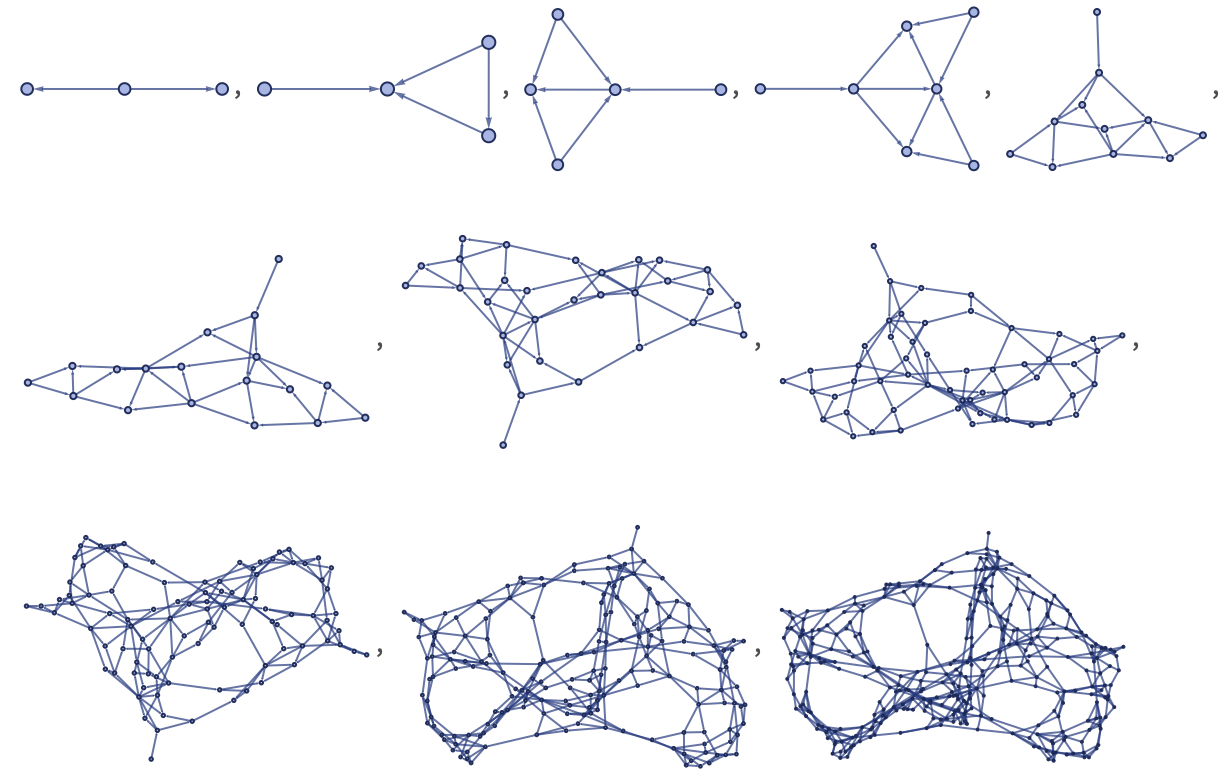
The causal graph is made from the updates, not the points of space
Suppose one rewrite event creates or modifies a relation that a later event uses. The two events then have a dependency: the second cannot be carried out in that history before the first has supplied the required information. A directed edge between the event nodes represents this dependence. Repeating the construction produces an event graph with a causal partial order. Independent events may be incomparable because neither depends on the other. [5]
A causal partial order is not the same as a universal clock. If events A and B are independent, one consistent schedule may apply A first and B second, while another applies B first and A second. The dependencies remain the same. Any graph formed by a finite acyclic dependency structure admits multiple topological orderings, corresponding to different admissible schedules. An ordered sequence of updates therefore contains more coordinate information than the invariant causal relation itself.
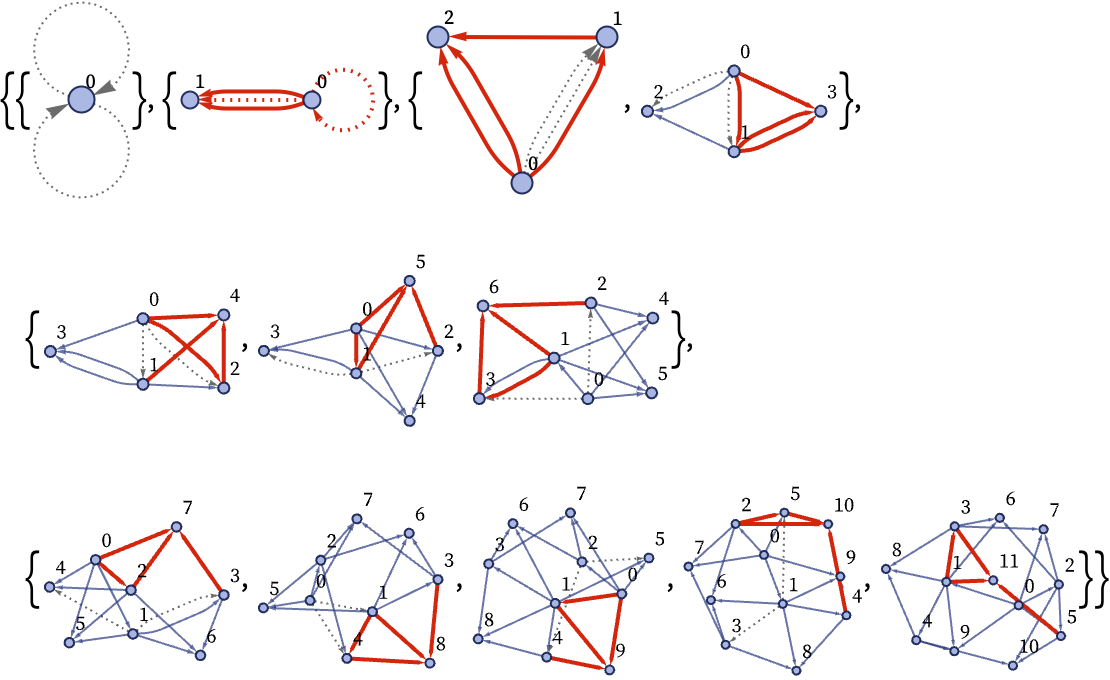
This parallels one of the ideas behind causal-set theory: fundamental spacetime may be modeled as a locally finite partially ordered set whose order captures causal relationships. But causal-set models and particular hypergraph-rewriting models are not equivalent by definition. In conventional causal-set approaches, the order and discrete element counts carry the central geometric information, whereas a rewriting model begins with evolving combinatorial relations and derives dependencies between update events. Both have nontrivial continuum-limit and phenomenology problems. [1][2]
The branching universe: when several updates are possible
At a given network state, more than one local rewrite may be available. Following every legal update produces a multiway graph whose vertices are entire network states and whose edges are rewrite transitions. Different paths represent different computational histories. Some paths diverge permanently, others later merge into the same state up to a specified equivalence. The Wolfram model emphasizes systems with causal invariance, meaning that different legal update orders agree on the relevant eventual causal structure under appropriate conditions. [3][6]
The last expression depicts local confluence: after alternative updates, both branches can eventually reach an equivalent state K. Local confluence and global confluence depend on the rule, termination properties and the chosen notion of equivalence; they do not hold automatically for arbitrary hypergraph systems. They are familiar topics in rewriting theory and algorithm design. Claims that causal invariance reproduces relativity or quantum interference require substantial extra assumptions and derivations.

A slice through the event structure is not time itself
A directed acyclic causal graph can be divided into successive spacelike-like slices, provided the partial order is respected. Different foliations may label the same events with different update-time coordinates. This suggests a powerful analogy with relativistic spacetime: there is no observer-independent universal simultaneity for separated events. Yet a graph's permissible orderings do not automatically prove that its continuum limit has Lorentz symmetry, a specific speed of light or Einstein's equations. Such properties are targets of the model and must be tested. [3][7]
To see the elementary mathematical point, let a monotone time label t assign each event a number. If ei precedes ej, the labels must preserve that relationship. Independent events can receive different relative labels on different foliations. The physically meaningful statement is the dependency relation, not a particular total sorting chosen for bookkeeping.

Causality and the arrow of time are separate questions
A dependency graph is directed because the update rule identifies inputs and outputs. But the familiar thermodynamic arrow means something stronger: low-entropy macrostates evolve overwhelmingly toward higher-entropy macrostates under typical conditions. An ordinary directed computation can be reversed if enough information is retained or the inverse map is known. Conversely, reversible microscopic dynamics can display an irreversible-looking macroscopic evolution. Direction in a diagram and thermodynamic irreversibility must not be treated as synonyms.
Consider classical phase-space dynamics. Liouville's theorem preserves fine-grained phase-space volume under Hamiltonian evolution, while macroscopic entropy can increase when an initially concentrated distribution develops fine structure that is unresolved by measurements. A comparable point holds for an isolated quantum system: unitary evolution preserves the von Neumann entropy of the full system, even while subsystem entropies can rise as entanglement spreads. [8][9]
That is why adding vertices, edges or rewrite events is not automatically an entropy calculation. An increasing graph size may simply reflect a chosen bookkeeping rule. To define a physically meaningful entropy one must specify the microstates, the observer's macroscopic observables, the allowed ensemble or a density operator, and how the relevant state counting is performed. A graph-complexity metric is an interesting diagnostic, not a thermodynamic entropy until a link is established.
Why the universe's low-entropy past matters
Boltzmann's statistical argument gives a particularly sharp explanation of the arrow. A macrostate containing many compatible microstates occupies a larger region of phase space and is correspondingly more probable under an appropriate measure. If an isolated system begins in an unusually small, low-entropy macroregion and evolves under mixing dynamics, its accessible macroscopic descriptions tend to become less constrained. The increase is typical, not an absolute rule forbidding microscopic fluctuations or recurrences. [8]
The Past Hypothesis is the proposal that the early universe began in an exceptionally special, low-entropy macrostate. Why that initial condition held remains a deep cosmological question. It is not solved by drawing arrows on a hypergraph, by asserting that networks become more complex, or by noticing that many computational histories branch. A convincing emergent-time theory must say something quantitative about the initial macrostate and the probability measure over histories. [9][10]
One can formulate a research test: choose a precise rewriting system, define a coarse-graining map C that assigns each microscopic hypergraph a macroscopic descriptor, specify a measure over microscopic histories, and compute how the number of compatible microstates changes. Without these choices, a statement that “graph entropy increases” is more a metaphor than a prediction.
The definition is schematic and may require quotienting by graph isomorphisms, imposing finite-volume restrictions, or choosing a probability-weighted measure. It makes an important difficulty explicit: for infinite graphs, raw counting may be divergent, and automorphism symmetries can make apparently different labeled states physically equivalent. A useful test must control those problems rather than bury them in a simulation plot.
Quantum entanglement creates an operational record of scrambling
Suppose a many-qubit system begins in a weakly entangled state. Under interacting unitary dynamics, information that was initially localized can become encoded in nonlocal correlations. Small regions then look increasingly mixed even though the full state remains pure. This is information scrambling, studied through entanglement entropy, operator spreading and out-of-time-ordered correlators. It often accompanies thermalization but is not identical to thermodynamic entropy production. [11]
The analogy with a growing causal dependency network is tempting. In both settings, an initially local influence can spread through many subsequent events. But causal reachability measures which update events may depend on earlier ones, whereas operator growth and entanglement refer to amplitudes, observables and a Hilbert-space state. A generic directed graph does not contain a quantum state, so equivalence between these quantities cannot be assumed. A well-defined map from rewrite histories to operators or quantum channels would be required.
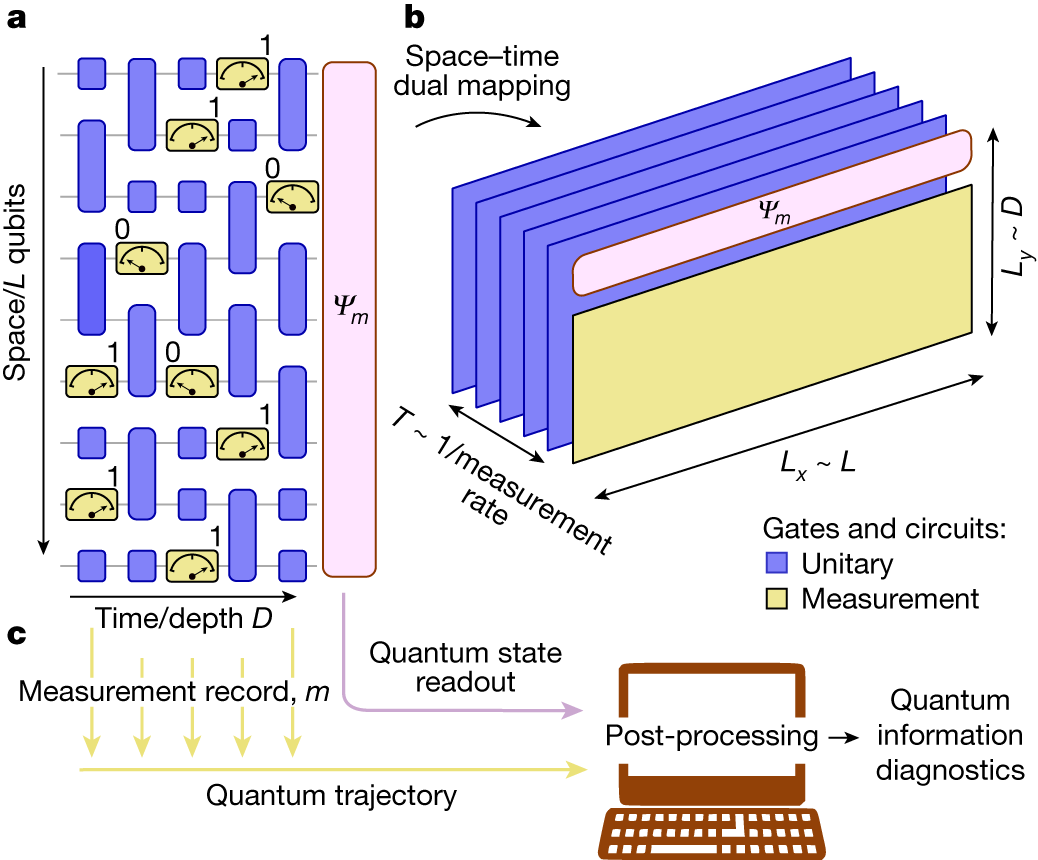
This distinction is reflected in experiment. A superconducting-processor study of monitored quantum circuits explored measurement-induced entanglement and a space-time duality of circuit representations. In 2024, reconfigurable neutral-atom processors used two-copy measurements to estimate entanglement properties of scrambled logical states. Such experiments show that entanglement patterns can be controlled and measured, but they are not direct observations that spacetime is composed of rewriting hypergraphs. [12][13]

Could different branches of history explain what an observer remembers?
The Wolfram Physics Project uses branchial graphs to summarize relationships between states on different branches of a multiway computation. It proposes that branch-like structure has connections to quantum superposition and entanglement. The relationship is an intriguing mathematical conjecture, but two states having common ancestors in a rewrite graph is not, by itself, the same as the existence of coherent quantum amplitudes between them. A quantum theory needs an inner product, amplitudes or probabilities, interference rules and measurement predictions that can be confronted with data. [6]
Memory is the sharper question. An observer makes a record when information about an event is encoded in degrees of freedom that persist long enough to be read. The apparent direction of memory requires explaining why records are overwhelmingly correlated with a lower-entropy boundary condition in the past. A computational history stored by a simulation trivially lists earlier updates because the programmer retained them; that does not establish a physical arrow of memory in a universe without an external log.
Recent discussions of an entanglement-based Past Hypothesis examine whether low initial entanglement could underwrite a decoherent arrow of time. It is a proposal with unresolved conceptual and cosmological issues, not an established theorem that the universe's history is caused by growing entanglement. Hypergraph models would need comparable precision about the initial state and observable records before making that claim. [10]
A concrete test that does not confuse growth with explanation
One could construct a small rewriting experiment with competing histories. Begin with several initial hypergraphs, including graph states whose coarse-grained properties are deliberately atypical. Evolve each rule with several update-order schedules. Record the resulting event dependency graph, graph invariants, a defined coarse-grained state distribution and the reversibility of the microscopic update. Separate rules with causal invariance from those whose event structure changes depending on scheduling.
Next, define a candidate entropy only after specifying a finite microstate ensemble and a measurable macrostate. Test whether it tends to increase from the chosen low-entropy initial state, whether an entropy decrease can be deliberately generated by a special initial condition, and whether reversing the dynamics reverses the observed trend when the boundary conditions are also reversed. If a rule's complexity rises in both chronological directions from a special low-complexity middle state, the result would resemble a two-sided arrow rather than a uniquely selected future.
A more ambitious variant maps rewrite events to a quantum circuit. There one could measure an actual reduced density matrix, subsystem entanglement, operator support and causal dependencies in parallel. The experimental hypothesis would be a quantitative relationship between these different observables under controlled scrambling dynamics, not a declaration that graph size is entropy. It would be especially informative to look for counterexamples: causally large computations with little entanglement, and strongly entangled states created by short, shallow circuits.
What does it mean for time to emerge?
There is a compelling distinction between the order of events and the orientation of experienced time. Discrete causal models attempt to reconstruct the first without assuming a continuous spacetime background. Statistical mechanics and quantum information illuminate the second through special initial conditions, coarse-grained records and growing correlations. Their conceptual overlap is real, but it should not be compressed into a single unverified statement about entropy or the origin of the universe.
The remarkable possibility is that geometry, causal influence and information processing may someday be described in a common formal language. Hypergraph rewriting offers one candidate vocabulary. Its legitimacy will depend on deriving recognizable physical laws and predictions while explaining what has been assumed. The arrow of time remains the stubborn part: we do not merely need a rule that makes the universe change. We need a reason that its changes leave traces of one temporal direction and not the other.

References
[1] Bombelli, Lee, Meyer and Sorkin (1987), Space-Time as a Causal Set. https://doi.org/10.1103/PhysRevLett.59.521.
[2] Sorkin (2003), Causal Sets: Discrete Gravity. https://arxiv.org/abs/gr-qc/0309009.
[3] Gorard (2020), Some Relativistic and Gravitational Properties of the Wolfram Model. https://arxiv.org/abs/2004.14810.
[4] Gorard (2020), Some Quantum Mechanical Properties of the Wolfram Model. https://arxiv.org/abs/2004.14810.
[5] Wolfram Physics Project, Updating Events and Causal Dependence. https://www.wolframphysics.org/technical-introduction/the-updating-process-in-our-models/updating-events-and-causal-dependence/.
[6] Wolfram Physics Project, Branchial Graphs and Multiway Causal Graphs. https://www.wolframphysics.org/technical-introduction/the-updating-process-in-our-models/branchial-graphs-and-multiway-causal-graphs/.
[7] Wolfram Physics Project, Foliations of the Multiway Graph and the Structure of Branchial Space. https://www.wolframphysics.org/technical-introduction/the-updating-process-for-string-substitution-systems/foliations-of-the-multiway-graph-and-the-structure-of-branchial-space/.
[8] Lebowitz (1993), Boltzmann's Entropy and Time's Arrow. https://doi.org/10.1063/1.881363.
[9] Albert (2000), Time and Chance. https://www.hup.harvard.edu/books/9780674011328.
[10] Al-Khalili and Chen (2024), The Decoherent Arrow of Time and the Entanglement Past Hypothesis. https://arxiv.org/abs/2405.03418.
[11] Landsman et al. (2019), Verified Quantum Information Scrambling. https://doi.org/10.1038/s41586-019-0952-6.
[12] Google Quantum AI and Collaborators (2023), Measurement-induced entanglement and teleportation on a noisy quantum processor. https://doi.org/10.1038/s41586-023-06505-7.
[13] Bluvstein et al. (2024), Logical quantum processor based on reconfigurable atom arrays. https://doi.org/10.1038/s41586-023-06927-3.
[14] Lloyd (2006), Almost Certain Emergence of Classical Spacetime. https://arxiv.org/abs/quant-ph/0501135.