
Published 25 October 2026 | Rihaan Shah. High-harmonic radiation from a semiconductor preserves a trace of how electrons scatter while being driven across its reciprocal lattice. A new experiment makes that trace quantitatively legible.
A spectrum that measures collisions
High-harmonic generation in a crystal is a demanding measurement of electronic coherence. A mid-infrared driving field creates electron–hole pairs and accelerates their crystal momenta over significant fractions of the Brillouin zone before the induced current radiates frequencies many times the fundamental. The observed spectrum is consequently governed by band dispersion, interband dipoles, optical driving and the survival of phase relationships between valence and conduction states. When the phase memory disappears, trajectories that would otherwise interfere coherently no longer contribute in the same way. The problem is most acute when strong fields move the carriers away from the valleys where conventional low-field optics measures comparatively long coherence lifetimes.
A paper by Viacheslav Korolev, Thomas Lettau, Vipin Krishna and collaborators, published in Nature Communications on 20 October 2026, tests a concrete microscopic explanation. Measurements of monolayer WS2 and MoS2 and bulk CdSe are compared with momentum-resolved electron–phonon scattering and semiconductor Bloch simulations. The central outcome is not merely that an assumed short coherence time can fit the high-harmonic yield. It is that scattering depends strongly on crystal momentum, and the laser drives carriers into parts of momentum space where their phase memory is much shorter than it is at the band extrema. That observation links strong-field spectroscopy to an identifiable many-body interaction [1].
The origin of harmonics in a periodic crystal
For a spatially uniform field in the length gauge, a minimal single-particle crystal Hamiltonian is H(t)=H0+e E(t)·r for an electron of charge −e. Crystal momentum follows the acceleration theorem, ħ dk/dt=−eE(t), provided a semiclassical band description applies. Thus k(t)=k0+(e/ħ)A(t) when E=−∂t A. A longer-wavelength pulse at fixed electric-field amplitude generally produces a larger excursion in reciprocal space, since the vector-potential amplitude scales as E0/ω. This simple relation explains why measuring the driving-wavelength dependence is a particularly incisive probe of momentum-dependent physics.
The emitted field follows the microscopic current J(t). Its high-frequency radiation is controlled, up to propagation and detection factors, by |ωJ(ω)|². The current has both intraband pieces from carriers moving through dispersive bands and interband pieces from evolving electron–hole polarization. Neither term is completely independent of the other under a sufficiently strong field. A multiband calculation is therefore preferable to assigning the whole signal to a single recollision picture.
An instructive pair of equations is J_intra(t)=−e Σ_n∫BZ [dk] v_n(k) ρ_nn(k,t) and J_inter(t)=dP_inter/dt, where v_n=(1/ħ)∇k ε_n and the interband polarization contains off-diagonal density-matrix components ρ_cv(k,t) multiplied by transition dipole matrix elements. Their coherent sum determines the observed waveform. Crystal symmetry further governs which harmonics and polarization components are allowed; distinct zigzag and armchair directions can therefore interrogate distinct paths even within the same monolayer.
In acceleration form, the central relation is The polarization dynamics may be summarized as These compact relations are schematic; the complete simulations include the evolving field-driven momentum and multiband coupling.
The coherence term that has usually been guessed
The semiconductor Bloch equations evolve populations and interband coherence in a time-dependent field. Schematically, an interband density-matrix element satisfies dρ_cv/dt=−iω_cv(k)ρ_cv+iΩ_cv(k,t)(ρ_vv−ρ_cc)−ρ_cv/T2(k), with additional drift and multiband coupling terms required in a complete gauge-consistent treatment. The last term damps the phase-coherent polarization. Many practical high-harmonic calculations have used one scalar T2 for an entire band or specimen. Such a constant is computationally convenient but does not describe how scattering changes as the same carrier is accelerated across the Brillouin zone.
The physical content of T2 must be handled carefully. Population relaxation and pure dephasing are related through 1/T2=1/(2T1)+1/Tφ in a simple two-level Markovian description. A momentum-dependent band-coherence decay obtained from scattering rates has additional band and many-body structure. The latest study calculates electron–phonon rates from first-principles electronic and vibrational properties and introduces a corresponding momentum-resolved dephasing map into strong-field simulations. This is an effective connection between scattering and polarization damping under the experimental conditions, not a claim that every possible decoherence mechanism is included exactly [1,5].
Why the wavelength is a diagnostic
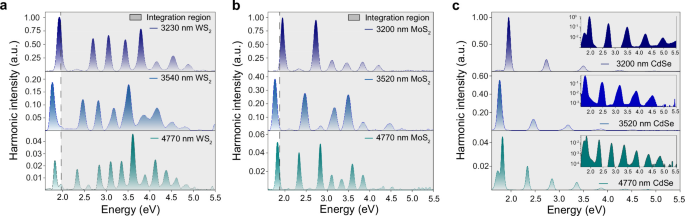
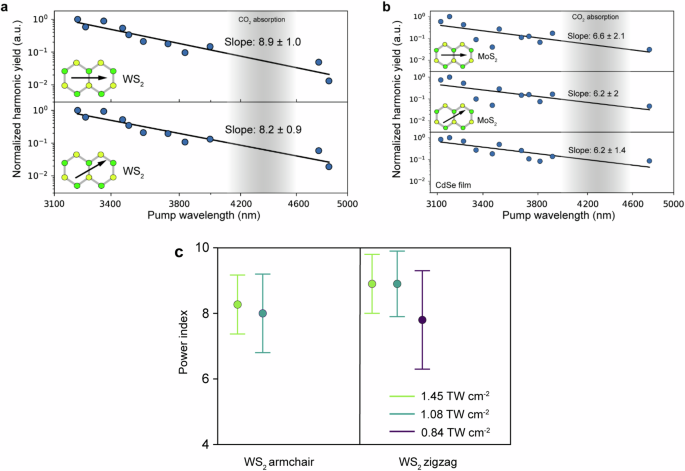
The experiment changes the mid-infrared driving wavelength while maintaining carefully characterized peak intensity and measuring emitted harmonics in an experimentally accessible spectral window above each material’s bandgap. The reported wavelength dependence of integrated harmonic yield is steep, broadly corresponding to power laws between approximately λ^(−6) and λ^(−9), with material and polarization dependence. To compare those slopes responsibly, the integration region, detector response, driving intensity and pulse properties must be treated consistently. Otherwise an apparent wavelength exponent can absorb changes in laser focus or spectral acceptance.
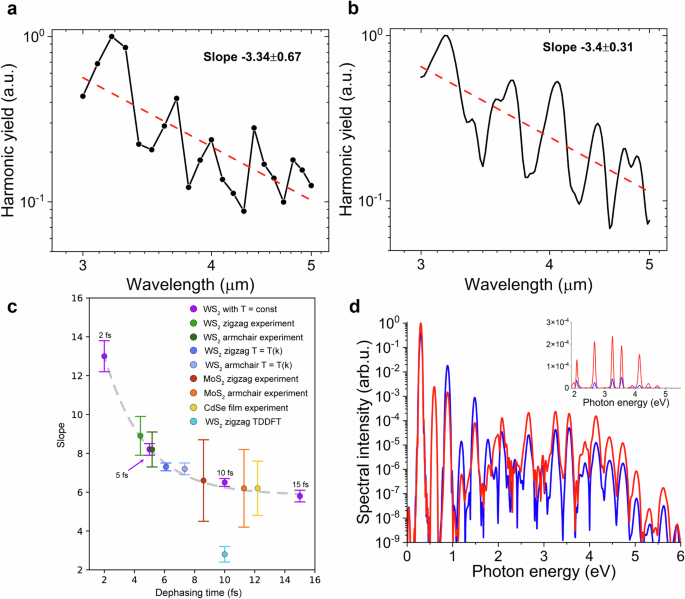
The authors compare these observations with calculations that omit explicit dephasing. Real-time time-dependent density-functional theory and semiconductor Bloch calculations agree with each other in that limit, with approximate slopes −3.3 and −3.4 for the WS2 case, yet they do not reproduce the observed much steeper decline. This comparison narrows the missing physics: the discrepancy is not simply an accident of choosing one numerical propagation scheme. It also does not prove uniqueness of an electron–phonon explanation, because other processes can modify the strong-field dynamics. The value of the subsequent calculation is that a microscopic scattering landscape predicts the right broad trend [1].
A landscape of femtosecond lifetimes
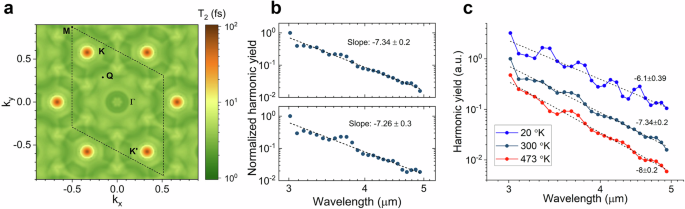
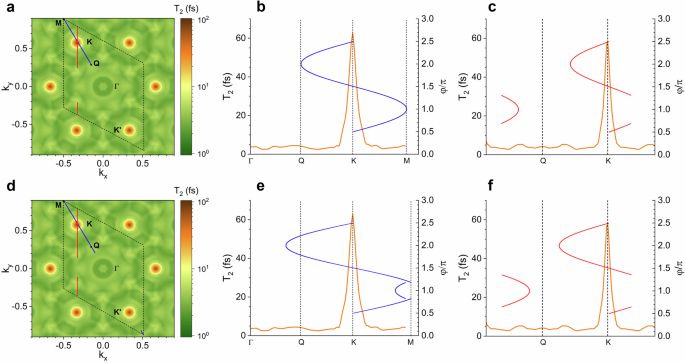
The calculated monolayer WS2 dephasing map is strikingly inhomogeneous. Near the K valley, a representative coherence time is about 70 femtoseconds at 300 K. Moving away from the valley reduces it below 10 femtoseconds, and regions near Γ reach roughly four femtoseconds. These values should not be interpreted as one universal lifetime for the entire crystal. They describe different momenta and, consequently, different segments of the same driven trajectory. The effective response of a pulse samples all those segments with weights set by the evolving polarization and emitted frequency.
In a trajectory approximation the surviving coherence can be visualized by an accumulated factor exp[−∫dt/T2(k(t))]. This equation, while not replacing the multiband Bloch treatment, illustrates the nonlocal-in-trajectory consequence of local scattering rates: even a short visit to a region of strong damping can strongly diminish the phase of a trajectory that began in a relatively coherent valley. The strength of HHG consequently depends on the full motion through reciprocal space, not only the optical linewidth at its starting point.
Including the calculated T2(k) produces simulated wavelength-scaling exponents around 7.3 ± 0.2 for zigzag and 7.2 ± 0.4 for armchair polarization in the authors’ analysis. The electron–phonon landscape also avoids some spectral distortions that arise when one forces a uniformly very short coherence time across the Brillouin zone. In particular, a constant five-femtosecond model can steepen the integrated yield but excessively suppress the plateau at long wavelengths. A momentum-dependent model allows coherent and strongly damped sectors to contribute differently [1].
Temperature, phonons and testable interventions
The proposed mechanism carries an experimentally useful prediction. Reducing the lattice temperature changes the phonon occupations and the available absorption processes. The simulations discussed in the paper suggest that at 20 K the valley coherence can approach a picosecond, while portions of reciprocal space continue to support extremely fast scattering. This asymmetry is physically reasonable: phonon emission need not vanish simply because thermal phonon absorption is suppressed. A cold lattice therefore improves some trajectories far more than others.
The calculated increase in high-harmonic yield can reach about an order of magnitude at long drive wavelengths, alongside larger interference oscillations. This is a prediction for the studied modeling framework rather than a universally guaranteed benefit of cryogenic operation. Temperature also changes bandgaps, linewidths and sample optics, and those effects must be controlled in a corresponding experiment. Separate measurements varying field intensity, carrier density and temperature could distinguish electron–phonon damping from electron–electron scattering, which may grow more influential under stronger photoexcitation [1].
The question of quantum light
Solid-state HHG is no longer only a source of classical coherent frequency conversion. Earlier work has reported quantum-optical signatures of the emitted harmonics, including nonclassical correlations in semiconductor emission. These studies make it relevant to ask whether phonon-induced phase fluctuations limit not only the mean harmonic yield but also the joint statistics and squeezing of different optical modes [7,8]. However, a high harmonic intensity does not automatically imply entanglement, and the damping time extracted from classical emitted spectra is not by itself a complete quantum-channel characterization.
A rigorous quantum-optical description would track the optical field’s correlation functions, including normally ordered quantities such as g^(2)(τ), quadrature variances, and intermode covariances, while treating the driven solid as an open many-body system. Electron–phonon coupling may introduce both damping and fluctuations constrained by the bath state. Simply inserting a non-Hermitian decay into a classical polarization equation does not fully determine the quantum noise inherited by the emitted light. The present study supplies a microscopic starting point for that larger problem; it does not report a new high-fidelity source of entangled photons [1,7,8].
What remains unsettled
The scattering rates used in the central model originate from equilibrium, field-free calculations. Under strong excitation the carriers may develop highly nonthermal distributions, screening can change, bands can be optically dressed, and electron–electron collisions can contribute. The paper explicitly recognizes these qualifications. It should not be read as a proof that electron–phonon scattering dominates every material, wavelength, density or driving regime. In addition, macroscopic propagation, phase matching, reabsorption and spectral collection affect measured yields. The most persuasive interpretation is therefore conditional: the computed momentum-dependent electron–phonon rates account for the measured scaling in these samples under the investigated conditions [1,6].
Several experiments follow naturally. A time-resolved measurement could vary the initial carrier population before the strong-field pulse. A polarization scan can reconstruct sensitivity to high-symmetry crystal directions. Temperature scans with calibrated intensity can test the predicted suppression of absorption-driven phonon scattering. Different strain states and isotopic compositions would perturb phonon energies and couplings without changing the basic crystalline platform. Matching more than a single integrated power-law exponent, including individual harmonic orders, phases and interference modulations, would place stronger restrictions on competing scattering models.
A spectrometer for interactions, not only band structure
High-harmonic spectroscopy has often been presented as a probe of electron dispersion and transition geometry. This experiment extends its target to the many-body processes that interrupt coherent motion. A longer wavelength does not merely stretch the laser cycle. At fixed field it pushes electron–hole dynamics through different parts of reciprocal space, where microscopic scattering may be dramatically faster. The observed steep decline in harmonic output can therefore encode a map of where coherence survives and where it collapses.
The essential achievement is a quantitative connection between a strong-field observable and a momentum-resolved scattering model. A useful next step is to turn that connection into a discriminating spectroscopic protocol, with independent control of phonon populations and carrier densities and with phase-sensitive characterization of the harmonics. The prospect is not simply brighter ultraviolet light, but a more detailed understanding of how a driven many-body material loses and preserves optical coherence on femtosecond timescales.
References
- V. Korolev, T. Lettau, V. Krishna et al., “Strong field spectroscopy of many-body interactions in solids,” Nature Communications 17, 10954 (2026). Source.
- G. Vampa et al., “Theoretical Analysis of High-Harmonic Generation in Solids,” Physical Review Letters 113, 073901 (2014). Source.
- T. T. Luu et al., “Extreme ultraviolet high-harmonic spectroscopy of solids,” Nature 521, 498–502 (2015). Source.
- H. Liu et al., “High harmonic generation from an atomically thin semiconductor,” Nature Physics 13, 262–265 (2017). Source.
- M. Selig et al., “Excitonic linewidth and coherence lifetime in monolayer transition metal dichalcogenides,” Nature Communications 7, 13279 (2016). Source.
- I. Kilen et al., “Propagation induced dephasing in semiconductor high-harmonic generation,” Physical Review Letters 125, 083901 (2020). Source.
- D. Theidel et al., “Evidence of the quantum optical nature of high-harmonic generation,” PRX Quantum 5, 040319 (2024). Source.
- J. Rivera-Dean et al., “Nonclassical states of light after high-harmonic generation in semiconductors: a Bloch-based perspective,” Physical Review B 109, 035203 (2024). Source.
- X. Liu et al., “Wavelength dependence of high-order harmonic yields in solids,” Physical Review A 98, 063419 (2018). Source.
- Z. Wang et al., “The roles of photo-carrier doping and driving wavelength in high harmonic generation from a semiconductor,” Nature Communications 8, 1686 (2017). Source.